








SA House Prices hit 8.2%, but is the peak near?
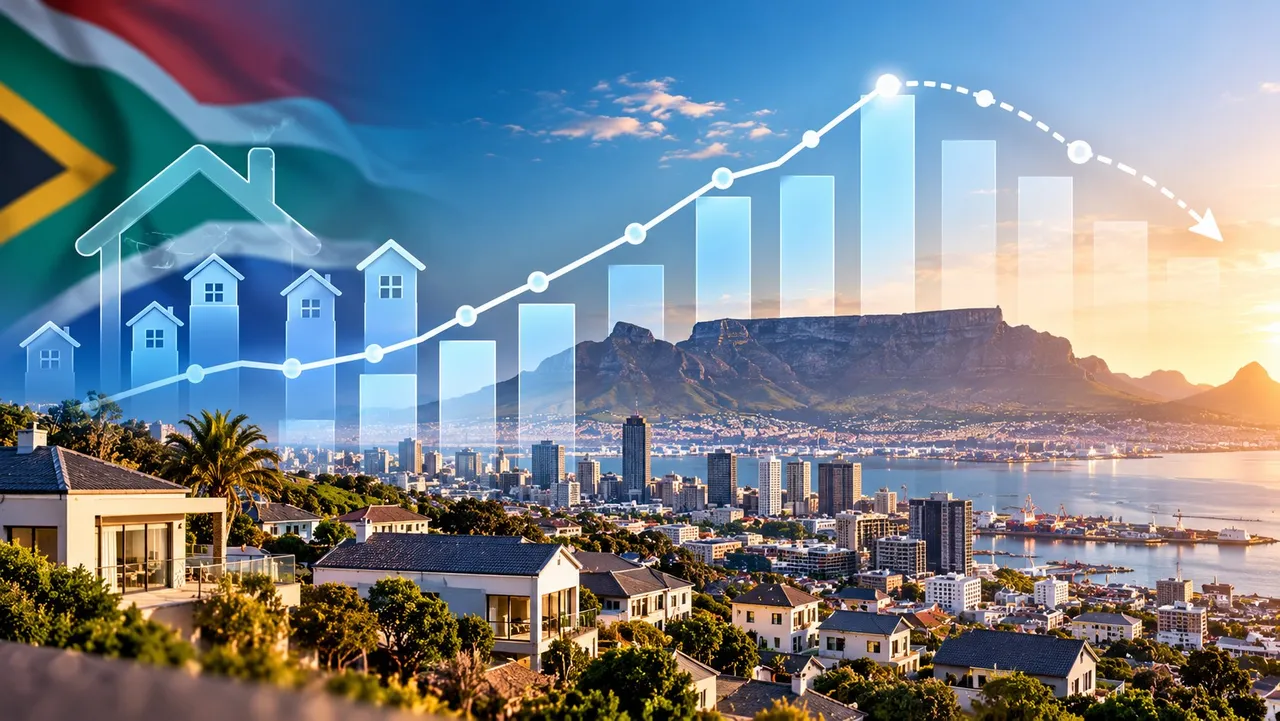
SA house prices rose 8.2% in May, but John Loos sees signs of a slowdown. See which markets are still rising and where momentum is starting to fade.
- National house prices rose 8.2% year-on-year in May, extending the recovery from growth of around 1.5% in late 2023.
- The Western Cape remains the standout major market at 11.2%, compared with Gauteng at 5.5% and KwaZulu-Natal at 4.5%.
- Slowing mortgage growth, higher inflation, interest-rate hikes and Western Cape affordability pressures point towards softer house-price growth later in 2026.
House prices are still rising, but the momentum is changing
South African residential property prices continued their recovery in May, with the latest Statistics South Africa House Price Index (HPI) showing national prices rising 8.2% year-on-year.
That was marginally higher than the 8.08% recorded in April and extends a significant recovery from annual house-price growth of only around 1.5% in late 2023. On the surface, 8.2% is a strong number.
But independent economist John Loos says investors and homeowners need to look beneath the headline.
The pace at which house-price growth is accelerating has started to lose momentum, while other indicators; including mortgage lending, inflation and interest rates are becoming less supportive.
“May 2026 saw further acceleration in national house price growth, but the pace of that acceleration has slowed, and real (inflation-adjusted) house price growth has declined.”
Loos believes these trends, together with growing affordability pressure in the Western Cape, could result in slower house-price growth during the latter stages of 2026.
What is the House Price Index telling us?
The Stats SA HPI tracks residential property price movements and provides an important indication of what is happening across South Africa’s housing market. The May data points to two trends happening simultaneously.
- First, annual house-price growth remains strong.
National growth has strengthened dramatically from the lows of late 2023 to reach 8.2%. - Second, the rate of acceleration is losing momentum.
That distinction matters. Prices do not necessarily have to fall for the property market to slow. They can continue increasing, but at progressively lower annual rates.
Loos says a possible growth peak appears to be forming. One clue is the month-on-month HPI. Monthly growth reached a multi-year high of 0.82% in November 2025, but has remained below that level for the subsequent six months.
That suggests the strong annual number may increasingly reflect momentum accumulated over previous months rather than a market continuing to accelerate at the same pace.
Five trends property investors should watch
1. National house-price growth has reached 8.2%
The most positive signal remains the headline number.
South African house prices increased 8.2% year-on-year in May, compared with 8.08% in April.
For homeowners, that means nominal property values are still appreciating strongly. For investors, however, the more important question is what happens next.
Loos argues that the recent slowing in the pace of acceleration makes a peak in annual growth increasingly plausible. In other words: The market may still be rising, but it may no longer be gathering speed.
2. Mortgage growth is sending a warning signal
One of the most important forward-looking indicators for residential property is mortgage lending. When new mortgage lending accelerates, more purchasing power is entering the housing market.
When it slows, future property demand can weaken.
South African Reserve Bank data cited by Loos shows growth in the value of new residential mortgage loans granted has already slowed substantially.
From a 18.2% year-on-year growth peak in the third quarter of 2025, growth in the value of new residential mortgage loans moderated to 9.54% for the three months to July 2026.
Loos links this slowdown partly to the end of the interest-rate-cutting phase in late 2025, followed by the start of rate increases from May 2026.
This matters because today’s mortgage approvals can influence tomorrow’s property transactions and prices. If mortgage growth continues to moderate, house-price growth could follow.
3. Inflation is eating into the real return
Nominal house-price growth of 8.2% looks impressive.
But investors also need to consider real house-price growth, the increase in property values after inflation.
May’s 8.2% annual increase remained comfortably above CPI inflation, producing real house-price growth of 3.61%. However, that real return is already weakening.
Real annual house-price growth reached a multi-year high of 4.98% in February, when CPI inflation was just 3%. By May, CPI had accelerated to 4.5%, reducing real house-price growth to 3.61%.
That illustrates an important principle for property investors: A rising property price does not automatically mean your wealth is increasing at the same rate.
The real gain is what remains after inflation.
4. The Western Cape remains SA’s powerhouse
The national average also hides enormous differences between provinces. The Western Cape remains comfortably ahead of South Africa’s other major residential markets. In May:
- Western Cape: 11.2%
- National: 8.2%
- Gauteng: 5.5%
- KwaZulu-Natal: 4.5%
Stats SA attributes approximately 4.7 percentage points of the national 8.2% growth rate to the Western Cape alone. That makes the province the single biggest contributor to national house-price growth.
Loos attributes its long-running outperformance to several factors, including stronger investor confidence, comparatively good service and infrastructure delivery, skilled semigration, foreign demand and stronger employment growth.
Those forces have helped create exceptional residential demand. But success has also created a new problem.
Is Western Cape affordability becoming the ceiling?
The Western Cape’s annual house-price growth has already moderated from 11.7% in February to 11.2% in May.
Gauteng has also eased marginally from 5.6% in March to 5.5% in May, while KwaZulu-Natal accelerated slightly from 4.3% to 4.5%.
That means two of South Africa’s three biggest provincial markets were already showing some loss of momentum by May.
For the Western Cape, affordability may increasingly become the constraint. Since the beginning of the Stats SA series in 2010, the Western Cape’s average house-price index has increased by an extraordinary 197.8%.
By comparison, Gauteng increased by approximately 85% and KwaZulu-Natal by 81.1% over the same period. That sustained outperformance has widened the affordability gap between the Western Cape and much of the rest of the country.
Loos believes this may eventually cause the provincial growth differential to narrow. The lesson for investors is important: Strong demand can push prices higher, but affordability ultimately places a limit on how quickly prices can continue outrunning household incomes.
The long-term numbers tell a very different story
Perhaps the most revealing statistic in Loos’s analysis comes from looking beyond the current cycle.
Since January 2010, South Africa’s average national house price has risen substantially in nominal terms. But after adjusting for CPI inflation, the average national house price in May 2026 was still approximately 0.3% below its January 2010 level.
That is an important reality check. Over more than 16 years, the average South African residential property has delivered virtually no national real capital growth. But once again, the national average conceals major provincial differences.
Western Cape versus the rest
The Western Cape has been the major exception. Between January 2010 and May 2026, its cumulative real, inflation-adjusted house-price growth reached 35.39%.
Gauteng, by comparison, was 15.87% lower in real terms, while KwaZulu-Natal was 17.67% lower.
Loos notes that seven of the ten provincial markets measured experienced significant real house-price corrections over the period.
The Western Cape has therefore been responsible for much of the strength visible in South Africa’s long-term national real house-price performance.
That provides useful context for the country’s continuing semigration story. Capital growth has not been evenly distributed. Where you bought has mattered enormously.
5. Interest rates could become the next brake
The final piece of the puzzle is interest rates.
Loos notes that the SARB increased interest rates for the first time in the current cycle in late May, followed by another increase at the September Monetary Policy Committee meeting.
At the same time, higher global oil prices and associated inflation risks could create additional pressure.
Even without further rate increases, Loos argues that the combination of:
- Higher inflation
- Slower economic growth
- Two interest-rate increases
- Slowing mortgage growth
- Growing affordability constraints
provides justification for expecting a softer national housing market later in 2026.
What does this mean for buyers and investors?
The latest HPI is not signalling a housing crash. Far from it. House prices are still growing nationally, and at 8.2% the annual rate remains relatively strong. But the direction of travel is becoming more important than the headline number.
For investors, there are four practical implications:
- Watch affordability.
Markets cannot indefinitely sustain property-price growth materially ahead of household income growth. - Watch mortgage lending.
Slower growth in new mortgage approvals can be an early indication of weaker future transaction activity. - Look beyond national averages.
Western Cape, Gauteng and KwaZulu-Natal are producing markedly different outcomes. - Measure real returns.
Nominal property appreciation needs to be assessed against inflation, financing costs, rental income and operating expenses.
The REI take: strong growth, but watch the turning point
South Africa’s residential property recovery remains intact. An 8.2% national annual increase is significant and represents an impressive improvement from the approximately 1.5% growth recorded in late 2023.
But investors should not assume that the next move is automatically higher. Mortgage growth is moderating. Inflation has risen. Interest rates have increased. Real house-price growth has already slowed.
And the country’s strongest residential market; the Western Cape is beginning to encounter the inevitable consequence of years of outperformance: affordability pressure.
Loos’s analysis therefore provides a useful warning against reading the latest HPI number in isolation. The South African housing market is still growing. The more important question now is whether 8.2% represents another step upward or the beginning of the peak.