








CapeTrain Express: The rail plan to reshape Cape Town
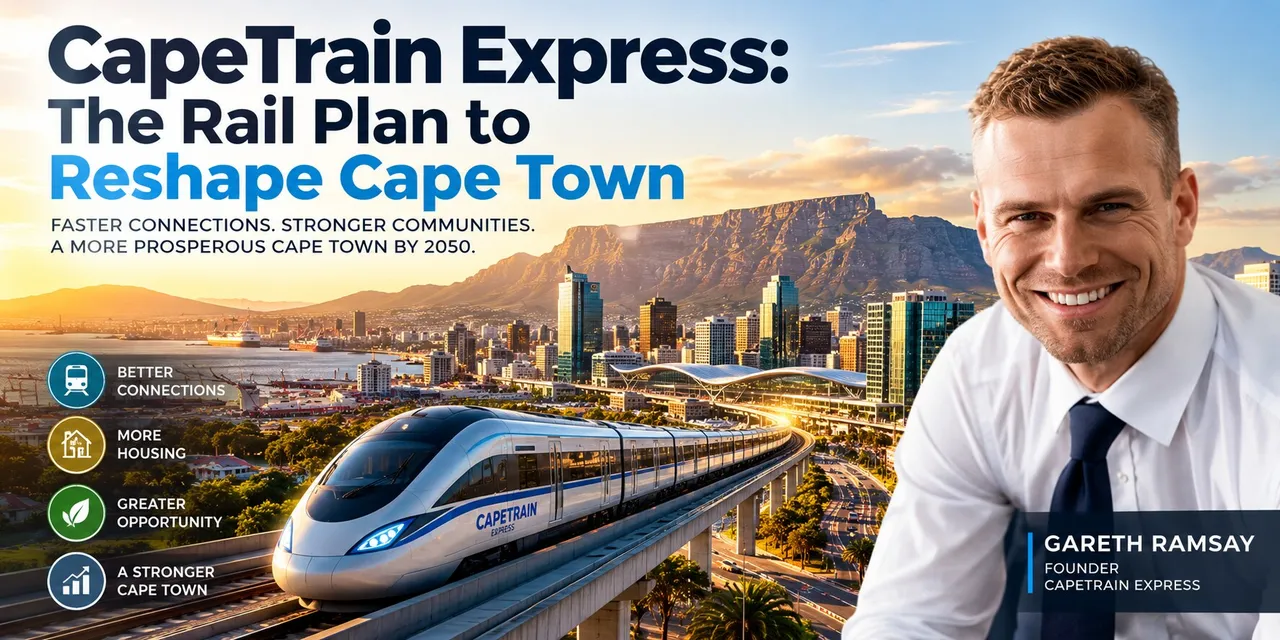
A proposed express rail network could connect Cape Town’s airports, CBD, Atlantic Seaboard, northern suburbs and emerging development nodes, while fundamentally changing where people live, work and invest.
- CapeTrain Express proposes new north-south and east-west rail corridors designed to transform Cape Town into a more connected 60-minute city.
- Stations could unlock development around Athlone, Philippi, Century City, the Foreshore, airports and other nodes while reducing dependence on cars.
- Founder Gareth Ramsay argues transport-led development could tackle spatial inequality while supporting Cape Town’s population, tourism and property growth to 2050.
Can Cape Town grow without grinding to a halt?
Cape Town is booming. Property investment is accelerating. Tourism continues expanding. New residential, commercial and mixed-use developments are reshaping the city. Major investment is flowing into the CBD, Atlantic Seaboard, Waterfront and surrounding precincts.
But underneath that growth sits a fundamental question: How will Cape Town move millions more people around the city by 2050?
That was the challenge put forward by CapeTrain Express founder Gareth Ramsay during a presentation at an Urban Real Estate Research Unit (URERU) event sponsored by Quoin Technologies at the University of Cape Town this week.
Ramsay’s argument is that Cape Town cannot separate its future property development strategy from its transport strategy. The city currently has approximately five million residents. According to figures presented by Ramsay, around 75% of households earn R22,000 per month or less, with lower-income households spending more than 43% of household income on transport.
Cape Town also faces an estimated housing backlog of around 500,000 units, with the annual housing shortfall estimated at between 22,000 and 28,000 units.
Meanwhile, private vehicles account for approximately 54% of passenger trips. If Cape Town’s population approaches 10 million over the next 25 years, simply doubling the number of cars moving along the N1, N2 and other major routes is clearly not sustainable.
Ramsay believes the solution lies in changing the relationship between transport, property and location.
The CapeTrain Express vision
CapeTrain Express proposes an express rail network that would complement, rather than replace, Cape Town’s existing PRASA rail and MyCiTi networks.
Its central objective is ambitious: Make travelling by rail across Cape Town as fast as, or faster than, travelling by private vehicle.
The proposed network introduces new corridors across the metropolitan region, including an east-west mainline linking Somerset West and Stellenbosch through Cape Town International Airport towards the Atlantic Seaboard, together with connections serving the northern suburbs and western seaboard.
A new north-south corridor would help break Cape Town’s historic pattern of transport routes primarily feeding commuters towards the CBD. The objective is to connect major residential, employment, tourism and development nodes to each other, rather than forcing passengers to travel through the traditional city-centre network.
Cape Town International Airport would be directly connected. So would major destinations and nodes including the Foreshore, CTICC, Cape Town Stadium, Sea Point, Century City, northern suburbs and potentially Cape Winelands Airport.
The proposal is designed to integrate with existing and future public transport rather than compete with it.
The ambition: turn Cape Town into a 60-minute city
Preliminary travel-time modelling presented by Ramsay suggests much of the metropolitan area could become accessible within approximately 60 minutes.
Under the proposal:
- Many station-to-station journeys could take less than 20 or 30 minutes.
- Somerset West to central Cape Town could potentially be achieved in under 40 minutes.
- The network would provide faster cross-city connections rather than primarily CBD-focused journeys.
- Existing PRASA rail would provide the metro layer.
- MyCiTi and other transport services would provide feeder connections.
- CapeTrain Express would become the missing express layer between them.
Ramsay describes this as expanding people’s “bubble of opportunity” increasing the number of jobs, schools, services and economic nodes that residents can reach within a reasonable travelling time. The concept could have profound consequences for property.
If a resident of Philippi, Athlone or another historically disconnected area can reach major employment centres rapidly and affordably, the definition of “well located” begins to change.
Transport could create new property nodes
This is arguably the most important element for property investors and developers. Cape Town’s most valuable development activity remains heavily concentrated around the CBD, Atlantic Seaboard and other established nodes.
Ramsay argues the city does not necessarily have only a land shortage. It also has a land-use and accessibility problem.
Improved high-capacity transport could make currently underutilised land significantly more viable for residential, commercial and mixed-use development.
Potential property opportunities include:
- Athlone Power Station: around 40 hectares of strategically located land that Ramsay argues could be transformed through a major transport interchange.
- Philippi: potentially repositioned from a peripheral location into a highly connected metropolitan node.
- Cape Town Foreshore: higher transport capacity could support greater development without requiring equivalent increases in parking.
- Century City: improved rail connectivity could strengthen an already significant mixed-use economic node.
- Northern suburbs: rail could reduce car dependency and N1 congestion while improving access to established and emerging property markets.
- Sea Point and Green Point: mass transit could support continued densification while easing severe road congestion.
- Airport precincts: reducing parking requirements could potentially release valuable land for higher-value development.
The property implication is significant. Transport infrastructure doesn’t simply move people. It can create land value.
A previously peripheral site can become a viable development node when residents can reach employment, education and amenities quickly.
Athlone could become a new transport and development hub
One of the most interesting examples is the former Athlone Power Station site. Ramsay highlighted approximately 40 hectares of well-located but underutilised land.
With an express station and connections across the metropolitan network, he believes Athlone could effectively become a major interchange connecting the north, south, east and west of Cape Town. That could create an entirely different development proposition around the site. It also illustrates the broader philosophy behind CapeTrain Express.
Instead of attempting to place virtually all new affordable housing into already expensive “well-located” areas, transport can potentially make more areas well located. That changes the property-development equation.
Connecting Cape Town’s two airports
Another potentially transformative component is a direct rail connection between Cape Town International Airport and Cape Winelands Airport.
Ramsay argues that a journey of approximately 20–25 minutes between the airports could allow them to function more like an integrated aviation system.
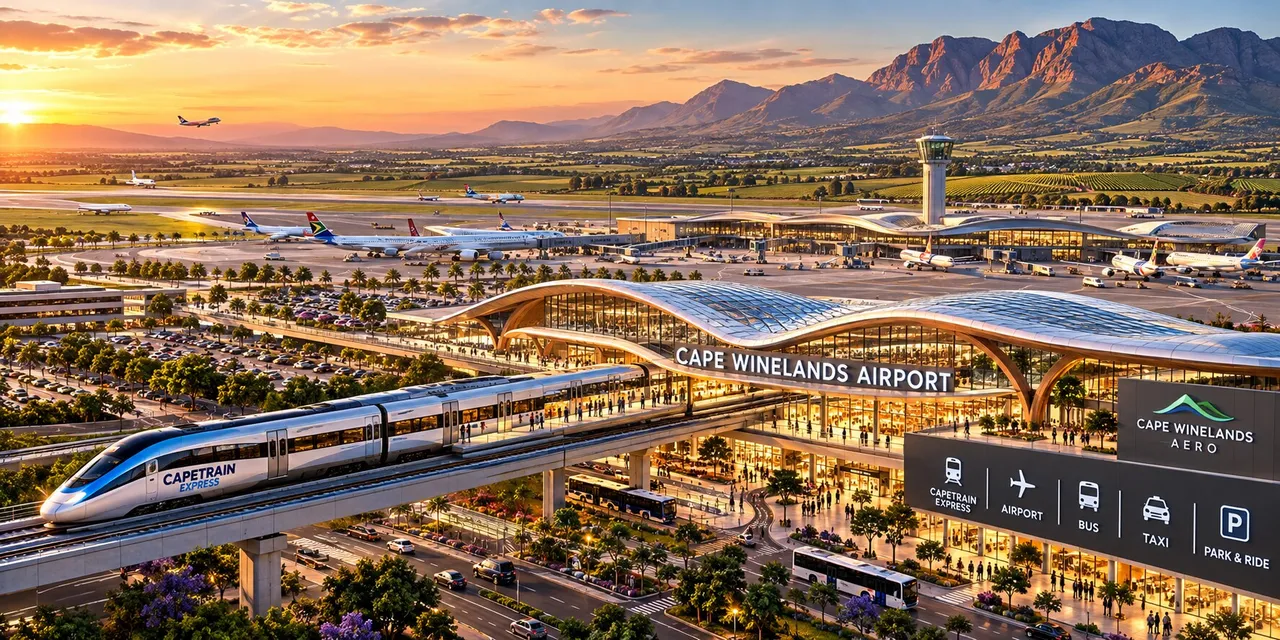
Cape Town International is already expanding but faces physical limitations. A high-speed connection could potentially allow Cape Winelands Airport to evolve from a secondary facility into a more significant complementary aviation hub, while connecting both airports directly into the wider metropolitan economy.
For property investors, the implications could extend well beyond aviation. Airport rail infrastructure can influence logistics, hospitality, offices, residential development and land values around both nodes.
Unlocking the Foreshore without simply adding roads
Cape Town’s Foreshore represents another major test. Ramsay questions whether continually adding road capacity can sustainably accommodate the Waterfront, CTICC, cruise terminal, CBD, stadium and planned developments.
He contrasted road and rail capacity in his presentation. According to the figures presented, a double-lane freeway can accommodate approximately 3,500 vehicles per hour per direction, while high-capacity rail could potentially move more than 20,000 passengers per hour per direction, depending on its configuration and operation.
A proposed Foreshore station could directly serve the CTICC, lower CBD, hotels and surrounding developments. For developers, reduced dependence on cars could also mean something else: less land and building space dedicated to parking.
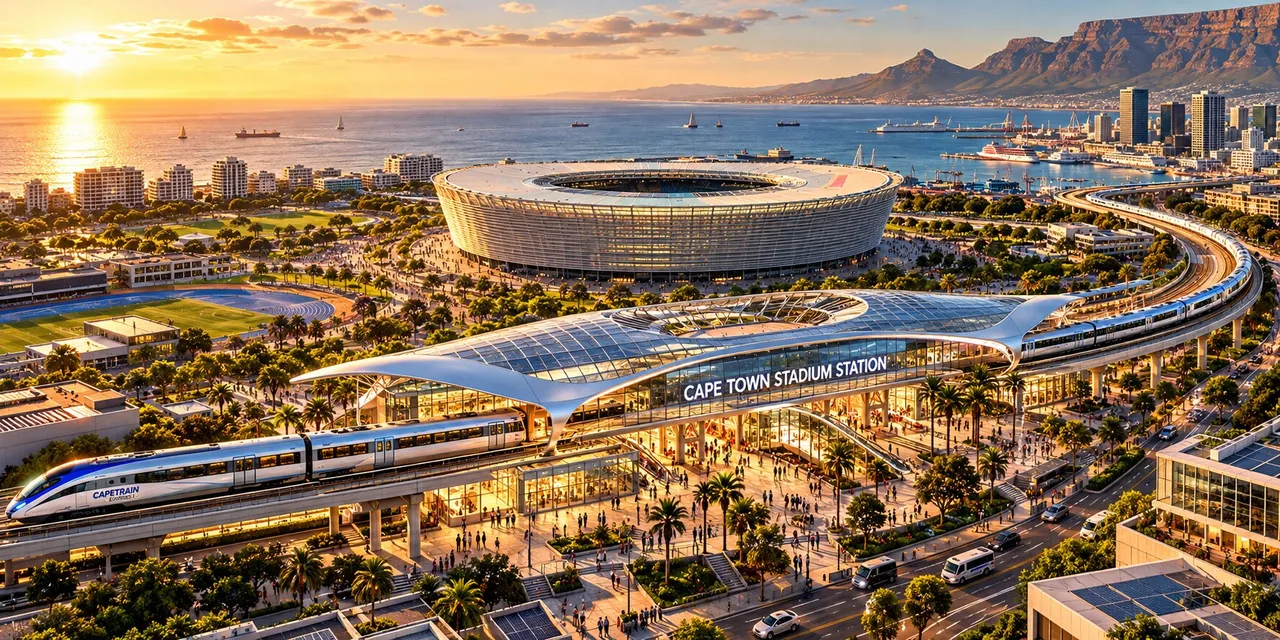
That potentially allows valuable urban land to be used more productively.
The spatial inequality argument
CapeTrain Express is not being positioned purely as a transport project. Ramsay sees it as an intervention into Cape Town’s inherited spatial structure.
Cape Town’s existing rail network largely reflects development patterns created decades ago and remains heavily focused on moving people along historic corridors.
The city, however, is becoming increasingly multi-nodal. Century City, Bellville, the Waterfront, the airport, Stellenbosch, Somerset West and other nodes are increasingly important employment and economic centres.
Ramsay argues that connecting these nodes could expand access to opportunity for communities historically isolated from them.
His challenge to the property industry is provocative: Instead of only moving affordable housing closer to opportunity, can transport bring opportunity closer to people?
Cape Town’s 2050 challenge
The City of Cape Town’s long-term vision calls for more than 75% of commuter trips to use public transport by 2050, according to Ramsay’s presentation.
It also envisages transit-oriented development and the need to accommodate potentially 50,000 new housing opportunities annually as the city grows.
But Ramsay points out that Cape Town has not constructed a completely new rail corridor for decades. He argues that existing infrastructure alone will struggle to accommodate the scale of population, property and economic growth anticipated over the next generation.
From vision to reality: what still has to happen
CapeTrain Express remains a proposal, not an approved construction project. That distinction matters. Ramsay says the proposal has been submitted for consideration as part of the National Rail Master Plan.
He also says Cape Town Mayor Geordin Hill-Lewis has expressed in-principle support for the concept, while Western Cape Premier Alan Winde has spoken positively about the potential impact of connecting the region’s airports by rail.
The CapeTrain team is also seeking inclusion in broader strategic infrastructure and national development processes. Significant work would still be required around:
- Detailed feasibility and engineering
- Capital cost
- Funding and financing structures
- Land and servitudes
- Environmental approvals
- Integration with PRASA and MyCiTi
- National, provincial and municipal alignment
- Ridership and revenue modelling
- Procurement and delivery structures
- Implementation timelines
These are substantial hurdles. But the scale of Cape Town’s growth means the underlying question cannot simply be postponed.
REI take: Transport could determine Cape Town’s next property cycle
CapeTrain Express is ambitious. Whether the eventual solution looks exactly like Ramsay’s proposal remains to be seen. But the central investment argument deserves serious attention.
Cape Town cannot indefinitely concentrate development into a handful of established nodes while continuing to move an expanding population predominantly by road. The city needs more housing. More commercial space. More tourism infrastructure. More investment. And it needs a transport system capable of supporting all of it.
For property investors and developers, the biggest opportunity may therefore not simply be where Cape Town is growing today. It may be identifying the places that become significantly more valuable when infrastructure changes their accessibility tomorrow.
If Cape Town is genuinely heading towards a population approaching 10 million, the conversation around transport can no longer be separated from the conversation around property.
The rail lines Cape Town chooses to build or chooses not to build, could help determine where the city’s next generation of property value is created.