









NEW RESEARCH: Where SA’s student housing money is going

The first South African Student Accommodation Monitor 2026 reveals the beds, money, demand and investment gaps reshaping the sector.
- South Africa’s modelled student-bed shortfall stood at 511,600 beds in 2020, while NSFAS projects 920,161 funded students in 2026.
- A funded bed may bill R4,940 monthly, but the student-weighted amount actually received is R4,869 and can fall to R4,388.
- TVET accommodation could be the overlooked opportunity: around 198,000 NSFAS-registered students, cheaper property and extremely limited institutional supply.
South Africa’s student accommodation market has long been sold on one compelling investment thesis: too many students and far too few beds. But a major new research report argues that investors need to look much deeper than the national shortage.
Where are the students? Who actually pays for their accommodation? How much reaches the landlord? What does a bed cost to operate? Where is supply being built and, critically, where is it still missing?
Those questions sit at the heart of the inaugural South African Student Accommodation Monitor 2026: The Beds, The Money, and The Gap, produced by My Student House and launched exclusively to the REI investment community.
The 32-page Monitor brings together proprietary operating data, an analysis of NSFAS accommodation payments and verified public data to provide an investor-focused picture of demand, supply, capital flows, rentals, returns, operating costs and risk.
Shortage is real, but investors need to follow the right gap
The headline numbers remain enormous. The Monitor traces the widely quoted student accommodation shortage back to the IFC's 2021 market assessment, which modelled a 511,600-bed supply-demand gap in 2020, potentially increasing to 781,000 by 2025.
However, the report argues that investors should not treat the national shortage as a blanket investment signal. The more actionable opportunity is the shortage of affordable, accredited accommodation in the places where funded students actually study.
That distinction matters. Public universities enrolled more than 1.07 million students in 2023, while public TVET colleges enrolled 564,089 and private higher-education institutions 286,454. TVET enrolments grew 8.8% year-on-year, according to the data cited in the Monitor.
NSFAS, meanwhile, projects 920,161 funded students for 2026, reinforcing the scale of state-backed demand.
The investor numbers behind a student bed
Perhaps the Monitor's most useful contribution is turning the student housing story into investable numbers. Its investor dashboard identifies four numbers that determine the economics of a funded bed:
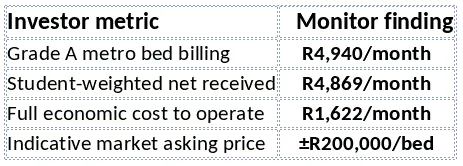
The observed asking-price range is R148,000 to R273,000 per funded bed, while the amount actually received varies materially between institutions. That creates an important warning for investors: do not underwrite a student housing investment simply against the headline NSFAS cap.
Although the cap is R5,200 for the relevant single-room category, the Monitor calculates a student-weighted net receipt of R4,869, with some institutions delivering only R4,388. It argues that underwriting against the headline cap could therefore overstate income by as much as 16% before costs are considered.
The report's worked 20-bed investment example produces a 9.4% net yield before finance, although the Monitor stresses that this is an illustration rather than a property valuation.
TVET could be the opportunity investors are missing
One of the strongest findings is outside the traditional university nodes.
Around 198,000 TVET students are registered with NSFAS for 2026, representing roughly 36% of the funded student population, yet the Monitor says very little purpose-built accommodation has been developed for them.
The investment economics are potentially compelling. TVET campuses are often located in lower-cost peri-urban and non-metro markets. The Monitor estimates buying and converting accommodation at around R125,000 - R150,000 per bed, compared with approximately R385,000 per bed to build new.
There is another advantage: TVET's January and mid-year intakes provide a second opportunity to fill vacancies. My Student House data shows 68% of applications received from May 2026 onward came from TVET students.
But the money comes with risk
This is not a one-way investment story. The Monitor finds that NSFAS payment reversals increased from 2.8% of gross disbursements in 2024 to 6.8% in 2025, while NSFAS reported 62,958 funded students living in unaccredited accommodation.
Operating costs are another pressure point. The report's central thesis is that demand remains structural and substantially state-backed, but accommodation economics are being squeezed between a rising cost base and capped income.
Geography also matters. My Student House recorded semester-one peak occupancy of 97.5% in Potchefstroom, 97.1% in Gqeberha/Port Elizabeth and 96.9% in Cape Town, compared with 87.4% in Gauteng and 88.1% in Bloemfontein.
The message for investors is clear: a national bed shortage does not mean every student property in every node is a good investment. The opportunity lies in understanding the intersection between demand, accreditation, payer mix, location, acquisition cost, achievable rent, operating cost and payment risk.
That is ultimately what makes the first South African Student Accommodation Monitor significant. It moves the conversation beyond “South Africa needs more student beds” towards the much more important investment question:
Which beds, where, at what price and who is going to pay for them?
The Monitor's conclusion is equally pointed: structural demand remains, supply is too slow and often mispriced, and the opportunity increasingly belongs to operators and investors capable of serving funded students affordably, at scale and with the data and systems to manage the risks.
ACCESS THE NEW STUDENT HOUSING RESEARCH
South African Student Accommodation Monitor 2026: The Beds, The Money, and The Gap
Access the new investor-focused research covering demand, supply, NSFAS funding, rents, costs, returns, locations and investment risk.
Missed yesterday's webinar?
2. WATCH REPLAY
Student Housing 2026 - The Data Behind the Investment Gap
Missed the live discussion? Watch the REI webinar unpacking the numbers, opportunities and risks shaping South Africa’s student accommodation market.
Want to go deeper?
3. GET RETHA VAN ROOYEN'S NEW BOOK →
Student Accommodation in South Africa - The Investor's Guide
Go deeper with Retha van Rooyen’s practical guide to understanding, investing in and operating student accommodation in South Africa.
A practical blueprint for building and scaling successful student accommodation investments, covering finance, development, accreditation, operations and portfolio growth.
4. JOIN THE ONLINE MASTERCLASS →
Create Wealth Through NSFAS Student Accommodation
30 September & 1 October 2026 | Online | R2,497
Take the next step with Retha’s two-day practical Masterclass covering how to identify, finance, develop and operate NSFAS student accommodation investments.
BONUS: Your R2,497 registration includes Retha’s new book, Student Accommodation in SA - The Investor’s Guide.