








Luxury property takes bigger slice of SA housing market
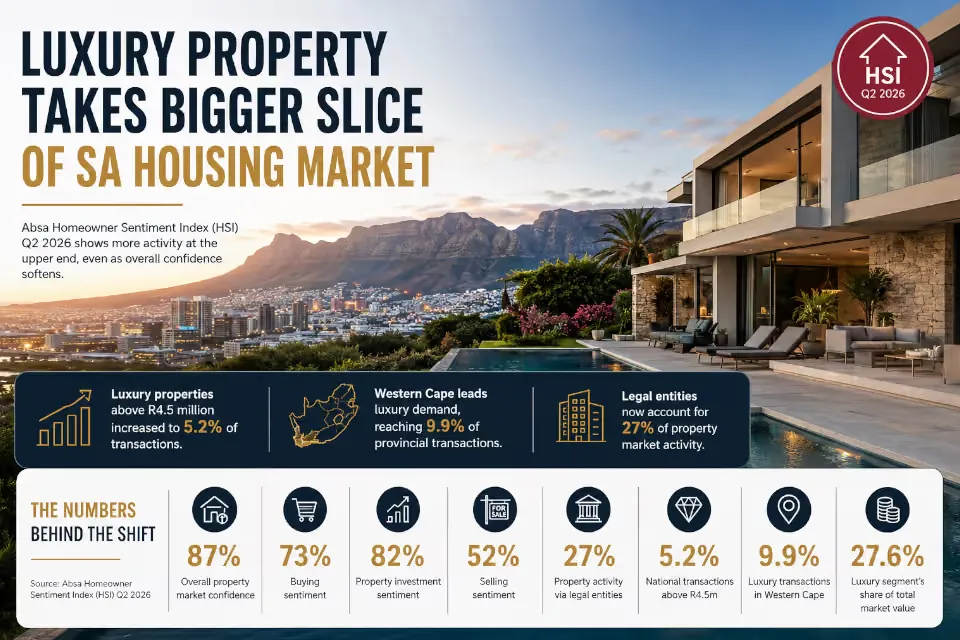
- Homes above R4.5 million increased to 5.2% of transactions, while their share of total market value climbed to 27.6%.
- The Western Cape is driving luxury demand, with properties above R4.5 million reaching 9.9% of provincial transactions.
- Legal entities now account for 27% of property activity, reflecting changing wealth-planning strategies among affluent buyers and entrepreneurs.
South Africa's luxury residential market is taking a bigger share of property activity, even as broader homebuyer confidence has softened under pressure from affordability, interest rates and economic uncertainty.
The latest Absa Homeowner Sentiment Index (HSI) for Q2 2026 shows a marked increase in transactions involving properties valued above R4.5 million, led particularly by the Western Cape.
Luxury homes increased from 4% of transactions a year ago to 5.2% in Q2 2026. More significantly from an investment perspective, the segment's contribution to the value of overall market activity jumped from 22.2% to 27.6% over the same period.
The findings point to an increasingly two-speed residential market: affordability pressures are making purchasing more difficult for many households, while activity at the upper end continues to expand.
What the HSI tells us about the property market
The Absa HSI is designed as a leading indicator of consumer confidence in South Africa's property market, tracking sentiment towards buying, selling, investing, buying rather than renting and renovating property.
First developed in 2015, the research has subsequently been expanded to capture emerging market and behavioural trends. The latest methodology targets around 1,300 consumers who are household decision-makers, with the sample weighted to better represent South Africa's population.
While luxury activity strengthened, the overall HSI slipped slightly from 88% in Q1 to 87% in Q2 2026.
Absa says economic uncertainty was a key contributor to the decline, with concerns around fuel and energy costs, inflation and the outlook for interest rates affecting sentiment. Despite this, South Africans continue to demonstrate a strong underlying desire to own property.
Luxury property bucks the broader trend
One of the standout findings is the growing concentration of activity at the premium end of the residential market.
Nationally, properties worth more than R4.5 million increased their transaction share by 1.2 percentage points year-on-year, from 4% to 5.2%. But the Western Cape is significantly ahead of the national trend.
Luxury transactions in the province increased from 6.6% to 9.9% of transactions over the past year. Put another way, almost one in every 10 Western Cape property transactions now falls above the R4.5 million threshold used in the report.
The figures reinforce the growing importance of the upper end of the market, not simply in transaction numbers, but in the amount of capital being deployed into residential property.
Wealthier buyers are changing how they own property
Another important trend is the increasing use of legal entities to acquire property. Legal entities accounted for 27% of market activity in Q2 2026, compared with 23.7% a year earlier.
According to the report, this trend is particularly prevalent among high-net-worth individuals and entrepreneurs who use legal entities as part of broader wealth-planning and wealth-management considerations.
That shift suggests the upper residential market increasingly needs to be viewed through an investment and wealth-management lens rather than simply as a measure of demand for expensive homes.
Tshepo Mashashane, Absa's Head of Business Strategy and Strategic Communication, says buyers and investors remain acutely aware of the economic and political environment and its potential effect on purchasing power and the financial commitments associated with owning property.
“Property ownership and investment are still desired goals, but the decision to enter the market is being viewed more carefully and strategically,” says Mashashane.
Confidence slips as affordability bites
The strength of the luxury segment contrasts with softer sentiment across the wider residential market. All major HSI measures declined during Q2:
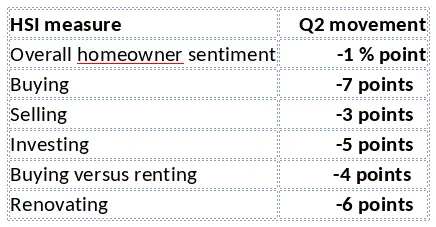
Buying sentiment fell to 73%, representing its biggest quarterly decrease since Q4 2022, while investment sentiment declined five points to 82%, also its largest fall since Q4 2022.
The numbers therefore don't indicate that South Africans have turned against property. Rather, the financial threshold for participating in the market is becoming increasingly important.
Affordability remains the biggest hurdle
Absa identifies affordability and economic pressure as the single biggest constraint on property ownership.
Respondents cited property prices, household debt and the overall cost of living, alongside the difficulty of funding deposits and bonds. Rising rates, levies, utilities and maintenance costs are also making the ongoing cost of ownership increasingly important.
For some households, these pressures are delaying or preventing purchases altogether. “Affordability is the single biggest constraint on property ownership,” says Mashashane.
“Many cannot afford deposits, bonds and rising ongoing costs such as rates, levies, utilities and maintenance. This is leading some to delay or abandon buying, downscale or sell, even though they still see property as desirable.”
The HSI provides further evidence of the tension. Among respondents explaining negative overall sentiment:
- 62% were concerned about economic instability.
- 49% pointed to high unemployment.
- 44% identified crime.
- 43% said property had become very expensive.
- 42% were concerned about political instability.
Property's investment case remains intact
Despite these concerns, underlying attitudes towards property remain remarkably resilient.
Some 87% of respondents expressed confidence in South Africa's property market, with Absa saying this is underpinned by the perception that property remains a secure asset capable of creating long-term wealth.
Among the positive drivers of overall sentiment, 50% believe property always increases in value, 49% see it as a source of long-term income and 47% regard property as a secure asset. Another 41% point to strong rental demand.
Mashashane says property therefore remains attractive, but investors are becoming more discerning.
“Many South Africans still see property as a safe long-term investment with the potential to appreciate in value and build wealth. But that value is now being judged more carefully against factors such as location, demand, political confidence, service delivery and expectations for the future.”
The numbers behind the shift
The Q2 findings paint a market in which confidence remains high, but capital is becoming increasingly selective:
87% overall property market confidence
73% buying sentiment
82% property investment sentiment
52% selling sentiment
5.2% national transaction share for homes above R4.5m
9.9% luxury transaction share in the Western Cape
27.6% luxury segment's share of total market value
27% property activity processed through legal entities
The luxury figures are particularly significant because they show that the increase is not confined to the number of properties changing hands. The premium segment is also absorbing a substantially greater share of the value flowing through the residential market.
A more selective property market emerges
South Africans have not lost faith in property. What is changing is who can transact, where they are prepared to put their money and how carefully they assess risk and value.
For mainstream buyers, affordability remains the defining constraint. At the upper end, however, stronger luxury activity, particularly in the Western Cape and the growing use of legal entities suggest that affluent buyers and investors continue to allocate substantial capital to residential property.
The Q2 HSI therefore reveals a market that is more cautious, more strategic and increasingly segmented.
For investors, the message is equally clear: property remains a favoured wealth-building asset, but location, affordability, rental demand, security, service delivery and long-term value prospects increasingly determine where the money goes.