








Growthpoint turns Cape Town office into net-zero landmark
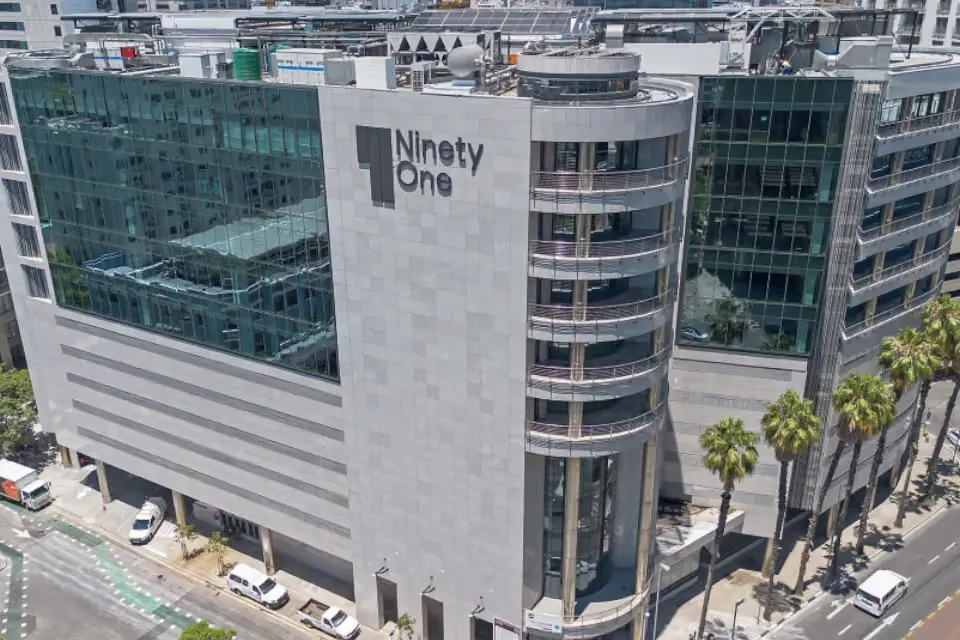
- 36 Hans Strijdom is Growthpoint’s 13th net-zero carbon certified property and also holds a 5-Star Green Star SA Design rating.
- Refurbishing rather than rebuilding retained the existing concrete structure, avoiding embodied carbon equivalent to about three years of operational emissions.
- The Ninety One headquarters will ultimately be fully renewable-powered, combining energy-efficient design with renewable electricity supplied through pooled wheeling.
Few properties illustrate the changing face of South Africa’s commercial real estate sector quite like 36 Hans Strijdom Avenue on Cape Town’s Foreshore.
More than a century ago, the surrounding precinct was closely associated with the coal- and oil-fired electricity infrastructure that helped power Cape Town’s expanding harbour and city. Today, the same area is becoming a showcase for a very different energy future.
Growthpoint Properties’ 36 Hans Strijdom, occupied by global investment manager Ninety One as its Cape Town headquarters, has achieved Net Zero Carbon Level 2: Occupant Emissions Modelled certification from the Green Building Council South Africa (GBCSA).
It is Growthpoint’s 13th net-zero carbon certified property, adding to the building’s existing 5-Star Green Star SA Design rating and demonstrating how an older commercial asset can be repositioned rather than replaced to meet increasingly demanding environmental standards.
For Growthpoint, the project is also part of a much larger decarbonisation strategy. The property group has more than 120 green building certifications across its South African portfolio and is targeting net-zero certifications for 20 buildings by 2028, supporting its longer-term ambition of portfolio-wide carbon neutrality by 2050.
Repositioning an existing asset
Ninety One has occupied the Growthpoint-owned Foreshore property for more than two decades, initially as a co-tenant and now, following the redevelopment, as sole occupant under a 15-year lease.
Rather than relocate to a newly constructed building, Ninety One and Growthpoint elected to substantially refurbish the existing property and convert it into a modern single-tenant corporate headquarters. That decision became fundamental to the building’s carbon story.
Timothy Irvine, Head of Asset Management for Growthpoint’s Office portfolio, says demolition and rebuilding would have been the simpler development solution, but would have come at a significantly higher carbon cost.
By retaining the existing concrete structure, the project avoided much of the embodied carbon associated with demolition, new concrete and reconstruction, saving the equivalent of approximately three years of operational carbon.
“Projects like 36 Hans Strijdom show that older buildings can be successfully repositioned for a lower-carbon future through a combination of thoughtful design, operational efficiency and renewable energy integration, while also providing modern, efficient, premium-grade space for users,” says Irvine.
For Ninety One, the decision was closely aligned with its own environmental objectives. “When we chose to refurbish rather than relocate, our net-zero ambitions were front of mind. Seeing 36 Hans Strijdom achieve Net Zero Carbon Level 2 certification confirms that decision was the right one,” says Thabo Khojane, Managing Director of Ninety One.
“It shows what's possible when an existing building is given the chance to be reimagined rather than replaced.” Khojane says remaining on the Foreshore also enabled Ninety One to preserve its long-standing connection to the precinct without compromising its environmental ambitions.
Building and powering low-carbon performance
The redevelopment extends well beyond retaining the existing structure. Growthpoint’s development division undertook a comprehensive refurbishment incorporating high-performance glazing, displacement air-conditioning, smart building-management technology, energy-efficient lighting and water-saving interventions.
Stairs replaced escalators in key circulation areas, reducing energy consumption while supporting a more efficient internal environment. But the building’s electricity supply is arguably where its transition becomes most significant.
In 2023, 36 Hans Strijdom became one of the first properties to participate in the City of Cape Town’s renewable electricity bilateral wheeling pilot, involving Growthpoint and Etana Energy. Renewable electricity generated at Growthpoint’s Constantia Village shopping centre was wheeled through the municipal grid to the office building.
The next step came in April 2026, when 36 Hans Strijdom became one of five Growthpoint properties participating in Cape Town’s pooled wheeling pilot.
This model enables renewable electricity generated elsewhere to move across electricity networks before being allocated among multiple participating buildings.
For 36 Hans Strijdom, electricity is supplied from the Boston Hydroelectric Plant near Clarens in the Free State, co-owned by Serengeti Energy and Growthpoint and managed by Serengeti Energy, with Etana Energy acting as the licensed electricity trader.
The renewable electricity travels through the Eskom network into Cape Town’s municipal grid before being allocated to Growthpoint’s participating properties. Ultimately, 36 Hans Strijdom is intended to be fully powered by renewable energy, with the majority of its grid electricity supplied through pooled renewable allocation.
Development & adaptive reuse reshapes commercial
The project also highlights an increasingly important issue for property investors and owners: what to do with ageing commercial buildings. Demolishing and replacing existing buildings can create modern, efficient assets, but construction itself carries a substantial carbon footprint.
Adaptive reuse offers an alternative, retaining the carbon already embedded in a building while upgrading its operational performance, extending its useful life and creating space capable of competing for quality tenants.
For Growthpoint, 36 Hans Strijdom demonstrates that sustainability can therefore become part of an asset-repositioning strategy rather than simply an environmental overlay.
“This redevelopment demonstrates how existing buildings can be adapted and upgraded to support increasingly ambitious sustainability targets while continuing to meet the evolving needs of tenants and cities,” says Engelbert Binedell, Chief Operating Officer of Growthpoint Properties.
Reenergising a precinct shaped by electricity infrastructure
The location gives the transformation additional significance. Historical records show that the Foreshore around present-day Hans Strijdom Avenue formed part of Cape Town’s early electricity-generation landscape.
The Dock Road Power Station opened in 1904, while the coal- and oil-fired Table Bay Power Station followed in the 1930s as electricity demand increased alongside the expansion of Cape Town and its harbour.
Rail infrastructure transported coal into the precinct, while parts of what is now the Foreshore were then still directly adjacent to Table Bay. Subsequent land reclamation fundamentally reshaped the coastline and created much of Cape Town’s modern commercial Foreshore.
As Wouter de Vos, Growthpoint’s Regional Head: Western Cape, notes, that history adds another dimension to the building’s transformation. A precinct once closely associated with fossil-fuel electricity generation is now home to a commercial property designed around energy efficiency, adaptive reuse and renewable power.
From old infrastructure to future-ready property
The investment significance of 36 Hans Strijdom extends beyond a single green certification. It demonstrates how landlords can retain and reposition existing commercial assets, secure long-term occupiers, reduce operational emissions and integrate renewable energy without necessarily starting again with a new building.
For Growthpoint and Ninety One, it is also a tangible example of landlord and tenant sustainability objectives working together.
And for Cape Town's Foreshore, the contrast is particularly striking: a part of the city shaped by the infrastructure of an earlier coal-powered economy is increasingly being repurposed for a lower-carbon future.
The building has remained. The way it is powered and the investment thinking behind it, has fundamentally changed.