







Stability fuels smart commercial property plays

- Repo rate steady at 6.75% restores pricing clarity and investor confidence.
- Demand concentrates in high-quality, operationally resilient assets.
- Fundamentals, not optimism, will define commercial returns in 2026.
A market reset built on fundamentals
With the Monetary Policy Committee (MPC) holding the repo rate at 6.75%, South Africa’s commercial property market enters 2026 with something it has lacked for years: predictability.
For experienced investors, this is not about cheap money. It’s about clarity.
The prime lending rate remains elevated at 10.25%, which means debt is still expensive in absolute terms. But the constant upward pressure on funding costs has eased. That shift restores the ability to price risk properly, structure deals realistically and transact with greater conviction.
“The commercial property market doesn’t move on optimism,” says Andrew Dewey, Managing Director of Swindon Property. “Performance is driven by fundamentals, namely, the spread between funding costs and sustainable yields, the durability of cash flows, and increasingly tough competition in a tenant market that has become far more demanding.”
In short: fundamentals are back in charge.
Pricing discipline returns
Interest rate stability has triggered a psychological reset across the market.
Investors are no longer underwriting acquisitions in an environment where the cost of capital can shift unexpectedly. That alone unlocks flexibility. Portfolio extensions can be renegotiated. Covenants can be rebalanced. Assets that struggled to trade in 2024 and 2025 may now find buyers, provided there is a credible leasing or operational strategy behind them.
However, this is not a broad-based rally.
Yield movements are becoming asset-specific. Stability allows the market to differentiate properly again. Strong buildings in strong nodes will compress. Weak buildings will drift.
“Stability should not be confused with safety,” Dewey cautions. “It gives the market permission to price risk properly again. Assets that can’t compete will lag, but this is precisely where informed advice becomes critical.”
Why the details matter in pricing
In 2026, macro recovery will not lift all boats. Micro realities will.
Performance will be determined by:
- Node quality
- Tenant demand depth
- Operating reliability
- Leasing friction
- Capital expenditure requirements
Dewey notes that valuation must reflect operating reality.
“Well-located assets that offer resilience in utilities, security and access, and that align with tenant needs, are expected to attract capital. These properties may appear expensive until competitive bidding highlights the cost of liquidity in a turning market.”
Secondary stock tells a different story. Buildings requiring substantial capital expenditure to remain relevant will trade at punitive yields, if they trade at all.
“If a building’s operating reality has changed, its valuation assumptions must change too. Applying yesterday’s metrics to today’s assets leads to unwelcome surprises.”
In this environment, underwriting discipline separates wealth creation from capital erosion.

Demand Trends: Follow the tenant signals
The defining theme of 2026 is occupier concentration into fewer, better-quality spaces.
Industrial and Logistics
This sector continues to send the clearest demand signal. Tenants are prioritising throughput, efficiency and operational continuity.
“Logistics tenants are not just buying space,” Dewey explains. “They are buying throughput, reliability and reduced downtime. Properties that remove friction from business operations and are priced accordingly can expect sustained demand and low vacancy.”
Retail
Performance remains nuanced. Grocery-anchored centres show resilience, intersecting daily necessity with value-driven shopping. Destination retail can perform, but only where tenant mix, leasing discipline, safety, parking flow and marketing are actively managed.
Office
Office demand has polarised. National vacancy has improved, yet recovery is uneven. Buildings that justify the commute — accessible locations, strong amenities, reliable utilities and a compelling user experience, are performing. Older stock in compromised nodes continues to struggle.
The market is no longer forgiving average assets.
Strategic Geography: Nodes over provinces
Smart investors are shifting focus from provinces to nodes.
Catchments defined by access routes, security, tenant ecosystems and operational resilience are attracting capital. The gap between strong and weak nodes is widening, and that gap translates directly into income stability versus persistent vacancy.
Private capital, Dewey argues, needs to think like institutional capital. The days of buying broadly and hoping for uplift are gone. Precision now drives performance.
Four core principles investors must follow in 2026
Dewey outlines four non-negotiables for investors:
1. Underwrite operating reliability as rigorously as rent
Cost-to-operate certainty is occupancy insurance.
2. Prioritise durable income over headline yield
High yields often disguise future vacancy and capex risk.
3. Avoid speculation
Have a defined strategy on re-tenanting, refurbishment or redevelopment and execute it with discipline.
4. Maintain liquidity
Secondary stock will create opportunities for buyers with capital ready to deploy.
These principles reflect a market that rewards preparedness, not bravado.
The bigger cycle perspective
According to Swindon’s research division, the interest rate cycle is once again settling at prime around 10.25%, echoing historical stabilisation patterns seen between 2006 and 2016.
The lesson is clear: this is not unprecedented territory. It is simply a return to historically normal funding conditions after a period of abnormal lows.
For the first time since rates hit historic lows in 2020, the commercial property market is operating within stable, transparent fundamentals.
The year ahead
2026 will not be driven by hope, stimulus or cheap debt.
It will be defined by competitive buildings, defensible nodes and income streams capable of withstanding operational realities.
“This year, fundamentals will matter more than ever,” concludes Dewey. “Buildings that can compete, nodes with genuine depth, and income streams that can withstand operating realities will define success.”
Stability has returned. Now the market will separate quality from compromise and reward those who understand the difference.
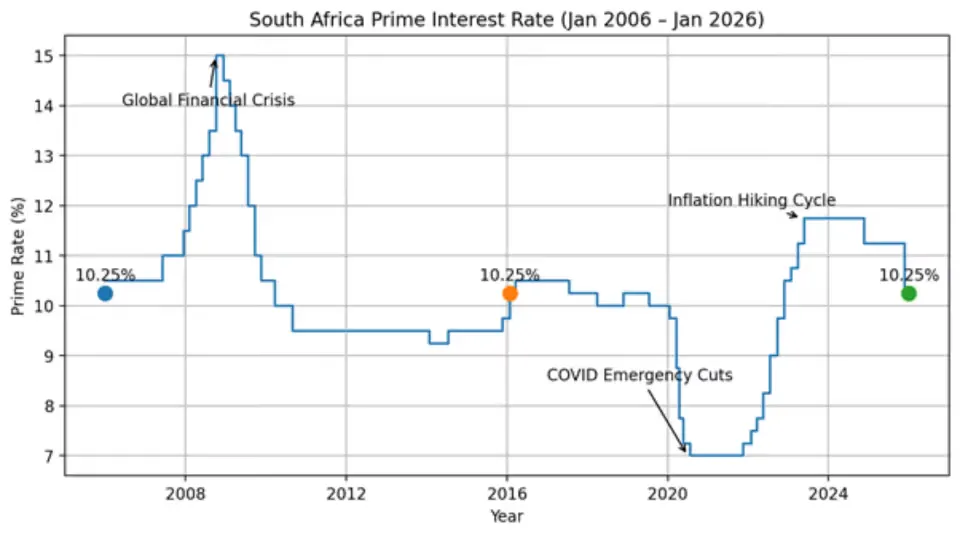
Source: Table from Swindon Property Research division
The table above shows the interest rate cycle, highlighting the 10-year period between cycles, 2006 to 2016, and again settling in 2026 at 10.25%.