






Inflation shock hits as rate hike fears return
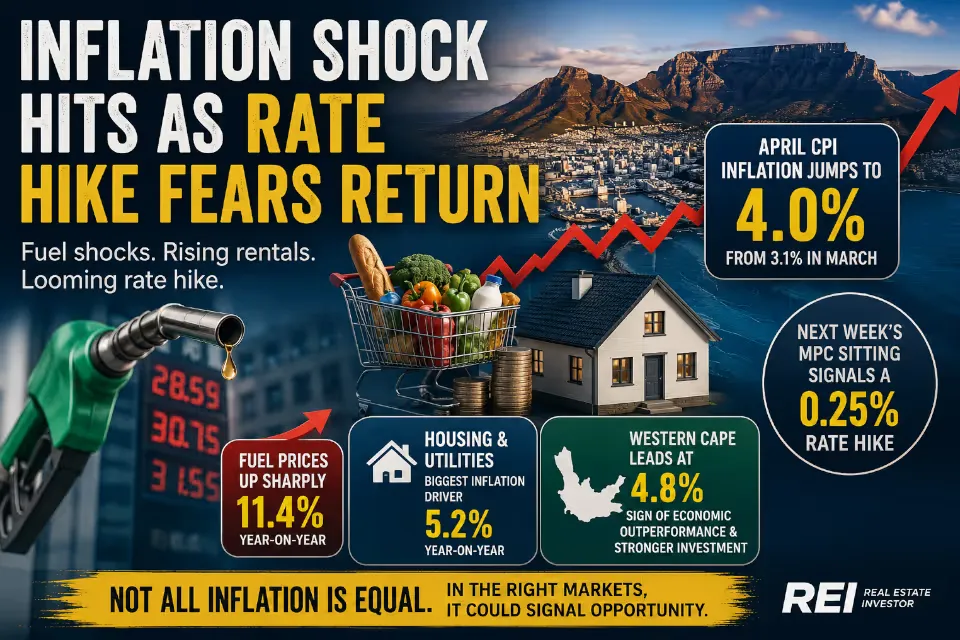
- April CPI jumps sharply to 4% as Gulf War-driven fuel hikes finally hit consumers.
- Housing and utilities remain South Africa’s single biggest inflation pressure point.
- Western Cape inflation surge may actually signal stronger investment and economic outperformance ahead.
South Africa’s inflation story changed materially this week as April’s CPI (Consumer Price Index) inflation rate surged sharply from 3.1% in March to 4% year-on-year, reigniting fears around interest rates, consumer pressure and the broader cost of living crisis.
The sharp increase was largely driven by fuel price hikes linked to the ongoing Gulf conflict, with petrol prices rising by more than R3 per litre and diesel by more than R7 per litre at the start of April. This pushed Transport CPI inflation sharply higher, with fuel inflation itself jumping 11.4% year-on-year.
Yet despite the headlines around fuel prices, it remains Housing and Utilities inflation that continues exerting the single biggest inflationary pressure on South African consumers and property owners.
Independent economist John Loos notes that the Housing and Utilities CPI, the largest weighted category within the overall inflation basket, contributed 1.2 percentage points of the total 4% CPI reading. The category itself increased by 5.2% year-on-year in April.
According to Loos, the real concern is increasingly municipal and utility inflation rather than purely rental pressure. Electricity inflation climbed to 8.2%, while municipal rates and non-electricity utility tariffs rose by 7%. Residential rental inflation nationally came in at 4%, with owner-equivalent rentals at 3.9%.
The implications for property owners, landlords and consumers are significant. Municipal costs, electricity tariffs, water charges, insurance costs and transport expenses are all moving higher simultaneously, placing increasing pressure on household disposable income and operating costs within the residential property sector.
Loos warns that the inflation surge could materially slow consumer spending and economic growth during 2026.
“In my economic growth forecast, I have projected a slowdown in real household disposable income growth, in part due to rising inflation eating into household income, and also because higher inflation can drive interest rate hiking,” says Loos.
His forecasts suggest household consumption growth could slow from 3.6% last year to just 1.6% in 2026, with economic growth potentially slipping below 1%.
That slowing consumer environment is likely to place pressure on discretionary spending, durable goods, vehicle purchases, holidays and other non-essential sectors.
However, buried within the inflation data is a very different and potentially bullish property story emerging out of the Western Cape.
While higher inflation is usually viewed negatively, Loos argues that the Western Cape’s significantly higher inflation rate may actually reflect stronger economic performance, rising demand and increased investment activity rather than simply deteriorating affordability.
The Western Cape recorded the country’s highest provincial inflation rate at 4.8%, significantly above the national average of 4% and materially higher than Gauteng’s 3.8%.
Loos says this divergence reflects stronger residential demand, stronger tourism activity, higher rental growth and broader economic outperformance in the province.
Western Cape residential rental inflation surged to 6.9% year-on-year versus the national average of 4%, while the province’s Housing and Utilities inflation reached 6.1% compared to the national average of 5.2%.
Importantly, the inflation divergence is not isolated to housing alone. Restaurant and accommodation inflation in the Western Cape reached 6.9%, education inflation climbed to 6.1%, while insurance and financial services inflation reached 6.3% all above national averages.
According to Loos, this broader inflation profile likely reflects stronger economic momentum, stronger tourism demand, improving employment growth and higher household income growth within the province.
“Higher CPI inflation is often portrayed as bad, but certain types of ‘high’ CPI inflation can reflect economic outperformance, which can ultimately lead to stronger investment, job creation and income growth,” says Loos.
For property investors, developers and landlords, that assessment carries important implications.
The Western Cape’s elevated inflation profile increasingly points towards:
- Continued residential undersupply
- Stronger rental growth
- Increased residential building activity
- Higher tourism and hospitality investment
- Continued semigration demand
- Rising infrastructure and commercial property investment
At a national level though, the inflation outlook remains concerning for interest rates.
With fuel inflation accelerating, Gulf conflict risks persisting and concerns mounting around second-round inflation effects across the economy, Loos now expects the South African Reserve Bank’s Monetary Policy Committee (MPC) to implement a 25 basis point interest rate hike at next week’s MPC meeting.
That would place additional pressure on already stretched consumers and highly indebted households, particularly within the residential property market. The reality is that South Africa’s inflation environment is becoming increasingly fragmented.
Nationally, consumers are under pressure from fuel costs, municipal inflation and slowing disposable income growth. But regionally particularly in the Western Cape, rising inflation is also reflecting stronger demand, economic resilience and renewed investment momentum.
For property investors, the message is becoming clearer:
Not all inflation is equal. In certain regions, higher inflation may not be signalling economic weakness at all, but rather stronger growth, tighter supply, stronger rental markets and increasing long-term investment opportunity.