






Heritage reimagined: Muizenberg’s new flexible workspace hub
- A 90-year-old civic landmark reborn as a modern collaborative workspace.
- Heritage preservation meets flexible, revenue-generating innovation.
- Workshop17 anchors economic renewal in Muizenberg’s historic core.
A Landmark with intent
Standing proudly on Muizenberg’s Main Road, facing the restless Atlantic, the Old Post Office has long been more than brick and mortar. Built in the 1930s during a period of rapid growth in the Deep South, the structure was conceived not as a mere utility, but as a civic statement.
At the time, Muizenberg was emerging as a hinge between Cape Town and its southern suburbs. The Public Works Department recognised the need for a larger post office, but under architect W.B.T. Newham, the brief became something greater. This would be a building that reflected identity, permanence and belief in community.
Newham, affectionately known for his passion for ceramics, insisted that art be embedded into public infrastructure. Hammer-dressed sandstone, arched windows and Cape-vernacular proportions were combined with striking ceramic murals crafted at the Ceramic Studio in Olifantsfontein. The building wasn’t simply functional — it told a story.
A living archive of communication
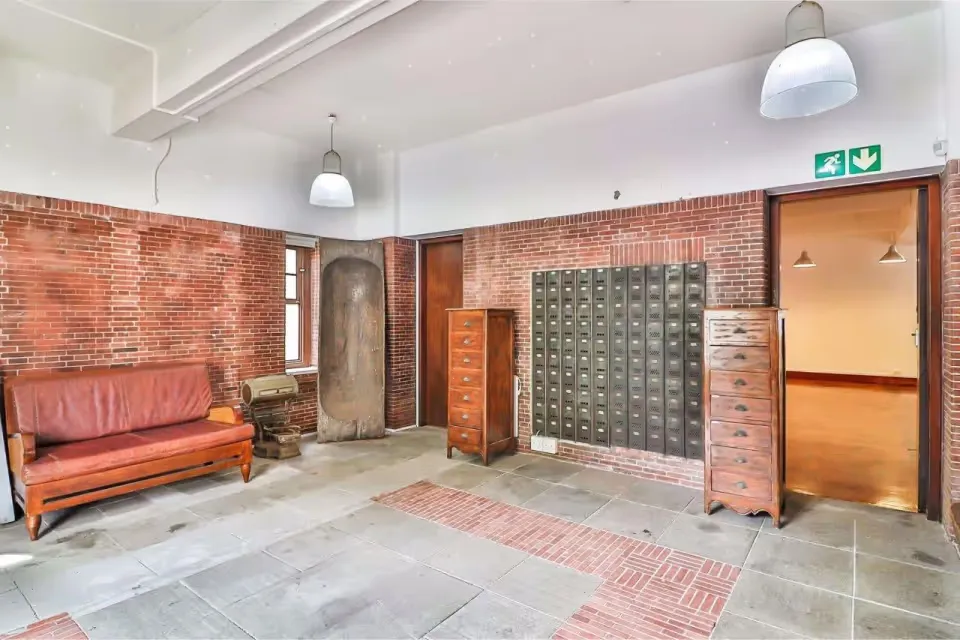
For decades, the post office thrived as a centre of movement and message. Letters, telegrams and telephone exchanges flowed through its halls. Pigeonholes lined the walls; sorting tables anchored its interior; parquet floors and Art Deco fittings framed daily human interaction.
The two ceramic murals on its façade, multi-masted ships riding stylised waves, symbolised connection across oceans. Fired permanently into stone, they reflected an era when communication required patience, trust and physical infrastructure.
As technology evolved, however, the building’s original function diminished. Emails replaced letters. Servers replaced switchboards. What was once the pulse of communication became increasingly redundant.
But heritage buildings rarely become obsolete. They pause, waiting for a purpose aligned with their design intent.
The Next Chapter: Workshop17 Muizenberg
That next chapter has arrived. The Old Post Office is being meticulously repurposed as a collaborative workspace by Workshop17, working alongside Hoven Designs, property owners Flip Floppers Pty Ltd and contractors W30.
Rather than stripping away history, the redevelopment leans into it. Original mailboxes remain embedded in the entrance wall. Architectural details are preserved. Natural light still floods through leaded windows. The core identity, connection, remains intact.
Today, instead of telegrams and envelopes, the building will host entrepreneurs, remote workers, small businesses and creative professionals. Ideas will move through fibre instead of bicycle couriers. Collaboration will replace queues.
Importantly, this transformation is not cosmetic. It introduces a highly interactive, revenue-generating use into a Heritage Protected Overlay Zone, reinforcing Muizenberg’s economic base while protecting its architectural character.
Independent heritage practitioner James J. Hallinan describes it as a “textbook example” of how a redundant heritage resource can be revitalised while preserving intrinsic qualities — supporting broader economic empowerment and renewal in historic Muizenberg.
History with Momentum
The Old Post Office was always about exchange of messages, of ideas, of trust.
Its sea-facing sandstone façade once symbolised South Africa’s outward-looking communication network. Today, it symbolises something equally relevant: the shift toward flexible, community-driven work environments.
In an era where hybrid work and decentralised offices are redefining urban nodes, the Deep South is no longer peripheral. It is strategic. By anchoring flexible workspace within a landmark building, Workshop17 strengthens Muizenberg’s civic core and positions it as a serious alternative to centralised office districts.
This is adaptive reuse done properly, not nostalgia, but continuity.
From Letters to Leadership
Nearly a century ago, W.B.T. Newham believed infrastructure shapes identity. If a community is to believe in itself, its buildings must reflect that belief.
Muizenberg’s Old Post Office once carried the weight of communication across oceans. Now it will carry conversations, collaborations and enterprise into the future.
The function has changed. The purpose has not.
From civic landmark to collaborative hub, this reinvention proves that heritage buildings are not relics, they are strategic assets. When reimagined with care, they become powerful engines of economic renewal and community momentum.
Muizenberg’s next chapter isn’t being written in ink. It’s being built in sandstone, fibre and shared ambition.