





Essential workers priced out of the communities they serve
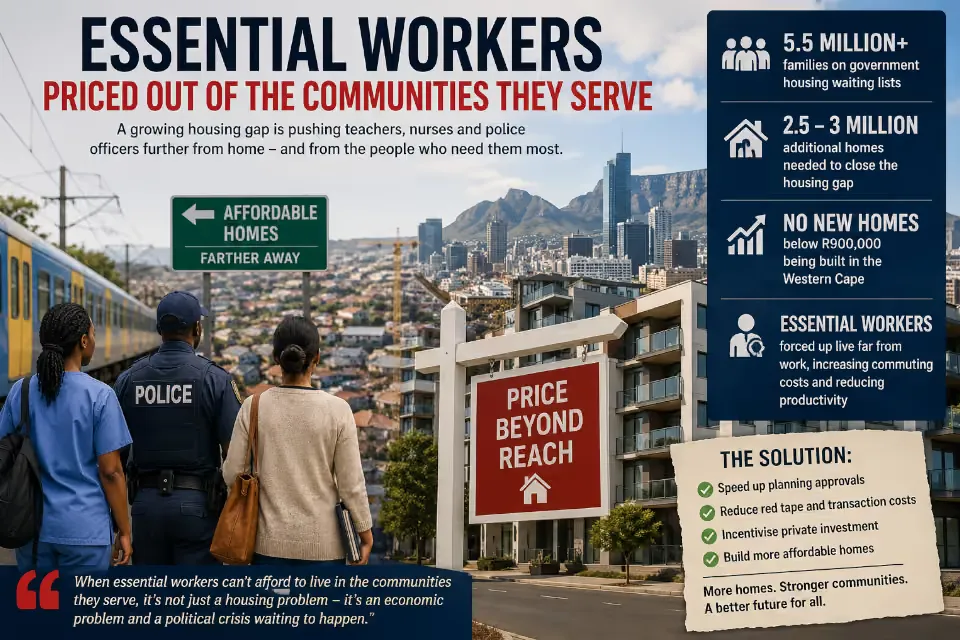
- South Africa needs up to three million additional homes to address its growing housing shortage and affordability crisis.
- Teachers, nurses and police officers are increasingly priced out of the communities they serve.
- Housing experts say regulatory reform is critical to unlock affordable housing supply and improve property affordability.
Essential workers priced out of the communities they serve
South Africa's affordable housing crisis is no longer just a property issue, it is becoming an economic, social and political challenge that threatens the sustainability of the country's cities.
South Africa's housing shortage has reached a critical point, with millions of families unable to access affordable homes and increasing numbers of essential workers finding themselves priced out of the communities they serve.
For many teachers, nurses, police officers and other frontline workers, home ownership near their workplaces has become increasingly unattainable as property prices continue to outpace incomes and new affordable housing developments remain in short supply.
Industry experts warn that unless housing supply is dramatically increased and regulatory obstacles removed, the country's affordability crisis will continue to deepen, affecting labour mobility, economic growth and the ability of municipalities to retain skilled workers.
Housing shortage reaches critical levels
Speaking at the Sustainable Human Settlements Summit earlier this year, President Cyril Ramaphosa highlighted the scale of the challenge facing the country. South Africa currently has:
- More than 5.5 million families on government housing waiting lists.
- A housing shortage estimated at between 2.5 million and 3 million homes.
- The greatest pressure within the "missing middle", where households earn too much to qualify for subsidised housing but too little to buy homes on the open market.
According to Renier Kriek, Managing Director of Sentinel Homes, this affordability gap has become one of the country's biggest property market failures.
"The housing shortage is particularly acute in the so-called 'missing middle', households that earn too much to qualify for government-subsidised housing but too little to afford homes available on the open market."
Property affordability under growing pressure
The affordability challenge is particularly evident in the Western Cape. Industry estimates suggest that virtually no new homes are being built below the R900,000 price point, leaving households earning between R25,000 and R30,000 per month with very limited opportunities to purchase homes close to where they work.
The result is that many key workers are being forced to commute long distances from more affordable areas, placing additional strain on household finances while reducing productivity and quality of life.
"What we're seeing is that ordinary working South Africans can no longer afford to live in the communities they help sustain," says Kriek.
"When teachers, nurses and police officers cannot afford decent housing close to their workplaces, it ceases to be merely a housing problem. It becomes an economic issue and, ultimately, a political one."
The Tafelberg debate highlights a national issue
The debate surrounding the future of the Tafelberg site in Sea Point has once again placed affordable housing firmly in the national spotlight.
The Constitutional Court recently reinforced the obligation of public authorities to consider affordable housing opportunities when making decisions regarding publicly owned land.
The case has reignited broader questions around how South Africa's cities can provide well-located housing for essential workers instead of forcing them further away from employment opportunities.
The challenge extends far beyond Cape Town. Across the country, municipalities face increasing pressure to deliver housing closer to economic hubs while balancing infrastructure constraints and growing demand.
Housing supply simply isn't keeping pace
According to Kriek, South Africa's biggest problem is that new housing supply continues to lag behind both population growth and household formation.
The situation has been further intensified by semigration, particularly into the Western Cape, where demand has accelerated in markets already facing severe housing shortages.
He believes municipalities should be measured by one key indicator: How quickly they enable new housing supply.
"If there is too little of something, prices inevitably rise. The only sustainable solution is to increase supply so that it meets demand." Kriek argues that the biggest obstacle is not a lack of private capital but rather lengthy planning approvals, fragmented regulations and increasingly complex development processes.
"From planning approval to people eventually moving into new homes routinely takes more than a decade," he says. "Much of that delay is created by cumbersome bureaucracy and ever-expanding regulation."
Massive demand, but too little investment
The country's affordable housing "gap market" represents roughly the middle 30% of South African households. Demand within this segment remains exceptionally strong, yet housing supply continues to decline.
Kriek believes the underlying problem is one of market design. Private investors, developers and lenders have capital available, but current regulatory conditions discourage investment in affordable housing.
"The holders of capital have choices," he explains. "If investment isn't flowing into affordable housing, we need to ask what is pushing it away."
Among the biggest concerns are lengthy eviction procedures, costly foreclosure processes and high transaction costs that significantly increase investment risk. He believes regulatory reform could encourage greater private sector participation while substantially increasing housing supply.
Unintended consequences of housing subsidies
Government's First Home Finance (FHF) subsidy, formerly known as FLISP, was introduced to help households earning between R3,501 and R22,000 per month purchase their first homes.
While well intentioned, Kriek argues that aspects of the subsidy have unintentionally reduced its effectiveness.
Despite millions of rand being allocated to the programme, large portions remain unclaimed. The reasons extend beyond public awareness.
A shortage of affordable housing stock limits opportunities, while the administrative complexity of subsidy transactions discourages many estate agents and other market participants from engaging with subsidy-assisted buyers.
"Estate agents often have to wait considerably longer to receive their commission where subsidy funding is involved," says Kriek. "That creates an unintended incentive to prioritise buyers who do not require government assistance."
Although reforms are being considered, he believes the administration of the subsidy remains unnecessarily complex.
A property challenge with national consequences
The affordability crisis is no longer confined to the residential property market. It now affects workforce mobility, household disposable income, productivity, investment confidence and economic growth.
It also has important implications for local government as municipalities prepare for elections later this year.
Without meaningful regulatory reform, faster development approvals and stronger incentives for private sector investment, South Africa risks widening the gap between where people work and where they can realistically afford to live.
The road ahead
For Kriek, the solution is clear. South Africa needs to unlock significantly greater housing supply, reduce unnecessary regulatory barriers and create an environment that encourages private investment into affordable housing.
Achieving this would not only improve home ownership opportunities but also stimulate construction, create jobs, strengthen local economies and help restore property affordability for thousands of working South Africans.
Ultimately, ensuring that teachers, nurses, police officers and other essential workers can afford to live in the communities they serve is not simply good housing policy, it is fundamental to building inclusive, economically resilient and sustainable cities.