





Inside Balwin’s landmark R2.26bn GEPF-PIC deal
The transaction taking Balwin private combines institutional capital, founder commitment and an ambitious plan to accelerate residential development across South Africa.
- Shareholders receive R4.35 cash per eligible share as Balwin moves from listed markets into a long-term private ownership structure.
- The GEPF, represented by the PIC, will own 49.3%, alongside Stephen Brookes, Rodney Gray and GRE Africa.
- The new structure aims to accelerate Balwin’s 30,000-home pipeline, grow its rental portfolio and strengthen its balance sheet.
Going private: Inside the landmark transaction
Balwin Properties is entering one of the most significant chapters in its 30-year history.
The residential developer is moving out of the public market and into private ownership through a transaction bringing together its founders, management, GRE Africa and the Government Employees Pension Fund, represented by the Public Investment Corporation.
It is more than a delisting. The transaction changes the source, structure and time horizon of the capital supporting one of South Africa’s largest sectional-title residential developers.
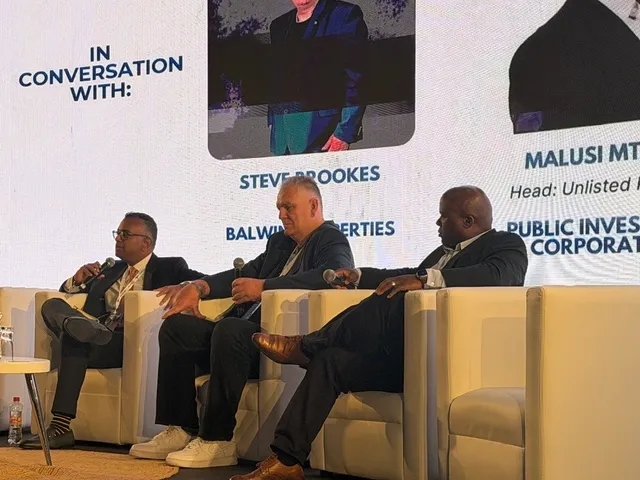
Speaking at the API Summit in Cape Town, the people behind the transaction explained how the deal was assembled and what it could mean for Balwin’s next growth phase.
The conversation was facilitated by Mesh Pillay, founder and CEO of YW Capital, with Balwin CEO Steve Brookes and Malusi Mthuli, head of unlisted property at the PIC.
The numbers behind the deal
The transaction is being implemented through a scheme of arrangement under which eligible Balwin shareholders receive R4.35 in cash for each scheme share.
The offer values Balwin’s entire issued share capital at approximately R2.26 billion. Because the founders and other reinvesting shareholders are retaining their interests, the maximum cash consideration required to acquire the remaining eligible shares is approximately R1.12 billion.
The offer represents premiums of:
- 23.15% to the 30-day volume-weighted average share price
- 26.12% to the 60-day average
- 34.48% to the 90-day average
- 40.95% to the 180-day average
These premiums were calculated against Balwin’s trading prices before the firm-intention announcement in May 2026.
The independent expert concluded that the proposal was fair and reasonable. Shareholders subsequently backed it overwhelmingly, with Pillay telling delegates that approximately 98% of the shares voted supported the transaction.
Who will own Balwin?
After the transaction, the private holding company’s ownership is expected to be:
- GEPF, represented by the PIC: 49.3%
- Volker Holdings, controlled by Stephen Brookes: 33.6%
- Rodna, associated with managing director Rodney Gray: 9.6%
- GRE Africa: 7.5%
This is a critical part of the story: Brookes and Gray are not cashing out and walking away. They are reinvesting their interests and continuing to lead the company.
“The founders of the business, Steve and Rodney, have chosen to stay in the business and rotate their capital back into the business,” Pillay said.
The structure gives eligible public shareholders a cash exit while retaining the operational leadership and experience responsible for building Balwin.
Why leave the listed market?
Balwin listed on the JSE in 2017, but Brookes said the company encountered two persistent problems: a relatively small free float and a substantial discount between the share price and underlying net asset value.
That disconnect limited the value public markets placed on Balwin’s assets and development pipeline. Residential development also requires substantial upfront capital. Projects can take years to progress through land acquisition, approvals, infrastructure, construction, sales and transfer.
Private institutional capital can give Balwin more room to invest through these cycles without being judged primarily on short-term market movements and reporting periods.
Brookes acknowledged that leaving the JSE was difficult. “It was also a sad moment for me,” he said. “But when you get a partner like the PIC, it is something to look forward to.”
Pillay argued that the transaction should not simply be viewed as another company abandoning the stock exchange. “I see it as a different pot of capital for Balwin,” he said.
Why the PIC chose Balwin
Mthuli said the PIC was attracted to Balwin as an established residential development platform with the leadership, systems and pipeline required to scale.
The PIC’s property portfolio currently stands at approximately R65 billion, but Mthuli said it remained underinvested relative to its mandate. It is also particularly light in residential and industrial property.
“We are very light on residential, which is why we are very excited about the deal that we did with Balwin,” he said.
Rather than investing in isolated developments, the PIC is seeking platforms with proven management and the capacity to deliver at scale.
Balwin has a pipeline of approximately 30,000 build-to-sell homes and an ambition to develop 10,000 build-to-rent units. Mthuli believes the partnership could enable Balwin to achieve within five years what may previously have taken a decade.
How the transaction could change Balwin
The partnership is expected to influence the business in four important areas.
- Faster development
Access to patient institutional capital could allow Balwin to unlock projects more quickly and accelerate delivery from its existing pipeline. - A larger rental portfolio
Balwin has historically operated primarily as a build-to-sell developer. The new structure could enable it to retain more units as long-term rental assets, introducing recurring income alongside development profits. - A stronger balance sheet
Institutional backing should improve Balwin’s ability to fund infrastructure, manage working-capital requirements and deliver larger projects. - Better coordination with government
Major developments are often delayed by approvals, municipal capacity and bulk-infrastructure constraints. The PIC’s institutional reach could help Balwin engage more effectively with public-sector stakeholders.
Returns and social impact
The transaction also creates an important connection between Balwin’s housing pipeline and the needs of GEPF members. The GEPF serves government employees, many of whom need access to well-located, good-quality and appropriately priced housing.
Brookes placed dignity at the centre of that objective. “If you live in a good house, it gives you good dignity,” he said. “That, to me, is an important part of this country.”
However, Mthuli stressed that the GEPF’s capital is not concessionary funding. As a defined-benefit pension fund, it must generate sufficient returns to meet its long-term obligations.
The investment must therefore deliver both commercial performance and measurable social value.
Green housing strengthens the investment case
Balwin’s green-building programme also helped make the company attractive to institutional capital.
The developer has invested extensively in EDGE-certified homes and worked with lenders and the International Finance Corporation to link green performance with improved financing.
Brookes highlighted green home loans that can reduce qualifying buyers’ mortgage rates by approximately 0.25 percentage points. While the reduction may appear small, the saving becomes significant over a 20-year mortgage.
Energy- and water-efficient homes can also lower monthly operating costs, improve resilience and strengthen long-term affordability. For developers seeking institutional or international capital, Pillay said the lesson was to understand what matters to the investor.
“Before you start the process, understand what the investment case to the investor is, not only what your investment case is,” he said.
A new chapter, not an exit
The transaction took approximately three years to assemble, reflecting the complexity of aligning founders, public shareholders, institutional investors, regulators and fund mandates.
Balwin will leave the listed market, but Brookes insists he is not leaving the company. “I’m not going anywhere,” he said. “This is a new era for Balwin.” That is the real significance of the deal.
It gives public shareholders an exit while retaining founder leadership and introducing the capital of Africa’s largest institutional investor.
The test now is whether the partners can convert that patient capital, Balwin’s development expertise and a 30,000-home pipeline into faster delivery, more rental housing and a stronger residential platform.
If they succeed, this will be remembered as more than the transaction that took Balwin private. It will mark the beginning of a substantially larger phase of growth.