




.avif)
.avif)

Attacq lifts dividend 17% as Waterfall pipeline expands
The REIT delivered double-digit distributable income growth, strengthened its balance sheet and advanced a R2.2 billion development pipeline at Waterfall City.
- Normalised distributable income per share increased 15.5% to 125.1 cents, exceeding Attacq’s previously guided growth range.
- The full-year dividend rose 17.2% to 102 cents per share, supported by stronger revenue and lower funding costs.
- Waterfall City’s construction and approved development pipeline now totals 85 247m², with an estimated total cost of R2.2 billion.
Attacq has delivered a strong set of full-year results, combining double-digit income and dividend growth with continued investment in Waterfall City and disciplined management of its balance sheet.
The JSE- and A2X-listed real estate investment trust reported a 15.5% increase in normalised distributable income per share (DIPS) to 125.1 cents for the year ended 30 June 2026. This was ahead of its previously guided growth range of between 11% and 14%.
The board declared a final gross cash dividend of 54 cents per share, taking the full-year dividend to 102 cents per share, an increase of 17.2% from the previous financial year.
Gross revenue increased by 9.3%, while net operating income grew by 7%. The performance was supported by improved letting, contractual rental escalations, income from recently completed developments and lower funding costs.
Attacq CEO Jackie van Niekerk said the results reflected the resilience the group has deliberately built into its business.
“The results reported today are the outcome of our team’s discipline and hard work, and of a business we have deliberately built to be resilient,” she said.
“We are building places where people want to be, and quality spaces across South Africa that meet the evolving needs of our communities.”
Attacq’s R22.6 billion property portfolio
Attacq’s property portfolio is now valued at R22.6 billion and is structured around three core areas: Waterfall City, the group’s completed property portfolio across the rest of South Africa, and other investments.
Its major assets include Mall of Africa, Waterfall Corner, Garden Route Mall, MooiRivier Mall, Eikestad Mall and the Lynnwood Bridge Precinct.
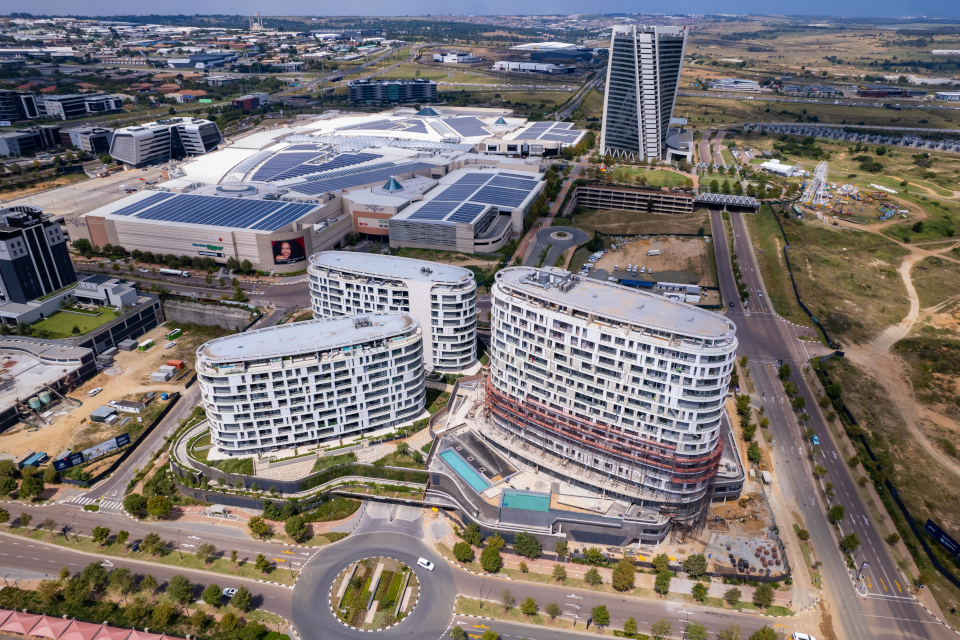
At the heart of the business is Waterfall City, where Attacq operates as both an investor and strategic development partner. The precinct includes completed properties, developments under construction and leasehold land that provides capacity for future growth.
The group’s broader investment portfolio also includes a 4% interest in Lango Real Estate Limited and selected diversification initiatives that complement its core property operations.
Attacq previously strengthened its financial position through a R2.7 billion transaction with the Government Employees Pension Fund, which acquired a 30% shareholding in Attacq Waterfall Investment Company.
The transaction reduced gearing and gave the group greater capacity to fund its development programme without placing unnecessary pressure on the balance sheet.
Results at a glance
Attacq’s operational and financial highlights for the year included:
- Normalised DIPS growth of 15.5% to 125.1 cents per share
- Full-year dividend growth of 17.2% to 102 cents per share
- Gross revenue growth of 9.3%
- Net operating income growth of 7%
- Portfolio occupancy of 94.9%
- Collection rate of 99.8%
- Client retention of 86.9% at renewal
- Gearing reduced to 25%, from 25.3%
- Interest cover ratio strengthened to 3.21 times
- Weighted average cost of debt reduced from 9.2% to 8.7%
- Municipal recovery ratio improved from 94.4% to 97.8%
The occupancy and collection figures are particularly important in the current operating environment. A 99.8% collection rate indicates that almost all billed rental income was collected, while the 94.9% occupancy rate provides a solid income base across the portfolio.
The reduction in the weighted average cost of debt also provided meaningful support to distributable income.
Attacq chief financial officer Peter de Villiers said the group’s capital structure gives it sufficient headroom to continue investing in Waterfall City.
“Our capital structure gives us the headroom to continue developing Waterfall City, allocating capital in a disciplined manner which will flow through to future distributable income,” he said.
Waterfall City drives the next growth phase
Attacq’s development activity under construction and in the approved pipeline at Waterfall City totals 85 247m² of gross lettable area.
The total development cost is estimated at R2.2 billion, with Attacq’s effective share amounting to 46 460m² at a cost of approximately R1.3 billion. Delivery of the projects is expected to continue through to 2028.
The group is also investing in the roads, water, electricity and other bulk infrastructure required to support Waterfall City’s expansion. Several major projects reached important milestones during the year.
Attacq completed Galileo, the fourth and final tower in the Ellipse Waterfall residential development, while the 11 151m² Vantage data centre opened during the reporting period.
Gateway East, a premium office development positioned at the main entrance to Waterfall City, is already 47% pre-let, with a further 33% of its space under offer.
The building will include restaurants opening onto the Mall of Africa piazza and is scheduled for full completion during the second quarter of Attacq’s 2027 financial year.
At Waterfall City Junction, a new logistics precinct east of the N1, construction is under way on a 22 142m² warehouse. A distribution facility for a national client is also proposed, with construction expected to begin in the next quarter.
The R634 million Waterfall City Conference Centre and Hotel has broken ground, while construction has also commenced on Aspire, a 20-storey residential tower.
Both developments are expected to be completed during the first quarter of 2028 and will further reshape Waterfall City’s skyline and mixed-use offering.
Demand for office and collaboration space also remained active. Tiger Brands, Boogertman + Partners, iOCO, Novonesis, Huge Group and Sinotile were among the businesses that took up space in Waterfall City during the year.
Infrastructure that supports tenants and visitors
Attacq is increasingly focusing on the infrastructure and public spaces that support the people working, living and shopping within its precincts.
The Izinga Transport Hub opened at Mall of Africa in March, consolidating taxi, food-delivery and online-delivery services within a purpose-built facility.
The hub includes enclosed waiting areas, dedicated security, charging stations, free Wi-Fi and ablution facilities. The site previously used for transport operations will be converted into Pantry by Marble, a premium street-facing convenience store scheduled to open during the first quarter of 2027.
“By turning infrastructure into attractive street-front retail, we help shape our city into a lively, walkable precinct,” Van Niekerk said.
Energy and water resilience remain priorities
Attacq continued investing in renewable energy, backup water and smart utility management as part of its strategy to reduce operating costs and improve the resilience of its buildings.
The group installed an additional 1.8 megawatt-peak of rooftop solar photovoltaic capacity during the year, taking total installed rooftop capacity across the portfolio to 18.5 MWp. Renewable energy supplied 13.7% of the group’s total power requirements, up from 9.1% in the previous financial year.
The municipal recovery ratio improved to 97.8%, supported by real-time consumption monitoring through Attacq’s Smart Utility Hub. This was a major contributor to the reduction in operating costs relative to income.
Further improvements are expected once the group’s power purchase agreement becomes operational. New developments are also being designed with rooftop solar installations, rainwater harvesting, backup water systems and smart metering incorporated from the outset.
Attacq added 5.3 megalitres of backup water capacity during the year. This included two additional tanks at Mall of Africa, providing the precinct with approximately five days of backup supply, and a further three megalitres installed across its logistics properties.
“Helping our tenants keep trading is the difference between a normal business day and a lost one,” Van Niekerk said.
Outlook: further growth expected in 2027
Attacq expects normalised DIPS to grow by between 6% and 9% during the 2027 financial year, with a dividend payout ratio of 80%.
Although this represents a moderation from the 15.5% growth achieved in 2026, it points to continued income and dividend growth as new developments are completed, occupied and brought into the group’s income-producing portfolio.
The group’s outlook will depend on maintaining occupancy and collection levels, controlling operating costs, managing development execution and preserving balance-sheet capacity.
A stronger platform for long-term growth
Attacq’s 2026 results reflect a property business benefiting from stronger operations, falling funding costs and a sizeable development pipeline concentrated in one of South Africa’s most prominent mixed-use precincts.
The 17.2% dividend increase is an immediate reward for shareholders, but Waterfall City remains the longer-term growth story. With R2.2 billion in development activity, major commercial, logistics, hospitality and residential projects under way, and continued investment in essential infrastructure, Attacq is positioning Waterfall City as the central driver of its future earnings.
The challenge now is execution: completing the pipeline on time, securing tenants and converting development expenditure into sustainable income.
For property investors, Attacq’s results show that disciplined capital management, high rental collections and investment in resilient precinct infrastructure can still deliver meaningful growth in a demanding South African operating environment.





.svg)

.avif)
















.avif)