





Six corridors redrawing Africa’s property map
Broll’s new intelligence report reveals how power, production, people and politics are concentrating Africa’s next real estate opportunities.
- Six cross-border growth corridors are connecting cities, ports, energy projects, industries, logistics hubs and rapidly expanding consumer markets.
- Africa’s demographic expansion creates potential, but population growth only becomes property demand when supported by jobs, infrastructure and affordability.
- Execution, transparent regulation, reliable data, local partners and patient capital will determine which corridor opportunities become successful investments.
Africa’s property opportunity through a new lens
For decades, investors have approached African real estate by asking which country or city offers the next major opportunity. Is it Kenya, Nigeria, Ghana, Zambia or South Africa? Nairobi, Lagos, Accra or Cape Town?
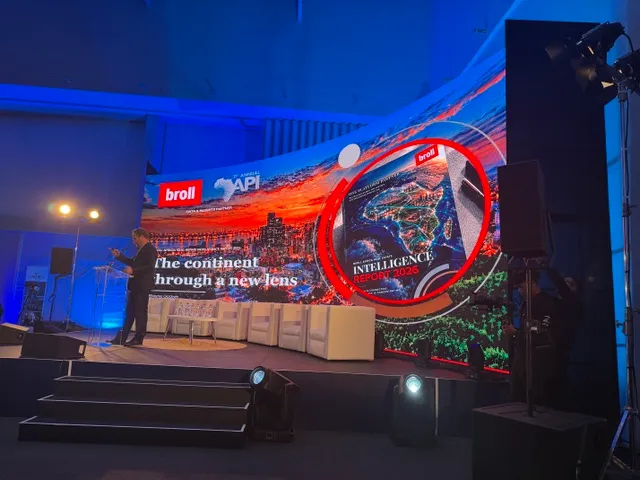
The Broll Africa Real Estate Intelligence Report 2026: The Continent Through a New Lens, launched at the API Summit in Cape Town, argues that investors should ask a different question: Which economic corridors are concentrating the infrastructure, capital, people and productive activity that will drive Africa’s next real estate cycle?
Presented by Wayne Godwin, Managing Director of Cushman & Wakefield | Broll Hospitality, the report identifies six emerging cross-border growth corridors created by the convergence of four powerful forces: Power, Production, People and Politics.
Rather than viewing Africa’s 54 countries as isolated markets, the report examines the connections between energy projects, mines, ports, cities, transport routes, industrial zones, technology infrastructure and growing consumer markets.
“The report is really a reflection on the demand side of the story,” Godwin told Real Estate Investor following its launch. “We stepped back and asked what factors are going to shape demand across the sector. We identified four: power, production, people and politics.”
The four forces reshaping Africa
- Power
Africa’s energy transition is creating demand for new generation capacity, transmission infrastructure and the critical minerals required by the global economy.
Reliable power is also becoming fundamental to industrial development, logistics facilities, data centres, hospitality and modern commercial property.
The property opportunity does not sit only alongside new power plants. It extends through the economic activity that dependable energy can support. - Production
Global supply chains are being reconsidered as governments and companies seek greater security, alternative trade routes and access to critical resources.
Africa’s mineral resources, agricultural capacity and potential for local manufacturing create substantial opportunities—but only where products can be processed, stored and moved efficiently.
This is why ports, railways, roads, industrial parks and logistics platforms are integral to the real estate story. - People
Africa’s demographic expansion remains one of its most powerful long-term drivers. By 2050, approximately one in four people globally is expected to be African, while the continent’s urban population is projected to double.
Godwin cautions, however, that population growth alone does not create investable property demand.
Africa’s median age is approximately 19. A significant part of this population is still moving through education and has not yet entered the workforce, formed households or become active consumers.
“That cohort is on the cusp of becoming 24 or 25 years old, working, earning, contributing and spending,” Godwin said. “That is where we start to see the demographic dividend coming through.” - Politics
While the global economy is becoming increasingly fragmented, Africa is gradually moving towards greater regional integration.
Trade agreements and cross-border infrastructure could connect markets that are too small to justify major investment individually. However, different legal systems, taxes, licensing requirements, land regulations and capital controls continue to increase uncertainty and the cost of investment.
For the corridor model to work, countries must improve policy coordination, regulatory transparency and the movement of capital, goods and people.
Why corridors matter
Economic activity frequently ignores political borders. Minerals extracted in the Democratic Republic of Congo, for example, may require transport infrastructure and port access through another country. That movement creates demand for warehouses, industrial property, housing, hospitality and services far beyond the location of the mine itself.
“Countries cannot be completely self-sustainable,” Godwin explained. “It has to be a web connecting infrastructure, resources, skills, roads and markets and that often crosses borders.”
The report’s six corridors bring these relationships into a single investment framework. Each corridor is assessed against existing property stock, infrastructure, resources, transaction activity, risks and the potential implications for different property sectors.
The analysis is reinforced by the US$2.2 billion API/Broll Deal Data Index, which connects the report’s structural investment thesis with evidence of where capital is already being deployed. Read the Broll Africa Real Estate Intelligence Report 2026
From the corridor to the street corner
The corridor approach does not mean investors can ignore traditional property fundamentals. A powerful infrastructure and economic story cannot rescue a poorly located, incorrectly priced or oversupplied asset.
“It does not matter how good the corridor fundamentals are if the asset class is on the wrong street corner,” Godwin warned during the panel discussion.
The report therefore provides a demand-side framework, not permission to invest without detailed local analysis. Investors must still examine:
- Location and accessibility
- Construction and financing costs
- Tenant affordability
- Competing supply
- Rentals and vacancies
- Regulatory conditions
- Infrastructure delivery
- Exit liquidity
- Local operating capability
Godwin advises investors to assess both high- and low-growth scenarios. Infrastructure can be catalytic, but projects based on one future mine, port, railway or energy investment can remain exposed for years if that catalyst is delayed.
Demographics do not automatically equal demand
Marinus van der Merwe, CEO of Fernridge Solutions, challenged investors to move beyond attractive population headlines and interrogate demand at ground level.
Fernridge’s spatial analysis maps households, incomes, mobility, visitation, spending patterns and competing supply to understand how consumers interact with particular locations.
Two shopping centres may record similar visitor numbers but serve households with completely different incomes, visit frequencies and spending power. Those differences can determine the appropriate centre size, tenant mix and investment value.
The lesson is straightforward: more people do not automatically mean more demand.
Urbanisation can also result from unemployment, climate pressure and failing rural livelihoods, not only growing economic opportunity. Property investment must therefore be grounded in employment, affordability and actual household behaviour.
Capital needs bankable platforms
Niyi Adeleye, Head of Real Estate Finance for Africa at Standard Bank Group, warned against confusing early interest with sustainable demand.
Real estate often follows infrastructure, but investors and lenders must determine whether the surrounding economy can support a project over its full investment period.
Adeleye also highlighted the increasing importance of domestic institutional capital. Local pension funds and financial institutions may understand market risks better and provide the patient capital required to establish successful platforms.
Once local investors demonstrate confidence, international capital may be more willing to follow. Godwin said international institutional investors generally require scale, professional management and evidence of previous success.
“They are not going to get out of bed for less than $100 million,” he said. “That capital wants a minority position in a professionally managed portfolio or platform.”
Africa therefore needs more credible operators capable of assembling assets into investable portfolios rather than presenting international institutions with isolated projects.
Data, transparency and local partners
A lack of consistent property data remains one of the continent’s biggest investment constraints.
Broll combines traditional information such as rentals, vacancies, pipelines and transaction evidence, with alternative data including spatial household mapping, aerial imagery and aggregated mobility patterns.
Godwin said this approach helps investors analyse demand at city, neighbourhood and catchment level in markets where conventional property information may be limited.
Local operating partners are equally important. Experienced partners understand local regulations, tenant behaviour, authorities, supply chains and operating risks. For Godwin, they are central to converting regional growth into successful assets.
The opportunity is real, but execution decides the outcome
The strongest message emerging from the report and API panel was that Africa no longer has a shortage of opportunity. The greater risk is selecting opportunities that cannot be executed successfully.
Projects are commonly derailed by incomplete funding, weak planning, inadequate technical skills, infrastructure delays, regulatory uncertainty and global economic shocks.
Godwin’s advice to South African investors is direct: enter African markets, but do so cautiously, in phases and alongside credible partners.
“Figure out your thesis, understand the risks and take the first step,” he said. “Even if it is a small step, momentum is important.”
The report does not suggest that investors back an entire corridor. The practical opportunity may lie in one city, neighbourhood, logistics node or strategic street corner that benefits from the larger forces surrounding it. That requires conviction backed by evidence.
Africa’s next real estate cycle will not be unlocked by population projections or ambitious infrastructure announcements alone.
It will be shaped by where power, production, people and politics converge and where investors can translate those forces into bankable, properly located and professionally operated property.
Read the full Broll Africa Real Estate Intelligence Report 2026