










Black women drive 146% surge in SA property investors
Listen · 1-minute summary
0:00 / 1:13
Read the summary
Black women drive 146% surge in SA property investors. New research from Lightstone shows South Africa's private property investment market is changing fast. Black women recorded 146 percent growth in investor numbers over the past decade, the biggest increase of any group, while Black men grew 124 percent. White male investors declined 17 percent, and White female investors declined 13 percent. Overall, the private investor base grew 22 percent, rising to more than 140,000 people, more than double the 10.6 percent growth seen across the broader property market. Most investors hold modest portfolios. Sixty one percent own just three properties, and the average value of investment properties fell from R3 million in 2015 to R2.8 million in 2025. Investors are also staying close to home. Sixty four percent of investment properties sit in the same municipality as the investor's own house, and around 80 percent are in the same province. Read the full story by Neale Petersen on rei.co.za.

New Lightstone research reveals how South Africa's private property investment landscape is transforming, with more investors, greater diversity and a growing preference for smaller portfolios.
- Black women recorded 146% growth in private property investor numbers over a decade, outpacing all other demographic groups analysed.
- South Africa's private investor base expanded 22% to more than 140,000, more than double the broader property market's growth rate.
- Six in ten investors own just three properties, while smaller portfolios and investment closer to home increasingly define the market.
A new generation reshapes property investment
South Africa's private property investment market is undergoing a significant transformation, with Black women emerging as its fastest-growing demographic group and smaller portfolios increasingly shaping the country's investment landscape.
New research by property data and analytics company Lightstone reveals that the number of private property investors increased by approximately 22% between 2015 and 2025, rising from fewer than 120,000 to more than 140,000.
That growth is more than double the 10.6% expansion recorded across the broader property market during the same period. But the most striking finding is not simply the increase in investor numbers. It is who is entering the market, how many properties they own and where they choose to invest.
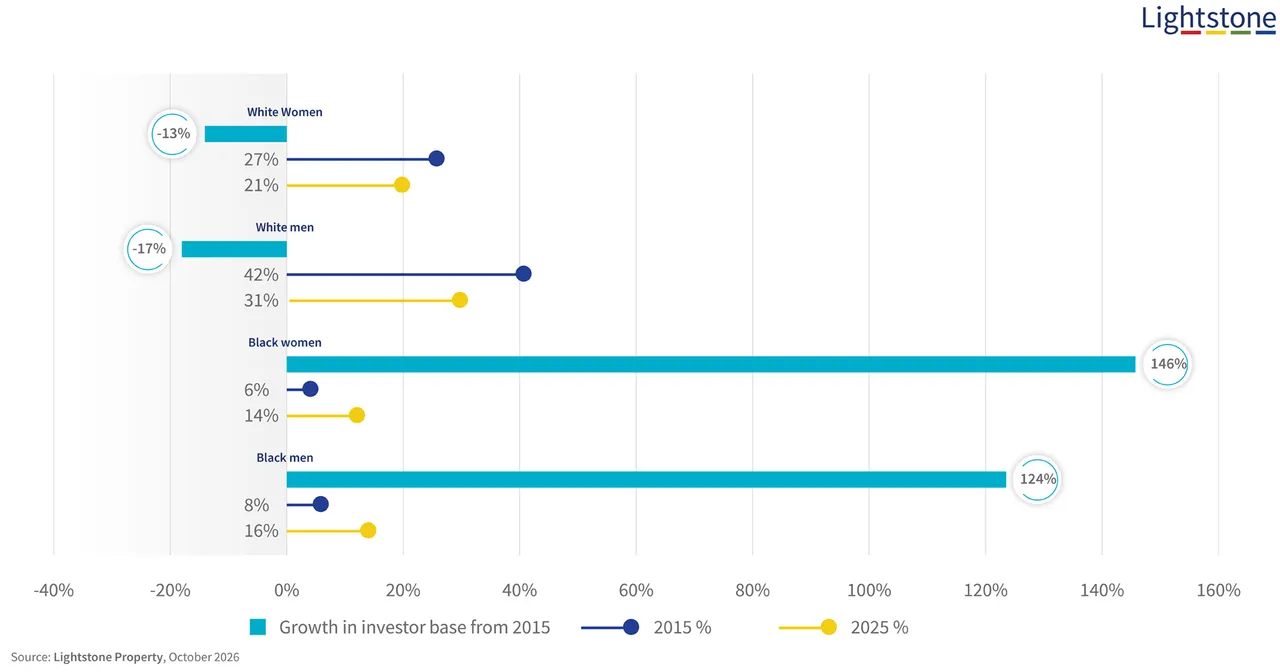
According to Lightstone's October 2026 analysis, Black women recorded a 146% increase in private property investor numbers over the decade, compared with 124% growth among Black men.
Meanwhile, the number of White male investors declined by 17%, while White female investors decreased by 13%. The findings point to a market becoming more diverse, with property ownership increasingly extending beyond traditional investor demographics.
Black women lead the transformation
Lightstone's demographic analysis highlights a substantial shift in the composition of South Africa's private property investor base.
The key findings include:
- Black women: Investor numbers increased 146%, with their share of the investor base rising from approximately 6% to 14%.
- Black men: Investor numbers increased 124%, with their market share doubling from 8% to 16%.
- White men: Investor numbers declined 17%, although they remain the largest individual demographic group.
- White women: Investor numbers declined 13%, while retaining the second-largest share of investors.
Although White investors continue to account for the largest proportion of private property investors, the pace of change among Black investors suggests a meaningful shift in market participation.
Importantly, these figures measure changes in investor numbers rather than property values or investment returns.
Six in ten investors own only three properties
One of Lightstone's most revealing findings is that South Africa's private property investment market is dominated by relatively modest portfolios.
Under its methodology, Lightstone defines a private property investor as an individual who owns or jointly owns at least three properties, each held for at least one year.
The figures challenge the perception that property investing is primarily dominated by individuals holding extensive portfolios.
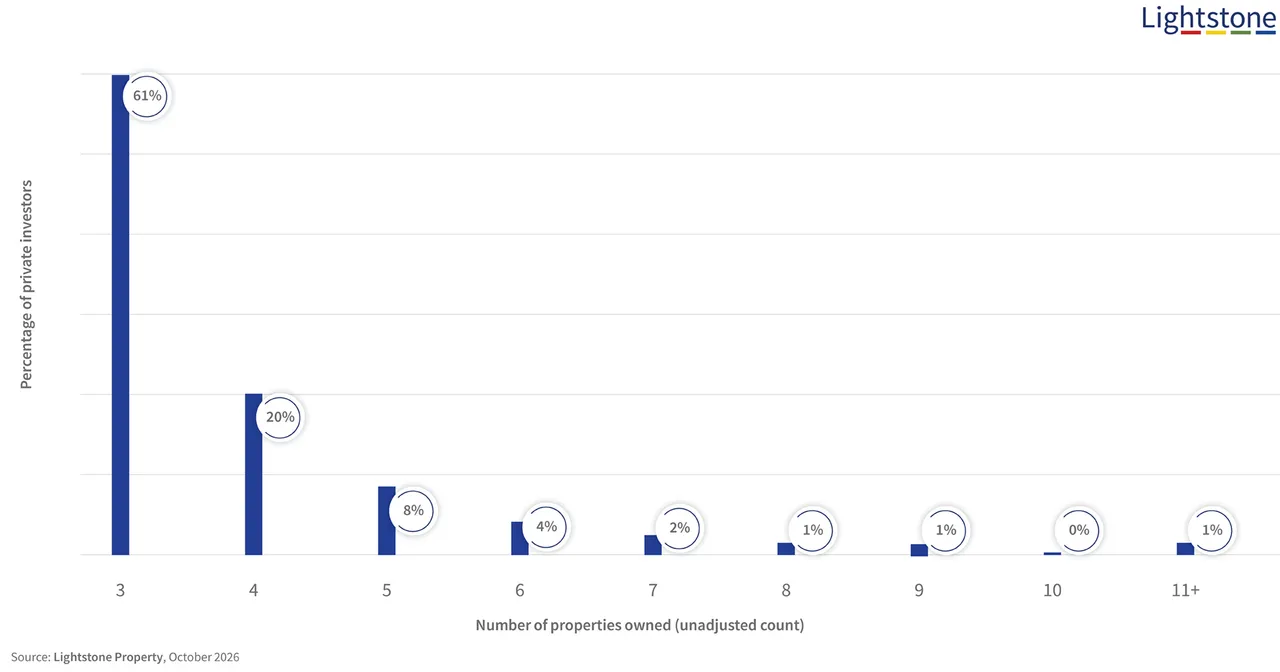
- 61% of private investors own three properties.
- 20% own four properties.
- 8% own five properties.
- Only approximately 1% own more than ten properties.
Nearly nine in ten private investors therefore hold between three and five properties. There is also a substantial pool of potential future investors immediately below Lightstone's three-property threshold.
The number of individuals owning two properties increased from 290,315 in 2015 to 373,435 in 2025. This suggests that the transition from homeowner to small-scale landlord or portfolio investor is an important feature of South Africa's residential property market.
Shared ownership: Who actually owns the property?
Property ownership is not always an individual undertaking. Lightstone found that a significant proportion of properties are jointly owned, typically by spouses or partners.
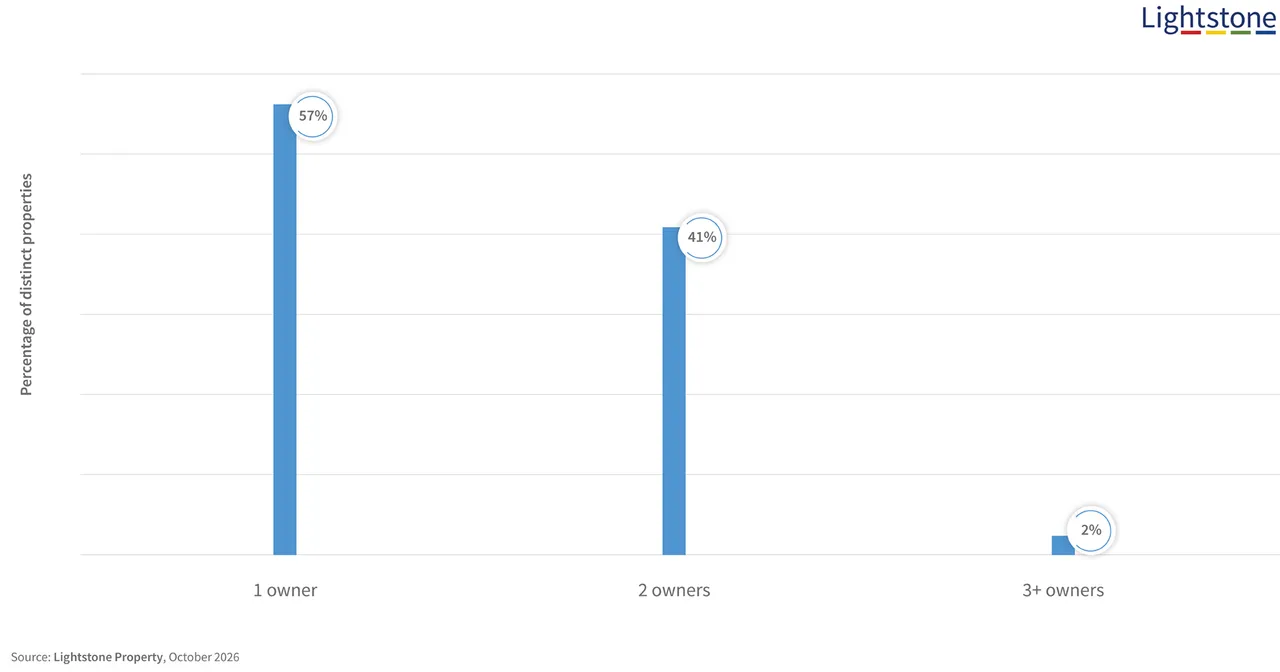
The breakdown shows that 57% of properties have one registered owner, 41% have two owners and only 2% have three or more. This distinction matters when calculating investment portfolio sizes.
When jointly owned properties are apportioned between their registered owners, the average number of properties attributable to each investor falls below three, despite every investor meeting Lightstone's three-property ownership threshold on an unadjusted basis.
For investors, it reinforces the importance of understanding ownership structures, financing arrangements and the financial implications of co-investing.
More investors, but smaller property portfolios
While South Africa's private investor population has expanded, the research shows that larger portfolios have become less common.
The decade-long changes are significant:
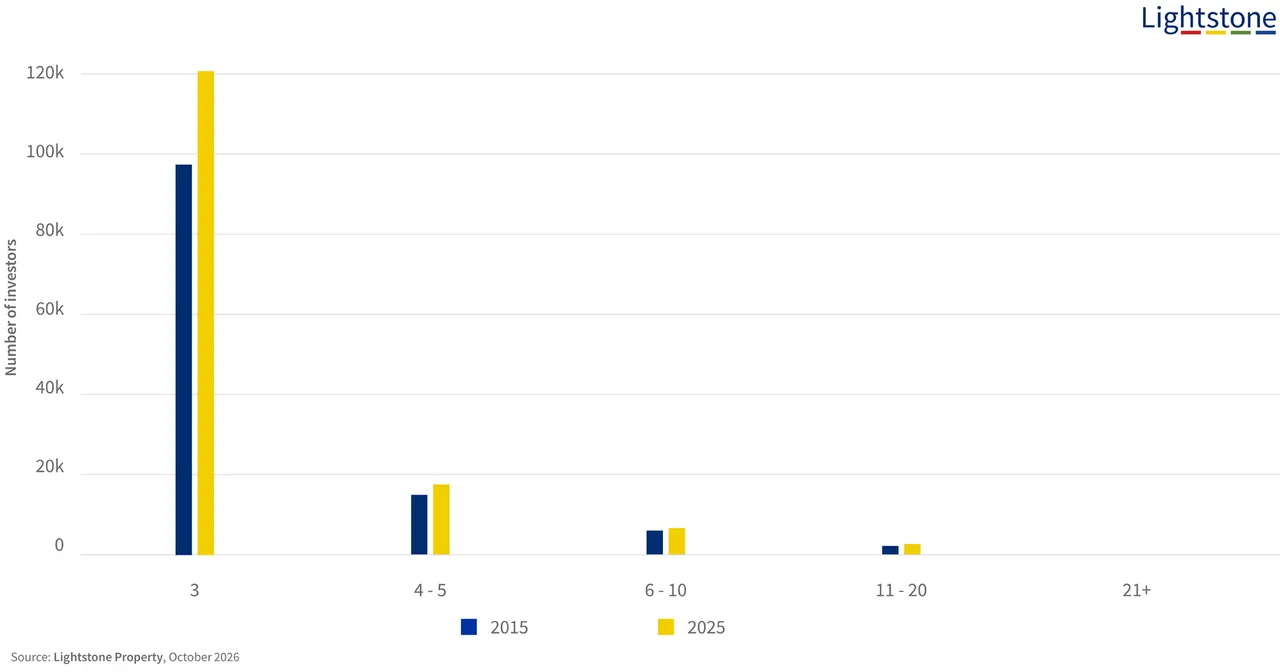
- Three-property investors increased by 24%.
- Four-to-five-property investors increased by 16%.
- Six-to-ten-property investors increased by 10%.
- Investors with 11–20 properties declined by 2%.
- Investors holding 21 or more properties declined by 20%.
The average value of investment properties, excluding the investor's primary residence, also decreased from approximately R3 million in 2015 to R2.8 million in 2025.
These are nominal figures, meaning the decline in inflation-adjusted portfolio value would be greater. The broader picture is clear: more South Africans are participating in property investment, but the typical portfolio is becoming smaller.
Investors prefer sectional title and familiar locations
Lightstone's research also reveals distinct differences between the properties investors choose to live in and those they acquire as investments.
While 82% of investors' own homes are freehold properties, sectional-title units account for 42% of their investment properties.
The preference for apartments and higher-density developments reflects the different requirements of investment property, including maintenance, rental demand and affordability.
Location remains equally important.
- 64% of investment properties are located in the same municipality as the investor's own home.
- Approximately 80% are situated within the investor's home province.
- Among Cape Town-based investors, 70% of investment properties are also located within Cape Town.
Much of the remaining investment activity among Cape Town investors is concentrated in nearby Western Cape markets, including the Winelands, Hermanus and the West Coast.
Rather than diversifying across distant provinces, many investors appear to favour markets they understand and can manage more easily.
Investor turnover and an ageing market
The research also identifies substantial turnover in the investor population. Only 49% of those classified as private property investors in 2015 still met Lightstone's definition in 2025.
Others had reduced their holdings below the three-property threshold. At the same time, the proportion of investors younger than 40 declined from 15% to 10%, while those aged 70 and older increased from 6% to 10%.
This partly reflects the natural ageing of investors who have maintained their portfolios over the decade, rather than necessarily indicating a sharp decline in younger people entering the market.
What this means for South African property investors
Lightstone's findings carry several implications for the residential investment market.
- First, the rapid increase in Black women entering property investment represents a significant change in the composition of the investor base and potential demand for investment-focused financial products and services.
- Second, the dominance of smaller portfolios suggests opportunities for property developers, estate agents, bond originators and rental management businesses serving investors acquiring their second, third or fourth property.
- Third, the concentration of investment activity close to home highlights the continued importance of local market knowledge, rental demand, affordability and property management.
- Finally, the declining prevalence of large portfolios raises questions about the financial and operational challenges of scaling residential property ownership.
The way forward: A broader investment market
South Africa's private property investment market is expanding, diversifying and becoming increasingly dominated by smaller portfolios.
The standout development is the 146% growth in Black women participating in the market, alongside the increasing number of investors building portfolios of three to five properties.
For the property industry, the opportunity is not simply to attract more investors, but to help them build financially sustainable portfolios through appropriate financing, tenant selection, rental management and disciplined acquisition strategies.
The central message from Lightstone's research is that South Africa's next phase of private property investment growth may be driven less by large landlords accumulating dozens of properties and more by a wider base of investors building wealth one property at a time.
Source: Lightstone Property, October 2026. Analysis covers private individuals owning or jointly owning at least three properties under Lightstone's stated methodology.