








Banks keep lending as homebuyers defy rate pressure
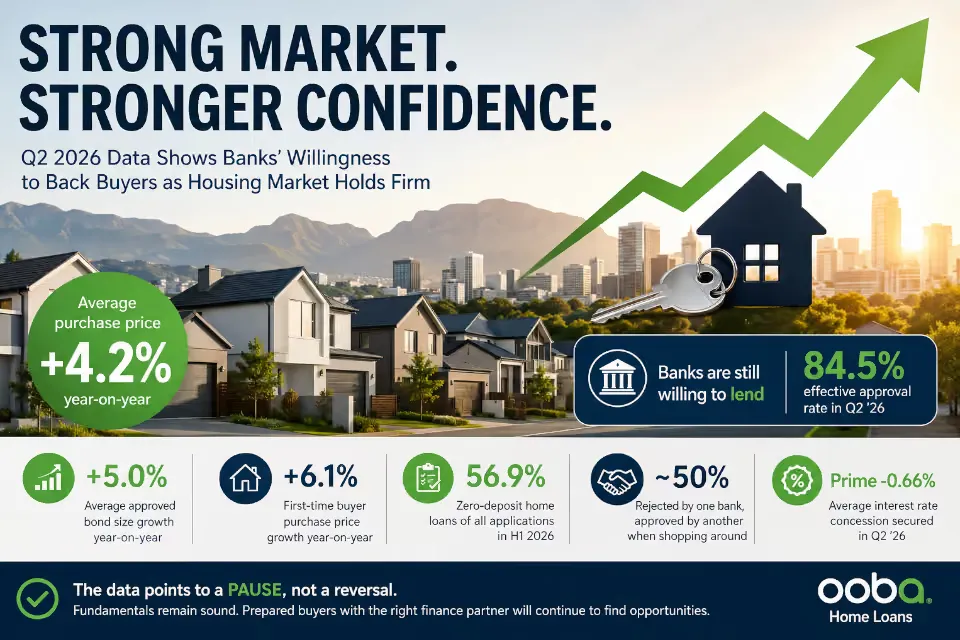
- Average home purchase prices climbed 4.2% despite higher interest rates, proving South Africa's housing market remains resilient.
- Banks continue backing buyers, with almost half of declined applicants securing finance simply by approaching another lender.
- Higher loan-to-value mortgages and zero-deposit home loans are helping buyers overcome rising upfront property costs.
Despite rising interest rates, inflationary pressure and global economic uncertainty, South Africa's residential property market continues to show remarkable resilience.
The latest oobarometer Q2 2026 released by ooba Home Loans reveals that while buyers have become more cautious, property values continue to rise, banks remain eager to finance qualifying borrowers and first-time buyers are still actively entering the market.
The findings come after a challenging quarter that saw higher fuel prices, persistent inflation and the South African Reserve Bank's first interest rate increase in several years. Yet, rather than signalling a market slowdown, the latest data suggests the housing sector is simply adjusting to a more expensive borrowing environment.
"Given the pressure on household budgets, some moderation in activity was to be expected," says Rhys Dyer, CEO of the ooba Group. "However, the data points to a pause rather than a reversal. While application volumes eased slightly, the value of those applications continued to grow, demonstrating that demand for homeownership remains intact."
Application volumes slipped by just 1.5% year-on-year, while the total value of home loan applications increased by 4.7%, highlighting that buyers continue to purchase higher-value properties despite increased affordability pressures.
Homebuyers Continue Paying More for Property
The oobarometer shows property prices remain firmly on an upward trajectory.
The average purchase price increased by 4.2% year-on-year to R1.77 million, while first-time buyers recorded even stronger growth, paying an average of R1.32 million, up 6.1% over the same period.
Approved home loan values also continued to increase.
Across all buyers, the average approved bond size grew by 5%, while first-time buyers received loans that were 7.9% larger than a year ago.
According to Dyer, this demonstrates that banks remain confident in the residential market.
"Approved bond size growth is outpacing property price growth, signalling that banks continue to support qualifying buyers with attractive lending terms as values rise. This is particularly encouraging for first-time buyers, who remain the segment most sensitive to higher borrowing costs."
Regionally, Johannesburg recorded the strongest house price growth at 10.1%, followed by Limpopo at 9.6%, while affordability continued to drive strong first-time buyer activity in the Free State and Mpumalanga.
Higher-LTV Loans Reduce the Deposit Barrier
One of the strongest trends emerging from the latest data is banks' continued willingness to finance a greater proportion of a property's purchase price.
High loan-to-value (LTV) lending has become an increasingly important tool in helping buyers overcome rising upfront costs.
The average deposit paid by first-time buyers declined from 10.4% to 8.9% of the purchase price over the past year, despite buyers purchasing more expensive homes.
Demand for zero-deposit home loans also continues to grow.
More than 56.9% of all home loan applications received during the first half of 2026 required no deposit, while demand for cost-inclusive home loans—which can also finance transfer and registration costs—continued to increase.
"The continued availability of these products demonstrates that buyers with limited upfront capital still have viable financing options, provided they meet banks' affordability and credit requirements," says Dyer.
Banks Continue Competing for Home Loan Business
Perhaps the clearest message from the latest oobarometer is that South Africa's banks remain highly competitive.
ooba Home Loans' effective approval rate improved from 82.8% to 84.5%, even in a tougher lending environment.
More importantly, almost one in every two applicants rejected by one bank successfully secured approval from another lender, highlighting the importance of comparing multiple finance offers rather than accepting a single decline.
"Different banks assess applications differently based on their own risk models and lending appetite," explains Dyer. "A single decline should never be viewed as the final answer. Shopping around can significantly improve both approval chances and the lending terms offered."
Competition between lenders also continues to benefit borrowers, with the average successful applicant securing an interest rate of approximately Prime less 0.66%, reflecting ongoing competition for quality home loan business.
Market Fundamentals Remain Sound
While geopolitical uncertainty and inflationary pressures are expected to keep interest rates elevated in the short term, ooba believes the underlying fundamentals of South Africa's housing market remain healthy.
Banks continue to lend aggressively, homebuyers are purchasing higher-value properties, first-time buyers remain active, and innovative financing solutions are helping reduce the barriers to property ownership.
As Dyer concludes:
"While uncertainty remains, the fundamentals of the housing market remain sound. Buyers who are financially prepared and secure the right financing solution will continue to find opportunities, even in a more challenging economic environment."
For investors, estate agents and prospective homebuyers alike, the latest oobarometer sends a reassuring message: despite economic headwinds, South Africa's residential property market remains resilient—and the banks are still very much open for business.