








Liquidations fall 23%, but property sector pressure persists
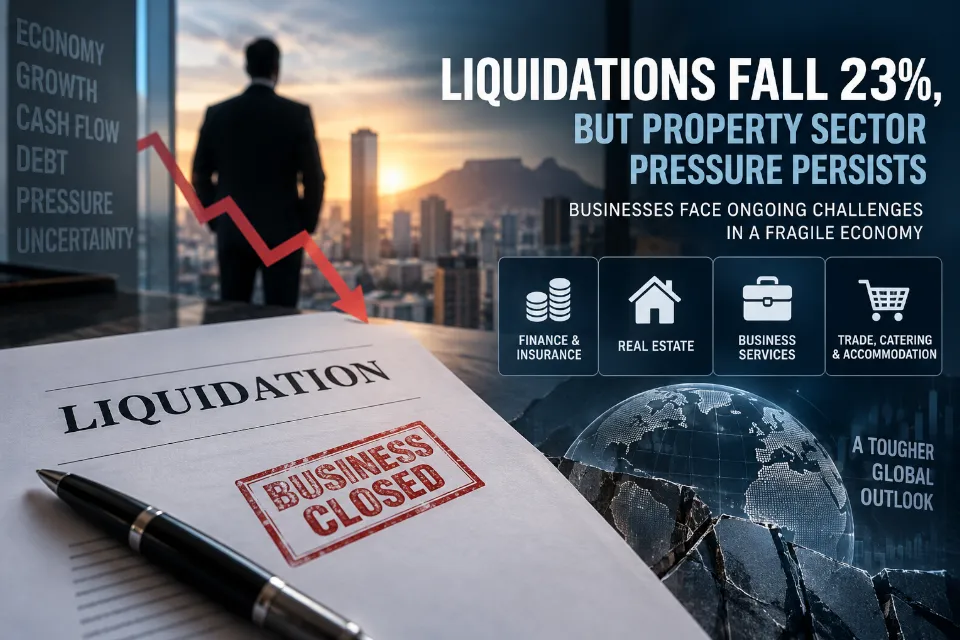
- Business liquidations fell 23.2% year-on-year in July, with 239 companies and close corporations liquidated during the month.
- Finance, insurance, real estate and business services remained significant contributors, signalling continued pressure across property-linked businesses.
- Global business failures are heading higher, with Coface forecasting insolvencies to increase by 6% worldwide during 2026.
South African business failures declined sharply in July, but finance, insurance, real estate and business services remain prominent in the liquidation data.
Liquidations are falling, but the pressure isn't over
South Africa recorded a substantial decline in business liquidations in July 2026, providing a positive signal for an economy in which companies have been navigating weak growth, rising operating costs, constrained cash flow and subdued consumer demand.
The latest Statistics South Africa figures show that 239 companies and close corporations were liquidated in July 2026, down 23.2% from 311 in July 2025.
The improvement extends beyond a single month. Liquidations declined 13.9% during the three months ended July 2026 compared with the corresponding period a year earlier, while the year-to-date total was 4.9% lower. But behind those improving headline numbers lies a more complicated picture.
Businesses remain exposed to slow-paying customers, weak demand, operating-cost pressures and broader economic uncertainty. And importantly for the property industry, finance, insurance, real estate and business services continued to account for a significant proportion of July's liquidations.
Aroni Chaudhuri, Chief Economist for Africa at Coface, cautions against interpreting the falling numbers as evidence that business risk has disappeared.
“The decline in liquidations is positive, but it does not mean the operating environment is less risky. Many businesses remain under pressure, particularly where cash flow is constrained by slow-paying customers, rising operating costs and weak demand.”
1. Liquidations drop 23.2% in July
The headline improvement is significant.
July 2026
- Total liquidations: 239
- July 2025: 311
- Year-on-year change: -23.2%
- Three months to July: -13.9%
- Year to date: -4.9%
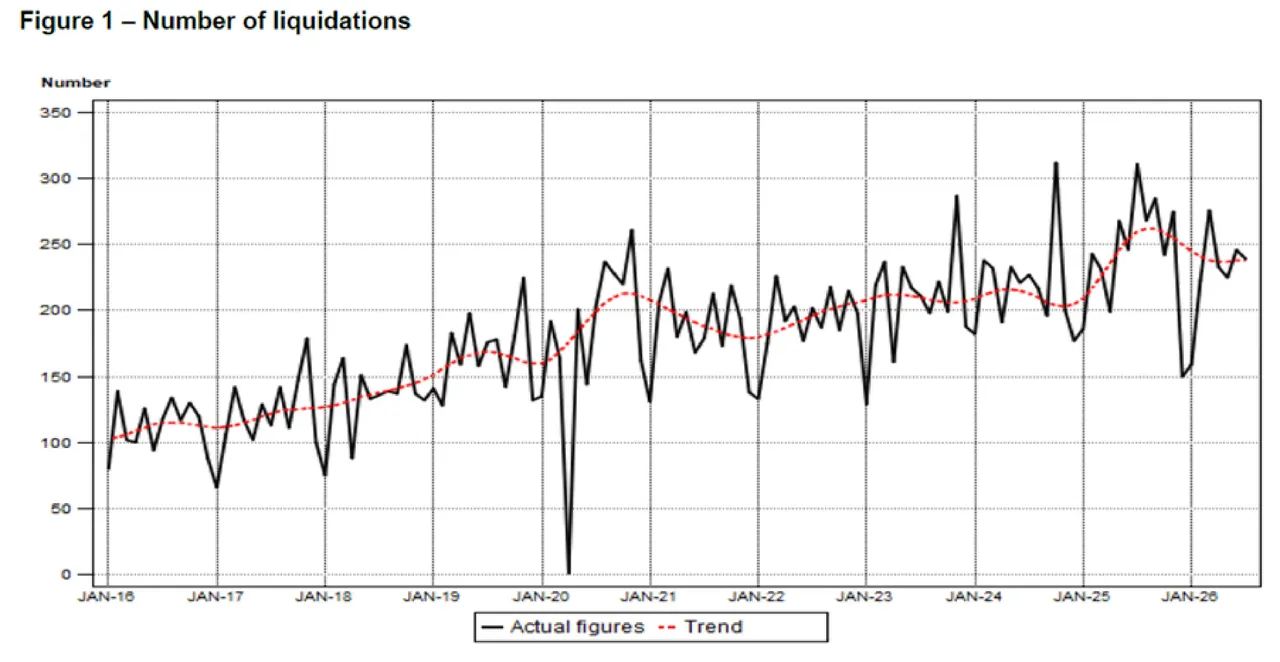
Liquidation statistics track companies and close corporations that are wound up because they can no longer continue operating or meet their obligations, although the figures can include both voluntary and compulsory liquidations.
The downward movement therefore provides an important barometer of business conditions. It does not, however, mean companies are suddenly operating in an easy environment.
Weak economic growth, infrastructure challenges, higher costs and low consumer confidence continue to affect businesses, while cash-flow pressure can become particularly acute when customers don't pay on time.
2. Property-linked businesses remain under pressure
One of the most relevant findings for property investors and professionals is the sectoral composition of the liquidations.
The finance, insurance, real estate and business services sector continued to represent a significant share of July's liquidations, followed by the trade, catering and accommodation sector. For the broader property economy, this warrants attention.
The property sector doesn't operate independently of the businesses occupying, financing, developing, managing and servicing real estate.
Financial distress among companies can ultimately flow through to commercial tenants, landlords, developers, contractors and property service providers, particularly when businesses begin cutting costs, reducing space or struggling to meet financial commitments.
For investors, the figures reinforce the importance of looking beyond the physical property when assessing risk. The financial strength of tenants, customers and counterparties can be just as important as location, valuation and yield.
3. Personal and partnership insolvencies remain elevated
Business liquidations provide only part of the picture. Statistics South Africa's insolvency statistics indicate that financial distress also remains present among individuals and partnerships.
A total of 143 insolvencies were recorded in July 2026. While insolvencies were down 11.8% year to date, the data indicates that unpaid debt remains a significant issue within the economy. Chaudhuri says the reinstatement of insolvency statistics allows the two datasets to provide a broader perspective on financial conditions.
“Since the statistical revision of liquidation data in April 2026 and the reintroduction of insolvency statistics in June 2026, these two variables can be analysed together as indicators of broader economic conditions.”
He also cautions that changes in financing conditions can take time to filter through to businesses and consumers. “With interest rates increasing, we can also expect insolvencies to increase in the coming quarters,” says Chaudhuri.
4. Global insolvencies are moving in the opposite direction
While South Africa's latest numbers have improved, the international picture is becoming more difficult. Coface research indicates that global business insolvencies increased 12% in early 2026, including a particularly sharp 22% rise in North America.
Coface subsequently revised its forecast and now expects global insolvencies to increase 6% in 2026. Several pressures are contributing to the deterioration:
- Geopolitical tensions
- Elevated financing costs
- Persistent inflationary pressures
- Weaker economic activity
Construction, chemicals and textiles are among the sectors Coface identifies as particularly vulnerable globally, while highly leveraged businesses and small and medium-sized enterprises remain exposed to elevated borrowing costs. South African companies are not insulated from these pressures.
“South African businesses are operating in the same global environment,” says Chaudhuri. “While local liquidation and insolvency trends have improved in recent months, companies will feel the impact of deteriorating economic conditions in the coming months, as the impact of price pressures and interest rate hikes generally materialize with a lag.”
5. Cash flow and unpaid debt remain critical risks
One of the most important underlying themes is cash flow.
A business can be profitable on paper but still encounter serious financial difficulty if customers don't pay on time and cash isn't available to meet salaries, rent, debt repayments, suppliers and other operating expenses.
For property businesses, the chain can become particularly important. A struggling company may become a struggling tenant. A tenant falling behind on rent can affect a landlord's cash flow. A landlord or developer under pressure can, in turn, struggle to meet financing or supplier obligations.
Coface argues that proactive credit-risk management can help businesses identify potential problems earlier, make better-informed decisions about whom they trade with and protect revenue.
For property investors, the same principle applies to tenant selection and ongoing tenant-risk management. Understanding the financial strength of the businesses ultimately responsible for paying the rent can become increasingly important when economic conditions deteriorate.
The numbers are better, but investors shouldn't ignore the warning
A 23.2% annual decline in July liquidations is encouraging, particularly alongside lower three-month and year-to-date figures. But it would be premature to conclude that financial stress has passed.
South African companies continue to face a difficult operating environment, property-linked businesses remain represented in the liquidation statistics, and the global insolvency cycle is deteriorating.
For investors and business owners, the message is therefore less about reacting to one month's numbers and more about managing risk before financial pressure becomes distress.
That means monitoring cash flow, scrutinising counterparties, managing unpaid debt and, for property investors in particular, understanding the financial resilience of tenants.
Fewer businesses may be failing today, but in a fragile economy, the quality of the income behind an investment matters more than ever.