





SARB hikes rates: What it means for property
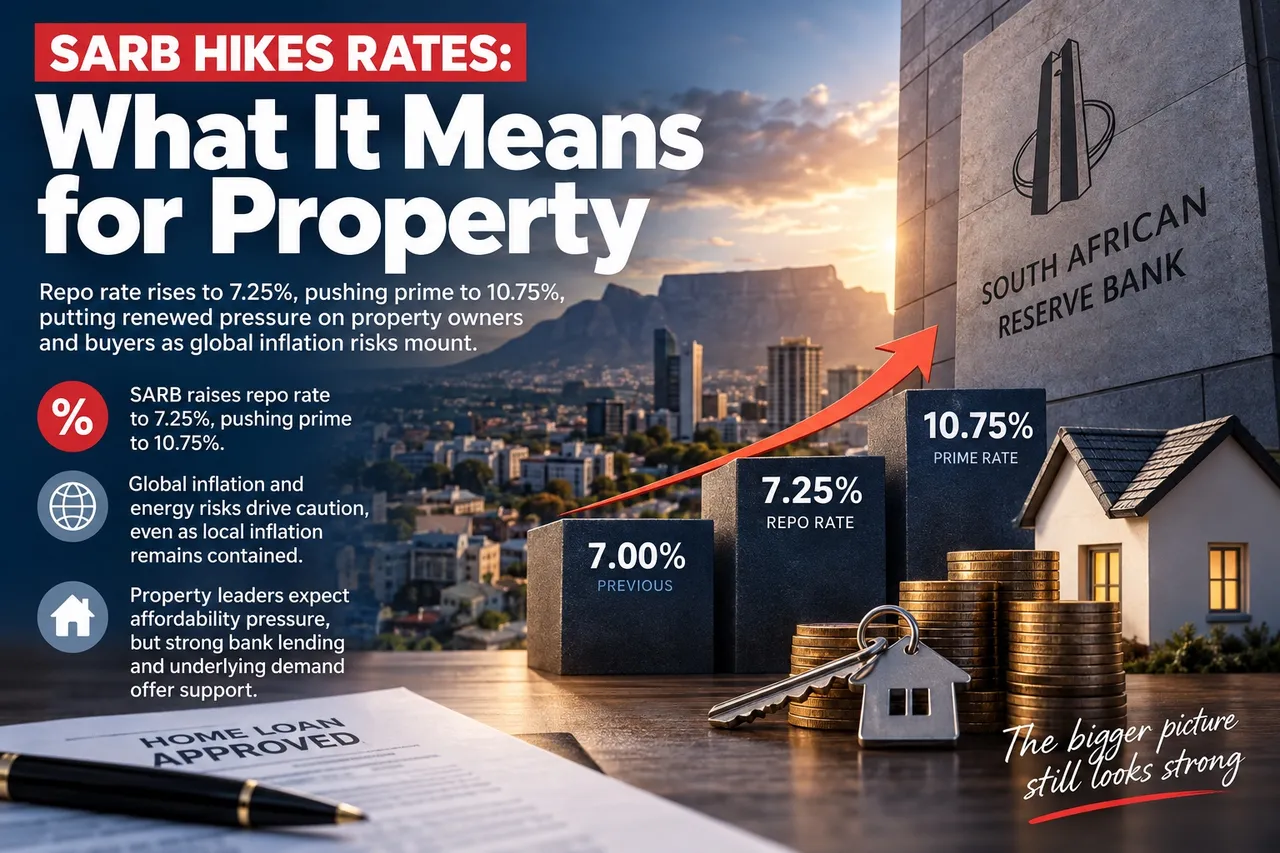
The repo rate rises 25 basis points to 7.25%, putting renewed pressure on property owners and buyers as global inflation risks collide with weak domestic growth.
- SARB has raised the repo rate to 7.25%, pushing prime to 10.75% and increasing monthly repayments for variable-rate borrowers.
- Global inflation and energy risks are driving caution, even as South Africa’s August inflation remained relatively contained at 4.4%.
- Property leaders expect affordability pressure, but competitive bank lending and underlying housing demand continue to provide support.
Another 25 basis points and property feels it immediately
South African homeowners, property investors and prospective buyers face higher borrowing costs after the South African Reserve Bank raised the repo rate by 25 basis points from 7.00% to 7.25%, taking the prime lending rate from 10.50% to 10.75%.
For property, the transmission is immediate. Variable-rate home loans become more expensive, investor financing costs rise and prospective buyers have to reassess affordability.
The increase follows the 25-basis-point hike in May, when the repo rate moved from 6.75% to 7.00%, meaning borrowers have now absorbed 50 basis points of tightening during 2026. Yet the domestic inflation picture alone does not tell the full story.
Statistics South Africa reported on Wednesday that annual consumer inflation edged up from 4.3% in July to 4.4% in August, while the CPI was unchanged month-on-month. Housing and utilities, transport, and insurance and financial services were among the largest contributors to annual inflation. (Statistics South Africa)
The bigger concern is what is happening beyond South Africa’s borders. Global inflation risks have intensified as geopolitical tensions have pushed energy prices higher. At the same time, major central banks are again tightening monetary policy.
The US Federal Reserve raised its target range by 25 basis points to 3.75%–4.00% on 16 September, while the European Central Bank raised its three key policy rates by 25 basis points earlier this month, explicitly citing inflationary pressure associated with the Middle East conflict. (Federal Reserve)
Against this backdrop, the SARB is confronting a difficult equation: protect price stability without placing unnecessary additional pressure on an already subdued domestic economy.
For South Africa’s property market, the question now is what another increase means for buyers, homeowners and investors.
Rhys Dyer: Global risks are driving the caution
Rhys Dyer, CEO of the ooba Group, says the hike needs to be viewed against the uncertain global environment rather than domestic inflation in isolation.
“While any increase in borrowing costs is disappointing for consumers and the property market at large, it is important to view today’s decision in context. Barring the 25-basis-point interest rate hike in May this year, the previous increase was in May 2023, reflecting what has otherwise been a relatively stable and supportive bank lending environment.”
Dyer says domestic inflation remains relatively contained, but external risks, particularly energy prices and international monetary tightening, have complicated the outlook.
The encouraging factor for property buyers, he says, is that South African banks continue to compete aggressively for quality home-loan business.
In August, ooba recorded a near-record average interest rate of 0.75% below prime, compared with an average of 0.64% below prime between January and July 2026.
“Banks continue to show a healthy appetite for home loan business, translating into higher approval rates, competitive lending rates and lower deposit requirements.”
For qualifying buyers, therefore, the headline prime rate does not necessarily represent the rate they will ultimately pay.
Dr Andrew Golding: Residential property remains resilient
Dr Andrew Golding, chief executive of the Pam Golding Property group, says the rate increase reflects the more challenging inflationary environment, but should be viewed alongside the resilience already evident in the residential market.
“While the 25-basis-point increase will add to borrowing costs for households, it needs to be viewed against the broader resilience of the residential property market. The increase is likely to reinforce the need for buyers to be more discerning about affordability and financing costs, but it does not alter the underlying demand for well-located residential property.”
Golding says first-time buyers will remain particularly sensitive to higher monthly repayments, but competitive lending is helping reduce some of the barriers to homeownership.
He points to the increasing availability of zero-deposit and cost-inclusive home loans for qualifying borrowers, which can help address one of the biggest obstacles confronting first-time buyers: the upfront cash required to purchase.
Location is also becoming increasingly important. In a higher-rate environment, Golding says buyers need to consider not only purchase price and monthly repayments, but infrastructure investment, economic activity, location fundamentals and longer-term demand.
There are also indications that properties are moving through the market more quickly. Golding cites FNB’s latest Property Barometer, which puts average time on market at 10 weeks and one day in Q3 2026.
Stephan Potgieter: Households feel it, but rates remain below 2023
Stephan Potgieter, CEO of BetterHome Group Mortgage Origination and BetterBond, says homeowners will experience renewed pressure on their monthly bond repayments, although today’s interest-rate environment remains below the peak reached three years ago.
“Although this isn’t the outcome households were hoping for, the increase should be viewed as a precautionary measure to absorb any potential oil price shocks amid ongoing hostilities in the Middle East.”
Potgieter points out that while prime has risen to 10.75%, it remains below the 11.75% level reached in 2023.
That difference remains meaningful for leveraged homeowners. According to Potgieter, a homeowner with a R2 million bond is still paying approximately R1,360 less per month than at the 2023 peak.
He says the combination of a relatively resilient rand and contained domestic inflation provides some reassurance, although future rate movements will remain dependent on inflation and external developments.
Samuel Seeff: Higher rates will squeeze consumers further
Samuel Seeff, chairman of the Seeff Property Group, takes a more critical view, arguing that another increase will place additional pressure on households and an economy already struggling to generate meaningful growth.
“The higher interest rate will do little to mitigate external cost shocks but will inflict real financial pain on households and businesses. Household budgets are already stretched following the May rate hike and other cost increases.”
Seeff argues that higher borrowing costs could weaken consumer confidence, constrain first-time buyer affordability and temper property-market activity.
However, he also acknowledges that the property market has remained resilient and that lending conditions continue to provide opportunities for financially well-positioned buyers.
The immediate impact is nevertheless clear: borrowers linked to prime will pay more from their next adjusted repayment.
What does 25 basis points cost on a home loan?
Based on a 20-year home loan at prime, the increase from 10.50% to 10.75% translates approximately into:
| Bond | @ 10.50% | @ 10.75% | Monthly increase |
|---|---|---|---|
| R750,000 | R7,488 | R7,614 | R126 |
| R1 million | R9,984 | R10,152 | R168 |
| R1.5 million | R14,976 | R15,228 | R252 |
| R2 million | R19,968 | R20,305 | R337 |
| R2.5 million | R24,960 | R25,381 | R421 |
| R3 million | R29,951 | R30,457 | R506 |
| R5 million | R49,919 | R50,761 | R842 |
For an investor carrying several financed properties, the cumulative impact can become significant. A portfolio with R5 million in variable-rate debt, for example, faces roughly another R842 per month, or just over R10,000 a year, assuming a 20-year repayment profile at prime.
That makes interest-rate sensitivity an increasingly important part of assessing cash flow and yield.
What should property buyers and investors watch now?
The rate hike does not change the fundamentals of a good property investment, but it does change the numbers.
Buyers need to stress-test affordability beyond today’s repayment, investors need to reassess cash-flow buffers, and borrowers should compare lenders rather than assume that prime is the best rate available to them.
For investors specifically, the important calculation is not simply whether the property produces an attractive gross yield. It is whether net cash flow remains sustainable after finance costs, levies, rates, maintenance, vacancies and other operating expenses.
Today’s decision also illustrates how quickly the interest-rate outlook can change.
Domestic inflation at 4.4% remains relatively contained, but South Africa is a small, open economy exposed to global energy prices, international interest rates, capital flows and currency movements.
The US Federal Reserve and European Central Bank have both tightened policy this month, demonstrating that renewed inflation concerns extend well beyond South Africa. (Federal Reserve)
Property enters the final quarter under pressure, but not paralysis
Another rate increase is not the outcome homeowners or property investors wanted.
It raises repayments, reduces affordability and tightens the numbers on leveraged investments at a time when household budgets are already under pressure. But the industry response also points to an important distinction between pressure and paralysis.
Banks are still lending. Qualifying buyers are securing rates below prime. First-time buyers remain active. Properties in stronger markets are selling. And demand continues to favour locations supported by employment, infrastructure, lifestyle and population growth.
The lesson for property buyers and investors heading into the final quarter of 2026 is therefore less about retreating from the market and more about getting the numbers right.
At 10.75% prime, finance has become more expensive again. That makes the quality of the deal, the interest rate negotiated, the cash-flow buffer and the underlying fundamentals of the property more important than ever.