





Reverse semigration? The data tells a different story
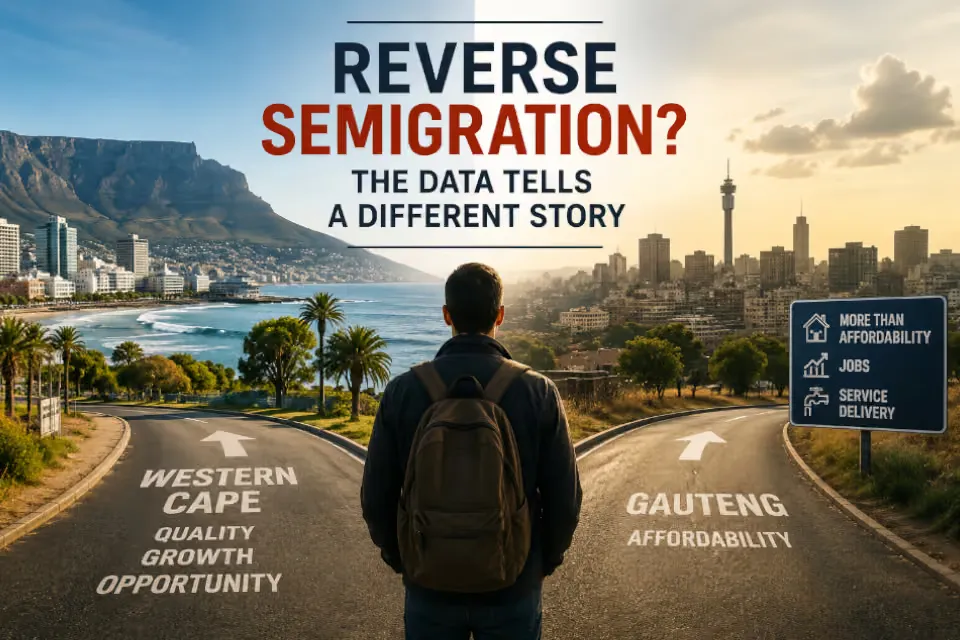
- Claims of a mass return to Gauteng are premature despite widening housing affordability gaps.
- The Western Cape still leads on jobs, service delivery, lifestyle and property performance.
- Gauteng needs stronger economic growth and reliable infrastructure, not just cheaper homes, to attract skilled professionals.
Is the great reverse semigration already underway?
For months, the narrative has gathered momentum. As Cape Town's property prices and rentals continue to climb, commentators have suggested that many homeowners and professionals are packing up and heading back to Gauteng in search of affordability.
It is an appealing headline. But according to independent economist John Loos, the evidence simply doesn't support the claim, at least not yet.
"There may be early signs that the pace of migration into the Western Cape is slowing as affordability comes under pressure, but calling it a 'reverse semigration' trend is probably premature," says Loos.
While Gauteng's comparatively affordable housing is becoming increasingly attractive, affordability alone is unlikely to reverse more than two decades of migration patterns.
The Western Cape still sets the benchmark
Although rising house prices have made buying a home in Cape Town increasingly difficult, the province continues to outperform the rest of South Africa on many of the issues that matter most to skilled professionals and investors.
Businesses continue relocating to the Western Cape because of:
- More reliable municipal service delivery
- Better infrastructure management
- Greater water security
- Improved electricity reliability
- Stronger governance
- Better maintained public spaces
- Faster-growing employment opportunities
For many households and companies, quality of life remains as important as affordability. As Loos notes, migration decisions are driven by far more than house prices alone.
What exactly is "Semigration"?
Loos believes the term itself has often been misunderstood. Traditionally, semigration has referred not to all people moving between provinces, but rather to higher-income, highly skilled individuals and families who relocate in pursuit of better economic opportunities, lifestyle, governance and quality of life.
These "semi-grants", as Loos describes them, typically include:
- Professionals
- Executives
- Entrepreneurs
- Investors
- Skilled workers
- Repeat homebuyers relocating between provinces
Importantly, Gauteng has continued to record strong overall population growth through migration from other provinces. The debate centres specifically on whether affluent and highly skilled households are now beginning to move back in significant numbers.
Loos argues there is little evidence that this has happened.
The debate isn't only about Gauteng and the Western Cape
One of Loos' most important observations is that South Africa's migration story has become overly simplified. Semigration is often portrayed as a two-way journey between Johannesburg and Cape Town.
The reality is considerably more complex. Increasing numbers of South Africans are exploring alternative coastal and lifestyle destinations, including:
- The Garden Route
- KwaZulu-Natal
- The Eastern Cape
- The South Coast
- Secondary coastal towns
As affordability pressures intensify in the Western Cape, these emerging markets could increasingly attract professionals seeking lifestyle without paying Cape Town premiums.
What the Wise Move data actually shows
Recent relocation statistics from Wise Move have fuelled much of the reverse semigration discussion. The data does show stronger growth in relocations from the Western Cape back to Gauteng than in previous years.
However, that does not mean Gauteng is experiencing a net inflow.
In fact, the opposite remains true. According to Wise Move's 2025 relocation data:
- 21.96% of relocations were from Gauteng to the Western Cape.
- Only 10.66% moved from the Western Cape to Gauteng.
- Gauteng therefore still recorded a net migration loss of 11.3 percentage points to the Western Cape.
The data also shows Gauteng recorded net outflows to KwaZulu-Natal and the Eastern Cape.
"The figures suggest Gauteng's net outflow may be slowing, but we are still some distance from what could genuinely be described as a reverse semigration trend," says Loos.
Affordability is changing the conversation
There is no denying that Cape Town has become dramatically more expensive.
Since 2010:
- Western Cape house prices have increased 188%.
- Gauteng house prices have risen 81.6%.
- Western Cape residential rentals have climbed 135.1%, compared with Gauteng's 64.1%.
That affordability gap is beginning to influence buying decisions and may reduce the pace of inward migration into the Western Cape. But affordability alone is unlikely to overturn years of migration trends.
Why Gauteng still has work to do
Loos argues Gauteng's biggest challenge is not housing affordability, it is competitiveness. If the province wants to attract affluent households and highly skilled professionals back in meaningful numbers, it must rebuild confidence through:
- Stronger economic growth
- Higher employment creation
- Reliable electricity supply
- Better municipal governance
- Improved infrastructure
- Efficient public services
- Safer communities
Employment statistics reinforce this challenge. Since 2015, employment in the Western Cape has increased by 27.5%, while Gauteng has recorded growth of just 4.2%.
That performance gap continues to influence where professionals choose to build careers and invest.
The bigger picture
Cheap housing has never been enough to attract long-term investment or skilled migration.
Many inland towns across South Africa offer affordable property, yet continue to lose residents because they cannot provide the jobs, infrastructure, governance and quality of life that households seek.
The same principle applies to Gauteng. Lower house prices may attract interest, but without stronger economic growth, dependable municipal services and improved quality of life, affordability alone is unlikely to reverse long-standing migration trends.
‘Reverse semigration’
The narrative of a mass "reverse semigration" from the Western Cape to Gauteng may make for compelling headlines, but the evidence tells a more nuanced story.
Yes, Cape Town's affordability challenges are beginning to moderate the pace of inward migration. Yes, Gauteng's lower property prices are becoming increasingly attractive.
However, the Western Cape continues to outperform on employment growth, governance, infrastructure, service delivery and overall quality of life, factors that remain central to the decisions of skilled professionals, entrepreneurs and investors.
As John Loos concludes, Gauteng's path to becoming South Africa's preferred destination once again will require far more than affordable housing. It will require rebuilding confidence through stronger economic performance, reliable municipal services and a significantly improved quality of life.
Until then, reports of a large-scale reverse semigration remain, in Loos' words, "probably premature."