








Rate hike risk returns as property buyers face new squeeze
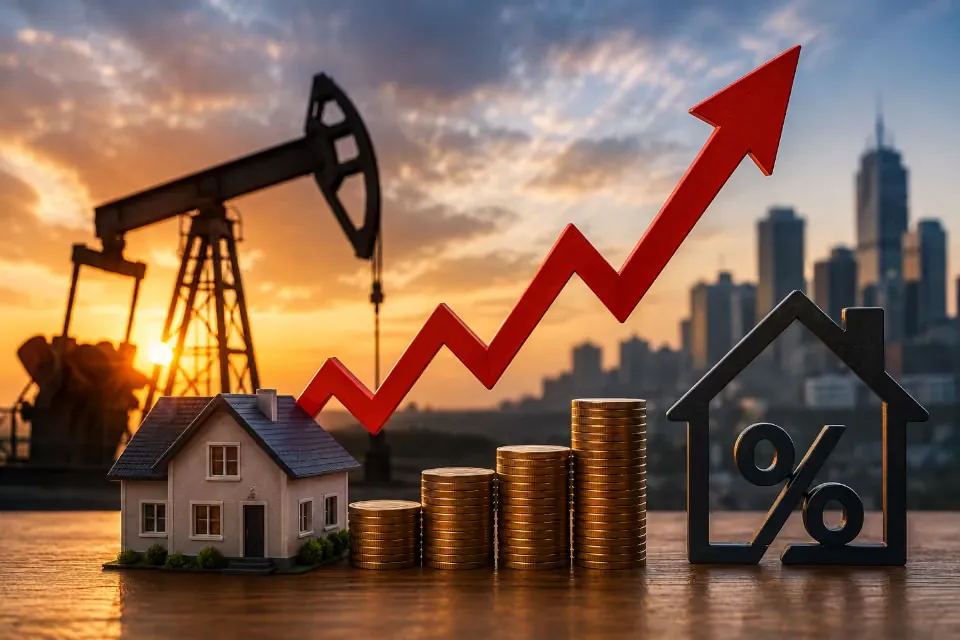
- John Loos economist expects another 25bp rate hike before year-end as elevated oil prices add renewed pressure to inflation.
- Home buying could be postponed as higher fuel, living and borrowing costs squeeze already-stretched household disposable income.
- SA economic growth could finish 2026 nearer 1%, while household consumption growth is forecast to slow sharply.
Oil, rates and new risks for property
Just as South African property buyers and investors were looking for greater economic stability and improved affordability, a renewed oil-price shock is threatening to put household finances and the property market, under fresh pressure.
In his latest Household Sector Economy report released on 3 September, independent economist John Loos warns that elevated global oil prices are feeding through South Africa’s economy at precisely the wrong time.
The renewed pressure comes as the unresolved US-Iran conflict and restrictions affecting shipping through the Strait of Hormuz continue to pose risks to global oil supply. Brent crude, which had fallen from around $118 a barrel in late April to approximately $71 at the beginning of July, had climbed back to around $95 a barrel at the time Loos compiled his report.
South African motorists are already feeling the consequences, with petrol prices rising by R1.34 a litre and diesel by around R3 a litre this week. But Loos’s central warning is that the consequences extend far beyond the petrol pump.
Higher energy prices can weaken global economic growth, push South African inflation higher and ultimately keep interest rates elevated, creating a three-pronged squeeze on household disposable income. And for property, that matters.
The property market faces a renewed affordability test
The residential market is particularly exposed because buying property is one of the largest credit-dependent financial decisions most households make.
Loos says that when interest rates rise, households tend to postpone purchases that depend heavily on credit, including vehicles, furniture, appliances and homes.
Some aspiring homeowners may instead continue renting or remain in family homes for longer rather than entering the property market. That affordability equation could come under renewed pressure before the end of 2026.
Average CPI inflation for the first seven months of the year stood at 3.9%, while July inflation reached 4.3% already noticeably above the 3.2% average recorded for 2025. Higher fuel prices now create renewed upward pressure on inflation because petrol and diesel costs feed through supply chains and ultimately into the prices consumers pay for other goods and services.
With the South African Reserve Bank targeting inflation at 3%, Loos expects monetary policy to remain a significant risk.
Following the 25-basis-point repo-rate increase in May, he expects one further 25-basis-point hike before the end of 2026. For property buyers with mortgages, investors carrying debt and prospective buyers trying to qualify for finance, that would mean affordability remains under pressure for longer.
Higher borrowing costs do not operate in isolation either. Households are simultaneously absorbing increased transport, food and other living expenses, leaving less disposable income available to service debt or save towards property deposits.
From home buying to home maintenance
The pressure could also affect existing property owners. Loos says financially constrained households typically cut non-essential spending first before postponing larger purchases and expenditure that can be delayed. That can include maintenance on homes and vehicles.
There are already signs of weakness in property-related household expenditure. Real retail sales for the hardware, paint and glass category, closely associated with home maintenance and improvement, fell 4% year-on-year in June 2026. This has implications beyond household budgets.
Extended periods of deferred maintenance can ultimately affect property condition and value, while weaker renovation and improvement expenditure can filter through to retailers, contractors and other businesses dependent on residential property activity.
The economy is also losing momentum
The wider economic backdrop adds another layer of risk. President Cyril Ramaphosa has identified 3% economic growth as a near-term priority, but Loos believes achieving that level remains some years away and that the external environment is currently working against stronger growth.
While first-quarter GDP growth reached 1.9% year-on-year, more recent high-frequency indicators point towards a softer economy. Manufacturing production declined 1.7% year-on-year during the first half of 2026, while mining production contracted by 5.1% in May and 4% in June. Real retail-sales growth also slowed from 3.7% in 2025 to 2.2% during the first half of 2026.
Business and consumer confidence have weakened too. The RMB-BER Business Confidence Index declined from 47 in the first quarter to 38 in the third quarter, while the FNB/BER Consumer Confidence Index fell from -7 in the first quarter to -19 in the second quarter.
Loos consequently expects economic growth for 2026 to come in nearer 1%, substantially below the 3% growth level government is targeting.
Consumers are starting to pull back
The risk for property is ultimately tied to what happens to household finances. Loos forecasts real household consumption expenditure growth slowing from a relatively strong 3.6% in 2025 to just 1.6% in 2026.
As disposable income comes under greater pressure, households are likely to respond by cutting non-essential expenditure, postponing larger purchases and becoming increasingly cautious about taking on additional debt. Property purchases fall squarely into that equation.
While some buyers will continue to transact, affordability-sensitive households can delay buying, remain in the rental market for longer or wait for greater certainty around interest rates and living costs. For property investors, that creates a more complicated environment.
Softer homebuying activity could support rental demand as prospective purchasers remain tenants for longer. At the same time, however, landlords are exposed to the same higher financing, maintenance and operating costs, while tenants themselves face increasing pressure on disposable income.
The result is a market in which tenant affordability, rental collections, financing structures and acquisition pricing become even more important to investment performance.
The bottom line for property investors
Loos does not suggest that South Africa is facing a severe consumer downturn yet. His warning is about the direction of travel.
Unless the geopolitical situation improves sufficiently to relieve pressure on global oil supply, South Africa could enter the final months of 2026 with elevated inflation, another possible interest-rate increase, slower economic and employment growth and increasingly constrained household spending.
That combination would put renewed pressure on homebuyer affordability and credit-dependent property demand just as the market heads towards year-end. For investors, the message is equally important.
The next phase of the property cycle may be less about simply waiting for lower interest rates and more about understanding whether households can absorb higher fuel costs, higher living costs and potentially higher borrowing costs at the same time.
And that means affordability for both buyers and tenants, is once again becoming one of the most important risks to watch in South African property.