








Community Schemes face a new era of accountability
From volunteer trustees to professional community asset managers, South Africa’s community schemes must embrace stronger leadership, transparency and accountability to protect property values and build better communities.
- Community scheme governance is evolving from volunteer administration towards professional leadership, strategic decision-making and greater accountability.
- NAMA is strengthening professional standards through revised disciplinary provisions, complaints procedures and closer regulatory cooperation.
- Better governance protects property values by improving financial management, maintenance planning, dispute resolution and long-term community sustainability.
From managing buildings to governing communities
South Africa’s community scheme industry must move beyond collecting levies, administering meetings and processing paperwork towards professional governance that delivers measurable improvements in property values, accountability and residents' quality of life.
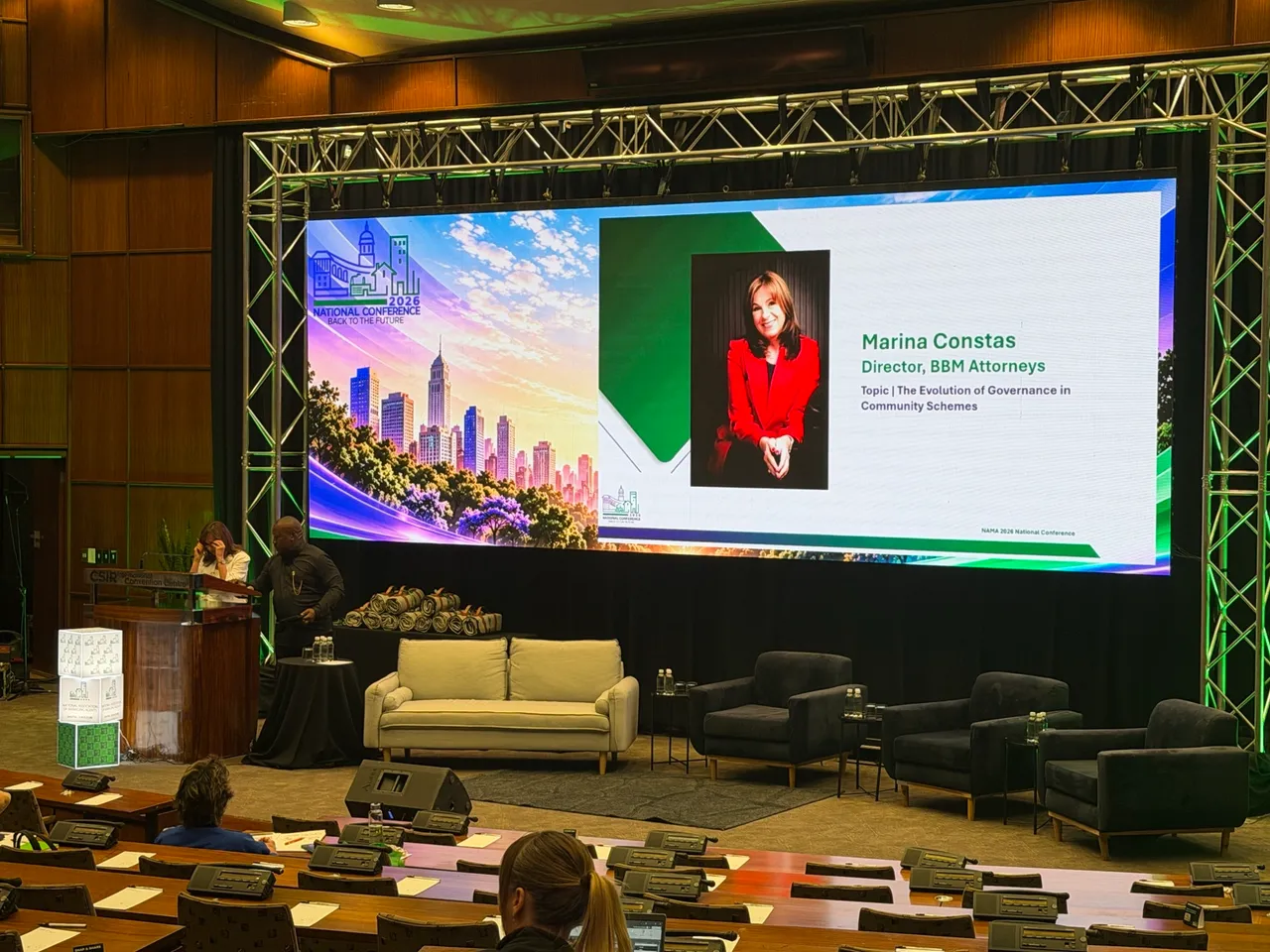
This was the central message from Marina Constas, Director at BBM Attorneys, sectional title and community schemes specialist, accredited mediator, arbitrator, author and speaker, during her presentation, “From Governance to Impact: The Evolution of Community Scheme Management,” at the 2026 National Association of Managing Agents (NAMA) Conference in Pretoria.

Constas challenged trustees, managing agents and industry professionals to rethink their responsibilities as community schemes become increasingly complex organisations managing substantial assets, infrastructure, budgets and competing stakeholder interests.
The central question, she argued, is no longer simply whether a scheme is being administered correctly, but whether its leadership is delivering meaningful outcomes.
How community scheme governance has evolved
Constas traced the development of sectional title governance through three legislative generations, beginning with the Sectional Titles Act of 1971, followed by the 1986 legislation and the introduction of the Sectional Titles Schemes Management Act, which came into operation in October 2016.
The establishment of the Community Schemes Ombud Service (CSOS) also introduced a broader framework for dispute resolution and accountability across different community scheme structures.
While early sectional title schemes relied heavily on informal administration and volunteer participation, modern schemes operate in a considerably more demanding environment.
Today’s governance responsibilities extend across:
- Financial planning, levy collection and reserve management.
- Long-term maintenance and ageing infrastructure.
- Regulatory compliance and transparent decision-making.
- Managing disputes and competing owner interests.
- Protecting shared assets and residents' quality of life.
Constas explained that the modern owner increasingly expects fairness, transparency, accountability, access to information and consistent treatment.
These expectations apply not only to sectional title bodies corporate but also to homeowners associations, share block schemes and retirement communities.
Trustees: From volunteers to accountable leaders
One of the most significant changes has been the evolution of the trustee’s role. Historically, trustees were often owners who volunteered their time to assist with practical administration, relying on neighbourliness, common sense and a willingness to serve.
Today, trustees are expected to make increasingly complex decisions involving financial commitments, infrastructure, legal obligations and competing interests. However, Constas warned that greater responsibility can also create hesitation.
Fear of making the wrong decision can result in delayed maintenance, unresolved disputes and governance paralysis. The challenge is to equip trustees with the knowledge, confidence and professional support required to make informed decisions.
This also reinforces the importance of leadership continuity, knowledge transfer and succession planning so that governance does not depend entirely on a small group of experienced volunteers.
Managing agents become community asset managers
Constas argued that the transformation of managing agents is among the industry’s most important developments. Traditionally, managing agents focused on collecting levies, paying creditors, preparing financial reports, convening meetings and maintaining records. Those responsibilities remain essential, but they are no longer sufficient.
Modern managing agents must increasingly operate as community asset managers, supporting trustees with strategic advice, regulatory knowledge, financial oversight, communication and conflict management.
Their responsibilities extend beyond administrative efficiency to influencing the long-term health of the communities they serve. For property owners and investors, this distinction matters.
A well-managed scheme is better positioned to address maintenance risks, preserve common property, manage financial pressures and maintain confidence among owners and prospective buyers.
NAMA strengthens professional accountability
A significant development highlighted during Constas’s presentation was the evolution of NAMA’s own governance framework.
According to Constas, amendments to NAMA’s memorandum of incorporation and professional code of conduct are intended to strengthen accountability and improve standards among its members. She outlined several provisions, including:
- Complaints register: Provision for a public-facing register involving subscribed managing agents.
- Professional conduct: A formal code of conduct supported by disciplinary procedures.
- Disciplinary measures: Written warnings, directives, fines of up to R5,000, membership conditions, suspension or termination.
- Regulatory cooperation: Referral of appropriate matters to the Property Practitioners Regulatory Authority (PPRA).
These measures represent a move towards stronger professional self-regulation. However, Constas emphasised that their effectiveness will depend on consistent, fair and transparent implementation.
She also identified an important limitation: NAMA’s membership-based disciplinary powers do not extend to managing agents who are not members. That raises broader questions about industry-wide professional standards and cooperation with statutory regulators.
Four principles for better community governance
Drawing on ideas from Discovery founder Adrian Gore’s book The Four Principles, Constas presented a framework for improving governance outcomes.
1. Disciplined optimism
Recognise the industry’s challenges without becoming overwhelmed by them. Ageing infrastructure, financial pressures and disputes should become opportunities to improve systems and accountability.
2. Focused urgency
Act before manageable problems become expensive crises. Deferred maintenance, unresolved financial issues and leadership indecision can have serious consequences for a scheme.
3. Declared goals
Establish a clear long-term direction. Beyond annual budgets and maintenance schedules, schemes should define what they want to achieve in asset preservation, community standards and financial sustainability.
4. The Pareto tail
Concentrate resources on the issues that create the greatest impact. A small number of recurring disputes or operational problems can consume a disproportionate amount of management time and money.
Together, these principles encourage trustees and managing agents to shift their focus from routine activity to meaningful results.
What this means for property owners and investors
The evolution of community scheme governance has direct implications for residential property investment. Owners increasingly need to look beyond the condition of an individual unit and assess the financial strength, leadership and operational performance of the scheme itself.
Before purchasing into a sectional title development or managed community, investors should examine the body corporate’s financial statements, maintenance plans, levy arrears, reserve funds, governance records and outstanding disputes.
Professional management and effective trustee leadership can help reduce unexpected costs, support more predictable maintenance expenditure and protect the long-term attractiveness of the development.
The way forward: Governance measured by impact
Constas concluded that the ultimate measure of governance should not be the number of meetings held, resolutions passed or reports produced. It should be whether decisions create safer communities, stronger assets, greater trust and a better quality of life for residents.
Her message to the industry was a call to move beyond administration and take greater responsibility for shaping the future of community schemes.
For South Africa’s property sector, the next evolution of community scheme management will be defined not simply by better compliance, but by professional leadership that protects assets, strengthens communities and delivers lasting value.