






R2m fines & jail threat for land grab syndicates

· New PIE Bill targets organised land invasion syndicates with R2 million fines, asset forfeiture and possible jail time.
· Courts may finally impose fixed deadlines on emergency accommodation and prolonged unlawful occupation cases.
· Small landlords could receive faster, lower-cost eviction relief under major proposed legal reforms.
South Africa’s eviction landscape could be heading for its biggest legal shake-up in more than two decades.
The Department of Human Settlements has officially gazetted the Prevention of Illegal Eviction from and Unlawful Occupation of Land Amendment Bill of 2026,a proposed overhaul of the country’s eviction framework aimed at tightening enforcement, accelerating legal processes, and cracking down on organised land invasion syndicates.
For years, property owners, municipalities and the courts have been trapped in a constitutional balancing act between protecting housing rights and enforcing property rights. The result has often been years-long litigation, spiralling legal costs, indefinite unlawful occupation, and mounting financial pressure on landlords and municipalities alike.
Now, government says the system can no longer continue in its current form.
During a media briefing on 16 April 2026, Human Settlements Minister Thembi Simelane outlined the intention behind the Illegal Eviction and Unlawful Occupation of Land Amendment Bill, positioning it as a necessary intervention to restore order, improve due process, and target the criminal networks increasingly linked to coordinated land invasions.
According to Ann-Suhet Marx, Director and Head of Litigation at VDM Incorporated, the Bill represents a “seismic shift” in South Africa’s property rights framework.
“The 2026 Bill is a direct response to years of judicial gridlock where landowners and municipalities were left with orders they simply couldn’t enforce,” says Marx.
“For the first time, the law is specifically targeting the syndicates behind these invasions, rather than just the desperate families caught in the middle.”
Why government is moving now
The PIE Act of 1998 was introduced to prevent arbitrary evictions during South Africa’s democratic transition and to ensure vulnerable occupiers were protected under the Constitution.
But over time, critics argue the legislation created unintended loopholes that allowed unlawful occupiers and increasingly organised syndicates, to manipulate the legal system.
Property owners often faced:
· Legal costs exceeding R100,000
· Eviction delays stretching beyond 18 months
· Municipal disputes over alternative accommodation
· Mortgage defaults and financial collapse
· Inability to enforce valid court orders
Municipalities, meanwhile, have battled growing pressure to provide emergency housing while dealing with budget constraints and expanding urban migration. The proposed amendments attempt to rebalance the system.
THE LAW: BEFORE VS AFTER
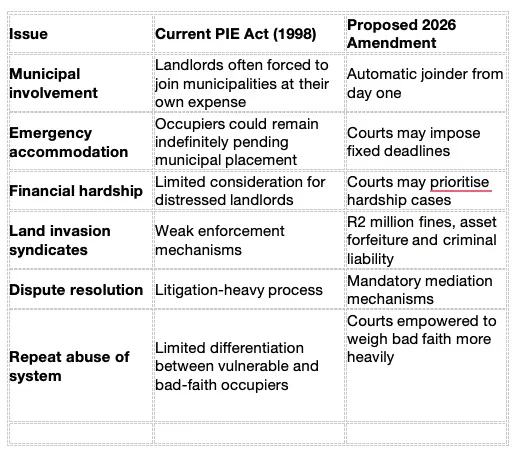
A lifeline for ‘Mom-and-Pop’ Landlords
While large-scale land invasions dominate headlines, Marx believes the real impact of the Bill may be felt most strongly among small-scale property investors.
“For a pensioner relying on a garden cottage for income, or a family that saved for years to buy a single rental property, the current system can be financially devastating,” she explains. “They simply cannot survive a R150,000 legal bill and an 18-month wait to reclaim their own property.”
The Bill introduces several mechanisms intended to assist smaller landlords:
· Low-cost mediation channels aimed at reducing litigation expenses
· Faster handling of cases involving severe landlord hardship
· Greater judicial distinction between vulnerable occupiers and deliberate abuse of the system
· Streamlined municipal participation in proceedings
For South Africa’s growing base of small-scale residential investors, the reforms could materially reduce both financial and legal risk.
A 60 day window for public comment
The Bill is now officially open for public participation, with comments expected to close around mid-June 2026.
Legal analysts believe this consultation period will be crucial, particularly around how courts interpret the balance between constitutional housing rights and strengthened property protections.
“This is not simply a property rights issue,” says Marx. “It is also about municipal sustainability, urban stability, and creating a legal framework that does not financially destroy either the property owner or the state.”
The “Just and Equitable” ambiguity
One of the biggest criticisms of the current system has been the broad interpretation of what courts consider “just and equitable”.
Cases such as Grobler v Phillips highlighted the difficulty of evicting vulnerable occupiers, even where alternative land or accommodation existed. Critics argued that the lack of clear statutory guidelines created inconsistent outcomes and prolonged disputes.
The 2026 Bill attempts to tighten this framework by introducing stricter criteria requiring courts to weigh evidence of bad-faith occupation more heavily.
The “Indefinite Stay” crisis
Another major flashpoint emerged following the precedent set in City of Johannesburg v Blue Moonlight Properties.
That ruling effectively placed significant pressure on municipalities to provide emergency accommodation before evictions could proceed.
In practice, this often created legal deadlocks where unlawful occupiers remained on private property indefinitely while municipalities struggled to provide housing solutions.
The new Bill seeks to break this stalemate by empowering courts to impose fixed expiry dates for temporary accommodation arrangements.
The ‘land grab syndicate’ loophole
Perhaps the most dramatic aspect of the proposed legislation is its direct attack on organised land invasion syndicates.
According to legal experts, current laws were largely ineffective against criminal groups that illegally sold or allocated occupied land for profit.
The amendments introduce:
· Fines of up to R2 million
· Asset forfeiture provisions
· Potential criminal prosecution
· Expanded liability for organisers and facilitators of coordinated invasions
The reforms follow mounting concern over increasingly organised land occupation activity linked to syndicate operations in several urban centres.
Cases such as City of Johannesburg v Unknown Individuals exposed the scale and sophistication of some coordinated invasions.
A win for due process
Importantly, the Bill is not positioned as an “eviction-at-all-costs” framework. Instead, legal experts argue it attempts to create a more regulated and balanced process.
Mandatory mediation, automatic municipal involvement, and stricter procedural timelines are all intended to reduce court congestion and shorten litigation periods.
“We are moving toward a system of regulated resolution rather than perpetual legal paralysis,” says Marx.
“By closing loopholes that allowed bad-faith actors to exploit the system, the Bill attempts to restore the balance originally intended by the Constitution.”
What happens next?
The proposed amendments still face parliamentary scrutiny, public submissions and potential legal challenges before becoming law.
But one thing is already clear: South Africa’s eviction and unlawful occupation framework is moving into a far more aggressive and structured era. For landlords, investors and municipalities, the stakes are enormous.
If passed in its current form, the PIE Amendment Bill of 2026 could fundamentally reshape how South Africa handles unlawful occupation, property rights, emergency housing obligations, and organised land invasions for decades to come.