





Property rights debate shapes SA’s economic future
- Constitutional property protections remain central to investment certainty, entrepreneurship, dignity and long-term economic inclusion in South Africa.
- Speakers argued title deeds unlock township development, wealth creation and intergenerational prosperity for millions of South Africans.
- Excessive regulation and a shortage of scalable ideas were identified as major barriers to entrepreneurship and economic growth.
Thirty years after the adoption of South Africa’s Constitution, political leaders, economists, entrepreneurs, investors and ordinary citizens gathered in Cape Town for a powerful and often provocative discussion about one of the country’s most important constitutional questions, property rights.
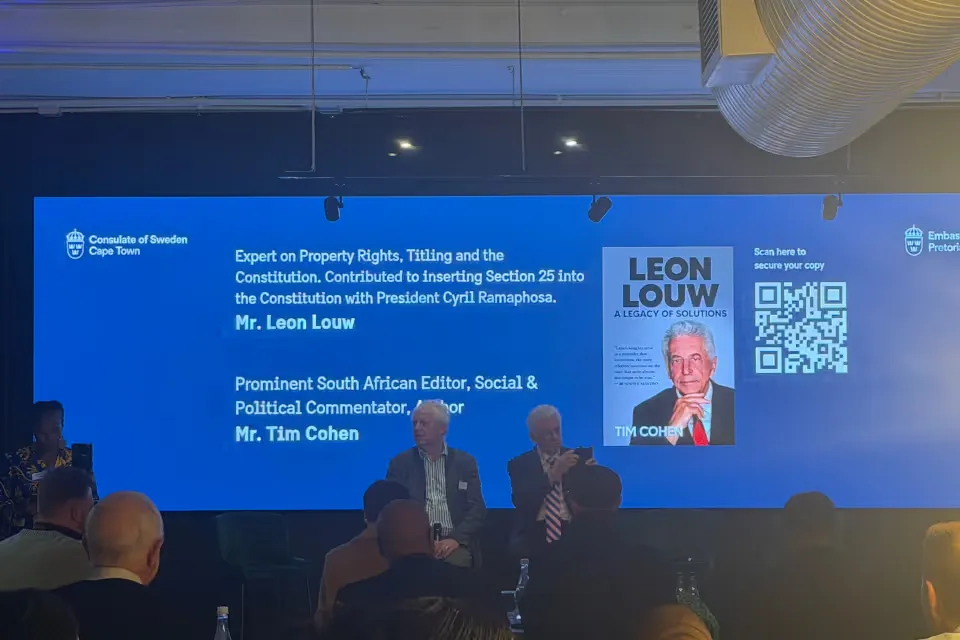
Hosted by Carl Fredrik Sammeli the founder of Bitprop last week, the seminar explored the origins and evolution of Section 25 of the Constitution and how property rights continue shaping legal certainty, investment conditions, entrepreneurship and the lived realities of South Africans today.
Held almost exactly three decades after the Constitution was adopted on 8 May 1996, the event brought together voices from politics, business, academia and civil society to debate land reform, title deeds, township entrepreneurship, constitutional protection and economic inclusion.
Among the speakers were Leon Louw, Paul Harris, Tim Cohen, Temba Nolutshungu, Prof Simphiwe Madikizela, Manka Sebastian and Nonkosi Klaas.
At the centre of the seminar was a crucial question: can South Africa simultaneously pursue transformation, economic inclusion, investment certainty and prosperity through stronger property rights and broader ownership?
The constitution’s forgotten property debate
One of the most compelling discussions came from Leon Louw, who recounted the final days of the constitutional negotiations in 1996 when the draft Constitution reportedly contained no property rights clause at all.
Louw explained how a small group of negotiators and business leaders lobbied political parties across the spectrum to ensure that what became Section 25 was ultimately inserted into the Constitution.
“The issue was not about protecting white privilege,” said Louw. “It was about protecting poor people from what apartheid had done to them, the denial of property rights.”
He argued that insecure tenure remains one of South Africa’s biggest hidden economic barriers, particularly for poorer communities in townships, informal settlements and traditional areas.
“Thousands of people are still having property effectively expropriated without compensation because they do not have titles,” he said. “The people most at risk are not wealthy suburbs, it’s ordinary South Africans living without formal ownership.”
Ownership changes lives
A recurring theme throughout the seminar was that ownership fundamentally changes behaviour, confidence and economic participation.
One of the most moving testimonies came from Bitprop homeowner and first-time landlord Nonkosi Klaas, who explained how receiving her title deed shortly after 1994 transformed her family’s sense of dignity and financial security.
“Knowing that the house is mine made me and my family proud,” she said. “My life changed after that.”
Klaas later partnered with township rental development platform Bitprop to build six backyard rental units on her property, generating monthly income well beyond her government pension.
Today she operates as both homeowner and entrepreneur. “What I’m earning now is far better than what I receive from SASSA,” she explained. “I’m no longer only dependent on government support.”
Her story became a practical example of how title deeds, ownership and entrepreneurship can work together to unlock intergenerational wealth creation inside township economies.
Township property emerges as a major growth opportunity
Author and senior editor Tim Cohen argued that South Africa continues underestimating the economic value sitting within township property markets.
“The next frontier for South African prosperity is not necessarily gold mines or wine estates,” Cohen noted. “It’s urban township land and unlocking the value trapped within it.”
Much of the discussion focused on the idea that ownership creates access to finance, investment and entrepreneurship, but only if legal systems support secure and transferable title.
Louw warned that many South African laws and regulations still effectively criminalise informal economic activity in poorer communities.
“If you drive from Sandton to Alexandra, almost everything in Sandton is lawful and almost everything in Alex is technically unlawful,” he said. “That’s the absurdity of our system.”
Speakers repeatedly argued that public participation, simplified titling systems and practical urban reforms are essential if South Africa wants broader economic inclusion and sustainable growth.
Entrepreneurs need fewer barriers, not more
Another strong theme emerging from the discussions was that South Africa’s economic challenges are not necessarily caused by a lack of funding, but rather by a shortage of scalable ideas, entrepreneurial execution and enabling regulation.
Paul Harris, banking pioneer, ex CEO of First Rand and one of SA’s top entrepreneurs, argued that while many entrepreneurs believe funding is the primary obstacle, genuinely strong ideas and execution remain the true drivers of successful businesses.
“It’s not really about capital,” said Harris. “If you’ve got a genuinely good idea and the ability to execute it, the money can come.”
Harris stressed that entrepreneurship is fiercely competitive and requires extraordinary resilience, persistence and long-term commitment.
At the same time, both Harris and Leon Louw criticised South Africa’s increasingly complex regulatory environment, arguing that excessive bureaucracy and outdated financial regulations are constraining entrepreneurship, innovation and economic participation.
Louw described many financial regulations as outdated remnants of older economic systems that disproportionately burden small businesses and poorer South Africans trying to enter the formal economy.
“We still have too many laws that make ordinary people criminals simply for trying to participate economically,” Louw argued.
The discussion touched on exchange controls, compliance burdens, SME barriers and restrictive regulatory systems that speakers believe continue limiting business growth and economic mobility.
Both Harris and Louw argued that simplifying regulation, modernising financial systems and reducing unnecessary bureaucracy could significantly accelerate entrepreneurship and township business development.
A constitutional balancing act
The seminar also highlighted the political complexity surrounding property rights and land reform.
Hon Crown Prince Adil Nchabeleng, Member of Parliament for the uMkhonto weSizwe party, argued that property rights and land reform should not be treated as opposing constitutional concepts.
“Property rights and land reform are complementary objectives within a constitutional framework that seeks fairness, stability and prosperity for all,” he said.
He acknowledged the need for stronger land titling systems while emphasising that millions of South Africans still lack secure tenure and meaningful economic access.
The broader discussions also extended into AI, entrepreneurship, township investment, public participation and financial inclusion.
Throughout the seminar, one consistent message emerged: constitutional protection alone is not enough. Economic growth also requires functioning institutions, practical implementation, simplified regulation and systems that enable ordinary South Africans to participate productively in the economy.
Ownership, dignity and economic freedom
Thirty years after South Africa adopted one of the world’s most progressive constitutions, the debate around Section 25 remains deeply relevant.
But as the discussions revealed, the conversation is increasingly shifting beyond expropriation and land reform toward something broader, how South Africa builds an inclusive ownership economy capable of unlocking entrepreneurship, township development, investment and long-term prosperity.
For investors, the seminar reinforced the importance of legal certainty, constitutional stability and transparent institutions.
For ordinary citizens, it highlighted something even more personal - dignity, ownership and economic agency.
As Leon Louw concluded during the seminar: “When people receive title deeds, you cannot believe the transformation that occurs. They suddenly start building, painting, planting and growing. Ownership changes everything.”