





May & July interest rate decisions put SA property on edge
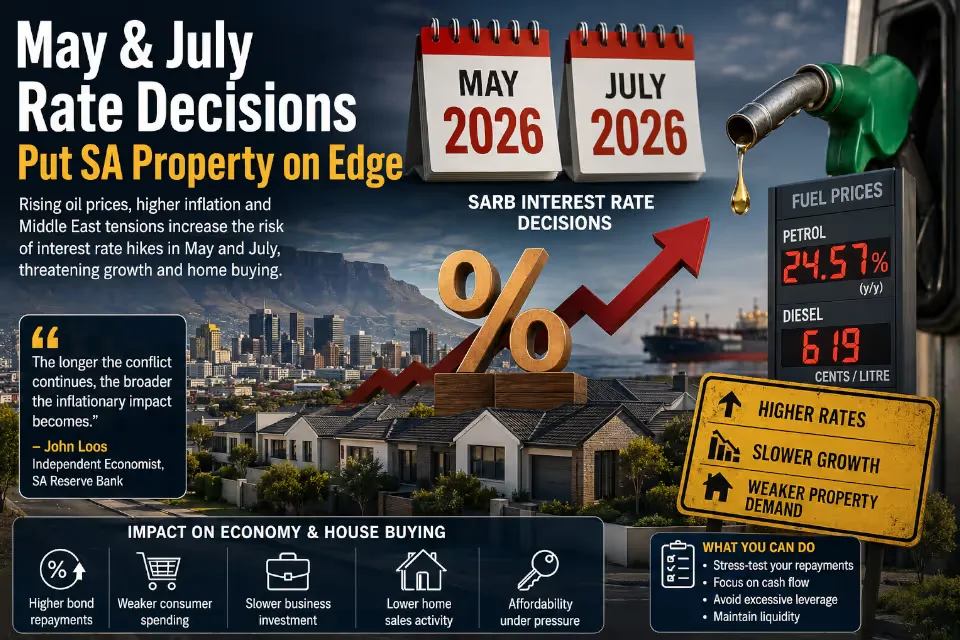
- Rising fuel and inflation pressures are increasing the risk of SARB interest rate hikes in May and July.
- Elevated global energy costs are weakening consumer confidence, housing affordability and broader economic momentum.
- Economists warn prolonged Middle East tensions could trigger slower growth, softer property demand and cautious investor sentiment.
South Africa’s fragile economic recovery is entering a far more uncertain phase as inflationary pressures, elevated fuel prices and persistent Middle East tensions raise the prospect of interest rate hikes at the South African Reserve Bank’s May and July Monetary Policy Committee meetings.
What was initially expected to be a temporary spike in fuel costs is increasingly becoming a broader economic concern that could affect everything from consumer spending and business confidence to home buying activity and investment flows.
According to John Loos, the longer global shipping disruptions and geopolitical tensions continue, the greater the pressure on inflation, growth and interest rate expectations in South Africa.
Fuel prices and inflation pressures intensify
The ongoing conflict in the Middle East and severe disruptions through the Strait of Hormuz have kept global oil prices elevated for far longer than markets initially anticipated.
Brent crude oil prices have surged from roughly US$60 per barrel at the start of the year to around US$114 per barrel, placing enormous pressure on fuel-importing economies such as South Africa.
The local impact is already becoming visible. Petrol prices rose by 327 cents per litre in May, while diesel surged by 619 cents per litre. Gauteng petrol inflation has accelerated to more than 24% year-on-year.
Loos expects CPI inflation to move from 3.1% in March to around 4% through winter as transport and logistics costs ripple through the economy.
“The longer the conflict continues, the broader the inflationary impact becomes,” he warns, noting that businesses will increasingly pass higher operating costs on to consumers.
Why May and July matter for interest rates
The SARB has maintained a relatively cautious stance in recent months, helped by subdued inflation earlier in the year.
However, that position is becoming increasingly difficult to sustain.
With inflation expected to rise above 4% during winter and fuel costs continuing to surge, economists now believe the May and July MPC meetings could become pivotal moments for the economy and property market.
Loos has revised his 2026 GDP growth forecast lower to just 0.8%, down from 1.1% in 2025, citing slower global growth, weaker consumer demand and the increasing likelihood of mild interest rate hikes.
A 25 basis point hike later this year is increasingly being viewed as the most probable outcome if inflation remains elevated.
Impact on the economy and home buying
Higher interest rates would immediately place additional pressure on already stretched households.
Consumers are expected to become more cautious, particularly around major credit-driven purchases such as homes, vehicles, furniture and appliances.
For the residential property market, the effects could be significant:
- Slower home sales volumes.
- Reduced first-time buyer activity.
- Increased affordability pressure.
- Slower residential development activity.
- Greater demand for rentals as buyers delay purchases.
Loos believes many aspirant buyers could remain on the sidelines longer, either renting or delaying upgrading decisions as uncertainty rises.
Market volatility already hitting investors
Broader investment markets are already reflecting the growing uncertainty.
The Public Investment Corporation (PIC), which manages approximately R3.9 trillion in assets, recently disclosed that global market volatility erased roughly R350 billion from its asset base during the recent sell-off.
The sharp decline underscores how rapidly geopolitical tensions, inflation fears and slowing growth expectations are reshaping investor sentiment globally and locally.
For property investors, this creates a far more defensive environment where affordability, cash flow management and tenant resilience become increasingly important.
Different scenarios facing South Africa
Scenario 1: Inflation Stabilises
If tensions ease and oil prices retreat, inflation could moderate later in the year, reducing pressure on the SARB and limiting the need for rate hikes.
Scenario 2: Mild rate hike cycle
This currently appears the most likely path. Inflation remains elevated through winter, forcing one or two modest rate hikes during 2026.
Scenario 3: Prolonged global pressure
Should energy prices remain elevated for several more months, inflation could become more entrenched, potentially leading to additional hikes and a sharper slowdown in property and consumer activity.
What buyers and investors should do now
In a rising-rate environment, discipline becomes critical.
Property investors and buyers should:
- Stress-test repayments against higher rates.
- Prioritise strong cash-flow assets.
- Avoid excessive leverage.
- Focus on defensive locations and resilient tenant demand.
- Maintain liquidity and reserve capital for volatility.
For developers and landlords, affordability and tenant retention are likely to become increasingly important themes over the next 12 months.
Outlook more fragile
South Africa’s economic outlook is becoming more fragile as elevated energy costs, inflationary pressure and geopolitical instability begin filtering through the broader economy.
The upcoming May and July SARB decisions are now taking on greater importance for consumers, investors and the property sector alike.
If inflation continues rising and oil prices remain elevated, interest rate hikes may become unavoidable.
And in a slower-growth environment, the property market’s next phase may be defined less by aggressive expansion and more by resilience, affordability and careful risk management.