









Gauteng's decline is becoming South Africa's property risk
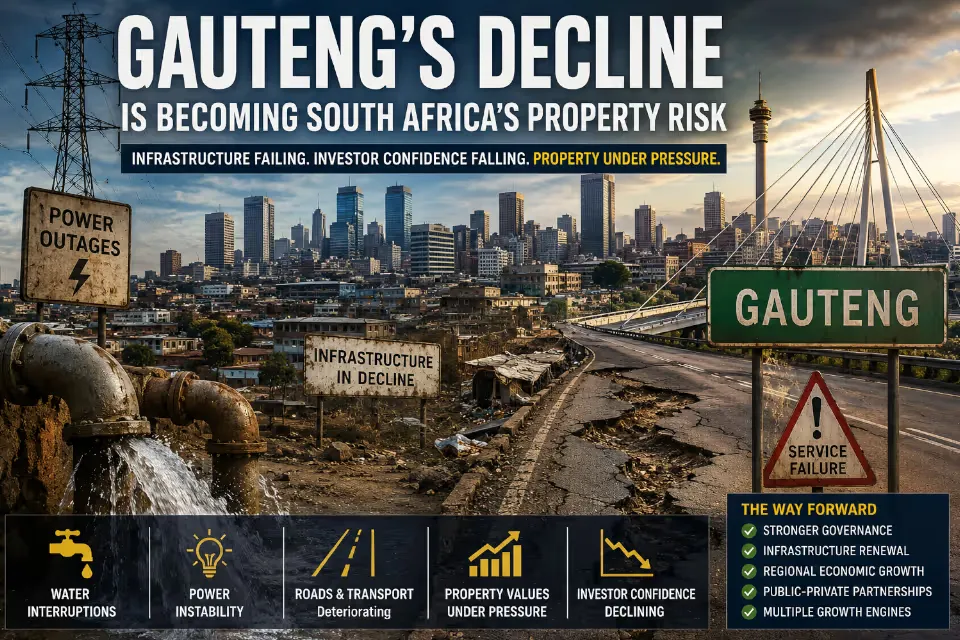
- Gauteng's infrastructure decline is undermining property values, investor confidence and economic growth.
- Johannesburg's challenges reflect broader failures across the inland economy, not just municipal mismanagement.
- Reviving Gauteng requires regional economic reform, infrastructure renewal and stronger local government performance.
South Africa's economic engine is losing power
For decades, Gauteng has been South Africa's undisputed economic powerhouse. Home to Johannesburg, Sandton, Midrand, Pretoria and some of the country's most important commercial and industrial hubs, the province contributes more than a third of national GDP and serves as the financial, logistics and services centre of Southern Africa.
Yet increasingly, concerns are mounting over deteriorating infrastructure, unreliable service delivery, growing urban decay and the impact these challenges are having on economic growth, investment and property performance.
According to independent economist John Loos, while the renewed focus on Gauteng's problems is both justified and necessary, the province's challenges cannot be viewed in isolation.
The reality is that Gauteng forms part of a much larger inland economic ecosystem, and many of the solutions lie beyond its provincial borders.
The growing infrastructure and service delivery crisis
Across Gauteng, businesses, residents and property owners face mounting challenges that have become increasingly difficult to ignore.
Key concerns include:
- Deteriorating roads and transport infrastructure
- Water supply disruptions and ageing networks
- Electricity instability and grid pressures
- Rising municipal debt and financial strain
- Urban decay in key business districts
- Poor maintenance of public spaces
- Safety and security concerns
- Delays in planning and development approvals
For property owners and investors, these issues directly affect rental demand, operating costs, business confidence and long-term capital growth.
Commercial tenants increasingly evaluate municipal performance when making location decisions, while residential buyers are becoming more selective about where they choose to live and invest.
Why Gauteng matters to property investors
The health of Gauteng's property market matters far beyond the province itself.
According to John Loos independent economist, Gauteng remains South Africa's largest provincial economy by a considerable margin and continues to play a critical role in employment creation and economic activity.
Historically, Gauteng and the Western Cape have been the country's two major "provinces of hope" attracting the strongest inward migration due to better employment opportunities and lower levels of poverty and unemployment.
However, Gauteng's economic performance has weakened significantly over the past decade. One of the clearest indicators is the province's labour absorption ratio, which measures employment relative to the working-age population.
In 2008, Gauteng's labour absorption ratio stood at 57.1%. By early 2026 it had fallen to 44.3%, reflecting slower economic growth and a declining ability to absorb new entrants into the labour market. This trend has profound implications for residential property demand, affordability and long-term investment returns.
The hidden driver: Regional economic imbalance
One of Loos' most important observations is that Gauteng's problems are not solely self-inflicted. The province acts as the services and economic hub for a broader inland economic region that includes:
- Limpopo
- Mpumalanga
- North West
- Free State
Together, these provinces account for nearly 60% of South Africa's GDP, almost 90% of mining activity and more than half of manufacturing output.
When these neighbouring economies underperform, Gauteng feels the consequences.
The impact on Gauteng
- Increased inward migration as people seek employment.
- Greater pressure on infrastructure and services.
- Higher housing demand without matching economic growth.
- Increased strain on municipal resources.
- Rising urbanisation challenges.
Loos argues that many municipalities surrounding Gauteng are in an even weaker position than those within Gauteng itself, contributing to population pressures and slower regional economic growth.
What this means for property markets
The property market is often one of the first sectors to reflect underlying economic and governance trends.
Residential Property
Challenges include:
- Slower house price growth.
- Greater pressure on affordable housing.
- Infrastructure concerns influencing buying decisions.
- Growing migration to better-managed nodes.
Commercial Property
Businesses increasingly favour:
- Reliable utilities.
- Stable municipal governance.
- Better transport access.
- Stronger safety and security environments.
This has accelerated demand for decentralised office nodes, mixed-use developments and private-sector managed precincts where service delivery standards can be maintained.
Industrial Property
Industrial investors are becoming increasingly sensitive to:
- Logistics efficiency.
- Road infrastructure quality.
- Electricity reliability.
- Municipal responsiveness.
These factors are now as important as location itself.
The Solutions: Rebuilding Gauteng's competitiveness
Loos believes the solution extends far beyond simply fixing Johannesburg's roads or balancing municipal budgets. A sustainable recovery requires strengthening both Gauteng and the broader inland economy.
1. Restore Municipal Capability
- Professionalise local government.
- Improve maintenance budgets.
- Accelerate infrastructure upgrades.
- Improve financial governance.
2. Encourage Regional Growth Nodes
Economic activity must become more diversified across inland provinces rather than concentrating almost entirely within Gauteng.
3. Expand Infrastructure Investment
Priority should be given to:
- Water systems
- Electricity networks
- Roads and transport corridors
- Public safety infrastructure
4. Support Private Sector Participation
Public-private partnerships can play a critical role in improving infrastructure delivery and precinct management.
5. Create More Economic Engines
South Africa needs multiple growth centres rather than relying predominantly on Gauteng and the Western Cape to drive employment and investment.
A Lesson from the Western Cape
Loos points to the Western Cape as an example of how strong surrounding municipalities and secondary growth centres can support a major metro. Successful towns and regional economies help spread population growth, ease infrastructure pressure and create additional demand for goods and services.
A similar approach could help relieve pressure on Gauteng while strengthening the broader inland economy.
The Way Forward
Gauteng's infrastructure and service delivery challenges are real and increasingly visible. They represent a growing risk to economic growth, investor confidence and property market performance.
However, focusing solely on Johannesburg's decline risks missing the bigger picture.
As John Loos points out, Gauteng is not an island. It sits at the centre of a vast inland economic region whose fortunes are deeply interconnected. Fixing Gauteng requires more than repairing roads, restoring power infrastructure and improving municipal governance.
It requires strengthening neighbouring economies, creating new growth nodes and reducing the immense demographic and economic pressures currently concentrated in one province.
For property investors, the message is clear: Gauteng remains too important to fail. But restoring its position as South Africa's primary engine of growth will require coordinated action, long-term planning and a recognition that some of the province's biggest solutions lie beyond its borders.