








Gauteng regains pull as SA migration patterns shift
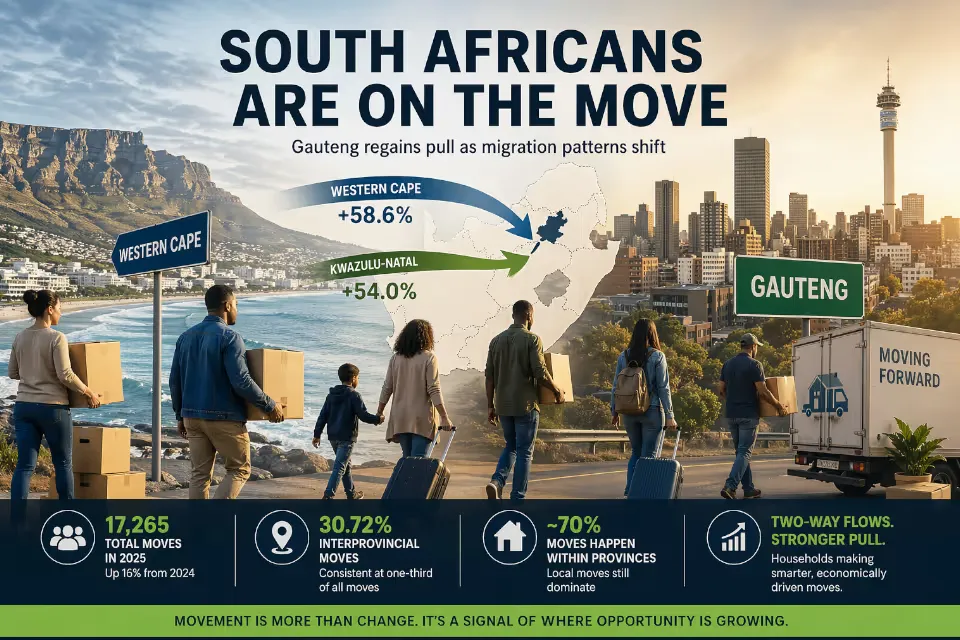
- Household moves rising, but migration patterns now reflect two-way flows, not one-directional ‘semigration’.
- Nearly 70% of relocations remain within provinces, reinforcing the dominance of local mobility.
- Moves from Western Cape to Gauteng surge 58.6%, signalling a strong economic pull back inland.
A new migration reality takes shape
South Africa’s migration story is changing and fast. The long-standing narrative of one-way “semigration” to the coast is giving way to a more complex, economically driven cycle of movement.
According to the Wise Move 2026 South African Migration Report: Movement, Momentum, and Migration, based on over 30,000 anonymised household moves, South Africans are relocating in greater numbers, but with sharper intent.
The data reveals a clear shift: mobility is rising, but decisions are increasingly shaped by affordability, employment access, and economic resilience rather than lifestyle alone.
“At household level, every move is personal. But at national level, migration becomes a powerful economic signal,” says Chante Venter, Co-founder and CEO of Wise Move.
“When you look at relocation at scale, it becomes a measurable record of how South African households adapt, where opportunity is concentrating, where costs are rising, and how people respond.”
Move volumes rise but structure holds
The data shows a notable increase in overall relocation activity:
- 2024: 14,830 total moves analysed
4,489 interprovincial (30.42%) - 2025: 17,265 total moves analysed
5,258 interprovincial (30.72%)
While total moves climbed significantly, the proportion of interprovincial relocations remained stable at around one-third. This points to a critical insight: South Africa’s migration structure is steady, but direction is shifting.
Local moves still dominate the market
Despite the focus on interprovincial migration, the backbone of South Africa’s mobility remains local.
Nearly seven out of ten moves happen within provincial borders, highlighting that most households are adjusting within familiar economic zones rather than relocating across the country.
However, this activity is not evenly distributed. Movement continues to cluster around key economic hubs, particularly Gauteng and the Western Cape where jobs, infrastructure, and services remain concentrated.
The Big Shift: Gauteng pulls movers back
The standout trend in the latest data is Gauteng’s renewed draw.
While total moves increased by 16%, inbound migration to Gauteng surged well beyond that baseline:
- Western Cape to Gauteng: +58.6%
- KwaZulu-Natal to Gauteng: +54.0%
Even after adjusting for platform growth, these corridors outperformed significantly by 42.6 and 38.0 percentage points respectively.
Crucially, outbound movement from Gauteng did not rise at the same pace. This signals a strengthening inward pull rather than a balanced exchange marking a clear shift in migration dynamics.
What’s driving the return?
The data points to a more pragmatic decision-making framework among households.
The lifestyle-driven coastal migration trend is now colliding with economic realities:
- Rising living costs in coastal metros
- Greater job concentration in Gauteng
- Access to services and infrastructure
- Pressure to stabilise household finances
The result is a recalibration. Households are no longer chasing lifestyle at any cost, they are prioritising sustainability and opportunity.
Why it matters for property and investment
Migration is more than movement, it’s a leading indicator of demand.
These shifts carry direct implications:
- Gauteng: Strengthening rental demand and renewed investor interest
- Western Cape: Potential softening at the margins as affordability pressures bite
- Secondary markets: Increased volatility as households reassess location value
Each relocation also triggers economic activity from logistics and services to local spending, amplifying its impact beyond property alone.
Entering a new phase
South Africa’s migration patterns are entering a new phase, more fluid, more responsive, and more economically driven.
The era of one-directional semigration is over. In its place is a dynamic system where households actively rebalance between cost, opportunity, and lifestyle.
Gauteng’s resurgence is the clearest signal yet: when economic pressure rises, fundamentals win.
For investors, developers, and property professionals, the message is simple, follow the movement, because that’s where the market is going next.
DOWNLOAD FULL REPORT