








Does prequalification give homebuyers the edge?
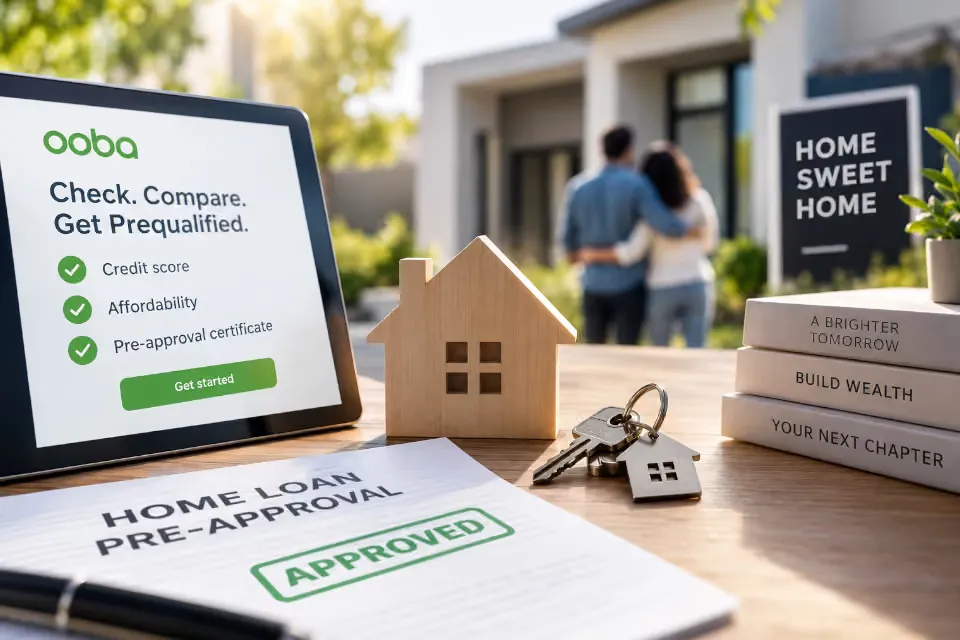
- Pre-approval gives buyers an early view of their credit profile, affordability and realistic property price range.
- A Qualified Buyers Certificate goes further, assessing finances more closely before a formal home-loan application is submitted.
- In August 2026, 91.6% of ooba customers with prequalification went on to secure home-loan approval.
The property market may be more accessible, but buyers still need to prove they can afford the home they want.
Does prequalification still matter in today's market?
South Africa's residential property market continues to offer opportunities for buyers, supported by the cumulative impact of six interest-rate cuts since September 2024 and competitive lending among the major banks.
Improved borrowing conditions have helped restore affordability and encouraged buyers, including first-time purchasers, to reconsider entering the market.
But cheaper borrowing doesn't remove one of the fundamental questions every prospective buyer needs to answer before starting the property search:
How much home can I actually afford and how likely am I to qualify for the finance?
That's where prequalification comes in.
A prequalification or pre-approval can provide an early indication of affordability and creditworthiness before a buyer starts making offers. A Qualified Buyers Certificate (QBC) takes the process further by examining the buyer's financial position in greater detail.
So, is it strictly necessary to have one before buying a property? Not necessarily. But in a competitive market, knowing your financial position before negotiating can significantly strengthen your hand and reduce the risk of pursuing a property you ultimately cannot finance.
Rhys Dyer, CEO of the ooba Group, says these documents are often underestimated by prospective buyers. “Often underestimated, this document can offer significant benefits,” says Dyer.
Prospective buyers can use free online tools such as ooba's Bond Indicator to check their credit score, estimate affordability and obtain a pre-approval certificate within minutes.
Understanding Pre-approval and a Qualified Buyer’s Certificate
Although the terms prequalification and pre-approval are frequently used interchangeably, Dyer says buyers should understand the distinction between an initial affordability assessment and the more comprehensive QBC process. A pre-approval is essentially an early financial health check.
“A pre-approval is a quick and simple way to determine what you can afford and what your credit score is by using an online pre-approval tool like the ooba Bond Indicator,” says Dyer.
It can help establish a realistic property budget before the buyer starts viewing homes, while also identifying potential credit or affordability issues that may need attention.
Dyer believes this should be one of the first steps in the homebuying journey. The ooba Bond Indicator, for example, provides an indicative affordability assessment, credit-score information and a pre-approval certificate. Importantly, this gives buyers a price range within which to conduct their property search.
A Qualified Buyers Certificate goes considerably further. Rather than relying primarily on an initial online assessment, the QBC involves a home-finance expert examining supporting documentation, undertaking more detailed credit checks and assessing affordability in a way designed to more closely resemble a bank's assessment.
“A Qualified Buyers Certificate is a more robust version of a prequalification. It is conducted by a home finance expert who carefully evaluates your affordability in much of the same way that the banks do,” says Dyer.
The objective is to establish a stronger picture of the buyer's ability to secure finance before a formal home-loan application is made.
The Benefits of a Qualified Buyers Certificate
For buyers, the biggest advantage is certainty. Knowing what you can realistically afford can prevent wasted time viewing properties outside your financial range and allows you to negotiate from a better-informed position.
It can also give sellers and estate agents greater confidence that an offer from a prospective buyer has a reasonable prospect of securing finance.
“A Qualified Buyers Certificate places you, the homebuyer in an elevated position as a ‘qualified buyer’, giving you more bargaining power when it comes time to negotiate the terms and conditions of the property sale agreement,” says Dyer.
There is also evidence of a strong relationship between prequalification and eventual approval. According to ooba Home Loans, 91.6% of its customers with a prequalification went on to have their home loans approved in August 2026. The average was 91.2% during the first half of 2026, compared with 90.8% in H1 2025.
But buyers need to understand an important distinction: Prequalification is not a home-loan guarantee. Final approval remains in the hands of the lender.
Banks will still assess factors including the property's valuation and suitability as security, as well as whether the applicant's income, debt or broader financial circumstances have changed before the formal application.
Common FAQs Answered
1. What financial requirements are assessed?
According to Dyer, the QBC process typically considers several key indicators:
- Credit score: A minimum score of 610 is required in ooba's QBC process.
- Income stability: Buyers should generally demonstrate consistent income for at least three to six months.
- Debt-to-income: Existing debt repayments should ideally not exceed 30% of monthly income.
- Employment: Permanent employment can support an application, although self-employed buyers can also qualify.
These measures provide a clearer picture of whether the applicant is financially positioned to take on a home loan.
2. What happens if I don't qualify?
A negative assessment before buying isn't necessarily the end of the journey. In fact, identifying the problem before signing an offer can be valuable.
“The beauty of this process is that it allows you to address any weak spots prior to officially applying for a home loan,” says Dyer. That could mean improving a credit score, reducing short-term debt, building a larger deposit, correcting credit-record issues or assembling the documentation lenders will require.
The buyer can then return to the market from a stronger financial position rather than discovering the problem only after submitting a formal bond application.
3. Does a certificate guarantee my bond?
No.A QBC provides a more detailed indication of affordability and creditworthiness, but it does not bind a bank to approve the eventual loan.
The lender still makes the final credit decision and must be satisfied with both the borrower and the property being financed.
4. Can it strengthen my offer to purchase?
Potentially, yes. A seller comparing competing offers may take greater comfort from a buyer who has already undergone affordability and credit assessment.
It does not automatically make that offer superior, but it can remove some uncertainty around the buyer's ability to obtain finance.
Added Measures for Success
- Prequalification is only one part of securing the right home loan.
- Buyers should also compare lenders rather than automatically accepting the first finance offer they receive.
- The difference between bank offers can affect both the interest rate and the total cost of owning the property over the life of the bond.
According to ooba Home Loans, it recorded a national home-loan approval rate of 84.5% in August 2026, while achieving an average interest rate for its customers of 0.75 percentage points below prime.
Even relatively small differences in the interest rate can translate into meaningful savings over a 20-year bond. Buyers can further strengthen their position by checking their credit profile early, reducing unnecessary debt, saving towards a deposit and transaction costs, maintaining stable finances and preparing supporting documentation before applying.
And there is one particularly important rule once prequalified: Don't take on substantial new debt before the bond is approved and the transaction is completed.
A new vehicle loan, credit facility or other financial commitment can change the affordability calculation on which the original assessment was based.
Preparation can be a buyer's competitive advantage
A prequalification certificate isn't a substitute for formal home-loan approval, and it doesn't guarantee that a bank will finance a particular property.
But that isn't really its purpose. Its value lies in giving buyers financial clarity before they make one of their biggest investment decisions.
A pre-approval establishes the starting point. A Qualified Buyers Certificate provides deeper verification. Comparing lenders can then help secure the most competitive financing available.
As Dyer puts it: “In a competitive market, being prepared can make all the difference between finding your dream home and missing out on an opportunity.”
For buyers, the lesson is straightforward: don't start with the property. Start by understanding your buying power.