





Community schemes at a crossroads: Lead or lose control
- Governance is broken: volunteer trustees carry complex fiduciary duties without the time, skills, or support to act decisively.
- Executive Managing Agents offer a scalable solution, shifting control to professionals and unlocking faster, smarter decision-making.
- AI won’t replace managers, but those who ignore it risk irrelevance in a rapidly professionalising industry.
An industry being forced to evolve
Community scheme management is no longer a back-office function, it’s a high-stakes discipline managing billions in assets, compliance, and stakeholder expectations.
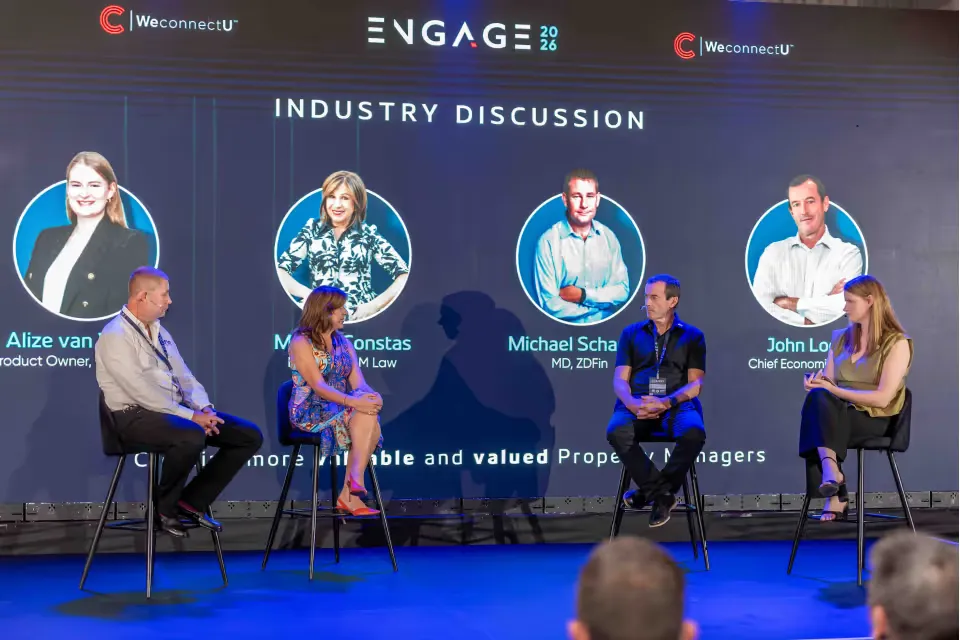
At Engage 2026, a standout panel tackled the uncomfortable truth:
the current model is under pressure and no longer fit for purpose at scale. Facilitated by Alize van Vuuren (WeconnectU Product Owner), the panel brought together:
- Marina Constas, Director at BBM Law
- Michael Schafer, Director at ZDFin
- John Loos, Independent Economist
Their message was blunt: adapt, professionalise, or fall behind.
Governance under Pressure: The trustee model is cracking
Community schemes have evolved into mini-economies, yet governance remains largely in the hands of volunteer trustees.
Marina Constas highlighted the growing disconnect: “We’re expecting individuals with full-time jobs to make complex legal and financial decisions, often with limited support.”
The results show for themselves:
- Delayed decisions
- Operational bottlenecks
- “Governance paralysis”
Managing agents are left stuck, responsible for execution, but without authority to act. The shift is inevitable:
- Trustees must move toward strategic oversight
- Professionals must take on operational control
The Untapped Opportunity: Executive Managing Agents
South Africa already has a solution, but it’s underused. The Executive Managing Agent (EMA) framework allows schemes to appoint a qualified professional to take over trustee functions.
Yet adoption remains low. Michael Schafer put it into perspective: “We’re talking about a sector managing billions, yet decisions are still being made in evening meetings by part-time volunteers.”
The EMA model changes that:
- Full-time, accountable decision-making
- Faster execution
- Professional financial oversight
For managing agents, this is the opportunity. Not just to administer, but to lead, advise, and control outcomes. As awareness grows, expect EMAs to move from exception to mainstream governance model.
Technology, AI, and the fear of job loss
AI is the elephant in the room and fear is holding people back.
John Loos offered perspective: “Every major technological shift is met with resistance before it becomes indispensable.” From calculators to computers, the pattern is the same:
- Fear
- Resistance
- Adoption
- Dependence
AI will follow the same path. Yes, it will replace tasks. But it will also create new roles, new efficiencies, and new value.
The Real Risk: Failing to adapt
Let’s be clear, the threat isn’t AI. The threat is standing still.
Loos put it bluntly: “The real risk is not technology itself. The real risk is failing to adapt to it.” In practical terms:
- Admin-heavy managers will struggle
- Data-driven managers will outperform
- Reactive operators will fall behind
Technology will separate professionals from the rest.
From Admin to Asset Management: A role redefined
Automation is already reshaping the daily workload. Tasks being reduced or eliminated:
- Manual admin
- Repetitive communication
- Data capturing
- Compliance tracking
What replaces them is far more valuable:
- Financial oversight
- Strategic planning
- Community value optimisation
- Stakeholder management
Professional identity the missing piece
From managing buildings to managing assets and outcomes, one of the most powerful insights from the panel is that community management lacks a strong professional identity. Compare it to:
- Chartered Accountants
- Actuaries
- Attorneys
These professions command respect and fees, because they are:
- Structured
- Skilled
- Recognised
Community management is heading the same way, but only if it evolves. Stronger identity means:
- Better talent attraction
- Higher standards
- Greater pricing power
- Increased industry credibility
The Path Forward
The industry is at a turning point. Three forces are reshaping it:
- Governance reform
- Technology and AI
- Rising complexity and expectations
The winners will be those who:
- Embrace Executive Managing Agent roles
- Invest in technology and data
- Shift from admin to strategic asset management
- Build a credible professional identity
As Alize van Vuuren summed it up with a simple truth: “Adaptability is the highest form of intelligence.”
In this market, that’s not philosophy. It’s a strategy for survival and growth.