







Why Hammerson is betting on retail again

REI EXCLUSIVE | Prime shopping centres are back on investors’ radar. Hammerson CEO Rob Wilkinson tells REI why dominant malls are strengthening and why valuations may still be behind the fundamentals.
- Prime retail remains attractively priced against competing property sectors, creating potential upside if institutional capital returns and yields compress.
- Hammerson is buying again, acquiring 50% of Manchester Arndale for £218 million and actively seeking further opportunities.
- Gen Z, omnichannel retail and stronger footfall are reshaping dominant malls while supporting occupancy, rental growth and earnings.
Retail was written off. Now the cycle is changing
For much of the past decade, shopping centres became one of global property investment’s least fashionable asset classes.
E-commerce was growing, consumers were moving online and institutional capital increasingly preferred logistics, residential and other sectors expected to benefit from stronger structural growth. COVID accelerated the pressure. Today, that investment thesis is being reconsidered.
In an exclusive interview with Real Estate Investor (REI) in Cape Town, Hammerson CEO Rob Wilkinson argues that prime retail property has moved from being one of the least favoured parts of real estate to one of its most closely watched. The important distinction is that the recovery is increasingly supported by the numbers.
Hammerson’s H1 2026 results showed footfall up 3%, like-for-like sales up 2% and flagship occupancy at 96%. Like-for-like net rental income increased 5%, while EPRA earnings rose 33% to £64 million.
The group subsequently increased FY2026 EPRA earnings guidance to approximately £132 million. But Wilkinson believes valuations have not yet fully caught up with the operational recovery. That could be where the investment opportunity lies.
The retail reset: the numbers
Hammerson’s changing investment story can be seen across several key indicators:
- 96% flagship occupancy, the group’s highest first-half occupancy in seven years.
- 3% growth in footfall, outperforming national benchmarks across Hammerson’s markets.
- £18.5 million of headline rent secured through H1 leasing.
- 5% like-for-like net rental income growth during the first half.
- 33% increase in EPRA earnings to £64 million.
- £132 million FY2026 EPRA earnings guidance, approximately 27% ahead of FY2025.
- £218 million invested for 50% of Manchester Arndale at a 7.8% topped-up net initial yield.
- 6% – 8% medium-term annual growth targets for both EPRA EPS and dividends per share.
The figures point towards something considerably more important than simply recovering footfall: the best retail assets are converting consumer demand into income growth.
What did investors get wrong about physical retail?
One of the biggest misconceptions of the previous cycle was that online and physical retail were competing channels.
Instead, retailers discovered that stores remain central to the digital ecosystem. Click-and-collect, returns, customer service, product discovery and brand experiences all rely on physical locations. The result isn’t necessarily more stores. It is fewer, better stores.
Major retailers are concentrating capital into dominant destinations with strong catchments, high footfall and the ability to support both physical and digital sales. That is creating an increasingly important divide between “the best and the rest.”
The strongest destinations are attracting brands, customers and investment, while weaker secondary retail assets face a far more difficult future.
For investors, therefore, the retail recovery should not be interpreted as a signal to buy every shopping centre. Asset quality and catchment strength are becoming more important, not less.
Why valuations matter
This is where Wilkinson believes the investment argument becomes particularly interesting. Prime retail assets continue to trade at materially higher yields than many of the property sectors institutional investors favoured during the past decade.
Wilkinson argues that the difference in prospective rental growth between sectors is not necessarily sufficient to explain the valuation gap.
If the best shopping centres can continue producing rental growth while institutional capital gradually returns to retail, there is potential for yield compression and capital appreciation alongside income growth. That is precisely the opportunity Hammerson wants to capture before the market fully reprices.
South African investors are asking the same question. If the operational performance of the strongest retail destinations has improved so substantially, why are yields still pricing in such a significant risk premium?
Wilkinson expects the return of institutional capital to be gradual rather than a sudden rush. For Hammerson, that may actually be advantageous: it provides more time to acquire assets at today’s pricing.
Why Manchester Arndale matters
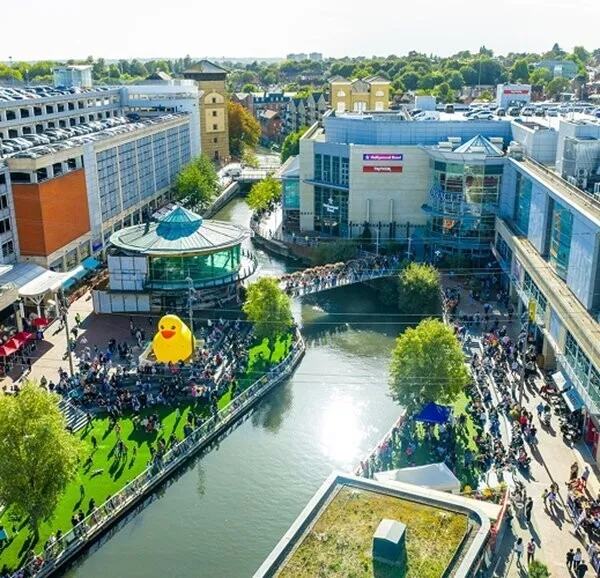
Hammerson has already put capital behind that conviction. The group acquired a 50% interest in Manchester Arndale for £218 million, its first major external acquisition in more than a decade. The transaction was completed at a 7.8% topped-up net initial yield and is expected to be earnings accretive from day one.
Manchester Arndale attracts more than 40 million visitors annually, according to Wilkinson, giving Hammerson exposure to one of the UK’s strongest urban catchments. But the opportunity goes beyond footfall.
Wilkinson points to a sizeable gap between rental levels at Manchester Arndale and Hammerson’s Bullring destination in Birmingham, despite Manchester’s scale and visitor numbers.
Hammerson believes active management, leasing and its relationships with major retailers can help close some of that gap and increase income.
Hammerson is buying again, but selectively
Manchester also signals a significant strategic shift. Hammerson is back in external acquisition mode. But Wilkinson stresses that the group will not buy simply to increase scale.
Its acquisition criteria start with two fundamentals: a strong, dominant asset and a strong catchment. Pricing, income-growth potential and relationships with major retail partners then become critical.
The immediate focus is predominantly the UK and potentially France, with other European markets offering longer-term opportunities. Wilkinson would like Hammerson to pursue another acquisition over the next 12 to 18 months, but capital discipline remains central.
The company remains committed to maintaining an investment-grade credit rating and will walk away from opportunities where pricing no longer meets its return requirements.
Gen Z is challenging the death-of-the-mall narrative
Perhaps one of the most surprising elements of the retail recovery is the consumer helping drive it. Wilkinson says Gen Z represents Hammerson’s largest customer group by footfall and sales.
The generation that grew up with smartphones, social media and online shopping still wants physical places. What has changed is what consumers expect from those places.
The modern successful mall increasingly combines retail with restaurants, entertainment, leisure, fitness, services, events and social experiences.
That is why Hammerson prefers the term “retail-led destination” rather than simply shopping centre. A successful retail property increasingly competes not only with another mall, but with hospitality, leisure and entertainment for consumers’ time.
What South Africa already understands
There is an important South African angle to this evolution. Wilkinson believes South Africa already understands the value of high-quality physical retail environments particularly well.
A clean, secure and professionally managed destination where consumers can shop, eat, meet and be entertained has long been embedded in South African shopping-centre culture.
Internationally, the idea is increasingly described as the “third place”, somewhere beyond home and work where people choose to spend time.
South African investors also understand retail property deeply, Wilkinson says, and Hammerson remains appreciative of the support it receives from its local shareholder base.
That matters because Hammerson’s JSE listing provides South African investors with direct exposure to prime retail-led destinations across the UK, France and Ireland.
What could derail the recovery?
The investment thesis isn’t without risk. Asked what could most seriously undermine Hammerson’s outlook over the next three to five years, Wilkinson’s answer was straightforward: the consumer.
The quality of the assets, retailers and operating platform may be strong, but retail ultimately depends on people continuing to visit and spend. Consumer weakness therefore remains the critical external risk investors should watch.
Did investors write off prime retail too soon?
The investment opportunity is not simply that “malls are back”. It is far more selective.
Dominant destinations are becoming increasingly important to retailers. Omnichannel strategies are reinforcing the role of physical stores. Gen Z is embracing physical destinations. Occupancy is high, footfall is growing and landlords are regaining rental pricing power.
Yet prime retail continues to trade at yields materially above several competing property sectors. If institutional capital eventually follows the operational fundamentals, 2026 could prove to be an important turning point in the retail property cycle.
After a decade of asking whether shopping centres were dying, investors may need to start asking a very different question: Did the market write off prime retail too soon?