









Billions flow into Cape Town CBD as office demand builds
Cape Town’s CBD commercial property market is gathering momentum as tight office supply, major new developments and demand for quality space drive fresh investment.
- Cape Town’s CBD has a record R12.8bn property pipeline, with more than R6bn committed to commercial and mixed-use developments.
- Cape Town recorded a 6.2% metro office vacancy rate in Q2 2026, maintaining its position as South Africa’s tightest major office market.
- Demand is concentrating around premium, well-located offices with parking, while ageing B-grade stock faces increasing pressure to upgrade or reposition.
Cape Town CBD enters a new commercial growth cycle
Cape Town’s CBD is building a compelling case for commercial property investment, with billions of rand flowing into new developments and upgrades as demand for quality office space collides with constrained supply.
The latest State of Cape Town Central City Report 2025 - A Year in Review, produced by the Cape Town Central City Improvement District (CCID), identifies a record R12.8 billion investment pipeline across 29 property developments in the Central City.
Residential development remains the largest component, but the commercial recovery is becoming increasingly significant. Six developments, around 21% of projects in the pipeline are purely commercial, representing R2.38 billion in investment. When mixed-use developments containing office and other commercial space are included, commercial and mixed-use projects in various stages of development have a combined value of approximately R6.16 billion.
It points to a CBD moving beyond its post-pandemic office reset and into a new phase of investment, redevelopment and repositioning.
Cape Town continues to outperform on office vacancies
One of the strongest signals is Cape Town’s office vacancy performance. According to SAPOA data cited in the report, the Cape Town metro recorded an office vacancy rate of just 6.1% in Q4 2025, compared with 15.8% in Johannesburg and 12.1% in Durban.
Cape Town’s vacancy rate edged only marginally higher to 6.2% by the end of Q2 2026. Within the Cape Town CBD itself, the office vacancy rate stood at 10% at the end of 2025, below the national office vacancy rate of 12.8%. It subsequently increased to 11.9% in Q2 2026, highlighting that the recovery is not uniform across every category of office stock.
The CBD nevertheless remains one of South Africa’s most important office nodes, with approximately 1.06 million m² of office space, accounting for around 39% of Cape Town’s total office stock.
Quality is becoming the dividing line
The headline vacancy numbers tell only part of the story. According to Rob Kane, CCID Board chairperson and CEO of Boxwood Property Fund, Cape Town’s commercial property sector is increasingly being shaped by strong demand for quality offices, limited new supply and continued investment in the CBD.
“These trends, together with the upgrading and repositioning of existing buildings, are creating further opportunities for the commercial sector and strengthening the CBD’s position as a business and investment destination.”
Kane describes the office market as increasingly “dumbbell-shaped”. Vacancies are relatively limited at the premium and lower-cost ends of the market, while older B-grade properties that have not been modernised are coming under increasing competitive pressure.
“There is limited availability of both P-grade and C-grade space. The shortage of C-grade space is partly a result of older buildings being acquired and redeveloped or upgraded for residential, apartment or hotel use, while some B-grade properties have not been modernised and have consequently struggled to remain competitive.”
For investors and landlords, that creates a clear message: location alone is no longer enough. Modern amenities, energy resilience, accessibility, flexible floorplates, parking and the overall tenant experience are increasingly determining which office assets win and which are left behind.
R6bn development wave reshapes the CBD
A substantial pipeline of commercial and mixed-use investment is now reinforcing that shift. Among the projects completed in 2025 was Growthpoint Properties’ R600 million renovation of Ninety One, while Neighbourgood completed the R32 million 93 Bree Workspace heritage redevelopment.
Neighbourgood is also undertaking further heritage renovations at 88 Loop Street and 67 Buitengracht Street, each valued at approximately R25 million.
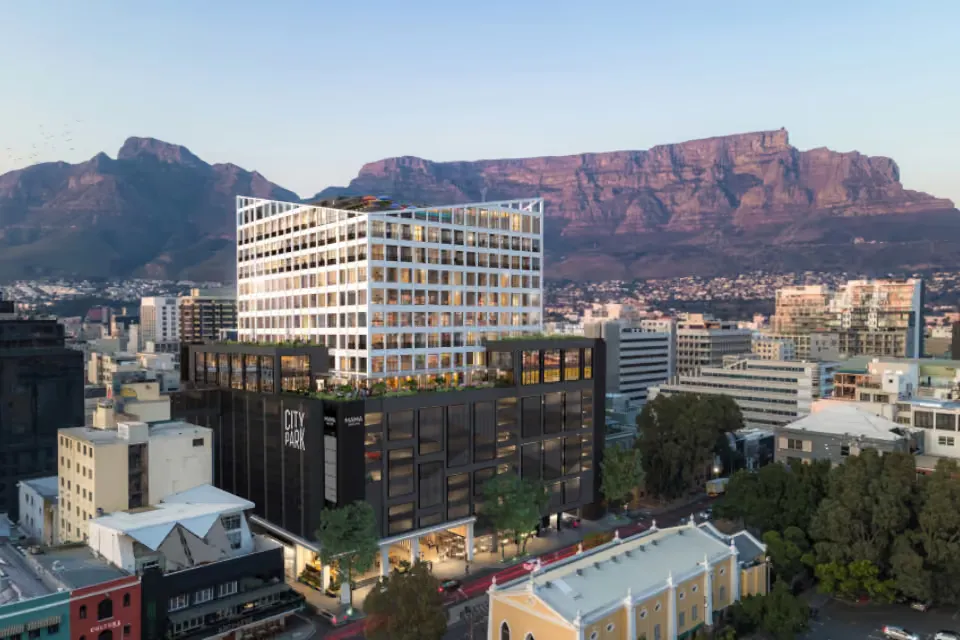
One of the most significant additions is City Park, the R1.3 billion redevelopment of the former Christiaan Barnard Hospital by Ingenuity Property Investments and Kasada Capital Management.
Scheduled to come on stream in Q3 2026, the project is expected to introduce approximately 10 500 m² of P-grade office space, alongside other uses that should contribute to both the daytime and night-time economy of the CBD.
Kane believes these developments create a multiplier effect extending well beyond the individual properties.
“As prominent buildings are upgraded or new developments take shape, they create greater confidence in the area. If you upgrade your building, others want to do the same.”
The Matrix raises the stakes
One of the biggest statements of confidence in Cape Town’s commercial market is Boxwood Property Fund’s planned R1.7 billion The Matrix development.
The proposed skyscraper at the intersection of Strand and Bree streets is set to include P-grade office accommodation, retail space and 570 parking bays, with completion scheduled for 2029. The development also highlights a factor that remains critical to corporate tenants: parking.
“Driving and parking is a South African reality, even as Cape Town moves towards a more walkable CBD,” says Kane.
While Cape Town continues to promote public transport, pedestrianisation and the concept of a 15-minute city, larger corporates still require sufficient parking ratios when selecting headquarters and major office locations.
“Existing properties do not always have the capacity or parking ratios required to accommodate larger tenants,” Kane says.
For developers, the challenge is therefore to reconcile the requirements of major corporate occupiers with the creation of a more pedestrian-friendly urban environment.
From office building to urban experience
That evolution is already influencing how new developments interact with Cape Town’s streets.
Kane argues that commercial buildings can no longer function as isolated structures disconnected from their surroundings. Developers increasingly need to consider restaurants, retail, public spaces, pedestrian movement and the broader experience created around their properties.
At The Matrix, for example, Boxwood has applied to remove parking immediately in front of the development to create more pedestrian space and allow restaurants and other businesses to extend onto the pavement.
The objective is a CBD where commercial buildings contribute not only office square metres but also to the quality and economic activity of the surrounding precinct.
OUTLOOK: Why Cape Town's commercial market matters
Cape Town's commercial property recovery should not be interpreted as a blanket boom across every office building. The 11.9% CBD vacancy rate in Q2 2026 shows that challenges remain, particularly for older or poorly positioned stock.
But underneath that headline number, the investment case is becoming more compelling. Limited new premium supply, relatively low metro vacancies, substantial redevelopment activity and continued corporate demand are creating a market increasingly divided between high-performing modern assets and buildings that need significant repositioning.
For investors, that divergence may create opportunity. Well-capitalised owners able to acquire, refurbish and reposition ageing office assets could benefit as obsolete stock is removed from the market or converted into residential, hospitality and mixed-use developments.
Meanwhile, the billions of rand flowing into projects such as City Park, The Matrix and other commercial and mixed-use developments demonstrate continued private-sector confidence in Cape Town's inner city.
The next chapter of the CBD is therefore unlikely to be about simply building more offices. It will be about building better offices, upgrading existing stock and creating mixed-use precincts where people want to work, live, invest and spend time.
As Kane concludes: “With each new development, the CBD can offer more to its residents, tenants and investors as it reshapes the urban experience into an ideal environment to work, live and play.”
For commercial property investors, the message from Cape Town is becoming increasingly difficult to ignore: capital is returning, quality is commanding demand, and the CBD is being repositioned for its next investment cycle.