





AI, inequality and why human connection still matters
- AI is reshaping commerce, cities and decision-making, but trust and human connection remain society's greatest assets.
- Housing affordability, climate shocks and demographic shifts are redefining how people live and communities function.
- Future built environments must prioritise resilience, walkability, flexibility and meaningful human interaction.
The future isn't just about technology
Artificial intelligence is transforming business, commerce and society at unprecedented speed. But according to Dion Chang, Founder of Flux Trends, Transition Guide and End-of-Life Doula, the defining challenge of the next decade won't be technology itself.
Instead, it will be how societies, cities and built environments preserve human connection amid rapid technological change.
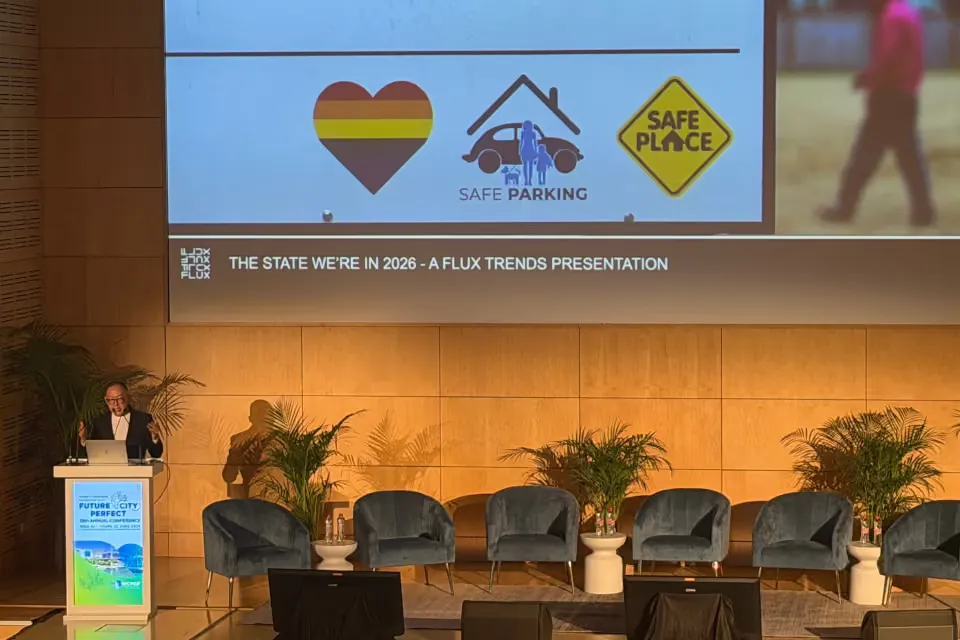
Speaking at the 13th annual conference hosted by Western Cape Property Development Forum on The State We're In 2026, Chang warned that AI, climate instability, inequality and shifting demographics are converging simultaneously, forcing businesses, property developers and governments to rethink what communities and spaces should look like.
"Ironically, the future of built environments is dependent on human connection, especially in an era where AI is accelerating every aspect of life."
AI is rewiring commerce and decision-making
Artificial intelligence is moving beyond being a tool to becoming an intermediary.
Agentic AI systems are beginning to shop, search and transact on behalf of consumers, fundamentally altering how businesses engage with customers.
Chang highlighted the shift from Search Engine Optimisation (SEO) to Generative Engine Optimisation (GEO), where AI agents increasingly summarise and make decisions before users even visit websites.
Key implications:
- AI agents may become the actual "customer".
- Traditional web traffic and search models are under threat.
- Businesses must learn to communicate with AI systems, not just humans.
- Entire financial and digital ecosystems are being rewired.
The dark side of AI: Fraud, trust and identity
AI is also creating new risks. Chang noted that AI-generated images, fake receipts, manipulated proof of delivery and even cloned identification documents are undermining trust across industries.
Financial institutions relying on document verification systems face increasing vulnerabilities.
Facial recognition technology presents another challenge. Mistaken identities can lead to people being excluded across entire retail networks, raising concerns around privacy, accountability and digital rights.
Key questions:
- How do institutions verify identity in an AI world?
- Who is responsible when algorithms get it wrong?
- Can trust survive synthetic realities?
The missing middle and a new housing reality
One of the most significant trends identified by Chang is the rise of ALICE households:
Asset limited, income constrained, employed
People with jobs are increasingly unable to afford housing despite being employed. This "missing middle" phenomenon is no longer confined to South Africa but is emerging globally.
Consequences include:
- More people living in vehicles.
- Growth of tent cities.
- Rising housing insecurity.
- Increasing pressure on affordability.
Multi-generational living returns
Economic realities are reshaping household structures. Young adults are staying at home longer, delaying homeownership and family formation. As a result:
- Multi-generational homes are making a comeback.
Chang says the Western obsession with independence is giving way to shared living arrangements long familiar across Africa and Asia.
New housing models are also emerging:
- Property guardianship
Originally developed in the Netherlands, empty buildings are occupied legally by residents in exchange for security and maintenance.
Countries embracing the model include:
- The Netherlands
- United Kingdom
- Ireland
- Germany
- France
These alternative living arrangements may become increasingly relevant in South Africa.
Climate whiplash is the new normal
Climate volatility is intensifying. Chang describes this phenomenon as "climate whiplash", rapid swings between extreme weather events.
Recent floods in the Western Cape and Eastern Cape, coupled with record heat across Europe, demonstrate how quickly conditions can change.
Impacts include:
- Crop losses.
- Infrastructure damage.
- Pressure on health systems.
- Rising insurance costs.
Climate resilience, he argues, must become a central component of urban planning and development.
How AI could transform insurance
One of AI's most promising applications lies in anticipatory insurance.
Using satellite imagery, weather models and predictive analytics, insurers can increasingly identify disasters before they occur.
Instead of paying claims afterwards, insurers could fund preventative action beforehand. AI-enabled insurance may:
- Help farmers move livestock.
- Protect homes before storms arrive.
- Reduce losses.
- Improve resilience.
Prevention may become more valuable than compensation.
The hidden cost of data centres
AI infrastructure requires enormous amounts of electricity and water. Chang warned that data centres are becoming the defining architecture of the 21st century, but not necessarily in a positive way.
Several new facilities proposed in South Africa could consume substantial portions of local electricity supply. Yet alternatives exist. In Switzerland, AI company Yera operates on renewable energy and recycles heat generated by servers to warm thousands of homes.
The lesson: Technology infrastructure must be designed with sustainability in mind.
Decision compression and the risk of cognitive offloading
AI is dramatically accelerating decision-making. Chang refers to this phenomenon as "decision compression".
In warfare, AI can reduce complex decisions to seconds. The same process is entering business. But speed brings risks. When humans outsource too much thinking to machines, they become detached from consequences.
Key challenge:
- How much decision-making should we delegate to AI?
- And where must human judgment remain indispensable?
Synthetic worlds and the search for authenticity
As deepfakes and synthetic influencers proliferate, trust is becoming increasingly fragile. People are struggling to distinguish what is real from what is manufactured.
Ironically, this uncertainty is increasing demand for genuine experiences and emotional connections. Authenticity is becoming a premium asset.
The rise of pets and the child-free generation
Demographic shifts are redefining households. More people globally now own pets than have children under 15.
Younger generations are:
- Delaying parenthood.
- Opting to remain child-free.
- Staying at home longer.
- Facing reduced prospects for homeownership.
The result is a booming pet economy. South Africa ranks among the world's most pet-friendly countries and pet-centred home design or "barkitecture", is becoming a growing trend.
Homes increasingly need:
- Pet-friendly layouts.
- Walking spaces.
- Shared community areas.
- Flexible living arrangements.
Why built environments must put humans first
Despite extraordinary advances in AI, Chang believes the future belongs to spaces that foster human interaction. Cities and developments cannot simply optimise for efficiency.
They must nurture belonging, relationships and wellbeing. Built environments will need:
- Walkability
- Community spaces
- Pet-friendly design
- Multi-generational living
- Climate resilience
- Flexible housing solutions
- Places that encourage connection
Humanity is the competitive advantage
Artificial intelligence is changing commerce, finance, work and decision-making faster than most people anticipated.
Yet amid inequality, climate disruption and demographic shifts, the defining challenge of the next decade is not technological sophistication. It is preserving trust, empathy and human connection.
For Dion Chang, the future of cities and property will not be measured solely by smart buildings or AI-powered systems.
It will be measured by whether the spaces we create enable people to live together, care for one another and build communities in an increasingly digital world.
"The future of built environments ultimately depends on human connection in an era increasingly shaped by artificial intelligence."