




.avif)
.avif)

Trustees, agents and the new rules of community scheme governance
- Community schemes face rising pressure from weak governance, trustee capability gaps and growing compliance demands.
- Volunteer trustees carry serious fiduciary responsibilities but often lack the training, time and support required.
- The future lies in stronger professional standards, better data, smarter systems and improved communication.
Why community scheme governance is under the spotlight
Community schemes have become one of the most important forms of housing and property ownership in South Africa. They include sectional title schemes, homeowners’ associations, share block developments and other forms of shared community living.
In reality, these schemes function as mini-economies. They collect levies, maintain shared assets, manage service providers, enforce conduct rules and protect the value of residents’ homes and investments.
Their governance falls within a formal regulatory framework. The Community Schemes Ombud Service (CSOS) oversees scheme governance, dispute resolution and registration, while the Property Practitioners Regulatory Authority (PPRA) regulates property practitioners and consumer protection. Both operate under the National Department of Human Settlements but perform different roles within the sector.
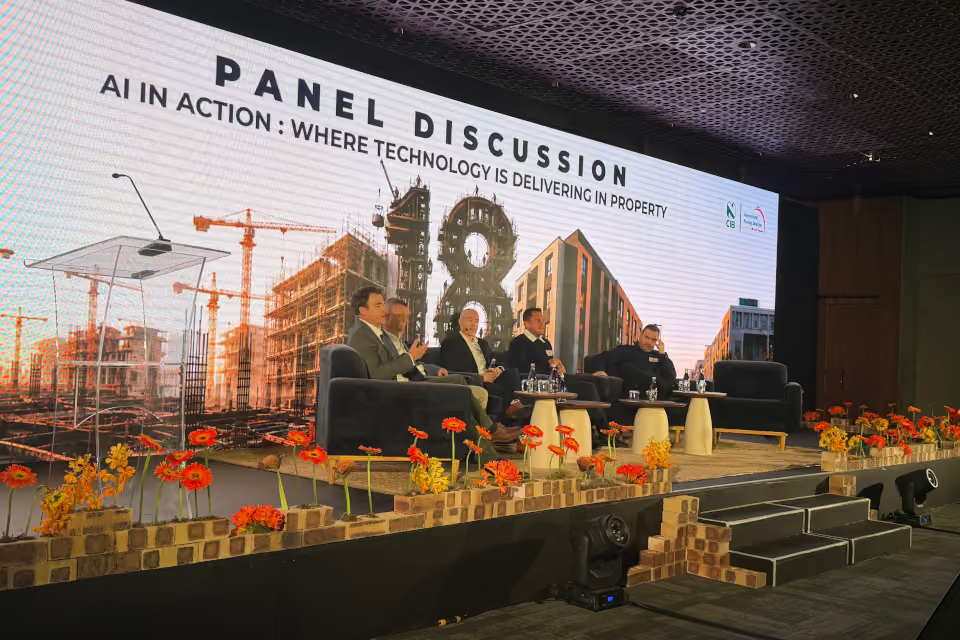
Against this backdrop, industry leaders gathered at the WeconnectU Engage 2026 conference at La Paris in Franschhoek to debate the evolving role of trustees and managing agents in sectional title and community scheme management.
Moderated by Tobie van der Merwe and Maritza Botha of WeconnectU’s Community Schemes division, the panel tackled tough questions around governance failures, trustee capability, compliance pressures, executive managing agents, data management and the growing operational demands being placed on managing agents.
At the centre of the discussion was a simple but powerful question: is the current governance model still fit for purpose?
A sector under pressure
Modern community schemes are far more complex than the apartment blocks of the past.
Trustees are expected to navigate fiduciary duties, financial management, reserve funds, maintenance planning, dispute resolution and regulatory compliance. Managing agents, meanwhile, increasingly play multiple roles of administrator, compliance partner, strategist and technology enabler.
At the same time, schemes face rising costs, ageing infrastructure, more demanding owners and growing regulatory oversight. Digital systems are also exposing governance weaknesses that may previously have gone unnoticed.
Hard truths about trustee governance
Marina Constas of BBM Law delivered one of the most direct assessments of the industry’s governance challenges. Her message was clear: many trustees are simply not equipped for the role they are expected to play.
Constas argued that compulsory trustee training shortly after appointment would significantly improve governance standards. Too often trustees enter office without a clear understanding of sectional title legislation, their fiduciary duties or the risks associated with poor decision-making.
She also emphasised the distinction between an administrator and an executive managing agent, noting that these are fundamentally different interventions designed for different governance failures.
Looking ahead, Constas believes the industry is moving towards a more professional community asset management model, where managing agents take a broader role in oversight, performance management and value enhancement.
She pointed to international examples such as Australia and the United States where managing agents operate as strategic partners rather than purely administrative service providers.
The shifting role of managing agents
Danie van der Merwe of WeconnectU highlighted another key trend: the evolving value of managing agents.
As automation and artificial intelligence take over routine administrative tasks, the real differentiator will be strategic value, enhancing community living, improving building performance and strengthening long-term asset management.
The focus, he argued, must shift from simply administering schemes to actively improving the resident experience, operational efficiency and investment value of community schemes.
Data, systems and professional standards
Johan Stander of Urbtech reinforced the importance of reliable information and systems.
Poor governance often goes hand in hand with poor data management. Fragmented systems, manual processes and inconsistent records make it harder to identify risks early and manage schemes effectively.
Meanwhile Vita Wilkens director & board member of NAMA (National Association of Managing Agents) emphasised the importance of industry self-regulation and professionalisation.
She clarified that while the PPRA regulates property practitioners and CSOS oversees scheme governance, organisations such as NAMA play a crucial role in building professional standards, advocating for the industry and supporting training and development.
Her message was clear: the industry cannot rely on government alone to professionalise the sector. Managing agents must organise, collaborate and raise standards from within.
Compliance challenges and the role of CSOS
Representatives from CSOS, Nokwanda Molefe & Nduduzo Mthimkhulu, acknowledged the challenges facing regulators.
They stressed that many schemes remain unregistered or fail to comply fully with governance requirements. Problems include outdated rules, incomplete financial submissions and limited use of digital platforms designed to improve transparency.
Technology, they said, can improve compliance and payment accuracy, but only if schemes and managing agents actively use the available systems.
Another area of debate centred on executive managing agents (EMAs). While often introduced to stabilise troubled schemes, concerns were raised about ensuring proper qualifications, oversight and support for professionals appointed to these roles.
Infrastructure, utilities and financial sustainability
Philip Nel of NABA Infrastructure Consultants Engineering and utility specialists also brought an operational perspective to the discussion.
Their warning was straight forward: Schemes that fail to monitor infrastructure and utilities properly will ultimately lose money.
Rising energy costs, solar installations, smart water metering and proactive maintenance planning are becoming essential tools for financially sustainable community schemes. Data and technology can assist, but only when supported by structured systems and professional expertise.
Key challenges facing community schemes
The debate revealed several recurring challenges across the sector.
- Trustee capability
This remains a major concern. Volunteer trustees often carry significant responsibility without adequate training or support. - Role confusion
This is another issue, with many schemes misunderstanding the responsibilities of trustees, managing agents, administrators and regulators. - Fragmented regulation
Between CSOS and the PPRA can also create uncertainty around governance and enforcement responsibilities. - Poor compliance culture persists.
Many schemes remain unregistered, submit incomplete records or fail to meet governance requirements. - Technology adoption
This presents another challenge. Digital platforms and AI tools can improve efficiency, but without structured data and proper systems they provide limited value. - Managing agents face increasing professional pressure
More is expected from managing agents every year while the market often still treats their role as purely administrative.
Signs of progress
Despite these challenges, the debate also highlighted encouraging signs.
There is growing agreement that professionalisation of the sector is essential. Industry leaders are increasingly recognising the importance of stronger trustee education, better data management and more strategic roles for managing agents.
There is also momentum behind improved collaboration between industry bodies, regulators and technology providers to strengthen governance standards.
The road ahead
The discussion at La Paris made one thing clear: the future of community scheme management will require more than simply maintaining the status quo.
Education, engagement and communication will remain critical, but they must be supported by stronger professional standards, better systems and clearer accountability.
Community schemes are no longer simple residential structures. They are complex property ecosystems responsible for protecting significant assets and investments.
The industry now faces a choice: lead the transition toward a more professional, data-driven and accountable governance model, or risk being forced into change by mounting governance failures and regulatory pressure.The shift has already begun





.svg)

.avif)


















.avif)