





Smarter offices are becoming a competitive advantage
- Smart offices are boosting productivity, reducing costs and helping businesses attract and retain top talent.
- AI, workplace analytics and flexible design are transforming offices into high-performing business assets.
- Organisations that optimise office space are improving collaboration, wellbeing and long-term profitability.
The office is no longer a cost centre, it's a growth strategy
For years, businesses have viewed office space primarily as an overhead to be minimised. Today, that thinking is rapidly changing.
As organisations adapt to hybrid working, rising operating costs and increasing competition for skilled employees, the modern workplace is emerging as a strategic business asset capable of improving productivity, reducing costs and strengthening organisational performance.
According to workplace design specialist Trend Group, companies that continue to measure office value purely in terms of rental costs risk overlooking far greater opportunities to improve efficiency, collaboration and long-term profitability.
Instead of asking "How much does our office cost?", businesses are increasingly asking "How much value does our workplace create?"
Modern offices are unlocking productivity
Hybrid work has permanently changed the way organisations operate. While remote work has provided employees with greater flexibility, it has also exposed new challenges around collaboration, employee engagement and digital fatigue.
Research highlighted by Forbes found that 69% of remote workers experience increased burnout from digital communication tools, while 53% say it has become more difficult to feel connected to colleagues.
As a result, the office is evolving from a place where people simply work into an environment specifically designed for collaboration, innovation, creativity and culture.
According to Trend Group, businesses are increasingly investing in workplace environments that actively support employee performance rather than simply providing desks and meeting rooms.
From overhead to opportunity
Technology is playing a major role in reshaping commercial workplaces. Artificial intelligence, workplace analytics and smart building systems are transforming traditional offices into intelligent environments capable of responding to the way employees actually work.
This shift is accelerating globally. According to JLL's 2025 Global Real Estate Technology Survey, 92% of corporate occupiers are already piloting artificial intelligence within their real estate and workplace functions.
Occupancy sensors, booking platforms, environmental monitoring systems and collaboration technologies now generate valuable workplace data that enables organisations to understand exactly how office space is being used. For many businesses, the findings are surprising.
Global workplace benchmarking shows average office utilisation remains between 55% and 65%, highlighting significant opportunities to optimise office layouts and improve space utilisation without compromising employee experience.
Rather than reducing office space indiscriminately, companies are increasingly redesigning workplaces around actual employee behaviour.
Smarter spaces, lower costs
Technology-enabled workplaces are also helping organisations control operating expenses.
Intelligent lighting, automated climate control, occupancy-based energy management and smart building platforms allow offices to consume fewer resources while creating more comfortable working environments.
These technologies not only lower electricity consumption and maintenance costs but also improve workplace functionality and sustainability.
For South African businesses facing rising municipal costs, electricity constraints and growing ESG obligations, smart buildings are rapidly shifting from optional investments to business necessities.
The result is an office that performs better while costing less to operate.
The workplace is now a talent strategy
One of the biggest shifts taking place is the changing role of the office in attracting and retaining talent.
Employees increasingly expect workplaces that promote flexibility, wellbeing and collaboration rather than traditional rows of fixed desks.
Trend Group believes workplace quality is becoming a competitive differentiator in the battle for skilled professionals.
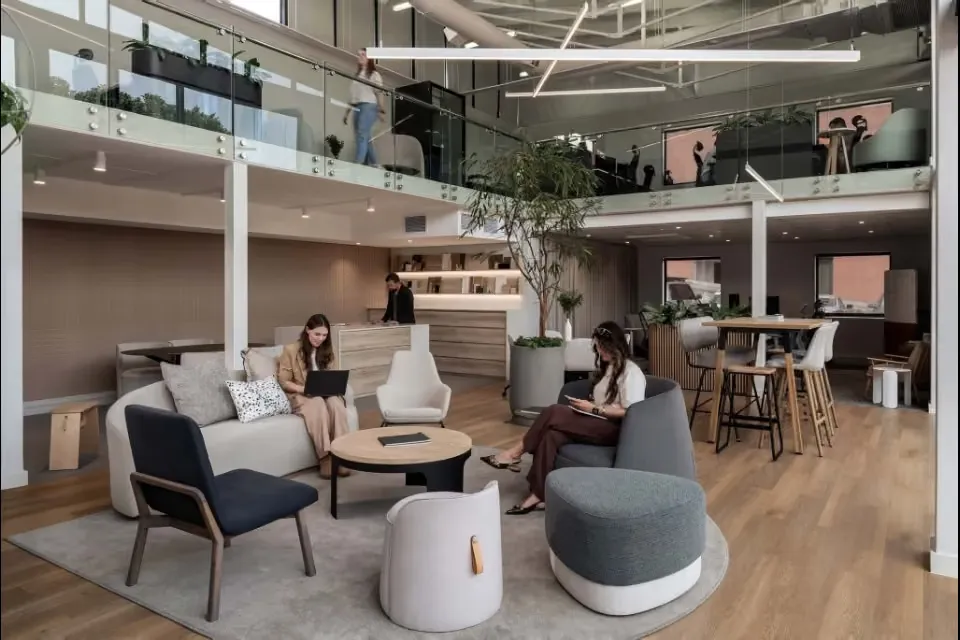
Modern offices incorporating collaboration technology, flexible work settings, ergonomic furniture, wellness features and adaptable meeting spaces help organisations improve employee engagement while strengthening company culture.
Technology alone, however, is not enough. The most successful workplaces combine digital innovation with thoughtful human-centred design that enables employees to perform at their best.
As Trend Group notes, the smartest workplaces are not necessarily those with the most technology, but those designed to help people collaborate more effectively, feel connected and achieve higher levels of performance.
Technology enabled workplaces deliver results
Trend Group has designed and delivered technology-enabled workplaces across multiple industries, including finance, telecommunications, professional services and enterprise technology.
Projects for organisations such as BASF South Africa and Boston Consulting Group demonstrate how flexible workplace design is helping businesses improve employee wellbeing, organisational performance and operational efficiency.
These projects reflect a broader shift taking place across the commercial property sector as businesses increasingly prioritise workplaces that support long-term resilience rather than simply reducing floor space
The future office is an investment, not an expense
The commercial office market is undergoing one of its most significant transformations in decades.
While rental costs remain important, they represent only one part of the equation.
The true cost of an office now includes productivity, collaboration, employee engagement, innovation, talent attraction and organisational culture.
Businesses that continue viewing office space solely as a cost centre risk missing opportunities to unlock significantly greater value.
Those investing in intelligent workplace design, smart technologies and human-centred environments are positioning themselves to reduce operating costs, improve performance and build more resilient organisations.
In today's business environment, the smartest office may no longer be the cheapest, it is the one that enables people and businesses to perform at their best.