








SARB faces toughest rate call of 2026
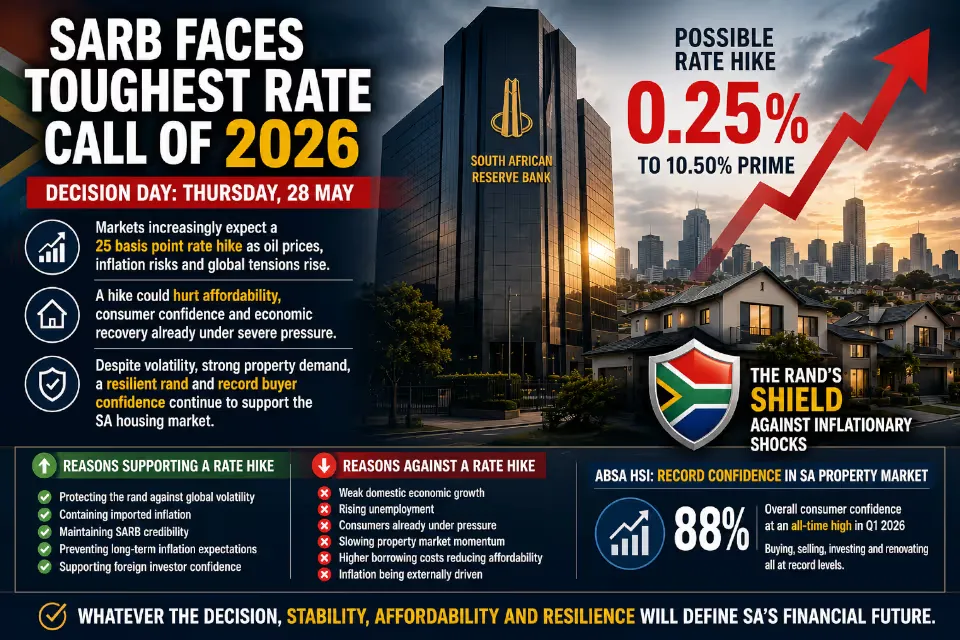
- Markets increasingly expect a possible 25 basis point rate hike as oil prices, inflation risks and Middle East tensions intensify.
- Property leaders warn a hike could hurt affordability, consumer confidence and economic recovery already under severe pressure.
- Despite global volatility, strong property demand, a resilient rand and record buyer confidence continue supporting South Africa’s housing market.
As the South African Reserve Bank Monetary Policy Committee (MPC) prepares to announce its latest interest rate decision on Thursday, 28 May, South Africa’s economy and property market stand at a critical crossroads.
What initially appeared earlier this year to be the beginning of a steady interest rate cutting cycle has rapidly shifted following escalating geopolitical tensions between Iran and the United States, rising oil prices, renewed inflation fears and heightened global market volatility.
With headline inflation climbing back to 4% in April from 3.1% in March and global crude oil prices surging amid Middle Eastern conflict, growing market expectations now point toward the possibility of a defensive 25 basis point rate hike by the Reserve Bank.
Should the SARB raise rates this week, the prime lending rate could increase to 10.50%, immediately impacting consumers, homeowners, property investors, businesses and broader economic confidence. Yet the decision is far from straightforward.
The battle between inflation and growth
The Reserve Bank now faces an increasingly delicate balancing act between containing inflation and protecting an already fragile economy struggling with weak growth, rising unemployment and deteriorating consumer affordability.
Samuel Seeff, Chairman of Seeff Property Group has made a strong call for the Bank to keep rates unchanged, arguing that the current inflation spike is largely temporary and externally driven rather than the result of overheating domestic demand.
“The reality is that this is a short-term inflationary blip which was entirely expected given the petrol price increase resulting from the Middle Eastern war-induced spike in the oil price on top of the annual Eskom electricity hike,” says Seeff.
“In fact, the inflation spike is not as high as we may have expected.” Seeff warns that increasing rates now would unfairly punish already strained consumers and potentially derail South Africa’s fragile economic recovery.
“With 345,000 jobs lost in the first quarter and unemployment up to 32.7%, economic optimism is weakening. Raising rates again would further hamper the economic recovery and punish consumers who are already burdened by the high interest rate.”
He argues that inflation remains largely imported and should not be treated as a sign of excessive consumer spending. “The higher inflation is largely imported. It is not the fault of consumers overspending in the economy, and they should not have to bear the brunt.”
Importantly, Seeff points out that inflation still remains within the SARB’s revised 3% to 4% target range, leaving room for the central bank to exercise caution and maintain policy stability. “This is critical for stability in the economy and property market,” he says.
Affordability versus resilience
Despite mounting global uncertainty, South Africa’s residential property market continues showing remarkable resilience.
According to Bradd Bendall of Betterbond, even if rates rise by 25 basis points, perspective remains important.
“A 10.50% prime rate remains significantly lower than the 11.75% highs experienced during 2024. For example, on a R2 million bond, monthly repayments will still be roughly R1,700 cheaper than they were two years ago, offering some comfort to over-extended consumers,” says Bendall.
However, he cautions that first-time buyers may face increasing affordability challenges. “Upfront deposit requirements have already surged by 38% for this segment in April alone. Coupled with a higher borrowing cost, this tightening credit environment may delay their entry into the market.”
Bendall says younger buyers are increasingly adapting through alternative strategies such as “rentvesting”, renting in preferred lifestyle areas while buying more affordable investment properties elsewhere.
Yet despite affordability pressures, Bendall notes that the property market enters this potential tightening cycle from a position of relative strength. Year-on-year home loan applications are up 6.2%, while average house prices continue reaching record highs.
“While a rate hike may temporarily cool short-term consumer enthusiasm, regional demand driven by semigration in the Western Cape and value-seeking buyers in Johannesburg’s south-eastern suburbs remains resilient,” he says.
The Rand’s defensive shield
The Reserve Bank’s decision this week is also deeply connected to protecting the rand and limiting imported inflation shocks.
According to Harry Scherzer of Future Forex, the SARB may view a pre-emptive rate hike as an important defensive tool to stabilise the local currency amid rising global volatility. “The ongoing conflict in the Middle East has pushed global oil prices above $100 a barrel, testing South Africa's newly implemented 3.0% inflation target,” says Scherzer.
“In this volatile environment, aggressive central bank policy acts as a vital shield for the local currency.”
He explains that maintaining attractive South African yields relative to developed economies helps support the rand through the emerging-market carry trade.
“This yield premium keeps the rand attractive to foreign yield-seeking investors, helping to anchor the currency and prevent capital flight.” A stronger rand becomes critical in limiting imported inflation caused by rising fuel prices and global supply-chain disruptions.
However, Scherzer warns that a supported rand does not necessarily eliminate broader economic risk.
“With fuel prices rising and local interest-rate swaps adjusting to price in higher-for-longer borrowing costs, businesses are facing unpredictable margins,” he says.
He adds that importers and exporters alike now face increasing currency volatility, forcing companies to move away from speculative approaches and adopt more structured hedging strategies. “Stability is the ultimate currency,” says Scherzer.
Absa sees strong underlying confidence
Despite macroeconomic uncertainty, rising fuel prices and geopolitical risks, South African consumer confidence in the property market remains surprisingly resilient.
Absa’s latest Homeowners Sentiment Index (HSI) for Q1 2026 recorded overall confidence at 88%, the highest level since the index launched in 2015.
The report revealed growing optimism among buyers, sellers, investors and renovators, with all sub-indices reaching record highs.
According to Tshepo Mashashane, many South Africans continue viewing property as one of the safest long-term investment assets available.
“The main driver of positive sentiment is that many South Africans believe property is a secure asset for investment,” says Mashashane.
“Investors are also expected to play a key role in the market, driven by ongoing demand for rental properties.” The report also showed particularly strong confidence among younger buyers aged between 25 and 34, highlighting continued long-term demand for homeownership despite affordability pressure.
Mashashane acknowledges, however, that rising fuel prices and global instability could still influence sentiment going forward. “Only time will tell whether there is a delayed impact as the macroeconomic environment changes,” he says.
The pros and cons of a possible hike
Reasons supporting a rate hike:
- Protecting the rand against global volatility
- Containing imported inflation
- Maintaining SARB credibility and inflation targeting
- Preventing long-term inflation expectations from rising
- Supporting foreign investor confidence
Reasons against a rate hike:
- Weak domestic economic growth
- Rising unemployment
- Consumers already under pressure
- Slowing property market momentum
- Higher borrowing costs reducing affordability
- Inflation being externally driven rather than demand-driven
The final call
Thursday’s MPC decision could become one of the most closely watched monetary policy moments in recent years.
A 25 basis point hike would signal that the Reserve Bank is prioritising inflation control, currency stability and long-term credibility amid growing global uncertainty.
Holding rates unchanged, however, would offer consumers, businesses and the property market much-needed breathing room at a time when economic growth remains fragile and affordability pressures continue intensifying.
Either way, South Africa’s financial landscape is entering a more uncertain and volatile phase. Yet despite the mounting pressure, one message continues emerging clearly across the property sector:
South Africa’s residential market remains far more resilient than many expected, supported by long-term demand, semigration trends, investment appetite and the enduring belief that property remains one of the country’s most important wealth-building assets.