










SA housing market holds firm as banks compete for buyers
Listen · 1-minute summary
0:00 / 1:23
Read the summary
SA housing market holds firm as banks compete for buyers. New data from ooba Home Loans for the third quarter of 2026 shows a market that is recalibrating, not retreating. House prices rose 5 percent annually to R1.76 million, even as home loan applications increased 2.1 percent quarter-on-quarter. Banks are fighting harder for quality borrowers, with September mortgage discounts averaging prime minus 0.83 percent, the most competitive level since 2009. Approval rates stayed strong at 84.3 percent. First-time buyers still made up 46.5 percent of applications, though many are leaning on zero-deposit and cost-inclusive loans to get into the market. Property investors are gaining ground too, now accounting for 13.1 percent of applications nationally, with the Western Cape leading at 33.7 percent. Rhys Dyer, CEO of the ooba Group, says, "While home loan activity remains below year-earlier levels, the data points to a market recalibrating rather than retreating." Affordability remains the biggest challenge ahead, but prepared buyers and selective investors are still finding opportunities. Read the full story by Neale Petersen on rei.co.za.

Despite higher borrowing costs and pressure on household finances, ooba Home Loans' Q3 2026 data reveals resilient property prices, stronger lending activity and growing investor demand.
- House prices rose 5% annually to R1.76 million, while home loan applications increased 2.1% quarter-on-quarter despite affordability pressures.
- Bank competition intensified, with September mortgage discounts averaging prime minus 0.83%, the most competitive levels recorded since 2009.
- Property investors gained ground, accounting for 13.1% of applications nationally, with the Western Cape leading at 33.7%.
Housing market recalibrates rather than retreats
South Africa's residential property market is showing encouraging signs of resilience despite higher interest rates, rising household expenses and continued pressure on homebuyer affordability.
New data from ooba Home Loans for the third quarter of 2026 reveals a market that is neither booming nor retreating. Instead, buyers are becoming more selective, banks are competing aggressively for quality borrowers, and property investors are identifying opportunities in specific regional markets.

According to Rhys Dyer, CEO of the ooba Group, modest quarterly improvements in home loan activity suggest that underlying demand for residential property remains intact. “While home loan activity remains below year-earlier levels, the data points to a market recalibrating rather than retreating,” says Dyer.
The latest figures offer important insights for homebuyers, property investors and estate agents navigating the final quarter of 2026.
1. Home loan activity improves despite affordability pressures
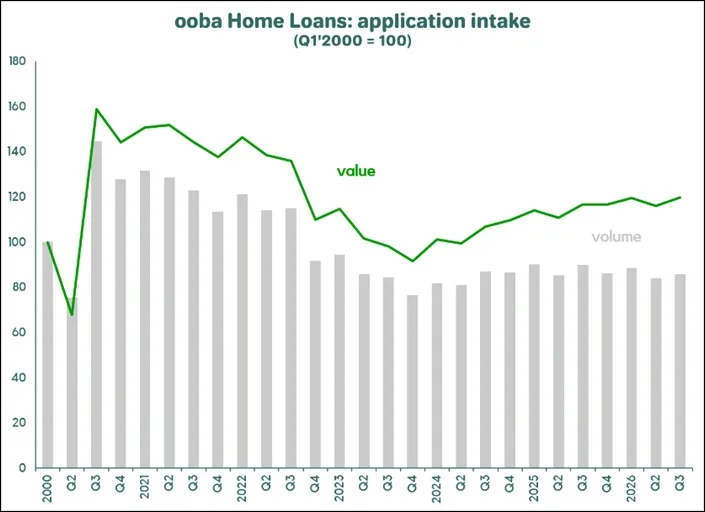
Although borrowing costs continue to constrain household budgets, mortgage activity improved between the second and third quarters.
The recovery remains modest, but it suggests that buyers are adapting to prevailing economic conditions rather than abandoning homeownership plans. Q3 2026 lending highlights:
- Applications received: Volumes increased 2.1% quarter-on-quarter.
- Application values: Rose 3.2% from Q2.
- Home loans granted: Volumes increased 1.7%.
- Value of approved loans: Increased 2.4% quarter-on-quarter.
Dyer believes the improvement is encouraging against a backdrop of higher fuel prices, interest-rate increases and household financial pressure. The figures indicate that demand remains present, although buyers are taking a more measured approach to purchasing decisions.
2. House prices rise 5%, but buyers become more cautious
National house prices continued to increase during Q3 2026, with annual growth exceeding consumer inflation. However, the slight quarterly decline suggests that buyers are becoming more price-sensitive.
Key property price indicators:
- Average national purchase price: R1,758,491, up 5% year-on-year.
- Quarterly movement: Average prices declined 0.5% from Q2.
- First-time buyer purchase price: R1,292,263, up 5.1% annually but down 1.8% quarterly.
- Approved bond sizes: Increased 7.7% annually overall and 5.7% among first-time buyers.
- Average deposits: Declined from 13.4% to 12.3% of purchase prices.
First-time buyers also reduced their average deposits from 8.9% to 8.4%. These figures suggest that purchasers are increasingly relying on mortgage finance while limiting the amount of cash committed upfront.
Regional property markets tell different stories
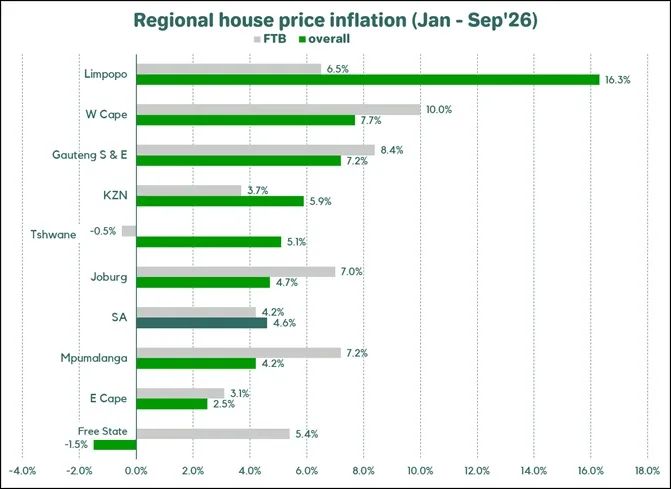
National averages conceal substantial differences between provincial and regional markets. According to ooba, seven of the nine regions monitored recorded overall house price growth above the 4% inflation benchmark used in its regional analysis.
Regional highlights:
- Limpopo: Recorded the strongest overall house price inflation at 16.3%.
- Free State: Experienced a 1.5% decline in average prices.
- Western Cape: Continued to demonstrate strong first-time buyer price growth.
- Gauteng South & East and Mpumalanga: Also recorded notable first-time buyer price increases.
- Tshwane: Overall prices increased while first-time buyer prices declined.
The variation reinforces the importance of analysing local market fundamentals rather than relying exclusively on national averages.
3. First-time buyers remain active despite financial pressure
First-time homebuyers remain a vital component of South Africa's housing market, accounting for almost half of all mortgage applications. However, their participation has moderated as affordability pressures persist.
First-time buyer and financing highlights:
- Market participation: First-time buyers represented 46.5% of applications, down from 48.1% in Q2.
- Zero-deposit applications: Accounted for 56.6% of all applications received.
- Cost-inclusive loans: Increased to 9.8% of applications, compared with 6.6% a year earlier.
- Zero-deposit approval rates: Reached 82.4% overall and 79.5% among first-time buyers.
Cost-inclusive financing can help qualifying buyers cover certain transaction expenses, including transfer and bond registration costs. For prospective homeowners struggling to accumulate substantial savings, these financing options can provide an alternative route into the market.
However, buyers must still assess affordability carefully, particularly where higher loan amounts increase monthly repayments and long-term interest costs.
4. Bank competition delivers the best discounts since 2009
One of the most encouraging developments in the Q3 report is the intensifying competition between banks for mortgage business. Despite recent interest-rate increases, lenders are offering more competitive discounts to attract creditworthy applicants.
Bank lending highlights:
- Average Q3 discount: Prime minus 0.76%, an improvement of 10 basis points from Q2.
- September discount: Prime minus 0.83%, the most competitive level since the first quarter of 2009.
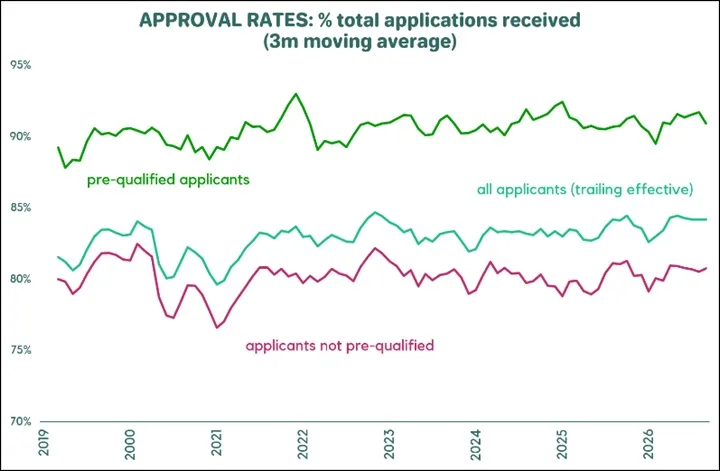
- Effective approval rate: Remained strong at 84.3%.
- Pre-qualified applicants: Achieved a 91.1% approval rate.
- Non-pre-qualified applicants: Recorded an 80.9% approval rate.
“The competition for quality borrowers remains strong and is translating into attractive interest rate discounts and consistently high approval rates,” says Dyer.
For buyers, the message is significant: the interest rate offered by a bank can materially influence the long-term cost of homeownership. Pre-qualification and comparing multiple lenders can therefore improve both the likelihood of approval and the competitiveness of financing terms.
5. Property investors increase their share of the market
While owner-occupier buyers remain cautious, investor activity is gaining momentum. Property investors accounted for 13.1% of mortgage applications in Q3, an increase of 1.6 percentage points from a year earlier.
The Western Cape continues to stand out as South Africa's most investor-oriented residential market. Investor market highlights:
- National investor participation: Increased to 13.1% of applications.
- Western Cape: Investors accounted for 33.7% of provincial applications.
- Mpumalanga: Investor participation increased 3.4 percentage points quarter-on-quarter.
- Limpopo: Recorded an increase of 3.2 percentage points.
- Gauteng South & East: Investor participation rose 3.0 percentage points.
The figures suggest that investors are identifying selective opportunities despite borrowing costs and broader economic uncertainty. For property investors, opportunities must still be evaluated against achievable rentals, vacancies, operating costs, levies, maintenance and financing expenses.
Importantly, investor application share measures mortgage demand, not completed transactions or guaranteed investment returns.
6. What lies ahead for South Africa's housing market?
Looking towards the end of 2026, affordability is likely to remain the defining challenge for residential property. Households continue to face pressure from living costs, while uncertainty surrounding interest rates may influence purchasing decisions.
Nevertheless, ooba's figures suggest that the market retains important sources of support.
Key trends to watch:
- Bank competition: Attractive mortgage discounts could help qualifying buyers manage borrowing costs.
- Selective buying: Purchasers are likely to remain focused on affordability, value and location.
- Life-stage demand: Growing families, downsizers and relocating households will continue to drive transactions.
- Investor activity: Markets with sustainable rental demand may attract additional investment.
- Regional performance: Local economic conditions will remain important determinants of property price growth.
Dyer believes prepared buyers can still find opportunities, particularly where pre-qualification and competitive mortgage offers strengthen their purchasing position.
The bottom line: A resilient but increasingly selective market
South Africa's residential property market is demonstrating resilience rather than rapid recovery. Annual house price growth of 5%, improving quarterly mortgage activity and competitive bank lending all point towards a market that continues to function despite affordability constraints.
The strongest opportunities are likely to favour buyers who understand their financial position, compare financing options and make informed decisions based on local market conditions.
For property investors, the growing share of mortgage applications is encouraging, particularly in the Western Cape, but disciplined due diligence remains essential.
The key takeaway is that South Africa's housing market has not stalled. It is adjusting to economic realities, with prepared buyers and selective investors continuing to find opportunities.
Source: ooba Home Loans, Q3 2026 housing market data. Figures relate to ooba's reported mortgage application and approval activity and should not be interpreted as a complete census of all South African property transactions.