




.avif)
.avif)

Rental growth hits 5.2%, but inflation is catching up
South Africa’s rental market strengthened in Q2 2026, led by exceptional Western Cape growth, but inflation and affordability are squeezing real returns.
- National rental growth accelerated to 5.2% in Q2, lifting the average monthly rent to a record R9,715.
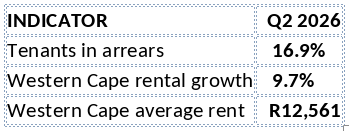
- Western Cape rents surged 9.7% to R12,561, while just 12.3% of tenants were in arrears.
- Inflation reached 5.0% in June, leaving rental growth only narrowly ahead as landlords face rising ownership and operating costs.
SA rentals strengthen, but the headline hides a divided market
South Africa’s residential rental market delivered its strongest quarterly growth in more than a year during Q2 2026, providing welcome momentum for landlords after a period of more moderate increases.
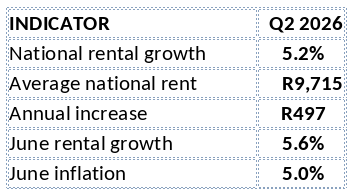
According to the latest PayProp Rental Index, national rental growth accelerated to 5.2% year on year, taking the average monthly rent to a new high of R9,715, R497 more than a year earlier. But investors need to look beneath the national number.
The quarter exposed an increasingly fragmented rental market. The Western Cape significantly outperformed the rest of the country, seven of nine provinces grew more slowly than the national average, inflation accelerated and tenant affordability remains under pressure.
For landlords, the message is increasingly clear: rental growth alone doesn't determine investment performance. What matters is the growth you retain after inflation, operating costs, vacancies and arrears.
Strong rental growth
Momentum strengthened throughout Q2. Annual rental growth increased from:
- 4.7% in April
- 5.3% in May
- 5.6% in June
June therefore recorded the fastest monthly rental growth since February 2025. For investors, that suggests landlords in many markets have regained some pricing power, but that power varies considerably depending on location.
“It’s encouraging to see rental growth accelerate for a second consecutive quarter, but Q2 also shows just how differently provincial rental markets are performing,” says Michelle Dickens, Commercial Director at PayProp.
Q2 RENTAL SNAPSHOT
Western Cape pulls ahead
The standout story is unquestionably the Western Cape. Rental growth reached 9.7% in Q2, the province’s strongest performance since Q4 2024.
Average rent climbed to R12,561 per month, an increase of R1,107 year on year and R436 in just one quarter. That puts Western Cape rents R1,999 above the Northern Cape, now the country’s second-most expensive provincial rental market.
But the Western Cape is doing more than simply outperforming. It is materially lifting the national average. PayProp calculates that without the Western Cape, national rental growth would have been only 4.3%, below inflation.
That is an important distinction for investors assessing national rental-market headlines.
High rents haven't broken payment performance
Despite the rapid escalation in rentals, Western Cape tenant payment performance remains exceptionally strong.
Only 12.3% of tenants were in arrears during Q2, the lowest percentage PayProp has recorded for any province in the history of its Rental Index. However, affordability is becoming increasingly important.
More than 27.5% of Western Cape rental properties now command rents above R15,000 per month, while a tenant with a budget of R7,500 has access to less than a quarter of the province's rental stock.
For investors, that creates a balancing act: strong demand can support rental escalation, but rents cannot indefinitely outrun tenant incomes and affordability.
Provincial fortunes shift again
The Western Cape was not the only province outperforming. The North West recorded rental growth of 7.8%, accelerating from 6.5% in Q1. Average monthly rent reached R7,679, up R554 year on year.
Elsewhere, performance was much more subdued.
- Gauteng: 4.4% growth | R9,646 average rent
- KwaZulu-Natal: 4.2% | R9,657
- Northern Cape: 4.3%, down sharply from 12.9% in Q1
- Limpopo: 4.1%, its lowest growth since Q4 2021
- Free State: 3.3%
- Mpumalanga: 2.3%, although up from just 0.4% in Q1
One particularly interesting comparison is Gauteng versus KwaZulu-Natal. Their average rents are now separated by just R11, despite being very different provincial property markets.
Dickens says the movements reinforce the importance of local intelligence. “Provincial performance can shift significantly from one quarter to the next. For landlords and rental professionals, up-to-date local market data is essential when setting rents and assessing the performance of a rental property.”
That is arguably one of the most important investor takeaways from the report: don't price a property off the national rental market. Price the actual submarket in which you own.
Inflation closes the gap
Here lies the warning behind otherwise strong Q2 numbers. Inflation accelerated during the quarter and reached 5.0% in June.
Rental growth remained ahead of inflation, but only narrowly. As a result, real rental growth is now at its weakest level since Q3 2024, despite stronger nominal rental increases.
That distinction matters. A landlord receiving a 5% increase in rent isn't necessarily 5% better off if maintenance, insurance, rates, levies, finance and other ownership costs are also increasing.
“Stronger rental growth is positive, but it needs to be viewed in the context of the wider cost environment,” Dickens says. “The margin over inflation has narrowed, and that will be important to watch over the remainder of the year.”
INVESTOR WATCH
Investors should therefore track five numbers, not simply annual rental escalation:
- Achievable rent →
- Vacancy →
- Arrears →
- Operating-cost inflation →
- Net yield
Ultimately, it is the net income remaining after expenses and lost income that determines the performance of the investment.
Arrears edge up from record low
Tenant payment performance remains one of the healthier features of the rental market, although Q2 produced the first sign of deterioration.
The percentage of tenants in arrears increased marginally from a record-low 16.7% in Q1 to 16.9% in Q2. That remains the joint-second-lowest arrears level recorded in the PayProp Rental Index. There was also a small improvement among tenants who were behind on payments.
Average arrears declined from 74.3% of one month’s rent to 73.5%. The bigger concern may lie ahead. PayProp notes that higher interest rates could increase debt repayments for tenants, with debt servicing accounting for a significant portion of average tenant income.
Importantly, arrears tend to lag interest-rate movements by around six to nine months. That means pressure experienced now may only become fully visible around the end of 2026 and beginning of 2027.
“Arrears remain close to record lows, which is encouraging,” Dickens says. “But the Q2 results show why landlords and rental professionals need to look beyond national averages.”
The bottom line: follow the real return
Q2 2026 delivered encouraging news for South African residential landlords. Rents are growing. Average rentals have reached record levels. Arrears remain historically low. And the Western Cape continues to demonstrate exceptional pricing power.
But investors should resist reading the 5.2% national rental-growth figure in isolation. Strip out the Western Cape and the national picture is considerably weaker. Inflation is closing the gap on rental escalation, affordability is being stretched in expensive markets and higher household debt costs could eventually feed into arrears.
The strongest rental investment therefore isn't necessarily the property achieving the biggest annual increase. It is the property capable of delivering sustainable rental growth, reliable tenant payment, manageable costs, low vacancy and a competitive net yield.
For the second half of 2026, that makes local market intelligence and tenant affordability every bit as important as headline rental growth.
ACCESS THE LATEST PAYPROP RENTAL INDEX Q2
Download the PayProp Rental Index





.svg)

.avif)


















.avif)