









LiDAR's real value is certainty, not just data
- LiDAR delivers certainty that reduces costly design errors, delays and construction rework.
- Digital twins help owners manage assets long after construction is complete.
- Technology alone is not enough, expert interpretation remains critical to success.
Beyond the Point Cloud: Why LiDAR is changing construction
As buildings become more complex and project costs continue to rise, architects, developers and property owners are increasingly looking to technology to improve accuracy, reduce risk and make better decisions.
One technology rapidly gaining traction across the built environment is LiDAR, short for Light Detection and Ranging.
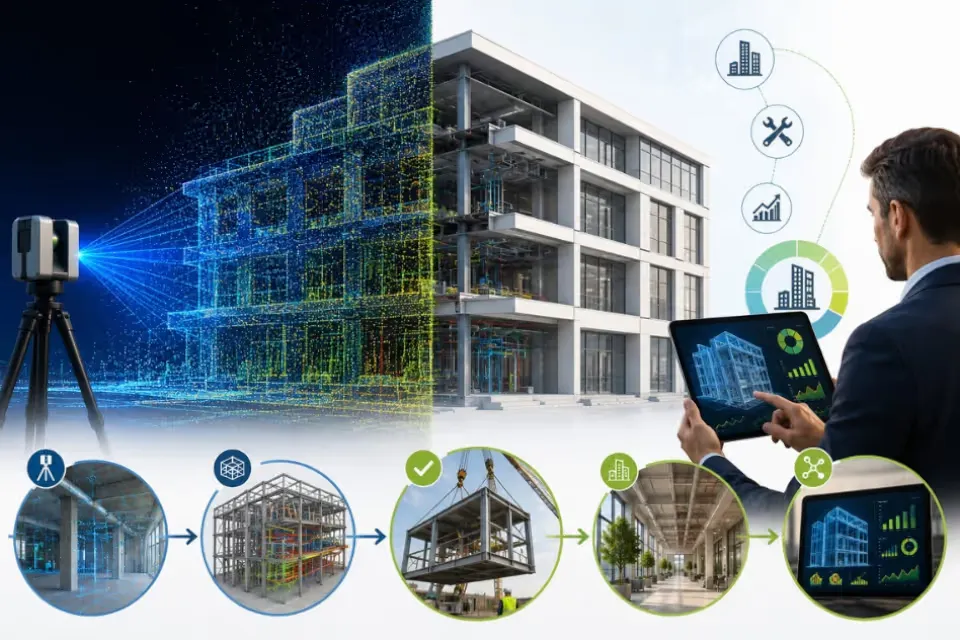
LiDAR works by using laser pulses to measure distances and create millions of highly accurate three-dimensional data points known as a point cloud. These data points capture the exact dimensions and geometry of a building, site or structure, creating a detailed digital representation of the physical environment.
While many people view LiDAR as simply a sophisticated measuring tool, Edward de Jager, Head of Operations at BPAS Architects, argues that this misses the point entirely.
"The most common misunderstanding is the belief that a raw LiDAR scan is a finished BIM model. In reality, converting a LiDAR point cloud into a smart, parametric model still requires significant human expertise and processing time."
According to De Jager, the scan itself is merely the starting point. The true value lies in the certainty that accurate data provides throughout a building's lifecycle.
BPAS uses LiDAR technology to create highly accurate Building Information Models (BIM) and digital twins that support design coordination, asset management, maintenance planning and long-term decision-making.
"When a point cloud is integrated into BIM, teams are no longer working from assumptions, incomplete surveys or outdated drawings. They are working from a precise digital representation of reality," says De Jager.
The hidden cost of 'Good Enough'
One of the biggest challenges facing the construction industry is the widespread acceptance of approximation.
Many projects begin with traditional surveys that are considered "good enough," only for inaccuracies to emerge later during design development or construction.
The result is often a cascade of avoidable problems.
"The industry often defaults to 'good enough' traditional surveys, ignoring the compounding interest of errors that occur when every subsequent consultant works off an inaccurate original measurement," says De Jager.
Minor inaccuracies introduced early in a project can quickly snowball into significant downstream issues, including:
- Structural clashes
- Design conflicts
- Material wastage
- Rework and reconstruction
- Delays to project completion
- Escalating project costs
- Variation orders and claims
By the time these issues become visible on site, they are often expensive and disruptive to resolve. De Jager believes many organisations continue to underestimate the financial consequences of uncertainty.
"Many firms still treat high-resolution data as a luxury, failing to realise that the cost of a LiDAR scan is negligible compared to the 10% to 20% budget blowouts caused by late-stage structural surprises."
The real benefit of LiDAR, therefore, is not the scan itself, but the confidence and certainty it provides before construction begins.
Identifying problems digitally before they become physical
One of the most powerful advantages of LiDAR is its ability to identify potential issues in a virtual environment before they occur in the real world.
By capturing complex geometries and structural conditions with millimetre-level accuracy, project teams can identify clashes, conflicts and design constraints long before construction starts.
"By capturing complex geometries and hidden structural deviations that traditional tools might miss, it eliminates the surprises typically found during construction," says De Jager.
This capability is particularly valuable when coordinating:
- Structural steel installations
- Timber construction systems
- Building services
- Mechanical and electrical infrastructure
- Bespoke architectural components
- Prefabricated building elements
According to BPAS, accurate scan data enables teams to test designs digitally, ensuring components fit correctly before arriving on site.
"Having a millimetre-accurate scan allows us to detect clashes between new designs and existing structural elements virtually, long before a single brick is laid." The result is faster construction, less waste and fewer costly surprises.
Instead of reacting to problems during construction, project teams can proactively resolve them during the design phase when changes are significantly cheaper and easier to implement.
The long-term value of a digital twin
While much attention focuses on the design and construction benefits of LiDAR, some of its greatest value emerges after a project is completed.
Using LiDAR data, architects and engineers can create a digital twin, a dynamic virtual representation of a physical building.
Unlike traditional drawings or static models, digital twins can evolve throughout a building's lifecycle and become a powerful operational management tool.
"A digital twin serves as a living record that allows facility managers to simulate maintenance scenarios and monitor structural health throughout the building's lifecycle," says De Jager.
When integrated with sensors and building management systems, digital twins can support:
- Predictive Maintenance
Identifying potential failures before they occur.
- Energy Optimisation
Monitoring performance and improving operational efficiency.
- Asset Management
Providing accurate information for maintenance and refurbishment planning.
- Portfolio Analysis
Helping investors and owners compare asset performance across multiple properties.
De Jager notes that some clients are already using digital twin data to evaluate acquisition opportunities and improve portfolio management decisions.
The technology is therefore evolving beyond architecture and construction into a strategic business intelligence tool.
Technology backed by human expertise
Despite the rapid advancement of LiDAR, digital twins and artificial intelligence, BPAS cautions against assuming that technology alone guarantees success.
The quality of outcomes still depends heavily on human expertise. "There is also a misconception that a digital twin is a 'set-and-forget' product rather than a living data ecosystem."
Without proper interpretation, ongoing maintenance and integration with building management systems, even the most sophisticated digital model can quickly lose relevance.
De Jager emphasises that the real value comes from combining advanced technology with experienced professionals who understand how to translate data into practical insights and informed decisions.
A scan can capture reality. But it takes expertise to understand what that reality means.
The future shaped differently
As construction projects become more complex and margins come under pressure, certainty is becoming one of the most valuable commodities in the built environment.
LiDAR is not simply about producing highly detailed scans or impressive 3D models. Its real value lies in reducing uncertainty, identifying risks earlier, improving collaboration and enabling better decision-making across the entire lifecycle of a building.
For developers, architects, contractors and property owners, the question is no longer whether digital technologies like LiDAR and digital twins will shape the future of the industry.
The question is how quickly organisations can adopt them effectively.
Because in a world where project delays, budget overruns and operational inefficiencies can destroy value, certainty is rapidly becoming a competitive advantage.