







Joburg property: Bargain prices or a warning sign?
Listen · 1-minute summary
0:00 / 1:25
Read the summary
Joburg property: Affordable value or a warning sign? Johannesburg offers larger homes and better value per square metre than Cape Town. But failing municipal services are raising questions about hidden costs and future returns. Stats SA reports annual price growth in June 2026 of 12 percent in Cape Town, against 4.9 percent in Johannesburg. Research by MANCOSA found that 56.8 percent of South African households experienced water interruptions during 2025. Owners in Johannesburg increasingly pay for solar, batteries, water tanks, boreholes and private security. These costs can cut net rental yields and strain cash flow. Grant Smee, CEO of Only Realty Property Group, says: "You can renovate a kitchen or install an inverter. You cannot personally fix the water network running through your suburb." The article urges investors to look beyond the asking price. They should check local water and electricity interruptions, recent selling prices, rental demand and the condition of roads. A well-priced property in a reliably serviced neighbourhood may deliver stronger long-term returns than a cheaper one with hidden costs. Read the full story by Neale Petersen on rei.co.za.
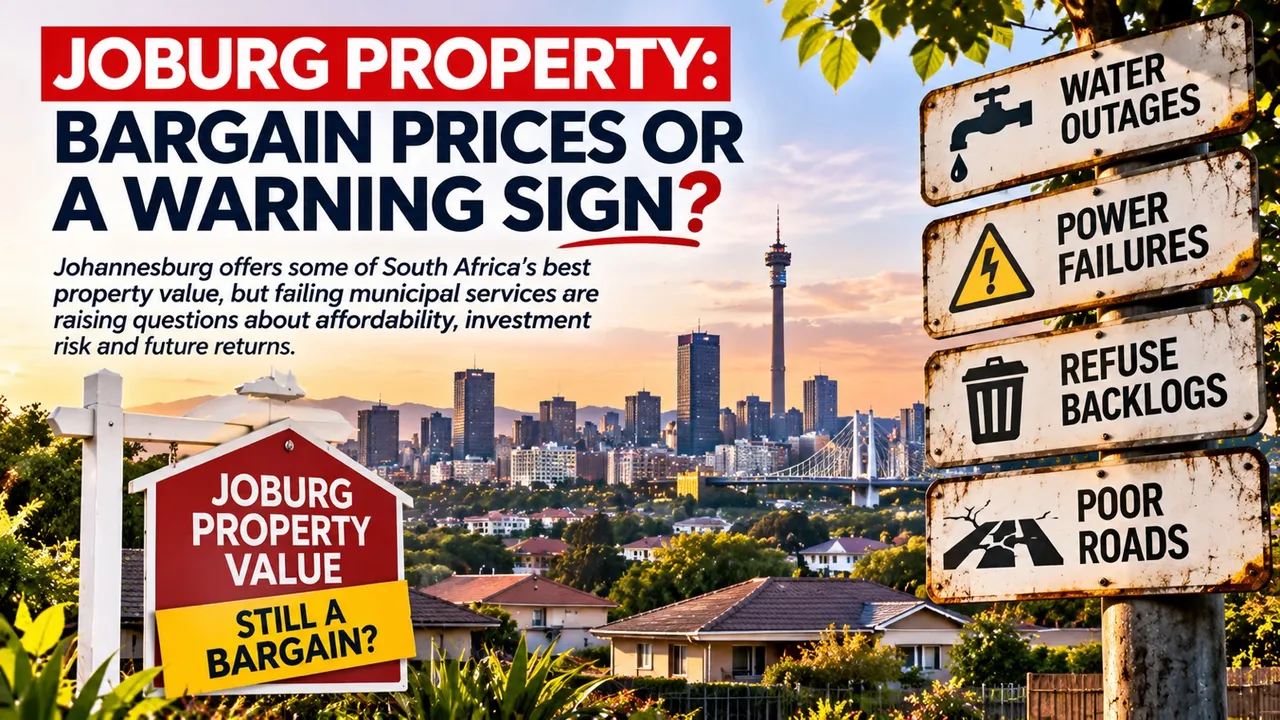
Johannesburg offers some of South Africa’s best property value, but failing municipal services are raising questions about affordability, investment risk and future returns.
- Affordability under pressure Johannesburg offers significantly more property for less, but municipal failures are increasing the hidden costs of ownership.
- Property performance diverges Stats SA reports 12% annual price growth in Cape Town versus 4.9% in Johannesburg in June 2026.
- Service delivery drives confidence Reliable water, electricity, roads and municipal management are becoming increasingly important to property values and investment decisions.
When affordability becomes a warning sign
Johannesburg has long offered one of South Africa’s most compelling residential property propositions: larger homes, established suburbs, access to the country’s economic heartland and significantly better value per square metre than Cape Town.
But a fundamental question is emerging for homeowners, buyers and property investors: is Johannesburg still offering genuine value, or are lower property prices increasingly reflecting the financial risks of unreliable municipal services?
Following the 4 November local government elections, which placed municipal performance firmly in the spotlight, the relationship between service delivery, buyer confidence and property values has become increasingly important.
Grant Smee, CEO of Only Realty Property Group, believes Johannesburg’s future property performance will depend less on competing with Cape Town’s prices and more on restoring confidence in the city’s infrastructure and management.

“Joburg does not, and should not, need to try to emulate Cape Town’s property market on house prices – I do believe that the latter is experiencing a semigration and tourism-induced bubble,” says Smee.
“But there is a difference between a home being affordable because a city offers good value and being discounted because buyers are pricing in the cost and risk of unreliable services.”
1Service delivery is becoming a property market issue
Municipal performance has moved beyond being a political concern. For property owners and investors, it increasingly influences operating costs, rental demand, tenant retention and long-term asset values.
Johannesburg residents have experienced recurring water interruptions, electricity infrastructure problems, deteriorating roads, broken traffic lights and refuse collection challenges.
Research by MANCOSA, published ahead of the municipal elections, highlighted the scale of the national infrastructure problem, reporting that 56.8% of South African households experienced water interruptions during 2025.
Why investors should pay attention
- Water reliability Interruptions increase the need for storage tanks, pumps and alternative water infrastructure.
- Electricity security Unreliable supply creates additional expenditure on solar, batteries and backup systems.
- Municipal maintenance Deteriorating roads, public spaces and infrastructure can undermine neighbourhood appeal.
- Buyer confidence Persistent service failures may influence purchasing decisions, rental demand and resale prospects.
The November election results left Johannesburg facing coalition negotiations after the Democratic Alliance emerged as the largest party with approximately 35% of the vote, but without an outright majority. Regardless of the eventual governing arrangement, the challenge remains restoring municipal functionality.
“When residents complain about water outages, potholes, electricity infrastructure or billing problems, those issues are not separate from the property market,” Smee explains.
“They influence how people experience an area and, over time, how confident they feel committing money to it.”
2Cape Town vs Joburg: The property price divide
Recent residential price performance highlights the widening gap between South Africa’s two major property markets. According to Statistics South Africa’s Residential Property Price Index, the annual price changes recorded in June 2026 were:
| Market | Annual price growth |
|---|---|
| Cape Town | 12.0% |
| Johannesburg | 4.9% |
| Western Cape | 11.6% |
| Gauteng | 4.9% |
Cape Town’s stronger growth reflects several market forces, including semigration, tourism, constrained housing supply and geographical limitations. Johannesburg, meanwhile, continues to offer comparatively affordable housing across established suburbs.
Smee cautions against attributing the price difference entirely to municipal performance.
“Cape Town has its own very particular market dynamics. Semigration, tourism, constrained housing supply and the simple geographic limitations on where the city can expand have all contributed to escalating prices,” he says.
“Equally, slower growth in Joburg does not mean that there is no demand or that every suburb is underperforming.”
What the numbers mean
- Cape Town Stronger capital appreciation, but increasingly challenging affordability for middle-income buyers.
- Johannesburg Lower entry prices and potentially attractive value, but greater scrutiny of municipal reliability is essential.
- Investors Citywide averages cannot replace suburb-level analysis of rental yields, demand, operating expenses and infrastructure quality.
“When you buy a home, you are not only buying what sits inside the boundary wall. You are buying into the roads, water network, electricity infrastructure, public spaces and municipal management around it,” says Smee.
“You can renovate a kitchen or install an inverter. You cannot personally fix the water network running through your suburb.”
3The hidden costs of buying cheap property
A lower purchase price does not automatically translate into a more affordable investment. Where municipal infrastructure is unreliable, property owners increasingly carry additional private expenditure to maintain acceptable living conditions. These expenses can materially change the investment equation.
Five costs investors must consider
- Backup electricity Solar installations, batteries, generators and ongoing maintenance.
- Alternative water Storage tanks, pumps, filtration and borehole systems where permitted.
- Private security Additional security services, monitoring and neighbourhood initiatives.
- Property maintenance Repairs and preventative expenditure associated with infrastructure disruptions.
- Estate and precinct levies Additional charges for privately managed facilities and services.
For landlords, these costs can reduce net rental yields and increase pressure on cash flow. For homeowners, they can significantly increase the true monthly cost of occupation.
“In those cases, the asking price is only one part of affordability,” says Smee. “A buyer also needs to ask what it will cost every month to compensate for the things they cannot rely on the municipality to provide consistently.”
4Joburg’s opportunity: Value plus reliability
Despite its challenges, Johannesburg retains important structural advantages. Its established employment centres, transport connections, educational institutions and comparatively affordable residential stock continue to support demand.
The opportunity is not necessarily to replicate Cape Town’s property price growth, but to strengthen Johannesburg’s competitive advantage through better service delivery.
Four priorities for rebuilding property confidence
- Restore essential services Improve the reliability of water, electricity and refuse collection.
- Maintain infrastructure Prioritise roads, stormwater systems, public spaces and preventative maintenance.
- Strengthen municipal finances Improve billing accuracy, revenue collection and infrastructure investment.
- Build investor confidence Establish predictable municipal operations that support long-term residential and commercial investment.
“The goal for Johannesburg should not be to become Cape Town and suddenly make housing unaffordable,” Smee says. “A city where middle-income families can still buy decent homes is a huge economic advantage.”
5What property investors should do now
Before purchasing in Johannesburg, investors should assess the performance of the immediate neighbourhood rather than relying solely on an attractive asking price.
Practical due diligence should include
- Investigating local water and electricity interruption patterns.
- Comparing recent selling prices, rental demand and vacancy levels.
- Assessing municipal rates, levies and additional operating costs.
- Checking the condition of roads, drainage and surrounding infrastructure.
- Evaluating backup systems and the financial health of sectional-title schemes or estates.
A well-priced property in a reliably serviced neighbourhood may deliver stronger long-term returns than a cheaper property carrying substantial hidden costs.
The real test of Johannesburg’s property future
Johannesburg’s property market is not without opportunity. Its affordability, established residential areas and economic significance remain compelling advantages.
But the true measure of property value is increasingly shifting beyond the purchase price to the quality, reliability and cost of the services surrounding the asset.
For investors, this means assessing municipal performance alongside location, rental yields and capital growth prospects. For Johannesburg’s incoming municipal leadership, the challenge is clear: restore the infrastructure and services that underpin confidence in the city’s property market.
“The property market is becoming a service-delivery scorecard because buyers experience municipal performance every day. They feel it in the water supply, the roads, the traffic lights and the costs they carry privately when those systems fail,” Smee says.
“If Joburg can remain affordable while becoming more reliable, better maintained and easier to live in, that is a far stronger property proposition than simply being cheap.”