





Inherited money abroad? 3 Steps to protect your wealth
- Inheriting money overseas involves legal, forex and banking processes that can delay access to your funds for months.
- Proper documentation and early planning can prevent costly delays, exchange rate losses and compliance issues.
- A foreign inheritance can become a powerful property investment if managed correctly from the outset.
Inheriting money from overseas? Here's what every South African needs to know
Losing a loved one is never easy. But when that loss results in an inheritance from another country, beneficiaries often find themselves navigating a complex web of legal, financial and administrative processes before they ever receive a cent.
For many South Africans, inheriting money from abroad represents a once-in-a-lifetime opportunity to build long-term wealth, invest in property or reduce debt.
Yet many are caught off guard by the timeframes, documentation requirements and foreign exchange considerations involved.
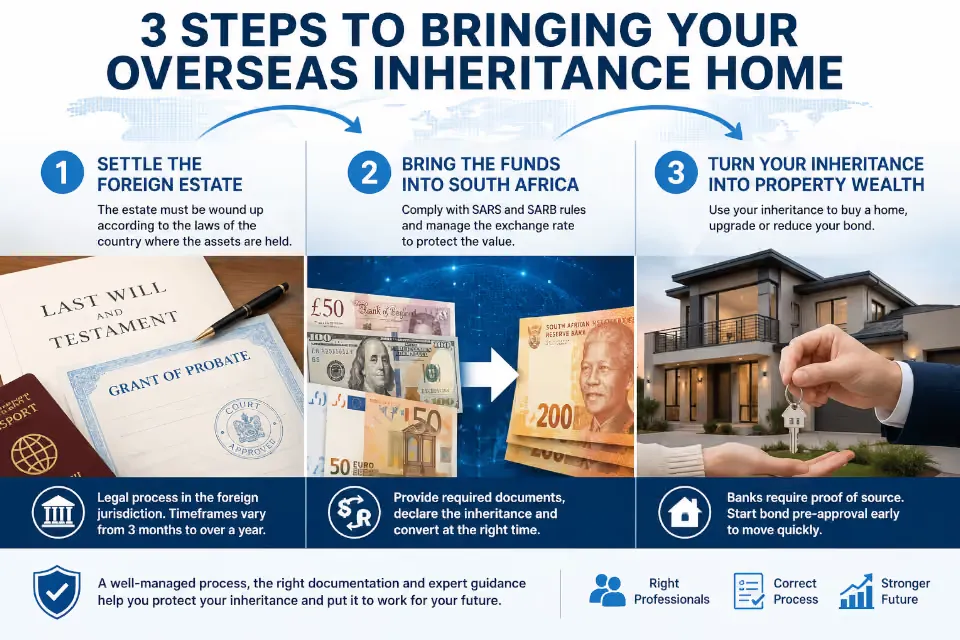
Understanding the three key stages of the process, from settling the foreign estate to transferring the funds into South Africa and ultimately investing them, can help beneficiaries avoid unnecessary delays, protect the value of their inheritance and make better financial decisions.
Step 1: Settling the foreign estate
The first and often longest stage is winding up the deceased's estate in the country where the assets are held.
An executor appointed in South Africa has no automatic authority in another jurisdiction. Instead, separate legal procedures must be followed according to the laws of that country.
In the United Kingdom this generally requires a Grant of Probate, while the process differs across the United States and other countries such as Portugal and many civil law jurisdictions.
The complexity of the estate largely determines how long the process will take. A relatively straightforward estate may be finalised within three to six months, while estates involving property, multiple beneficiaries, overseas investments or contested wills can take a year, or even longer, to conclude.
Until then, beneficiaries generally have no access to the funds and often very limited visibility regarding the progress of the administration.
Understanding this timeline is important, particularly for beneficiaries hoping to use the inheritance to purchase property or settle debt.
Step 2: Bringing the money into South Africa
Once the foreign estate has been finalised, the next challenge is transferring the funds into South Africa in compliance with local tax and exchange control regulations.
The good news is that an inheritance is not regarded as taxable income in South Africa and is therefore generally not subject to income tax or donations tax.
However, beneficiaries must still maintain a clear documentary trail. Typically this includes:
- The final liquidation and distribution account.
- The executor's confirmation.
- A copy of the will.
- Certified translations where required.
- Proof of the international transfer.
- Disclosure of the inheritance in the beneficiary's next annual tax return.
These documents satisfy both regulatory compliance and future financial verification requirements. However, one of the biggest risks is often overlooked, the foreign exchange market.
Harry Scherzer, CEO of Future Forex, says many beneficiaries assume that once the estate has been finalised, the process is effectively complete.
"The part that catches most beneficiaries off guard is that inheriting foreign money and receiving it in rands are two separate events. The estate process determines when the funds become available, but the exchange rate on the day you convert determines what you actually walk away with."
Currency movements during the estate administration process can materially change the final value received.
"On an inheritance of £200,000, a 5% move in the pound-rand exchange rate can change the outcome by R250,000 or more and the beneficiary almost never controls the timing," says Scherzer.
He recommends appointing a foreign exchange specialist as soon as beneficiaries become aware of the inheritance, not only when the funds are released.
"The best thing you can do is have your compliance documentation ready, the death certificate, the will, the executor's letter and the final distribution account and engage a forex specialist before the estate is finalised, so that when the funds are released you can move immediately rather than losing valuable time gathering paperwork."
Step 3: Turning your inheritance into property wealth
For many South Africans, an overseas inheritance provides the ideal opportunity to buy a first home, upgrade to a larger property or significantly reduce an existing home loan.
However, purchasing property introduces another important compliance process. Banks are required to verify the source of any deposit used in a home loan application. Where the deposit originates from an overseas inheritance, lenders must be able to trace the funds from the foreign estate through to the applicant's South African bank account.
Fortunately, much of the documentation required during the estate administration process also satisfies the banks' due diligence requirements.
Bradd Bendall, National Head of Sales at BetterBond, says proper preparation makes all the difference. "The good news for beneficiaries is that an inheritance can be one of the simplest deposit sources to work with, provided the paperwork is in order."
He explains that the same documents used to transfer the funds into South Africa, including the will, executor's confirmation, final distribution account and proof of the international transfer, provide the paper trail banks require.
"Our advice is to begin the home loan pre-approval process while the estate is still being finalised. By the time the inheritance reaches South Africa, you'll already understand your affordability, your borrowing capacity and exactly what documentation the bank requires."
Early preparation means buyers can act quickly when suitable properties become available, rather than delaying the purchase while finance is arranged.
A Connected process, not three separate events
Although receiving an overseas inheritance may appear to be a single financial event, it is in reality a carefully connected process involving legal administration, foreign exchange planning and financial readiness.
Each stage influences the next. The foreign estate determines when funds become available. Currency markets determine how much those funds are ultimately worth in rand. Proper planning and documentation determine how quickly beneficiaries can put that money to work, whether purchasing a home, investing in property or strengthening their long-term financial position.
By working with the right professionals at every stage, from the foreign executor and foreign exchange specialist to the bond originator South Africans can minimise delays, protect the value of their inheritance and convert a once-off windfall into lasting wealth.