










CSOS under administration: What property owners must know
Listen · 1-minute summary
0:00 / 1:29
Read the summary
CSOS under administration: What property owners must know. South Africa's Community Schemes Ombud Service has been placed under administration after its board was dissolved on 6 November. On 11 November 2026, the Department of Human Settlements appointed Leshabe Rampedi as administrator. Minister Thembi Simelane acted after an independent investigation found governance failures, prolonged leadership instability and risks to financial sustainability. For owners, the legal position has not changed. Levies must still be paid. Adjudication orders remain binding. Pending disputes stay within the process, and trustees and directors remain accountable. The biggest risk is delay. Marina Constas of BBM Attorneys said, "I would be particularly concerned about the backlog of unresolved disputes and whether the intervention will result in further delays in adjudication." Longer waits could strain scheme cash flow and maintenance. Investors should check levy arrears, pending disputes, special levies, maintenance reserves and governance records before buying. The Minister must review the institution's performance every 6 months while it remains under administration. The test is whether CSOS delivers, not merely survives. Read the full story by Neale Petersen on rei.co.za.
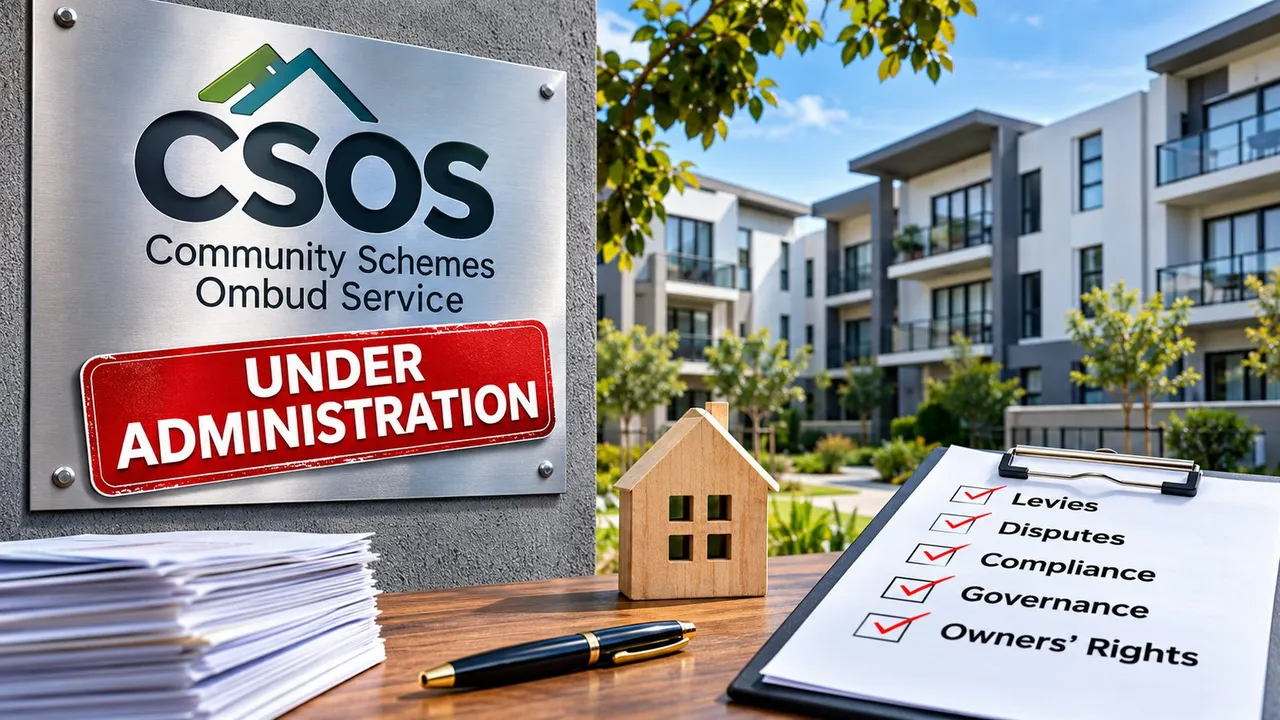
The dissolution of the CSOS board raises serious questions about governance, dispute backlogs and accountability. Legal experts explain what changes and what doesn’t for South Africa’s community schemes.
- CSOS remains operational: The board’s dissolution does not suspend the law, levy obligations, dispute-resolution processes or existing adjudication orders.
- Dispute delays are a major concern: Owners, trustees and managing agents could face longer waiting periods while the administrator addresses institutional failures.
- Accountability is now critical: The intervention presents an opportunity to restore confidence, improve adjudication and strengthen oversight of community schemes.
A regulator in crisis: What happens next?
South Africa’s Community Schemes Ombud Service (CSOS) has been placed under administration following the dissolution of its board, raising urgent questions for sectional title owners, homeowners’ associations, managing agents and property investors.
On 11 November 2026, the Department of Human Settlements announced the appointment of Leshabe Rampedi as administrator, following the board’s dissolution on 6 November.
Human Settlements Minister Thembi Simelane invoked section 28(1) of the Community Schemes Ombud Service Act after an independent investigation identified governance failures, prolonged leadership instability, allegations of mismanagement and risks to the institution’s financial sustainability.
Rampedi, a public-sector executive with more than 25 years’ experience who also serves on the board of the Property Practitioners Regulatory Authority (PPRA), has been tasked with stabilising the institution, addressing outstanding investigations, developing a turnaround plan and accelerating critical appointments.
But for the thousands of community schemes that depend on CSOS, the central question is straightforward: Will disputes still be resolved, levies enforced and owners’ rights protected?
Two community-scheme legal specialists, Marina Constas of BBM Attorneys and Johlene Wasserman of Van Deventer Dowlath & Marx Inc. (VDM), provide important guidance on what the intervention means in practice.
1. Marina Constas: The law remains fully operational

Constas emphasises that the CSOS’s governance crisis must not be confused with the legal standing of the institution or its statutory responsibilities.
“The appointment of an Administrator does not suspend the Community Schemes Ombud Service Act 9 of 2011, nor does it remove or diminish the statutory mandate of CSOS.”
The CSOS remains a statutory juristic person. Its functions; including dispute resolution, promoting good governance and regulating scheme governance documentation continue.
What this means
- The CSOS Act and applicable community-scheme legislation remain in force.
- Owners retain their rights to submit disputes and seek relief.
- Existing adjudication orders remain enforceable.
- Pending applications are not automatically cancelled or suspended.
- The statutory right to appeal qualifying adjudication orders to the High Court remains available.
Constas also raises an important governance question: the industry needs clarity on the precise terms of Rampedi’s appointment and the extent of his delegated authority.
Under section 28(5) of the Act, the Minister must review the institution’s performance every six months while it remains under administration.
2. Johlene Wasserman: Five obligations that do not change

Guidance circulated by VDM makes the immediate position clear: dissolving the board does not remove the obligations of schemes, owners, trustees or directors.
- Community schemes must remain registered. Schemes must continue meeting their CSOS registration and levy obligations.
- Owners must continue paying levies. Ordinary and properly authorised special levies remain payable in accordance with the applicable legal framework.
- Adjudication orders remain binding. Administration does not invalidate existing orders. Parties must comply unless an order is lawfully suspended or set aside.
- Pending applications continue. Dispute-resolution matters remain within the CSOS process, although operational restructuring may lead to delays.
- Trustees and directors remain accountable. Their governance, financial management, maintenance and fiduciary responsibilities continue.
The practical message is that CSOS being under administration is not a legal holiday for community schemes. Compliance cannot be deferred simply because the regulator is undergoing restructuring.
3. Dispute backlogs: The biggest risk for owners and investors
While the statutory framework remains intact, the CSOS’s ability to deliver timely dispute resolution is a pressing concern.
The institution deals with disputes involving unpaid levies, conduct rules, maintenance obligations, financial management, governance procedures and managing agent appointments.
Delays can have significant financial consequences, particularly where unresolved disputes prevent schemes from collecting revenue or undertaking essential maintenance.
Constas warns:
“I would be particularly concerned about the backlog of unresolved disputes and whether the intervention will result in further delays in adjudication.”
Key risks facing community schemes
- Growing backlogs: Existing disputes could take longer to reach adjudication.
- Financial pressure: Unresolved levy disputes may weaken cash flow and delay maintenance.
- Governance uncertainty: Trustees and managing agents may struggle to obtain timely decisions on contested matters.
- Property transactions: Outstanding disputes and financial obligations may complicate sales and transfers.
Constas stresses that schemes cannot simply suspend their operations while the institution addresses its internal challenges.
“Levies must still be collected, budgets implemented, maintenance undertaken and governance obligations fulfilled.”
4. What managing agents and trustees must do now
The immediate priority is to maintain proper governance, preserve documentation and ensure that disputes continue to be managed proactively. Drawing on Constas’s comments and VDM’s guidance, the following actions are particularly important.
| Responsibility | Recommended action |
|---|---|
| CSOS registration | Maintain registration and statutory compliance |
| Levies and finances | Continue collecting levies and paying applicable CSOS contributions |
| Pending disputes | Monitor case progress, deadlines and correspondence |
| Adjudication orders | Comply with binding orders unless lawfully suspended or set aside |
| Recordkeeping | Preserve financial statements, minutes, notices and supporting evidence |
| Governance | Continue trustee meetings, budgeting and maintenance planning |
For managing agents, this is also an opportunity to review internal compliance systems and ensure that clients receive accurate information about the implications of administration.

5. Property investors: Why this matters beyond compliance
The CSOS intervention has implications for property investors considering sectional title units, townhouse complexes, residential estates and other community-scheme investments.
The central investment issue is not simply whether CSOS continues to operate, but whether unresolved governance disputes could affect the financial health, management and future value of a property.
Five due diligence checks before buying into a community scheme
- Levy arrears: Examine the scheme’s arrears position, collection performance and financial statements.
- Pending disputes: Establish whether material CSOS applications or adjudication orders affect the scheme.
- Special levies: Identify approved or anticipated special contributions and their potential impact on investment returns.
- Maintenance reserves: Review the maintenance plan, reserve funding and major capital expenditure requirements.
- Governance records: Check relevant meeting minutes, management rules and evidence of ongoing disputes.
These checks should form part of the investment assessment before an offer to purchase becomes unconditional.
Constas highlights the importance of due diligence:
“In the context of property transactions, estate agents and conveyancers should continue to exercise appropriate due diligence in relation to outstanding levies, special contributions, pending disputes and any adjudication orders affecting a particular unit or community scheme.”
For investors, a property with an attractive asking price can quickly become a costly acquisition if the underlying scheme has serious financial or governance problems.
6. Can administration restore confidence in CSOS?
Although the intervention follows serious institutional concerns, it also presents an opportunity to improve the organisation’s effectiveness.
Constas believes the turnaround should involve meaningful engagement with sectional title specialists, managing agents and representative industry bodies.
“The Administrator has an important responsibility to restore stability and confidence in the institution.”
The success of the intervention should ultimately be measured by practical improvements rather than announcements alone.
Five outcomes the property industry should demand
- Transparent governance: Clear accountability, delegated authority and reporting on the turnaround process.
- Reduced backlogs: Measurable improvements in dispute-resolution turnaround times.
- Consistent adjudication: Reliable decisions supported by appropriate legal and administrative capacity.
- Improved accessibility: Better communication, application tracking and service delivery.
- Financial sustainability: Stronger financial controls and a credible long-term operating model.
The administration should be assessed against these outcomes, particularly given the statutory requirement for six-monthly ministerial performance reviews.
The bottom line: CSOS must deliver, not merely survive
The dissolution of the CSOS board represents a serious intervention in an institution that plays a central role in South Africa’s sectional title and community-scheme sector.
For owners, trustees, managing agents and investors, however, the immediate legal position remains unchanged. Levies must be paid. Governance obligations continue. Adjudication orders remain binding. Pending disputes remain within the statutory framework.
The greater concern is whether the administrator can address institutional weaknesses without further compromising dispute resolution.
As Constas concludes: “The community schemes sector needs a strong, properly resourced and effective CSOS. Ultimately, it is the owners and residents of community schemes who depend on it.”
For property investors, the real test will be whether the intervention produces a more accountable, accessible and efficient regulator capable of protecting the interests of South Africa’s community schemes.