








SARB holds rates: What it means for property in 2027
Listen · 1-minute summary
0:00 / 1:22
Read the summary
SARB holds rates: What it means for property in 2027. The South African Reserve Bank kept the repo rate at 7.25 percent and the prime lending rate at 10.75 percent on Thursday, 19 November 2026. The vote was close. Four Monetary Policy Committee members voted to hold, while three favoured a hike. Headline inflation rose to 5.2 percent in October, from 4.5 percent in September. Property leaders welcome the stability, but warn that affordability remains stretched. Pam Golding's Dr Andrew Golding points to Western Cape house price growth of 11.6 percent in October, its strongest since 2010. ooba says first-time buyers made up 48.6 percent of home loan applications in October. Samuel Seeff estimates national residential sales volumes are approximately 10 percent lower year-on-year. Inflation, weak growth and household affordability remain significant constraints. The rate hold is breathing room, not a green light for aggressive borrowing. Investors should assess purchases against current borrowing costs, rather than rely on expected rate cuts. Read the full story by Neale Petersen on rei.co.za.
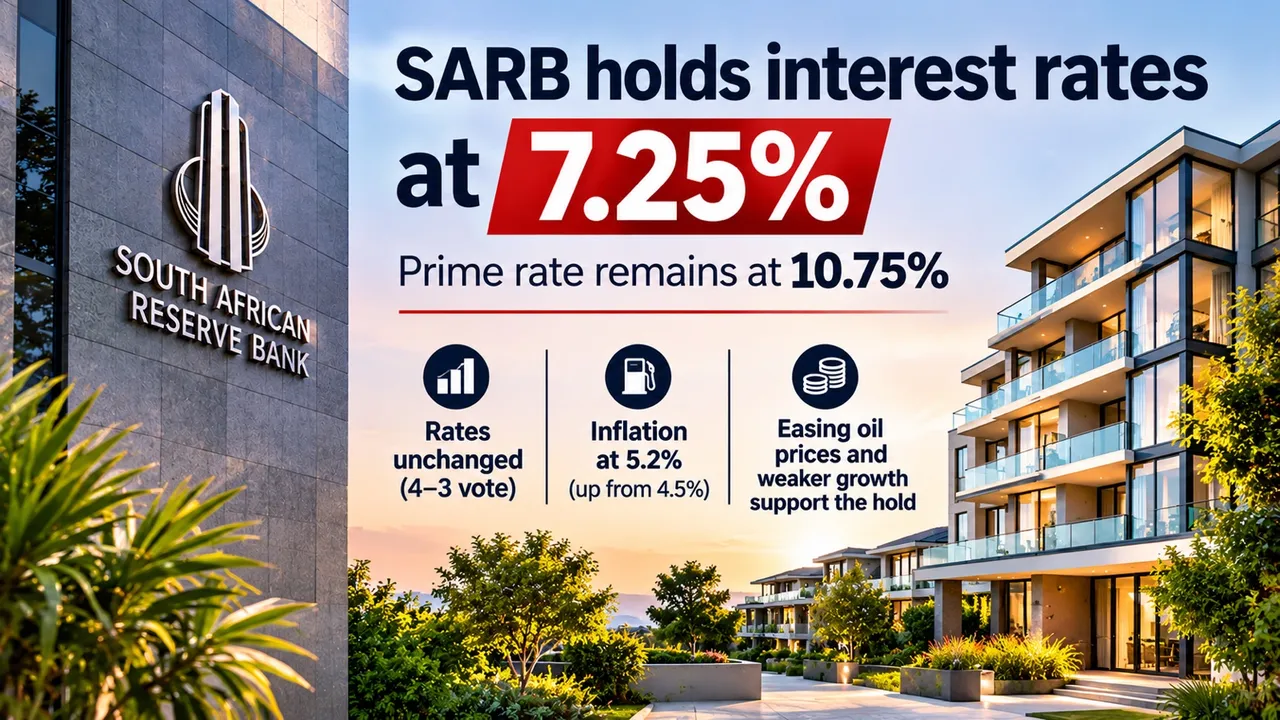
With the repo rate unchanged at 7.25% and prime at 10.75%, property leaders welcome stability but warn that inflation, affordability and borrowing costs remain critical challenges.
- Rates unchanged: SARB holds the repo rate at 7.25% and prime at 10.75%, avoiding further pressure on homeowners and property investors.
- Inflation concerns: October inflation climbs to 5.2%, leaving the MPC narrowly divided, with four members voting to hold and three favouring a hike.
- Property outlook: Industry leaders see improving mortgage demand, resilient house prices and opportunities for buyers, but caution that affordability remains stretched.
SARB holds firm as property market looks to 2027
South Africa’s property market has been given a measure of stability heading into 2027 after the South African Reserve Bank (SARB) kept interest rates unchanged on Thursday, 19 November 2026.
The Monetary Policy Committee (MPC) maintained the repo rate at 7.25% and the prime lending rate at 10.75%, providing relief from the prospect of another increase in mortgage repayments after two 25-basis-point hikes earlier this year.
However, the decision was far from unanimous. SARB Governor Lesetja Kganyago revealed that four MPC members voted to keep rates unchanged, while three supported an increase, highlighting growing concerns about inflation and the outlook for monetary policy.
Headline consumer inflation accelerated to 5.2% in October from 4.5% in September, driven largely by higher fuel and transport costs. Core inflation also increased to 4.2%, suggesting that price pressures are beginning to extend beyond energy.
Despite these concerns, expectations of easing international oil prices, potential fuel price reductions in December and subdued domestic economic growth provided grounds for holding rates steady.
For the property industry, the decision removes the immediate threat of another increase in borrowing costs, although it offers no reduction in existing mortgage repayments.
The key question now is whether greater interest-rate stability, competitive mortgage lending and improving buyer activity can translate into stronger property investment and transaction volumes during 2027.
Five leading property executives share their perspectives on the decision and what it means for the year ahead.
1. BetterBond: Rate stability supports buyer confidence

Stephan Potgieter says the decision provides much-needed certainty for homeowners and prospective buyers heading into the festive season.
While borrowers will not benefit from lower repayments, they have avoided a further increase following September’s rate hike.
Potgieter believes South Africa’s residential market continues to demonstrate resilience, supported by record-high incomes among first-time and repeat buyers and improved deposit affordability compared with the 2024 interest-rate peak.
Key market signals
- Stable interest rates provide a clearer basis for household financial planning.
- First-time buyer deposits, adjusted for inflation, remain below their levels at the 2024 rate peak.
- Improving inflation and lower fuel prices could create more favourable borrowing conditions during 2027.
Potgieter believes the rate hold provides a foundation for renewed housing market momentum, particularly if inflationary pressures ease in the coming months.
2. Pam Golding: Cape Town leads as house prices recover

Dr Andrew Golding welcomes the rate hold as an important confidence boost for buyers and sellers, with improving mortgage conditions and stronger activity across several residential markets.
He points to encouraging house price growth, particularly in the Western Cape, where demand continues to outpace many other regions.
Key property market indicators
- Western Cape: Annual house price growth reached 11.6% in October, its strongest performance since 2010.
- Cape Town: Prices increased by 12.1% during the year, compared with 6.4% in Nelson Mandela Bay.
- Gauteng: Price growth improved to 2.9%, while KwaZulu-Natal remained around 2.5%.
- Middle market: Properties priced between R2 million and R3 million recorded 6.3% growth in October.
- First-time buyers: Accounted for approximately 48.5% of home loan applications in October, according to ooba data cited by Golding.
Golding believes competitive bank lending, improving first-time buyer participation and limited supply in sought-after locations should support the market into 2027.
However, he cautions that affordability and regional differences remain important considerations for investors.
3. Seeff: Rate hold prevents further pressure on households

Samuel Seeff believes the SARB made the right decision by avoiding a third interest-rate increase this year, providing an important reprieve for financially stretched households and businesses.
He argues that much of the recent inflationary pressure has originated from external fuel and energy shocks rather than excessive domestic consumer demand.
With economic growth downgraded to approximately 1.2%, Seeff warns that further rate increases could weaken consumer spending, housing affordability and economic activity.
Key concerns and opportunities
- Earlier rate hikes have increased mortgage repayments and pressure on household budgets.
- National residential sales volumes are estimated to be approximately 10% lower year-on-year.
- Housing shortages in high-demand areas continue to support prices and reduce selling times.
- Competitive mortgage lending and more moderate price growth offer opportunities for financially prepared buyers.
Seeff believes the rate hold will help stabilise confidence, although sustained recovery will require improved economic growth and eventually lower borrowing costs.
4. ooba: First-time buyers driving housing market resilience

Rhys Dyer says the unchanged repo rate provides a more predictable environment for buyers and homeowners as South Africa approaches 2027.
Despite inflationary pressures, ooba’s latest mortgage data points to continued demand, particularly among first-time buyers.
Key housing finance indicators
First-time buyers’ share of home loan applications in October
48.6%Average national purchase price for the year to date, up 4.7% annually
R1.75mAverage first-time buyer purchase price
R1.29mAverage deposit requirement in October, down 1.7 percentage points year-on-year
12.8%Quarter-on-quarter growth in home loan applications during Q3 2026
2.1%Dyer also highlights growth in formal employment, with 357,000 more people formally employed than a year earlier, potentially supporting future mortgage eligibility.
He believes competition among banks, sustained first-time buyer participation and more stable borrowing costs provide a foundation for cautious optimism, although future rate reductions remain uncertain.
5. Tyson Properties: Rate hold brings relief, but caution remains

Craig Woods welcomes the SARB’s decision to hold the repo rate at 7.25%, describing it as a positive conclusion to a challenging year for homeowners and property investors.
Despite pressure from a weaker rand, volatile oil prices and global economic uncertainty, Woods believes 2027 offers reasons for cautious optimism, particularly if fuel costs ease and municipal service delivery improves.
Key insights for property investors
- Interest-rate risks: Two 25-basis-point hikes in 2026 demonstrate why buyers must budget for potential increases.
- Affordability: Rising household costs mean prospective buyers should consider more conservative purchase prices and maintain financial buffers.
- Investment strategy: Focus on properties with long-term growth potential and opportunities for future improvements.
- Mortgage management: Existing homeowners should review expenses, compare insurance costs and consider refinancing where appropriate.
Woods advises investors to prioritise financial resilience rather than speculate on future interest-rate cuts.
His message: Buy within your means today and position yourself for opportunities in 2027.
What does the rate hold mean for property investors?
The SARB’s decision provides stability, but it does not eliminate the financial pressures facing homeowners, landlords and developers.
For investors with variable-rate mortgages, monthly repayments remain unchanged. For prospective buyers, borrowing costs are more predictable, while competition among lenders continues to create opportunities to negotiate financing terms.
However, the narrow MPC vote and elevated inflation suggest that further rate increases remain a risk if price pressures persist. Property investors should therefore assess acquisitions against current borrowing costs rather than relying on anticipated rate reductions.
The bottom line: Stability today, opportunity in 2027?
South Africa’s property market is entering 2027 with mixed but increasingly encouraging signals. Home loan demand remains resilient, first-time buyers are active, banks continue to compete for mortgage business and several residential markets are recording improving price growth.
Yet inflation, weak economic growth and household affordability remain significant constraints.
The SARB has given the property market breathing room, not a green light for aggressive borrowing.
For property investors, the opportunity lies in identifying well-priced assets, securing competitive finance and building portfolios capable of delivering sustainable returns regardless of the next interest-rate decision.
The next phase of South Africa’s property recovery will depend not simply on when interest rates fall, but on whether stronger household finances, economic growth and investor confidence can support sustained demand.