








Calgro's Memorial Parks surge as housing growth stalls
Listen · 1-minute summary
0:00 / 1:40
Read the summary
Calgro's Memorial Parks surge as housing growth stalls. JSE-listed developer Calgro M3 has released interim results for the six months ended 31 August 2026, showing a business split between a slowing housing market and a booming memorial parks division. Group revenue rose 1.22 percent to R465 million, while headline earnings per share fell 4.67 percent to 78.99 cents. Net debt to equity climbed to 0.86, and no interim dividend was declared. Memorial Parks, operating in Gauteng, Cape Town, Bloemfontein and Rustenburg, was the standout performer. Revenue there jumped 20.04 percent to R47.81 million, with gross margins improving to 54.78 percent and cash collections rising to R60.83 million. Grave sales volumes grew 16.21 percent and burials rose 19.19 percent. Residential development, still nearly 90 percent of group revenue, slipped slightly to R417.87 million, though its margin improved to 26.56 percent. Calgro holds 1,418 residential opportunities under construction or in stock, with about 55 percent secured through guaranteed offtake agreements. The group is also pursuing land disposals in Cornubia and Vredehoek to manage debt. Read the full story by Neale Petersen on rei.co.za.

Calgro M3's interim results reveal a business navigating subdued affordable housing demand while its memorial parks division delivers stronger revenue, margins and cash generation.
- Memorial Parks revenue rose 20.04% to R47.81 million, with gross margins reaching 54.78% and cash collections increasing to R60.83 million.
- Group revenue increased 1.22% to R465 million, while headline earnings fell 4.67% to 78.99 cents per share.
- Calgro holds 1,418 residential opportunities under construction or in stock, with approximately 55% secured through guaranteed offtake agreements.
A property developer navigating two very different markets
JSE-listed property developer Calgro M3 is navigating a challenging affordable housing market while finding an increasingly valuable source of growth in an unlikely place: its private memorial parks business.
The group's unaudited interim results for the six months ended 31 August 2026, released on 19 October, reveal a business focused on preserving margins, managing capital carefully and positioning itself for the next phase of residential development.
Revenue increased modestly by 1.22% to R465 million, compared with R460 million a year earlier. Gross profit margins remained resilient at 29.46%, comfortably above Calgro's strategic target range of 20% to 25%.
However, headline earnings per share declined by 4.67% to 78.99 cents, while net debt to equity increased to 0.86 from 0.74 at the February 2026 year-end. No interim dividend was declared.
Behind those numbers is an increasingly important strategic shift: Calgro is using a growing memorial parks operation to diversify earnings and generate cash while remaining selective about residential construction.
Memorial Parks emerges as a growth engine
Calgro's Memorial Parks division was the standout performer during the reporting period. The business operates private memorial parks in Gauteng, Cape Town, Bloemfontein and Rustenburg, offering landscaped, managed and secure alternatives to traditional cemeteries.
Its interim performance highlights the strength of demand for this specialised property-related service.
Key results:
- Revenue increased 20.04%, from R39.83 million to R47.81 million.
- Gross profit margin improved to 54.78%, from 50.39%.
- Grave sales volumes increased 16.21%.
- Burials increased 19.19%.
- Cash collections rose 17.84% to R60.83 million.
- Completed lay-by sales accounted for 26.20% of segment revenue.
The division now represents approximately 10% of group revenue, but its higher margins and cash generation give it a strategic importance beyond its current size.
Calgro CEO Ben Pierre Malherbe has indicated that the group intends to expand its memorial parks footprint, with an ambition to add a new park approximately every second year.
The longer-term potential is significant, although expansion will depend on land availability, capital requirements and sustained customer demand.
For investors, the attraction is the business's combination of land-based assets, customer demand and cash collection.
Affordable housing remains the core business
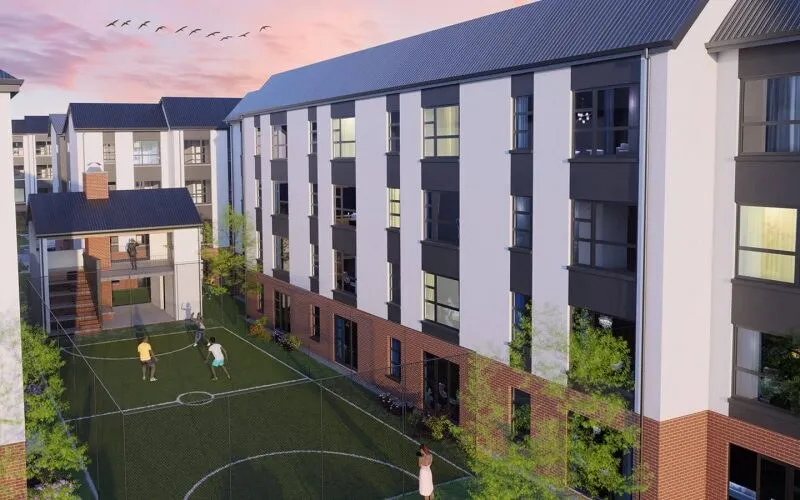
Residential development still accounts for nearly 90% of Calgro's revenue.
However, this division continues to operate in a constrained market where household affordability, consumer confidence and financing conditions influence the pace of sales and construction.
Residential development revenue declined slightly to R417.87 million from R420.20 million in the comparative period.
Its gross profit margin nevertheless improved to 26.56%, from 26.25%.
Calgro's approach increasingly favours sales-led construction, with the company seeking stronger evidence of buyer demand or guaranteed offtake before committing additional development capital.
This strategy is particularly relevant in a market where building costs, municipal infrastructure requirements and household financial pressure can make speculative development risky.
The group reported:
- 1,724 serviced residential opportunities available for development.
- 1,418 opportunities under construction or held in stock.
- Approximately 55% of those opportunities sold through guaranteed offtake agreements.
- A wider residential development pipeline of approximately 30,000 opportunities, according to management commentary.
The company is also pursuing residential products at different price points to respond to affordability constraints.
Why rental investors matter to Calgro's strategy
One of the more significant developments is the growing role of institutional and portfolio rental investors.
Rather than relying exclusively on individual households buying homes directly, Calgro is increasingly working with investors seeking multiple residential units for rental portfolios.
This creates a different route to market.
An investor purchasing a block of units can provide a developer with greater sales certainty, support phased construction and reduce exposure to individual mortgage approvals.
For Calgro, guaranteed offtake agreements can help align construction with committed demand.
For rental investors, the opportunity lies in acquiring housing stock designed for an established affordability segment.
However, the investment case still depends on realistic rental yields, tenant affordability, operating costs, maintenance and occupancy.
A guaranteed development offtake is not the same as guaranteed rental income.
That distinction matters when evaluating the sustainability of any residential investment.
Non-core land sales and a more focused portfolio
Calgro is also progressing the disposal of non-core land and projects as part of its capital management strategy.
Two properties are particularly relevant:
Cornubia, KwaZulu-Natal: Calgro has accepted an offer to purchase its landholding, with the prospective buyer undertaking due diligence. Completion would represent the group's planned exit from the province.
Vredehoek, Cape Town: The group has received a memorandum of understanding relating to its land parcel, with due diligence and transaction finalisation still outstanding.
The values of these proposed disposals have not yet been disclosed.
The transactions therefore remain prospective, rather than completed sales.
The strategy reflects management's intention to concentrate resources on developments with greater scale and stronger alignment to its core affordable housing market.
Bankenveld and the longer-term development pipeline
Despite near-term caution, Calgro retains substantial development ambitions.
Its Bankenveld District City project in Johannesburg is among the major developments expected to support future residential delivery, with a longer-term potential of up to 20,000 units.
Projects of this scale require phased infrastructure investment, planning approvals, construction capacity and sustained demand over several years.
For investors, the important question is not simply the number of units in a development pipeline, but how efficiently that pipeline can be converted into completed, transferred and income-generating properties.
Calgro's emphasis on servicing land, securing offtake and sequencing construction suggests a deliberate effort to balance growth ambitions with financial discipline.
What investors should watch next
Calgro's interim results highlight five important indicators for shareholders and property investors:
- Residential sales: Whether affordability and buyer confidence improve enough to accelerate housing delivery.
- Memorial Parks: Whether the division can sustain its growth and attractive margins.
- Debt management: Whether planned asset disposals help reduce gearing.
- Construction pipeline: How quickly serviced land and committed sales translate into transfers.
- Cash generation: Whether earnings growth is supported by stronger operating cash flow.
REI PERSPECTIVE | Diversification with discipline
Calgro M3's latest results tell a broader story about South Africa's property development market.
Demand for affordable housing remains substantial, but demand alone does not guarantee profitable development. Buyers must be able to finance purchases, developers must manage construction costs, and projects must deliver acceptable margins.
Calgro's memorial parks operation provides an increasingly useful earnings and cash-flow complement to its residential business.
Yet the core challenge remains converting a large housing pipeline into completed sales without taking excessive balance-sheet risk.
The takeaway: Calgro's next phase of growth will depend not only on how much it develops, but on how carefully it allocates capital, secures buyers and converts projects into cash.
Source: Calgro M3 unaudited interim results for the six months ended 31 August 2026, released 19 October 2026, and management commentary reported following the results.