





Burstone unlocks R4.5bn with new property fund platform
Burstone’s new R5.4bn South African platform with Nedbank Property Partners accelerates its shift towards a capital-light global funds management model.
- Burstone is seeding the new platform with 14 retail and industrial properties valued at approximately R5.4 billion.
- The transaction releases R4.5 billion in capital while cutting Burstone’s reported loan-to-value ratio to below 20%.
- Nedbank Property Partners joins the platform as Burstone targets further institutional capital and recurring fund management income.
Burstone Group is making one of its biggest strategic moves yet in South Africa, establishing a R5.4 billion property platform that will release R4.5 billion in capital and accelerate its transformation from a traditional property owner into a capital-efficient international real estate and funds management business.
The newly established SA Core Plus platform, created in partnership with Nedbank Property Partners (NPP), will initially hold 14 South African retail and industrial properties.
But the significance of the transaction goes well beyond moving properties into a new investment vehicle. Burstone will retain a 50% equity interest, continue managing the properties and earn recurring fund and asset management fees, while simultaneously freeing substantial capital for new investment opportunities in South Africa and internationally.
In effect, Burstone is positioning itself to manage more property without having to own 100% of every asset on its balance sheet.
A R5.4bn property portfolio from day one
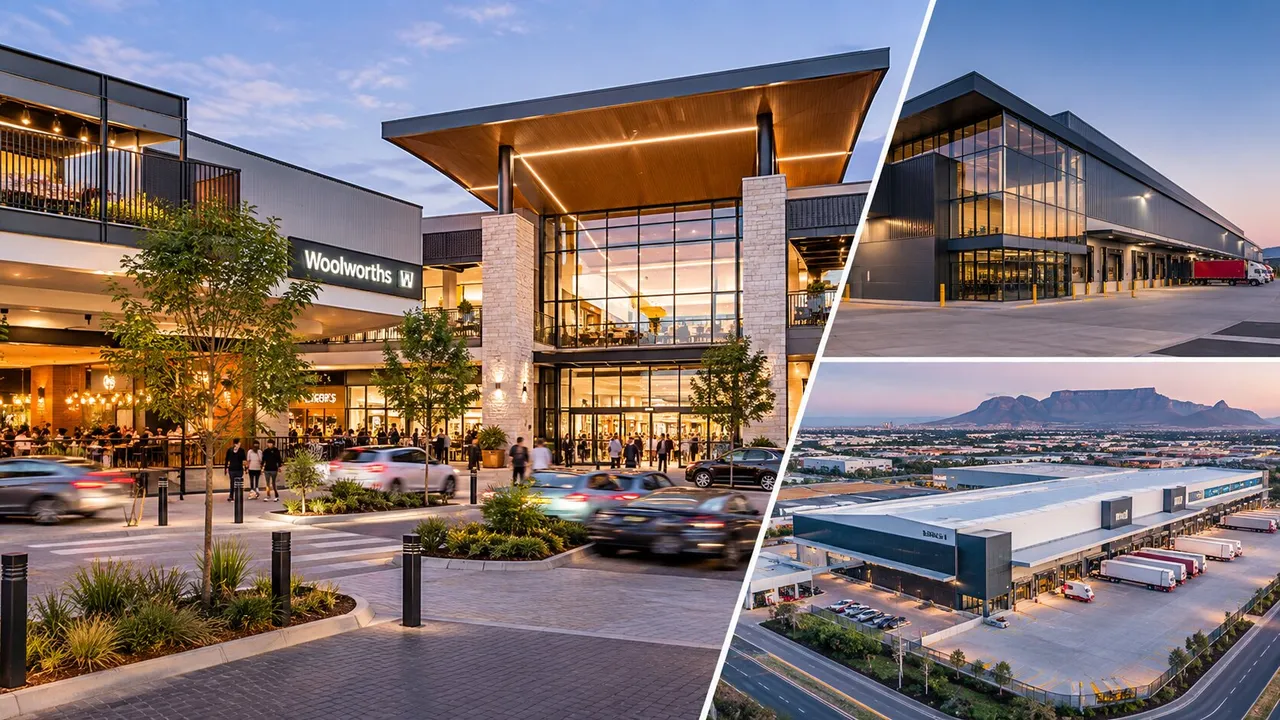
Burstone will seed the SA Core Plus platform with a diversified portfolio of 14 properties comprising five retail centres and nine industrial and logistics assets.
The portfolio has:
- Gross asset value: approximately R5.4 billion
- Blended asset yield: 8.4%
- Retail assets: five dominant rural and peri-urban shopping centres
- Industrial assets: nine warehousing and logistics properties
- Geographic exposure: Gauteng, Western Cape, KwaZulu-Natal, Free State and Mpumalanga
The industrial portfolio is supported by established tenant covenants and long-term lease profiles, while the retail component provides exposure to dominant shopping centres serving rural and peri-urban markets.
The combination gives the platform diversification across both property sectors and geographic markets from inception.
Nedbank comes in alongside Burstone
Nedbank Property Partners, the real estate-focused equity and mezzanine financing business within Nedbank Corporate and Investment Bank, will partner Burstone in the new platform.
Burstone will retain a 50% equity interest and serve as both fund manager and asset manager. This is important to the economics of the deal.
Burstone is not simply selling properties and walking away. It maintains exposure to the performance and potential upside of the underlying assets while adding another source of recurring income through management fees.
NPP’s participation represents the platform’s first close, but Burstone’s ambitions extend considerably further.
The platform has been designed from the outset to accommodate additional private and institutional capital, and Burstone says it is already in discussions with another significant institutional investor regarding a second close.
That potentially turns the initial R5.4 billion portfolio into the foundation for a considerably larger South African property investment vehicle.
Why releasing R4.5bn matters
Perhaps the most significant number in the announcement is not R5.4 billion. It is R4.5 billion. That’s the amount of capital Burstone expects the transaction to release for further local and international growth opportunities.
For property companies, capital locked into directly owned real estate cannot simultaneously be deployed into new acquisitions, developments or investment platforms.
By introducing an investment partner while retaining a meaningful stake and management mandate, Burstone can recycle capital from existing assets and redeploy it into new opportunities.
This is central to the capital-light model increasingly being pursued by large international real estate investment managers.
Instead of growth depending solely on continuously increasing the size of its own balance sheet, Burstone can combine its capital with that of institutional partners while earning fees for sourcing, managing and growing the assets.
From property owner to fund manager
The transaction represents another step in Burstone’s broader strategic repositioning. The group has already been building its funds and asset management model internationally.
In Europe, Burstone has expanded the strategy through partnerships including its European light industrial platform with Hines European Real Estate Partners III, while in Australia it has extended the model through the Irongate Group. The SA Core Plus platform now brings that strategy into Burstone’s home market.
For investors, this changes the composition of the business. Burstone increasingly earns income not only from rent generated by properties in which it invests, but also from managing third-party capital and assets.
That creates the potential for a more diversified and recurring earnings base without requiring Burstone to fund every rand of future portfolio growth itself.
Fee income and assets under management climb
The financial implications are material. Following the transaction, Burstone expects fee revenue to increase to 19.3%, compared with 15.5% at 31 March 2026.
Third-party assets under management are expected to increase by 10.9% to R26.8 billion, while equity under management increases 4.5% to R11.5 billion.
The transaction is also expected to be earnings accretive. For investors, these numbers demonstrate the changing economics of Burstone’s business: a greater proportion of earnings is being generated through funds and asset management rather than relying exclusively on directly owned real estate.
Balance sheet gets a major reset
The impact on Burstone’s gearing is equally significant. Its reported loan-to-value (LTV) ratio is expected to decline from 39.6% to between 17.5% and 19.5% following the transaction.
On a look-through basis, LTV is expected to improve from 48.6% to between 40.5% and 42.5%. That materially strengthens the group’s balance sheet and provides additional capacity to pursue growth opportunities.
At the same time, Burstone says its existing guidance of 4% to 6% growth in distributable income per share remains unchanged. The transaction has also been structured to preserve Burstone’s REIT status.
Institutional capital is the next growth lever
The longer-term opportunity lies in what happens after this first transaction. The SA Core Plus platform has deliberately been structured as a scalable, permanent-capital vehicle, allowing additional private and institutional investors to invest alongside Burstone.
If the model gains traction, Burstone can potentially grow the platform by acquiring further properties without having to fund the entire acquisition cost itself.
That gives the company several potential sources of return:
- returns from its direct equity investment;
- recurring fund management fees;
- asset management income;
- growth in third-party assets under management; and
- the ability to recycle capital into new investments.
It is a fundamentally different growth model from simply acquiring additional buildings onto a REIT’s balance sheet.
“A defining moment for Burstone”
Burstone Group CEO Andrew Wooler described the establishment of the platform as a defining moment for the group’s South African business.
“This transaction transforms our balance sheet, diversifies our income, and positions Burstone as a genuine funds management business with a growing and recurring fee revenue base.”
Wooler said the South African platform builds on several years of developing the model in Europe and Australia and gives Burstone the opportunity to scale it with an institutional partner in its home market.
NPP Divisional Executive Jean Roux said the combination of Burstone’s asset management track record, the quality of the initial portfolio and the structure of the platform gave NPP confidence in its long-term value-creation potential.
What this means for property investors
Burstone’s latest move reflects a broader evolution in institutional real estate.
The traditional listed-property model has largely been about owning buildings, collecting rent and growing portfolios. The emerging model is increasingly about capital partnerships, asset management, co-investment and recycling capital more efficiently.
For Burstone, the immediate benefits are significant: R4.5 billion of released capital, materially lower gearing, a growing recurring fee base and continued exposure to a R5.4 billion South African property portfolio. The bigger test will be what management does with that additional firepower.
If Burstone can attract further institutional investors, grow assets under management and redeploy its capital into investments generating attractive risk-adjusted returns, the SA Core Plus platform could become considerably more important than the 14 properties with which it launches.