








AI valuations are reshaping SA property market

- AI-powered property valuations are delivering faster, smarter and more accurate pricing across South Africa’s residential market.
- Lightstone’s AI valuation model combines decades of property data, machine learning and human oversight to improve lending and investment decisions.
- Explainable AI, transparency and local market intelligence are becoming critical competitive advantages across property and financial services.
Artificial intelligence is rapidly transforming the way South Africa’s property market measures, analyses and values residential real estate.
What was once largely driven by professional judgement, historical comparable sales and manual interpretation is now evolving into a sophisticated ecosystem powered by machine learning, predictive analytics, imagery, data integration and explainable intelligence.
At the centre of this shift is Lightstone Property’s AI-powered valuation platform, AiVM, which is helping reshape how banks, valuers, lenders, investors and property professionals approach residential property valuations.
Speaking at the Africa Valuation Conference 2026, Hayley Ivins-Downes, Managing Executive Real Estate, Lightstone Property explained how the future of property valuation is no longer simply about comparing past transactions.
Instead, it is increasingly about combining trusted data, machine learning and human expertise to create faster, more accurate and more transparent valuation outcomes.
The power behind the data asset
According to Ivins-Downes, the strength of any AI valuation model ultimately depends on the quality, scale and depth of the data feeding it.
“Valuation models are only as strong as the information they learn from,” she said.
By combining:
- Deeds records
- Cadastral data
- Municipal valuation rolls
- Listing information,
- Point-of-interest data
- Imagery
Lightstone’s AI ecosystem is able to build a far richer and more dynamic understanding of property value than traditional valuation methods alone.
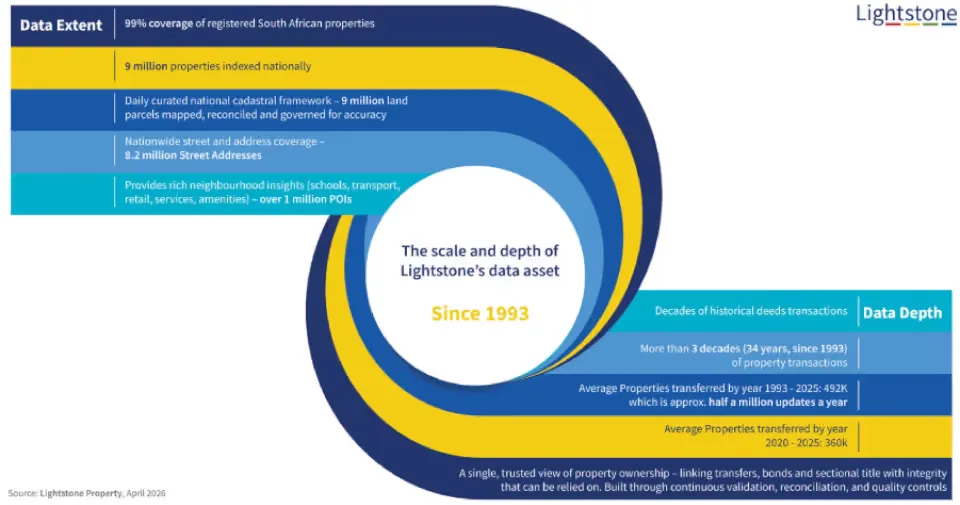
Ivins-Downes revealed that Lightstone’s data environment includes:
- Nationwide coverage of registered South African properties,
- Millions of indexed street addresses,
- Decades of deeds transaction history.
This creates one of the most comprehensive residential property datasets on the continent.
How AI valuations work
AiVM uses a combination of:
- Property location
- Erf size
- Previous sales history
- Municipal data
- Neighbourhood trends
- Structured market inputs
This is to estimate market value with far greater speed and scalability. Importantly, however, Lightstone has focused heavily on making the system explainable rather than operating as a mysterious “black box”.
To improve transparency and trust, the platform includes:
- A confidence score and
- A safety score
This allows banks, valuers and decision-makers to assess not only the estimated value itself, but also the reliability and strength of the prediction. That level of explainability is becoming increasingly important in global AI adoption.
AI supporting, not replacing, professionals
One of the strongest themes from Ivins-Downes’ presentation was that AI should enhance human expertise rather than replace it entirely.
She highlighted the importance of “human-in-the-loop” decision-making, where AI supports:
- Analysts
- Valuers
- Lenders
- Property professionals,
This still allows room for professional judgement, interpretation and oversight. This balanced approach reduces operational friction while maintaining accountability and professional integrity.
The three pillars driving Lightstone’s AI strategy
Ivins-Downes explained that Lightstone’s AI valuation ecosystem is built around three core pillars:
1. Transparency
Unlike generic AI systems operating as closed “black boxes”, Lightstone’s “white box advantage” allows predictions to be interrogated, understood and validated by human users.
This creates greater trust and accountability within the lending and property ecosystem.
2. Integrity
Lightstone is currently Africa’s only member of the European AVM Alliance, meeting strict global benchmarks for:
- Statistical rigour
- Independence
- Valuation consistency
Its AI models are also trained specifically around South African market realities, including:
- Deeds office anomalies
- Municipal data gaps
- Informal market activity
- Local transaction behaviours
This localisation gives the platform a significant competitive advantage over generic international AI models.
3. Outcomes
The biggest commercial value lies in operational efficiency and better decision-making.
Ivins-Downes highlighted how AI-driven valuations can:
- improve banking efficiency,
- accelerate bond approvals,
- reduce lending friction,
- improve pricing precision,
- and enhance investment analysis.
Banks are increasingly able to obtain “lending-grade” market values almost instantly at offer-to-purchase stage, improving turnaround times and reducing transaction bottlenecks.
The future of valuation is already here
Lightstone is now exploring even more advanced AI applications including:
- Computer vision
- Satellite imagery
- Aerial mapping and
- Enhanced geospatial analytics
This is used to improve valuation accuracy and market coverage even further. The broader message from the presentation was clear: Artificial intelligence is no longer a future experiment within property valuation.
It is already becoming a practical operational tool reshaping the property and financial sectors in real time.
The way forward
As South Africa’s property market becomes increasingly digitised, data-driven and efficiency-focused, AI-powered valuation systems are rapidly moving from innovation to necessity.
The real differentiator, however, will not simply be artificial intelligence itself.
It will be:
- The quality of the data
- The transparency of the models
- The ability to explain outcomes and
- The integration of human expertise alongside machine intelligence.
Ultimately, the future of property valuation may no longer belong solely to the traditional valuer or the algorithm alone, but rather to the intelligent partnership between both.