THIS WEEK'S BIGGEST TAKEAWAYBILLIONS FLOW INTO CAPE TOWN CBD AS OFFICE DEMAND BUILDS
A record R12.8bn pipeline and tight office supply are driving fresh capital into Cape Town’s next CBD investment cycle.
Cape Town’s commercial property recovery is moving into a new phase. Billions are being committed to new developments and upgrades, office supply remains relatively tight, and demand is increasingly concentrating around premium, well-located buildings.
But this is not a blanket office boom. The opportunity is becoming increasingly divided between modern, high-performing assets and ageing buildings that need to be upgraded, converted or repositioned.
For investors, that divergence may be where the opportunity lies.
EDITOR’S DESKCAPITAL IS MOVING - BUT SELECTIVITY MATTERS MORE THAN EVER
This week’s property stories tell us something important about where the South African investment market is heading.
Confidence is returning, but capital is becoming far more selective. Cape Town’s CBD now has a R12.8 billion development pipeline, with more than R6 billion committed to commercial and mixed-use projects. Growthpoint is strengthening its balance sheet, recycling billions from non-core properties and directing capital towards higher-quality assets and growth opportunities.
Residential investors are returning too. Buy-to-let activity is strengthening, while Cape Town homes continue to sell considerably faster than Johannesburg properties across multiple price bands.
Yet stronger markets bring their own risks. Cape Town’s house-price outperformance is rewarding existing owners while making entry increasingly difficult for buyers and tenants.
Short-let investors remain exposed to currency movements, global travel patterns and geopolitical shocks. And in commercial property, artificial intelligence is rapidly becoming available to everyone, meaning technology itself may no longer provide the competitive advantage.
The common thread is clear: owning property is not enough. Investors increasingly need to understand the quality of the income, strength of demand, cost of capital, liquidity of the asset, depth of the data and risks sitting behind the return.
WHAT SHOULD INVESTORS BE DOING NOW?
Follow the capital. Major investment and development activity can reveal where confidence, infrastructure and future demand are concentrating.
Interrogate the income. Rental growth means little if vacancies, finance costs, levies, maintenance and operating expenses destroy the net return.
Understand your exit before you enter. Cape Town and Johannesburg are demonstrating why liquidity should form part of every acquisition decision.
Stress-test the downside. Rates, vacancies, currency movements, regulation and unexpected costs should be modelled before you buy — not discovered afterwards.
Use technology, but trust intelligence. AI can process information faster than ever. Better data, market knowledge and experienced judgement determine whether that information creates value.
This is not a market for passive assumptions. It is a market for investors prepared to research harder, price risk properly and move decisively when the numbers make sense.
THE INVESTOR PULSE
RESIDENTIAL | DEMAND IS BACK - BUT PRICE DISCIPLINE MATTERS Buy-to-let activity is strengthening as South Africans return to residential property investment, while Cape Town continues to demonstrate stronger liquidity and seller pricing power than Johannesburg.
But Cape Town’s success is also creating an affordability challenge. Higher prices reward existing owners while increasing the barriers facing new buyers and tenants.
INVESTOR WATCH: Don't confuse a strong market with a good deal. Test achievable rent, net yield, financing costs, vacancy risk and resale liquidity before buying.
COMMERCIAL | CAPITAL IS FOLLOWING QUALITY Cape Town’s CBD investment pipeline is accelerating as developers and landlords respond to demand for better offices, mixed-use precincts and modernised buildings.
The dividing line is increasingly asset quality. Premium, well-located and appropriately equipped offices are attracting demand while ageing stock faces pressure to reposition.
INVESTOR WATCH: Look beyond headline vacancy rates. Building quality, parking, energy resilience, tenant experience and precinct fundamentals are becoming increasingly important to performance.
LISTED PROPERTY | BALANCE SHEETS ARE BACK IN FOCUS Growthpoint’s latest results underline a broader shift towards disciplined capital allocation.
The group lifted its dividend 7.4%, disposed of R4.9 billion in non-core assets and reduced South African loan-to-value from 34.5% to 30.2% as it prepares for its next leadership chapter.
INVESTOR WATCH: Watch where REITs recycle capital. Lower leverage, stronger liquidity and investment into higher-performing sectors can matter as much as headline portfolio growth.
DEVELOPMENT | HIGH RETURNS ATTRACT NEW SUPPLY Cape Town’s exceptional property performance is encouraging development capital back into the market.
That is positive for construction and housing supply — but investors should remember the cycle: strong returns attract capital, capital creates supply, and additional supply can eventually moderate rental and price growth.
INVESTOR WATCH: Don't extrapolate exceptional growth indefinitely. Track development pipelines alongside demand before pricing future capital appreciation into an acquisition.
PROPTECH & AI | THE ADVANTAGE IS SHIFTING TO THE DATA AI tools are becoming universally accessible across property.
That means competitive advantage is moving away from simply having the technology towards the quality of the proprietary data, market intelligence, relationships and human judgement sitting underneath it.
INVESTOR WATCH: Before trusting an AI-generated property conclusion, ask: What data produced it? How current is it? What is missing? And who is checking the answer?
GLOBAL RISK | YOUR PROPERTY CAN BE LOCAL - YOUR RISK ISN’T Cape Town short-let owners are discovering how quickly events thousands of kilometres away can affect bookings, pricing and operating costs.
Currency swings, airline capacity, geopolitical shocks and changing source markets can all influence returns.
INVESTOR WATCH: Diversify guest markets, monitor airline capacity and forward bookings, understand your submarket and optimise for net yield — not occupancy alone.
AI is becoming universal, but property’s real advantage will come from better data, deeper insight and experienced human judgement. The question is no longer simply who has AI. It is who has the proprietary information, relationships and market knowledge capable of turning AI into genuine commercial intelligence.
Growthpoint strengthens its balance sheet, recycles R4.9bn in assets and positions for growth as a new CEO takes the helm. Lower leverage, improving operating metrics and disciplined capital recycling provide the backdrop to Norbert Sasse’s final results before Estienne de Klerk takes over.
South Africans are returning to buy-to-let property, but sustainable returns depend on mastering cash flow, leverage, costs and risk. Investor appetite is strengthening, but buying property and making a successful property investment remain two very different things.
Cape Town homes are selling faster across every price band, while stronger seller pricing power leaves buyers less room to negotiate. New market data reveals a striking liquidity gap between Cape Town and Johannesburg — with important implications for entry price, negotiating power and eventual exit risk.
Cape Town’s property boom is rewarding owners and investors, but soaring prices and rentals are deepening the affordability divide. Strong capital growth looks excellent on an investor’s balance sheet. For the household struggling to buy or rent, the same market can look very different.
Cape Town short-lets remain attractive, but global shocks, currency swings and rising costs demand smarter risk management. Today's short-let investor is effectively operating an internationally exposed hospitality business inside a property asset. Here's how to build greater resilience into the return.
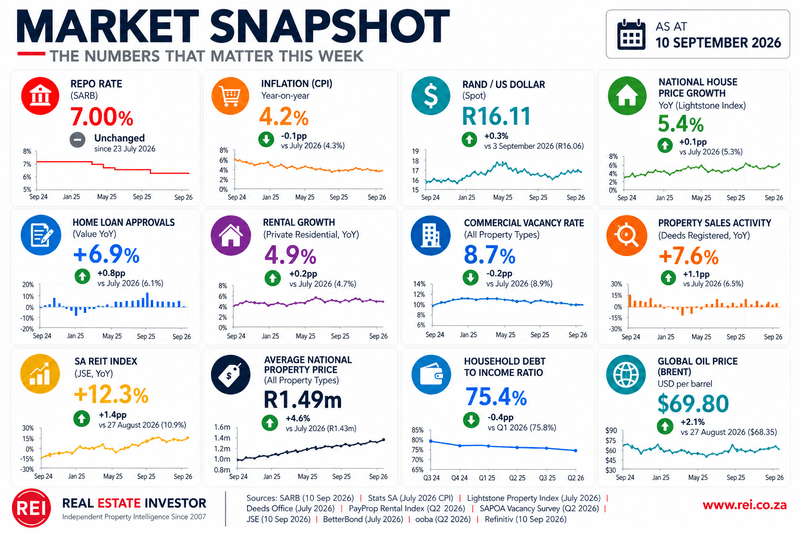
MARKET SNAPSHOTThe Numbers Behind the Investment Story
Interest rates, inflation, the rand, house prices, lending activity and property performance are shifting the investment equation. See the numbers investors need to know this week.
THE LAST WORDDON'T JUST WATCH THE MARKET. READ WHAT IT IS TELLING YOU.
Property markets rarely send investors one perfect signal.
This week, Cape Town is telling us that capital is returning. Residential data is telling us liquidity matters. Growthpoint is telling us balance-sheet discipline matters. Short-lets are reminding us that risk can arrive from anywhere. And AI is demonstrating that information without judgement is not intelligence.
The opportunity is not simply to follow what is rising. It is to understand why it is rising, whether the return is sustainable, what could change and what you will do next.
Use the weekend to look again at your portfolio, your next acquisition or the deal sitting on your desk. Run the numbers. Challenge the assumptions. Understand the downside. And when the opportunity is right, be ready to act.
Have a great weekend.
QUOTE OF THE WEEK “The best investors don’t predict every market move. They understand the signals, price the risk and are ready when opportunity arrives.” REI Investor Edge
You are receiving this email because you opted in through the REI website, subscribed to our newsletter or magazine, registered for one of our webinars, or attended an REI event.
Mailing address: REI, 10 Howard Studios, Sheldon Way, Pinelands, 7405, Cape Town, South Africa.