
Real Estate Investor Magazine
March 2026 edition: full text
Every page of the March 2026 issue as text. To see a page as it was designed, open it in the magazine.
Read it as a magazineCONTENTS MARCH 2026 #188
PUBLISHING CREDITS
EDITORS VIEWPOINT
6 - Momentum Returns
12 - 17
18 - 37
18 - Beyond the property cycle - Broll
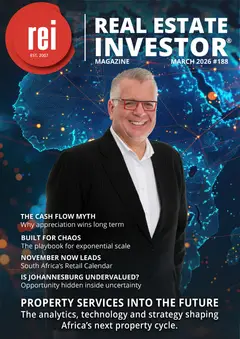
FRONT COVER
Image: Malcolm Horne - Group CEO Broll Property Group
COMPANY SPOTLIGHT
12 - At the helm: Malcolm Horne
COVER STORY FEATURE
10 - Nick Taylor
MASTER INVESTOR
10 - 11
4 - Publishing & Editorial Team
ASK THE EXPERTS
38 - 57
38 - The Beat of Africa: eXpcon
46 - 15 Years of Grove Properties
15
2
REI MAGAZINE MARCH 2026
14
18
COMMERCIAL
STUDENT ACCOMMODATION
76 - 83
BUSINESS MASTERY
84 - 97
84 - Built for Chaos: The Playbook for Exponential Scale
RETAIL
PROPERTY MANAGEMENT
104 - 111
INVESTING
114 - 137
114 - Is cash really King? 126 - How the 14% return works
76 - November now leads SA’s retail calendar
68 - 75
68 - Partnership over profit
TECHNOLOGY
104 - AI moves beyond chat
58 - The Invisible Auction Economy
58 - 65
138 - 145
GREEN BUILDINGS
138 - Solar Unlocked
146 - 167
WEALTH
146 - Cash flow positive investing
156 - Is Johannesburg’s future...
98 - 103
98 - WeconectU
EVENTS
170 - 179
170 - eXpcon Cape Town 176 - Inside the systems behind scalable property wealth
84
156
3
PUBLISHING TEAM
CONTRIBUTORS
NEALE PETERSEN
FOUNDER & EDITOR-AT-LARGE neale@rei.co.za
MARISA GEORGE
ACCOUNTS MANAGER marisa@rei.co.za
GRAHAM MILLER
WEBSITE SPECIALIST graham@rei.co.za
Nick Taylor Belinda Clur Malcolm Horne Hilton Rose Khanya Gundwana
Jacques Grove’ Jaco Grobbelaar Jason Lee Professor Adrian Saville Ian Mcleod
Retha van Rooyen Vusi Thembekwayo Johann van der Merwe Eric Nienaber Nick Morgan
Daniel Lombard Gerhard van der Westhuizen
PUBLISHERS
ADDRESS
10 Howard Studios, Sheldon Way, Pinelands, Cape Town, 7405
WEBSITE
www.rei.co.za
CONTACT US
+27 21 761 3848
Office Whatsapp 0768147639
info@rei.co.za
SUBSCRIBE
NEWSLETTERS
ADVERTISE
JADE NICHOLSON
SENIOR DESIGNER design@rei.co.za
CHRISTIAN SCHUTTE
Disclaimer: The views and opinions expressed in this publication are those of the respective authors and contributors and do not necessarily reflect the views, policies or positions of Reale Activation (Pty) Ltd.
DIGITAL MARKETER christian@rei.co.za
4
REI MAGAZINE MARCH 2026
5
EDITOR’S VIEWPOINT
Strength, scale & strategy in a recalibrating market
Momentum is building. This month’s cover conversation with Malcolm Horne, Group CEO of Broll Property Group, captures a theme that runs through this entire edition: strength before scale.
In a market still navigating capital constraints, energy transition pressures and evolving institutional expectations, Malcolm’s message is clear, disciplined growth wins. Expansion without operational depth introduces risk. Governance is no longer compliance; it is competitive advantage. And in a fragmented market, clarity of strategy matters more than noise.
It’s a powerful leadership perspective and one that resonates beyond corporate boardrooms.
I had the privilege this month of presenting at the 2026 eXpcon International Conference in Cape Town, where over 1,400 agents are now active in South Africa, placing the group firmly within reach of the top 10 nationally. My session, The Agent Advantage: 12 Habits that Separate the Top Earners, reinforced a similar principle: consistent performance is built on discipline, not hype. The top producers are intentional. They execute daily. They understand leverage.
That theme carries through this edition. We ask: Is cash really king? We explore the deeper drivers of property wealth beyond simple cash flow. We celebrate 15 Years of Grove Properties, built by investors, for investors. We unpack how November now leads South Africa’s retail calendar, as the full-year 2025 Clur Index reveals a structural festive shift and a maturing consumer culture.
And in Built for Chaos, we explore exponential scale in unpredictable environments, because uncertainty is no longer temporary. It is structural. This market is not weak. It is recalibrating.
Those who strengthen their foundations, read the data carefully and execute with discipline will not only survive 2026, they will outperform.
Let’s build with intention.
REI MAGAZINE MARCH 2026 6 Founder & Editor-In-Chief
QUOTE OF THE MONTH Spend each day trying to be a little wiser than you 7 were when you woke up. - CHARLIE MUNGER
Built on Consistency. Trusted by Private Investors.
Founded in 2006, Opportunity Private Capital is a Cape Town–based boutique investment company. We structure and deploy private investor capital into residential property developments. Investors participate as capital providers, with a proven track record of returns generated trhough development execution and sales.
8
Simple. Secure. Significant.
REI MAGAZINE MARCH 2026
O
pportunity Private Capital offers private investors access to the value created during the residential property development phase, a return stream traditionally reserved for developers.
This limited investment opportunity allows investors to participate in the capital uplift generated through development, without the operational burden of direct property ownership.
Key Investment Highlights Projected returns from 14% p.a - returns scaled per investment value. Defined capital protection with development assets. Minimum investment from R100,000. Investment timeframes: Estimated 18 - 24 months.
10 YEAR PERFORMANCE
AVERAGE INVESTOR RETURNS vs CPI
Investment Objective To provide private investors with alternative portfolio diversification by granting access to residential property development returns, supported by tangible property assets and disciplined capital structures.
Who This Investment Is For This opportunity is suited to investors seeking: Exposure to property development returns. Predictable, time-bound investment structures. An alternative to direct property ownership. Asset-backed capital protection. Investments with a consistent track record.
R 601 792 427
R 1.1 Billion
16.94 Months
Total Private Investments
Total Project Value
Ave Investment Timeframe
CPI
AVE RETURN
The average return for the period represents the capital-weighted average simple interest rate of investments exited during the year, across the applicable investment tiers.
Source: Opportunity Private Capital and Macrotrends.net
Risk Profile Low to Medium, supported by asset-backed security and defined project structures. Capital deployed into residential developments in highdemand areas around Cape Town.
Capital Security Investor capital secured by underlying development assets. Properties held as security for investors until exit. Independent Security Trust mandated to safeguard investor interests.
Opportunity Private Capital (Pty) Ltd, is a licensed Financial Services Provider, number FSP53400.
9
Cape Town rate change: What short-term rental owners must know
Question
With Cape Town considering higher municipal rates for full-time short-term rentals, how could this affect investment returns and what should owners do now to protect their yields?
Expert Insight: Nick Taylor
MANAGING DIRECTOR OF NOX CAPE TOWN
The City of Cape Town is currently reviewing how full-time shortterm rental properties are rated for municipal purposes. While the final policy and timelines are still under consideration, property owners should begin assessing the potential financial impact now rather than waiting for the regulations to be finalised.
Under proposals currently being discussed, short-term rental properties that are not primary residences could move from the residential rating category to a business or commercial classification.
This would result in municipal rates that are approximately 135% higher than the residential tariff. Properties valued below R7 million could also lose the residential rebate applied to the first R435,000 of municipal valuation.
For property owners who rely on rental income, this could materially affect net returns. Based on early modelling, the additional cost could equate to roughly R9,665 per R1million of property value annually. In many cases this may translate into a 4.5% to 6.5% increase in operating costs and reduce net rental yields by around 0.5% to 1%.
The impact could be most noticeable during quieter winter months when margins are already tighter.
10
REI MAGAZINE MARCH 2026
ASK THE EXPERTS
Key Insight
“Regulatory change doesn’t automatically reduce demand. If supply tightens, well-positioned short-term rentals could achieve stronger nightly rates.”
For owners, the most important step now is understanding the real financial performance of their property. This means analysing occupancy patterns, achieved daily rates, booking trends and net yield after all fixed and variable costs.
Where owners take a proactive approach, adjusting pricing strategies, reviewing cost structures and modelling different scenarios, they are far better positioned to protect long-term returns.
The key is not reacting emotionally to regulatory change but making informed decisions based on reliable data and a clear understanding of the investment’s financial fundamentals.
CLICK HERE if you have a property question
11
MASTER INVESTOR
By Neale Petersen
12
REI MAGAZINE MARCH 2026
At the the making
helm: Malcolm Horne and of a platform business
13
MASTER INVESTOR
In a market shaped by volatility, capital discipline, energy pressure, ESG demands and shifting investment flows, scale alone is no longer enough. Under Group CEO Malcolm Horne, Broll Property Group is pursuing a more deliberate path, strengthening the core, expanding with intent and positioning itself as a platform partner in a property sector undergoing structural change.
The result is a business that is not only growing, but growing with discipline, depth and long-term relevance.
“Expansion without strength is risk. Strength before scale is strategy.”
- Malcolm Horne
14
REI MAGAZINE MARCH 2026
For more than two decades, Malcolm Horne has been part of the growth story of Broll Property Group. Having joined the business 22 years ago and served as Group CEO since 2011, he has helped steer the company through one of the most transformative periods in African real estate services.
MALCOLM HORNE
During his tenure, Broll has evolved from a traditional property services business into a broader operating platform spanning property management, occupier services, facilities management, advisory, research, risk capability and new growth areas including hospitality, project and development services, and energy wheeling. It is a shift that reflects both the changing nature of property and the growing sophistication of client expectations.
Yet Horne’s leadership style is not built on noise. It is grounded in operational discipline, simplification, empowerment and long-term trust.
He speaks less about chasing expansion and more about building strength at the core, creating room for entrepreneurship inside the business, and making sure every new move has a clear value case behind it.
15
MASTER INVESTOR
That philosophy has helped deliver results. Over the past two years, Broll has achieved the strongest financial performance in its 50- year history, a sign not only of momentum, but of the strength of the underlying platform. For Horne, however, the deeper source of pride lies elsewhere: in people development, succession depth, transformation, skills transfer and the ability of the business to create meaningful impact across multiple markets.
This is leadership rooted in patience rather than haste, conviction rather than spectacle. In a fragmented market, that may prove to be one of Broll’s greatest competitive advantages.
Malcolm Horne at a glance
• 22 years with Broll • Group CEO since 2011 • Led Broll through major continental expansion • Oversaw strongest financial results in Broll’s 50- year history over the past two years • Focused on disciplined growth, talent depth and platform resilience
16
REI MAGAZINE MARCH 2026
REAL ESTATE
INVESTOR
INDEPENDENT AND PRACTICAL PROPERTY INTELLIGENCE
JOIN SOUTH AFRICA'S LEADING PROPERTY INVESTOR PLATFORM
REI.CO.ZA
17
COVER STORY
By Neale Petersen
18
REI MAGAZINE MARCH 2026
Beyond the Why this not cyclical
property cycle market is structural,
19
COVER STORY
One of the most important ideas in Horne’s reading of the current market is that the sector is not simply moving through another familiar property cycle. That assumption, he suggests, is too simplistic for the complexity now shaping real estate.
What is unfolding is more structural. Geopolitical shifts, different capital sources, energy insecurity, ESG imperatives, rising client expectations and the growing overlap between property performance and business performance are fundamentally changing what property means and what clients require from their partners.
Bricks and mortar still matter, of course. But assets are no longer viewed only as static investment vehicles. Increasingly, they are operating platforms that influence revenue, resilience, cost efficiency, user experience and strategic flexibility. This is changing the nature of advice, service delivery and value creation across the sector.
“Property has moved beyond bricks and mortar. It has become an operating platform for business performance.”
That shift is also changing the way capital is allocated. Rather than disappearing, capital is being recalibrated. Traditional flows may look slower or more cautious, but capital is still seeking opportunity, often in different sectors, different structures and increasingly from different geographies.
For service providers, this means old models are under pressure. Fragmented service lines and reactive mandates are giving way to a preference for integrated thinking, stronger data, clearer accountability and deeper advisory capability. In that environment, businesses that can connect strategy, operations and execution stand to gain.
20
REI MAGAZINE MARCH 2026
BROLL PROPERTY GROUP
What’s changing in the market?
• • • • •
Capital is more disciplined, not absent Clients want strategic partners, not just vendors Energy and ESG are now operating priorities Data-led insight is replacing instinct alone Platform capability matters more than isolated services
Our Vision
Build one integrated high-performing, profit-yielding business - driving scale, cross-selling and long term client retention.
Our Mission
Provide multi-disciplinary, value-adding, professional real estate services in multiple geographies.
21
COVER STORY
Strength before scale: Why Broll is reinforcing the core before accelerating growth
If there is one phrase that captures Broll’s strategy, it is this: strength before scale.
In practical terms, that means resisting the temptation to expand for appearance’s sake. Instead, the business has spent the past several years deepening its core platforms in property management, occupier services and facilities management across the continent. Those capabilities form the operating spine of the group.
This matters because growth built on weak foundations creates risk for both company and client. New service lines can look exciting on paper, but if the core platform lacks consistency, governance, skills depth and execution strength, expansion becomes distraction rather than strategy.
22
REI MAGAZINE MARCH 2026
BROLL PROPERTY GROUP
Horne’s view is blunt: the most difficult part of growth is not announcing it, but delivering it with excellence. That demands operational depth, not just ambition.
“The easiest thing in business is to announce growth. The hardest thing is to deliver it with excellence.”
23
COVER STORY
Inside Broll, operational depth means simplified structures, clear authority, skilled teams, entrepreneurial freedom within a disciplined framework and a culture that allows the business to remain agile without becoming chaotic. It also means making sure the core business remains strong enough that new ventures are given time, investment and runway to mature properly.
This is one reason Broll’s expansion does not feel opportunistic. Its newer initiatives are not being used to compensate for weakness elsewhere. They are being layered onto a stable, resilient operating base.
What operational depth means at Broll
• Strong property management base • Deep occupier and facilities capability • Simplified internal structures • Skilled teams with decision-making authority • Governance that supports execution • New growth areas backed by real investment
24
REI MAGAZINE MARCH 2026
BROLL PROPERTY GROUP
Governance as an edge: From compliance burden to competitive advantage
Governance has become one of the defining themes of modern property leadership. But for many businesses, it remains misunderstood.
In weaker organisations, governance is treated as a compliance burden or a bureaucratic necessity. In stronger ones, it becomes a source of trust, discipline and competitive edge.
Broll is clearly aiming for the latter.
Institutional clients today are evaluating more than technical capability. They are looking for reliability, control, transparency and the ability to perform consistently within increasingly demanding frameworks. Governance is central to that equation. But Horne is equally clear that governance cannot come at the expense of entrepreneurship or agility.
2003 2004 2006 2007 2013 2013 2013 2013 2013 2014 2014 2015 2015 2015 2018 2024
Namibia Nigeria Ghana Malawi Rwanda Indian Ocean Mauritius Kenya Zambia Botswana Zimbabwe Ivory Coast Mozambique Uganda Gabon Egypt 25
COVER STORY
“Governance must protect the business without choking progress.”
The challenge is to build governance structures that are shaped by the realities of property, not imposed in ways that disconnect decisionmaking from the operational front line. That is where Broll believes it has created an edge: embedding governance into the platform without suffocating initiative.
This matters especially in public-sector work, multi-jurisdictional operations and institutional mandates where proof of value must sit alongside process discipline. In those spaces, governance is no longer a tick-box issue. It is part of the value proposition.
Why governance matters more now
• It underpins institutional trust • It helps secure complex mandates • It supports scalability with control • It strengthens risk management • It allows innovation within a disciplined framework
• Governance that supports execution • New growth areas backed by real investment
Expansion with intent: Hospitality, projects and growth that answers real market demand
Broll’s newer growth moves reveal a disciplined logic. They are not random adjacencies. They are extensions of what clients increasingly need.
26
REI MAGAZINE MARCH 2026
BROLL PROPERTY GROUP
One such area is hospitality, a sector where specialist skills, service discipline and platform thinking are becoming more valuable across Africa. Broll sees an opportunity to bring a dedicated team into a market that requires both international understanding and operational nuance.
Another is project and development services. Here, the rationale is equally clear. As occupiers, institutions and developers demand more integrated delivery, the ability to manage projects and development processes internally opens up a different level of conversation and deeper involvement in the property lifecycle.
“If we can’t add real value, we don’t want to do it.”
These moves are measured rather than aggressive. They reflect a broader philosophy that partnership often makes more sense than acquisition where specialist depth, infrastructure or existing expertise are critical. Broll is willing to build, partner or invest depending on what best serves long-term value creation and cultural fit.
That last point matters. As a people business, Broll sees culture as central to sustainable expansion. Growth that damages culture is not really growth. Intentional expansion, by contrast, strengthens the business while broadening the client value proposition.
Broll’s expansion themes
• Hospitality services • Project and development services • Research and data capability • Energy solutions • Strategic geographic expansion • Partnership-led growth where it makes sense
27
COVER STORY
Energy, value and the next layer of advisory: Why energy wheeling is more than a side offering
Among Broll’s newer strategic moves, energy wheeling stands out because it captures so much of what the modern property market now demands: cost efficiency, resilience, sustainability, technical insight and practical value creation.
Through a joint venture with Blue Energy, Broll has entered a fastemerging space that allows clients to access renewable energy more flexibly and, potentially, at lower cost. In South Africa especially, where energy insecurity has forced businesses to rethink power strategy, this is not peripheral. It is becoming central to how assets are operated and how portfolios are protected.
“Energy wheeling isn’t a distraction from the platform. It strengthens the platform.”
What makes this significant is that Broll is not treating energy as a disconnected add-on. It is integrating it into the broader client conversation around operating efficiency, strategic resilience and platform value. That is exactly what differentiates a platform partner from a narrow service provider.
For clients, the appeal is obvious. Energy wheeling introduces the possibility of lower costs, more flexibility and improved sustainability outcomes without requiring them to navigate the complexity alone. For Broll, it demonstrates a willingness to move where the market is going, but only where it can add genuine value.
28
REI MAGAZINE MARCH 2026
BROLL PROPERTY GROUP
Why energy wheeling matters
• Supports energy resilience • Can lower operating costs • Aligns with ESG and sustainability goals • Extends Broll’s advisory relevance • Reflects real market demand, not trend-chasing
29
COVER STORY
Seeing Africa differently: Local depth, international standards and a wider investment lens
Broll’s African footprint is one of its most important differentiators. The group’s strength lies not simply in having offices across multiple geographies, but in having built embedded teams, local partnerships and long-term presence in those markets.
That creates an advantage that cannot be manufactured overnight. It brings cultural fluency, operating insight, local decision-making access and a better understanding of how risk actually behaves on the ground. In a continent too often read from a distance, that matters.
“We’re not just a South African business in Africa. We’re building African platforms that can stand on an international stage.”
30
REI MAGAZINE MARCH 2026
BROLL PROPERTY GROUP
At the same time, Broll is unapologetic about benchmarking itself against international standards. The ambition is not to be the best in Africa by default, but to be judged alongside global peers. That combination, local roots with international discipline is increasingly relevant as new capital looks toward Africa from the East, the Middle East and other emerging corridors.
In Horne’s view, many in the market are still underestimating how these capital relationships are shifting and what that means for future opportunity. Broll wants to be positioned not only where capital is deployed, but where those conversations begin.
Why Broll’s African footprint matters
• Deep local market understanding • Embedded teams and partnerships • Long-term trust built over time • Better risk navigation • More credible engagement with international capital
31
COVER STORY
From service provider to platform partner: What clients should expect over the next 12 to 18 months
The most important shift in Broll’s positioning may be conceptual rather than structural: the business increasingly sees itself not just as a service provider, but as a platform partner.
That distinction matters. Service providers execute tasks. Platform partners help clients manage complexity, connect moving parts and make better strategic decisions over time. They become part of the operating and investment conversation, not just the delivery chain. For property owners, funds and institutions, this is increasingly valuable. The challenges facing portfolios today are not neatly separated. Energy affects cost. Governance affects mandates.
Data affects leasing strategy. Facilities performance affects tenant retention. Development decisions affect long-term resilience. Clients need partners who can navigate those connections without oversimplifying them.
Our Services
• • • • • • • • •
32
Property Management Energy Wheeling Sectional Title Property Management Residential Management, Letting & Sales Retail Leasing Occupier Services Energy, Water & Sustainability Solutions Capital Markets Broking & Transactions
REI MAGAZINE MARCH 2026
BROLL PROPERTY GROUP
• • • • • • • • • • •
Auctions & Sales Project & Development Services Workplace Design & Build Strategic Risk Management Hospitality Valuation & Advisory Services Integrated Facilities Management Soft Services Technical Services PropTech & AI Intel, Data & Research
33
COVER STORY
“Our role is to make complexity manageable and growth intentional.”
That is what Broll is leaning into. Over the next 12 to 18 months, clients can expect the business to remain focused on the strength of its core platform while selectively expanding into areas that make complexity more manageable and growth more intentional.
This is disciplined innovation rather than restless diversification. It reflects a company that knows what it is, what it does well and where it believes it can add the most value.
What clients can expect from Broll
• Stronger integrated platform support • More strategic advisory capability • Practical solutions around energy and operations • Continued focus on governance and trust • Disciplined innovation, not opportunistic expansion
34
REI MAGAZINE MARCH 2026
BROLL PROPERTY GROUP
One Broll. One platform. One disciplined strategy.
In a fragmented market, clarity is rare. Yet that is precisely what Broll appears to be building: a business clear about its strengths, deliberate about its expansion and confident enough to pursue growth without losing discipline.
For Malcolm Horne, the formula is straightforward: strengthen what works, expand where it makes sense and execute with rigour. That may not be the loudest strategy in the market, but it may well prove to be one of the most durable.
As the property sector continues to shift, structurally, strategically and geographically, businesses that combine resilience, relevance and trust are likely to emerge strongest. Broll is clearly positioning itself to be one of them.
“Strengthen what works. Expand where it makes sense. Execute with discipline.” Malcolm Horne
35
COVER STORY
Broll by the numbers
• 50 years in business • 22 years with Malcolm Horne • CEO since 2011 • More than 1,000 clients • 17 African countries / regional presence as applicable • Strongest financial results in company history over past two years
Partner with a platform built for complexity
To learn how Broll Property Group is helping property owners, institutions and investors navigate change, optimise performance and unlock more strategic growth across Africa.
Visit Broll.com
36
REI MAGAZINE MARCH 2026
BROLL PROPERTY GROUP
Your Story Matters.
INVESTOR OF THE YEAR 2026
Where Credibility Meets Opportunity
ENTER NOW
www.investoroftheyear.co.za
Brought to you by SAPIN in partnership with Absa Home Loans
37
COMPANY SPOTLIGHT
Khanya Gundwana
38
REI MAGAZINE MARCH 2026
The Beat of Town 2026 Real Estate
Africa: eXpcon Cape Sets a New Standard for
39
COMPANY SPOTLIGHT
The energy in Cape Town this February wasn’t just the late summer heat—it was the electric pulse of eXpcon Cape Town 2026. Taking place from 17 to 19 February, this highly anticipated event marked eXp Realty’s official debut on the African continent and celebrated five years of groundbreaking local operations. It was far more than a traditional conference; it was a world-class real estate extravaganza that firmly planted South Africa on the global stage.
After 14 meticulously planned months and a R7 million investment, the event was a monumental success. We welcomed over 1,200 registrants, with a peak audience of 800 guests gathering to celebrate “The Beat of Africa” at the Cape Town International Convention Centre (CTICC).
From Zero to the Largest Independent Agency in Africa
In his opening address, Andrew Thompson, CEO and Country Leader of eXp South Africa, reflected on a journey that borders on the miraculous. “Five years ago, we started with zero agents, zero leadership, and zero infrastructure. Zero of everything,” Thompson noted.
Today, eXp Realty South Africa operates as the fastest-growing real estate company on the continent. We are now the third-largest by agent count in South Africa and the largest independent real estate company in Africa. The momentum from 2025 alone is staggering: boasting 110 CAP agents and 7 ICON agents in just 14 months, alongside the successful execution of the industry’s biggest-ever real estate data transfer. This unique virtual environment has created unprecedented margins and profitability, paving the way to maintain the strategy of being number one in agent support and services with world-advanced tools and tech. By applying this focus, everything else falls into place to be the best in the business in the years to come.
A World-Class Agenda: Global Flair Meets Local eXcellence
Co-hosted and coordinated by Bongiwe Budaza, Andrew Thompson, and Khanya Gundwana, the event was a masterclass in collaboration.
40
REI MAGAZINE MARCH 2026
eXp International
We proudly welcomed eXperts from eXp World Holdings, alongside impressive African delegations eager to invite eXp Realty to operate within their own countries.
The three-day agenda was packed with immense value, thought leadership, and cultural celebration:
• The Global Vision: eXp International’s Felix Bravo opened our eyes to the trillion-dollar African real estate opportunity, while Chief Marketing Officer Wendy Forsythe delivered a powerhouse keynote on modern marketing and content creation.
• Future-Proofing Real Estate: Tech was front and center. Seth Siegler captivated the audience by exploring the state-of-the-art future of AI, while Lightstone’s Hayley Ivins-Downes broke down the “South Africa Data Advantage” for precise pricing.
• Mastering the Market: From Dr. Roelof Botha’s economic forecasting to Mike Walters and Stuart Hyslop detailing high-performance systems for luxury and commercial spheres, the educational value was unmatched..
41
COMPANY SPOTLIGHT
Stars, Spirits, and the “Beat of Africa”
The theme, “The Beat of Africa,” was brought to life through unforgettable entertainment. Attendees were captivated from Day 1 by the soul-stirring global sensations, the Ndlovu Youth Choir.
The intellectual fire was further fueled by a speaker lineup of absolute legends. Rugby World Cup Champion Bryan Habana shared the “Mind of a Champion” alongside the brilliantly witty Dan Nicholl, while global powerhouse Vusi Thembekwayo delivered a masterclass on leading at the edge and mastering chaos.
Yet, perhaps the most impressive sight was seeing our very own agent team—including Chase Winshaw, Lizna Nel, Princess Ncuthe, Keegen Bain, Garikayi Mudzudzu, Renee Ruth, and so many others—taking the stage. Seeing our local agents, leadership, and corporate sponsors standing shoulder-to-shoulder with international giants showcased the positive, collaborative culture that defines us.
Showcasing South Africa to the World
Cape Town was seriously on show. International guests experienced broadcast interviews atop Table Mountain in glorious 29°C weather, charting the next decade of global real estate with unparalleled views, followed by an authentic post-event game drive.
As Andrew aptly put it: “Offer a great experience, and your tourists and travelers will invest.” We are fiercely proud of our people and our country. A massive thank you to FNB for elevating this experience by hosting us at the top of the Portside Tower, the tallest Green Building in Africa.
Milestones, Movements, and Giving Back
The event was also a platform for historic milestones and heartfelt philanthropy:
42
REI MAGAZINE MARCH 2026
eXp International
• The eXp Realty Fund Run in support of Laureus Sport For Good: Kicking off the week on the 17th, the eXp Realty Fund Run brought our community together in motion along the Sea Point promenade. This culminated in a deeply moving highlight: the handover of a R1.5 million cheque to Marlene Coetzee-George for Laureus Sport for Good South Africa Foundation, presented by Ferdi Abrahams.
• The Rise of WIN: Supporting the eXp Women’s Impact Network (WIN) is set to become a powerful movement in South Africa. As proud WIN Ambassadors, Lizna Nel and Khanya Gundwana are thrilled to see this initiative empowering female leadership across the industry and fostering a community of unstoppable women.
• Youthful eXcellence: We proudly celebrated Shené Vorster, who took the stage as the youngest-ever eXp ICON agent—proving that the future of real estate is bright.
• The Grand Finale: The closing awards ceremony was an explosive wrap-up hosted by the incredible Elana Afrika-Bredenkamp alongside Andrew Thompson. With the Drum Cafe South Africa bringing the rhythm, the room was a sea of unity, dance moves, and well-deserved celebrations. Special recognition must also be given to all our CAP Agent Superstars—including those who could not attend the event in person—whose phenomenal dedication and hard work continue to fuel eXp Realty South Africa’s growth.
43
COMPANY SPOTLIGHT
A Personal Note of Thanks from Andrew Thompson
As we look toward a future that is nothing less than eXceptional, Andrew Thompson shared this heartfelt message:
“I personally would like to thank our Corporate Sponsors—including Currencies Direct, Lightstone, ESI Attorneys, Old Mutual, Snappit, Multinet Home Loans, The Virtual Agent, —our International Guests, our Suppliers and Service Providers, all the Speakers and Entertainers, and our Special Guests looking in at eXp. To our very own leadership team—I love you all. And to our amazing agents that continue to eXcel at every level, we thank you. The feedback has been so phenomenal that we are already planning our next massive South African event in 2028.”
The Road Ahead: 2026 And Beyond
The outlook for 2026 is nothing short of eXceptional. This event has generated incredible traction that will fuel eXp Realty South Africa’s growth for the next five years. But you don’t have to wait until 2028 to experience the energy. With approximately 40 roadshow events planned across the country before year-end, the momentum from Cape Town is just the beginning.
We invite you to be part of this incredible momentum—don’t miss your chance to attend an event near you. To consumers across the market, whether you are buying, selling, investing, or developing: reaching your real estate goals starts with a simple conversation. Connect with an eXp Real Estate Professional today. It would be our absolute privilege to partner with you on your property journey.
Experience “The Beat of Africa” for yourself! Watch the official eXpcon Cape Town 2026 highlight video here.
44
REI MAGAZINE MARCH 2026
45
COMPANY SPOTLIGHT
By Neale Petersen
46
REI MAGAZINE MARCH 2026
15 Years Built by
of Grove Properties: Investors, for Investors
47
COMPANY SPOTLIGHT
Fifteen years ago, Jacques Grove’ didn’t set out to build “another property estate agency.” He set out to solve a problem most investors only understand after they’ve been bruised by it: property is not passive, and it’s not a hobby.
It’s a business with people, systems, risk, culture, cash flow and capital allocation decisions that can either compound wealth or quietly destroy it.
That’s the real story behind Grove Properties’ first 15 years. It isn’t a victory lap. It’s a blueprint.
Because Grove’ wasn’t built in a boardroom. It was built in the trenches through early wins, expensive lessons, and the hard-earned clarity that the biggest risk in property isn’t “the market.” The biggest risk is poor decision-making, poor management and poor partners.
If you want to understand why some investors build real portfolios while others spend years stuck with “never-ending shortfalls,” you’ll find the answer in Grove’s evolution: from investor to operator, from transactional broker to long-term asset manager, and from “selling property” to running property like a business.
The investor journey that shaped the business
Jacques started investing more than two decades ago while still studying, during the 2004 - 2005 boom. Like many investors in that era, he was exposed to the classic ingredients: property clubs, deal marketing, the excitement of easy credit, and the inspirational fuel of books like Rich Dad Poor Dad. A boom market can make almost anyone look clever. But it also creates a dangerous illusion, that property “always works.”
His first deal wasn’t residential. It was commercial: two small offices in Bellville purchased for around R400,000 with tenants in place. On paper, it looked like a steal. In real life, it was the start of his education.
48
REI MAGAZINE MARCH 2026
Grove Properties
Then came the familiar investor trajectory: buy-to-let, off-plan deals, larger commercial properties, diversification into regions that looked attractive on brochures but were less impressive in reality. Like many investors, the assumption was that because property is “brick and mortar,” it behaves predictably. It won’t.
When the 2008 Global Financial Crisis hit, the market stopped forgiving mistakes. Vacancies dragged on. Deals that looked “safe” on spreadsheets bled cash in real life.
Some investments became long-distance management headaches. Others became that quiet, dangerous category investors rarely talk about: properties you can’t sell without taking a painful loss, but that keep draining your cash every month.
That period didn’t just teach Jacques about markets. It taught him about risk.
“A passive investment is a government bond. Property is a business.”
49
COMPANY SPOTLIGHT
And that single principle became the foundation for everything Grove would later build.
The turning point: From transactions to relationships
The property industry trains many practitioners to chase transactions: list, sell, rent, repeat. It’s the loudest wins model and it often rewards short-term activity over long-term outcomes.
Jacques saw something deeper. He saw how commoditised the industry had become and how transactional culture damages trust. He saw agents selling advice they’d never had to live with as owners. He saw what happens when incentives are built around “closing” instead of “stewarding.” And he saw the downstream effect in the part of the industry that suffers the most reputational damage: property management.
Ask tenants and landlords where most frustration lives, and the answer is predictable. It’s not always the property itself, it’s the breakdown in communication, accountability and standards. So Grove’ pivoted.
Instead of building a boiler-room sales machine, the company began to focus on building a relationship-driven business: earn trust, deliver outcomes, and partner with investors over time.
The mission became simple and sharp: Move clients from property “ownership” to portfolio “management.”
This is where Grove’s positioning becomes distinctive. Most property businesses are built around transactions. Grove has increasingly built around investor outcomes.
50
REI MAGAZINE MARCH 2026
Grove Properties
The missing link: Portfolio Asset Management
Here’s the gap that defines the modern South African property market:
• If you own two or three properties, you often manage them yourself. • If you own hundreds of millions in assets, you can hire institutionalgrade asset managers. • But if you’re in between, that messy middle of serious private investors, entrepreneurs and family portfolios, the support is thin.
That is where Grove planted its flag. Portfolio Asset Management is the discipline of treating each property as a business unit and the portfolio as a balance sheet with a strategy, targets, controls and performance tracking. It’s not “admin.” It’s governance and value creation.
51
COMPANY SPOTLIGHT
The process starts with professionalising the basics:
• • • •
Stabilising occupancy and income De-risking leases, compliance, insurance and documentation Tightening arrears control, maintenance standards and tenant rules Fixing the “leaks” that quietly erode returns
Then it moves into value creation:
• Rental optimisation and repositioning • Unit reconfigurations to improve yield • Conversion opportunities (for example, turning underperforming offices into residential) • Medium-scale development thinking — once cash flow is stable
The logic is clear: you can’t do sophisticated growth projects on unstable cash flow. First you stabilise the asset. Then you unlock value.
52
REI MAGAZINE MARCH 2026
Grove Properties
“Informal tenants pay informal rents. Professionalise the building and the income follows.”
A principle most investors ignore: Every building has a culture
One of Jacques’ sharpest insights is this: property isn’t only about numbers, it’s about standards.
Every building has a culture. If the landlord never fixes anything, accepts “anything that pays,” and runs the place informally, the building attracts and keeps informal behaviour. That culture repels quality tenants. It limits rent growth. It increases arrears. It increases damage.
And it makes the property harder to finance, harder to sell and harder to scale.
Change the culture and the building changes. That doesn’t require magic. It requires discipline:
• • • • •
Clear rules and consistent enforcement Faster maintenance response Professional billing and communication Improved security and presentation A tenant experience that respects good people and filters out bad behaviour
Over time, you raise tenant quality and with it, yield, stability and asset value.
This is what separates property “owners” from property “operators.” Owners hope. Operators manage.
53
COMPANY SPOTLIGHT
The Grove growth story: Quality people, not “bums in seats”
From 2020 to today, Grove has scaled from a small team to around 22 people, but with a deliberate philosophy: productivity, professionalism and cultural fit over headcount.
Jacques speaks openly about culture being the real operating system of any property business. In an industry where many teams are built around pressure and ego, Grove has leaned into a different model: Values, alignment and professional standards.
The company also built what Jacques describes as an “interdependence” model, positioned between traditional agencies (high control, lower splits) and independent models (higher splits, lower support). The goal is to give agents multiple income streams and real operational backing while keeping collaboration strong and standards high.
And that matters, because investor service is operationally heavy. It requires systems, accountability and execution, not just charisma.
The hard-earned success principles behind 15 years
Grove’s story holds lessons for serious investors and serious property businesses that are worth printing out and sticking on the wall.
1. Don’t confuse property with “safe”
A great-looking deal can become a decade-long shortfall if you ignore vacancy risk, local demand and tenant quality.
2. Cash flow first, then expansion
Before you chase growth, stabilise income, reduce risk and fix operations. Big upgrades come after the building pays its way.
54
REI MAGAZINE MARCH 2026
Grove Properties
3. Run your portfolio like a business
4. Choose partners who have owned property
If you can’t answer “what’s my strategy for the next 3 - 5 years?” you’re drifting. Drift destroys portfolios.
Advice from people who’ve never carried vacancy risk or fought utility disasters can cost you millions.
5. Systems scale. Chaos collapses
What works at three properties breaks at ten. What works at ten breaks at fifty. Systems are survival.
6. Relationships beat transactions
The fastest commission is rarely the best long-term decision. Trust compounds and so does reputation.
55
COMPANY SPOTLIGHT
The next chapter: Bigger ambition, clearer strategy
Grove’s next phase is unapologetically ambitious: to become South Africa’s leading portfolio asset management platform in its category and to expand into larger regional footprints with high-quality teams.
Behind the scenes, the company has been systematising execution and strengthening its operating model, because scale without control is just expensive chaos.
And that’s the real meaning of the 15 year milestone: Grove’ didn’t grow by chasing volume. It grew by building capability and aligning the business around investor outcomes.
The message
Property rewards discipline, not hope. The Grove story is a reminder that the biggest edge in property investing isn’t finding “the next deal.” It’s building the operational muscle to run property like a business, protect cash flow, and create value deliberately.
Fifteen years in, Grove’s message is simple: Built by investors. Built for investors. And built on the principles that actually survive cycles.
Unlock your potential in property - Earn up to 80%
Click Here to Join Grove Properties.co.za
Visit Grove Properties.co.za
56
REI MAGAZINE MARCH 2026
Don’t limit your clients – multiply their options
Don’t just take our word for it – here’s what estate agents have to say about partnering with BetterBond
57
COMMERCIAL
The Invisible The Power
By Professor Adrian Saville & Ian McLeod
58
REI MAGAZINE MARCH 2026
Auction Economy of Auctions - Part 4
59
COMMERCIAL
You may not hear them. You may not see them. But auctions are setting prices for electricity, computing power and the very words you type into Google every second of every day.
There’s the unmistakable smack of the hammer coming down as the deal is sealed. And we all know the unique tone auctioneers take when inviting bids. These can be noisy affairs.
However, most of the auction behaviour happens in silence these days. Offers and bids in the modern economy take the form of binary signals, soundlessly shooting around the internet, through data centres, and resolving by algorithm rather than human and hammer. The sums of money and shear efficiency are staggering.
These auctions aren’t just operating in the background. They’re often under our noses. Several might be playing out on your screen while you read this.
Auctioning eyeballs, one clicks at a time
Every time someone types a query into Google, an auction is initiated. In fact, it takes place before the results load. Advertisers bid for the right to appear alongside a specific search term, and the winner is chosen not simply by price, but by a formula balancing bid size, relevance and expected click-through rates.
This system, refined over two decades by Google and others, is a variant of a generalised second price (GSP) auction. On this (and modern auction science generally), Paul Milgrom and Robert Wilson are the leading brains. The pair shared the Nobel prize in 2020 for their work on novel auction designs.
60
REI MAGAZINE MARCH 2026
In short, the GSP auction means the highest bidder gets the top slot, the second highest the next, and so on. That is standard. The kicker is that each winner pays the price of the bid just below them. So, the winner pays the second highest bid price and so on.
That said, the specifics of the precise mechanisms applied by each online giant are closely guarded secrets. The gist is public, but the granularity is the subject of much speculation. Advertisers with marginally smarter bidding or more amenable keyword selection might just punch their advert to the all-important top spot.
The scale is astonishing. The global online advertising market was worth half-a-trillion US dollars in 2025.[1] It is likely to double in size by 2032.[2] Notably, however, this size doesn’t mean that detail is lost. Search advertising prices attention with extraordinary granularity.
61
COMMERCIAL
A search for “cheap flights” at 9am in London may fetch a very different price from the same search at midnight in Johannesburg or 3pm in Istanbul. This is price discovery at the speed of light, tailored for location, device time, time of day and much more.
In effect, Google runs billions of micro-auctions daily, pricing attention in milliseconds.
From electricity to cloud computing
Advertising is only part of this story. Wholesale electricity markets in Europe, North America and parts of Africa rely on daily auctions to determine which power plants run and at what price. Generators submit bids reflecting their costs; the marginal plant sets the market price. When energy is scarce, prices spike - not because of greed, but because auctions reveal scarcity with brutal honesty and unmatched efficiency.
Cloud computing works in much the same way. Firms bid indirectly for server capacity through dynamic pricing mechanisms run by providers such as Amazon Web Services (AWS). During periods of heavy demand, computing power becomes more expensive, rationed not by queues or auction hammers, but by price.
As demand for energy booms with our increasing appetite for artificial intelligence (AI), this is likely a field where innovative auction systems
will become increasingly useful.
Brutal but elegant
Algorithmic auctions have their opponents. They can be accused of producing price volatility and can be accused of leading to higher prices. In response, defenders will argue that volatility and prices are relative. Additionally, that there is a cost to ensuring stable, low prices. Usually someone is paying for these benefits – it might just not be the end user.
62
REI MAGAZINE MARCH 2026
A tangible example captures the challenge. Imagine you’ve just seen your favourite band live in concert. You and 80,000 other fans are now exiting the stadium. Half of the crowd is on their phones trying to order a ride share.
Some will argue that it is unethical for ride-haling services to raise prices. So-called “surge pricing” might elevate fees 20 times. Service providers should, the argument goes, be forced to apply standard prices.
Would this help? You and your 40,000 competitors for a ride home might see the standard price on your phone screen. But is it really a price if no driver will take your fare? At standard prices 40,000 people are left with a standard number of cars and willing drivers. Algorithmic bidding would be different. With tired concert-goers free to bid prices up, those willing and able to pay a higher price will push prices higher to get a ride home. This will coax more drivers out of bed and into their cars. Those willing to pay at the top end of the spectrum will be next in line. And so, it will go until everyone is home – meaning “equilibrium” is restored.
The auction option might be brutal, but it is elegant. As economist Thomas Sowell reminds us, “There are no solutions, only trade-offs.”
63
COMMERCIAL
Five Articles: Five Lessons
From the ancient Babylonian marriage market to the online auctions happening beneath your fingertips, this series has traversed the phenomenon of the auction.
1 What have we learned?
Auctions endure Designs will progress and the platform will vary, but the auction is a powerful solution to many commercial conundrums.
2 Auctioning efficiency
Wherever buyer and seller are better off in the long run by trading via auction, that is what we’ll do.
3 The human element
Economics is a social science. Auctions, likewise, are designed, run and used by humans. The behavioural element matters.
4 Future focus
As more of the economy is run in the cloud, powered by digital systems, the speed, scalability and reliability of auctions will become increasingly relevant, even if, as this article shows, it happens in silence.
5 Ye olde auction
For as long as we value nostalgia and feel the need to learn from the past, auctions will be the natural marketplace for the historical artefacts, beautiful, old, rare, and difficult to price.
Auctions are no longer confined to salerooms and gavels. They are embedded in the architecture of modern markets, silent, scalable and relentlessly efficient.
The hammer may be gone. The auction is not.
64
REI MAGAZINE MARCH 2026
Until our next series…next month.
__________________________________________________________
[1] Grand View Research, Inc. (2025). Online advertising market (2026–2033) size, share & trends analysis report by type, by platform, by pricing model, by end use, by region, and segment forecasts (Report No. GVR-4-68040-088-9).
[2] Tunuguntla, S., Mela, C. F., & Pratt, J. (2026). Targeting Information in Ad Auction Mechanisms. arXiv preprint arXiv:2601.09541.
Adrian Saville is Professor of Economics, Finance & Strategy at GIBS Business School (Gordon Institute of Business Science) and founder of Boundless World, Adrian’s work focuses on business model design, innovation, capital allocation, and growth strategy to help businesses turn complex market shifts into clear strategy and measurable results.
The Authors
Ian Macleod is a senior research associate at GIBS Business School (Gordon Institute of Business Science) and partner at Boundless World. Ian translates rigorous economic insight into practical playbooks for real-asset and financial markets, turning messy markets into transparent, value-unlocking mechanisms.This thought leadership article is produced as part of a series for The High Street Auction Co, South Africa’s premier auction house. Learn more here: https://www.highstreetauctions.com/
65
66
REI MAGAZINE MARCH 2026
67
STUDENT ACCOMMODATION
By Retha van Rooyen
68
REI MAGAZINE MARCH 2026
Partnership over profit: Rethinking student housing
69
STUDENT ACCOMMODATION
The moment we stopped competing
A few years ago, I attended a university housing forum. The room was filled with developers, landlords, residence managers, university officials and government representatives.
For the first hour, it felt like a battleground. Universities spoke about unaccredited housing. Landlords pushed back on red tape. Administrators highlighted compliance gaps. Students, as always, were caught in the middle.
Then a young university housing officer said quietly: “At the end of the day, we all want the same thing for students to feel safe, supported and to succeed.”
The room went silent. That was the moment I realised something simple but powerful: we are not on opposite sides. We are on the same side.
In South Africa’s fast-growing student accommodation sector, we cannot afford to operate in silos. Collaboration is no longer idealistic, it is essential.
How we partner across the system
The student housing ecosystem has three key pillars:
• Universities hold the students and the standards. • Government holds policy and funding mechanisms. • Private providers hold infrastructure, agility and innovation.
When these pillars operate independently, students fall through the cracks. When they align, the entire system strengthens.
At My Student House, partnership is intentional. It doesn’t happen by chance, it’s built through consistency and trust.
70
REI MAGAZINE MARCH 2026
1. University Collaboration
We work closely with university housing departments to align on accreditation, inspections and student wellbeing programmes. Open communication ensures smoother processes and better student outcomes.
2. Government & NSFAS Alignment
3. Community Integration
Understanding policy shifts and funding frameworks is critical. Compliance is not a burden, it’s the framework that protects students and strengthens credibility.
Student housing does not exist in isolation. We integrate with surrounding communities to create safer, more stable environments that support long-term sustainability.
4. Industry Collaboration
We believe in openness. Sharing knowledge with fellow operators elevates the entire sector. Healthy competition is good, but shared standards are better.
What we’ve learned along the way
Building partnerships comes with lessons, some learned the hard way.
71
STUDENT ACCOMMODATION
Here’s what experience has taught us:
• Partnership builds sustainability. When landlords and universities communicate early, problems are resolved faster and students thrive.
• Transparency reduces tension. Clear reporting and accountability create trust across the system.
• Shared programmes stretch budgets. Collaborating on transport, wellness initiatives and student events delivers better value for everyone.
• Purpose must guide profit. Occupancy means little if students feel unsafe or unsupported.
• Culture flows from leadership. When operators collaborate, we model the kind of community we want students to build.
The truth is simple: a fragmented sector weakens us all. A connected one elevates everyone.
72
REI MAGAZINE MARCH 2026
Advice for Landlords & Operators
1. Communicate early and often
For those active in student accommodation or entering the space — here are five practical principles:
Build relationships with university housing offices before issues arise. Keep dialogue open with students and parents.
2. Participate in the ecosystem
Attend forums. Share insights. Stay informed. The strongest operators are those plugged into the broader network.
3. Offer more than beds
Modern universities value partners who contribute to student development, not just landlords who collect rent.
4. Respect compliance
5. Lead generously
Accreditation is not red tape; it is a language of trust. Compliance protects both investors and students.
Sharing knowledge strengthens the industry. Hoarding it weakens it. Student housing is not a short-term play. It is a long-term commitment to infrastructure, people and reputation.
The Bigger Picture: Beyond Property
Student accommodation is more than an asset class. It forms part of South Africa’s education backbone.
When students live in safe, well-managed, compliant environments, their academic success improves. Their confidence grows. Their futures expand.
When we align our goals, we do more than manage properties, we stabilise lives.
73
STUDENT ACCOMMODATION
At My Student House, we believe in:
• Collaboration over competition • Transparency over ego • Purpose over polish
Because success in this sector is not measured by the number of rooms under management. It is measured by the number of students supported on their journey to independence and achievement. The leaders of tomorrow are shaped by the environments we create today.
Let’s Build Together
If you are a university housing representative, landlord, policymaker or investor, we invite you to partner with us.
Let’s create a more connected, compliant and compassionate student accommodation ecosystem.
My Student House Contact details
About the Author Retha van Rooyen is the Founder & CEO, My Student House and also an author of the book ‘Creating wealth in student accommodation in South Africa.’
74
REI MAGAZINE MARCH 2026
EMAIL getinfo@mystudenthouse.co.za CELL 084 575 1000 WEBSITE www.mystudenthouse.co.za
MAXIMISE YOUR PROPERTY’S POTENTIAL WITH SMART STUDENT ASSET MANAGEMENT WITH MY STUDENT HOUSE
getinfo@mystudenthouse.co.za
084 575 1000
www.mystudenthouse.co.za
AS NSF dited
re
Acc
WHAT WE DO
Private Student Accommodation Management
Investor, Conversion, Accreditation Services Turning Properties into Purpose Student Placement & Rent Collection Filling Rooms, Building Trust Incident Management Protecting Students, Landlords & Reputations Facilities & Operations From Repairs to Disciplinaries Transport Management Moving Students Safely & Seamlessly Student Management & Wellbeing More Than a Roof, a Support System Neighbourhood Engagement Changing How Communities See Students
Smart investors choose partners who deliver results. Our proven model combines compliance, care, and community to maximise occupancy and protect your ROI.
FIND US
Cape Town Bloemfontein Gqeberha Gauteng Potchefstroom 75
RETAIL
November now leads retail calendar
Full year 2025 Clur Index reveals a festive shift, resilient growth and a consumer culture.
By Neale Petersen
76
REI MAGAZINE MARCH 2026
SA’s
structural maturing
77
RETAIL
For decades, December was the undisputed king of retail trading. In 2025, that crown shifted again. According to the latest Clur Shopping Centre Index, November has now outperformed December for the second consecutive year — signalling a structural change in festive season dynamics rather than a once-off anomaly.
“This was the second year running that November’s growth performance eclipsed that of December, with this growth coming off a high 2024 base,” says Belinda Clur, Managing Director of Clur International. “December’s relative higher trading density gap has diminished significantly since 2023.”
The Clur Index is derived from the Clur Collective, South Africa’s leading early-warning performance, strategy, analysis and benchmarking platform built exclusively for shopping centres to optimise returns. The endorsed industry standard covers over 5.4 million square metres of retail space across listed and unlisted property funds in South Africa and Namibia.
November takes control
November 2025 closed with annualised trading density growth of 4.4% year-on-year, outperforming CPI by 0.9%. While slightly below the fullyear index, it comfortably beat December’s 2.7% growth rate.
Super-regional centres led November at 6.2%, followed by regional centres at 4.0%.
The Black Friday effect has clearly entrenched itself. Pressurised consumers are increasingly consolidating spend into a destination shopping strategy earlier in the season.
78
REI MAGAZINE MARCH 2026
CLUR CONNECT
December told a different story. Community and smaller centres led performance at 4.1%, indicating stronger convenience-driven purchases rather than large discretionary splurges. When combined, November and December delivered 3.4% growth, positive, but below both the full-year figure and the robust January - October expansion of 5.5%.
The festive period is no longer carrying the year. The year is carrying the festive period.
A year of resilient growth
The full 2025 national Clur Index for All Centres recorded 5.0% annualised trading density growth, outperforming CPI by 1.8%. Community and smaller centres led full-year growth at 5.5%, followed by regional centres at 5.3%. Super-regional centres showed the strongest expansion relative to mid-year levels.
National annualised trading density closed at R42,780 per sqm, led by super-regionals at R52,524 per sqm and community centres at R48,441 per sqm.
The two extremes of scale continue to dominate: destination and convenience.
Provincial power shifts
In November, Gauteng topped the provincial rankings with 5.3% growth, edging out the Western Cape at 4.9%.
However, the Western Cape retained its dominance over the full year, delivering 5.7% growth and outperforming CPI by 2.5%. Gauteng followed at 5.2%, while KwaZulu-Natal posted 3.6%.
In absolute trading density terms, the Western Cape led at R49,682 per sqm, followed by KwaZulu-Natal at R44,858 and Gauteng at R41,214.
79
RETAIL
For investors and landlords, the Western Cape remains structurally robust, but Gauteng’s November leadership signals renewed competitive intensity.
Rental discipline holds
On the rental front, stability remains the defining feature. The full-year Base Rent to Sales ratio closed at 6.6%, reinforcing controlled market risk since mid-2024.
December base rental growth reached 5.4% year-on-year, outperforming CPI by 1.8%.
Super-regional centres achieved rentals of R330.74 per sqm, while the national average closed at R245.28 per sqm. The Western Cape again led provincial rental performance at R271.36 per sqm.
Landlords and tenants appear aligned around sustainable growth rather than aggressive escalation.
The rise of the belief economy
Beyond performance metrics, 2025 marked a cultural pivot. Clur identifies the evolution from an “Attention Economy” to what she terms a “Belief Economy.”
“Rawness, grit and creativity are new core values that resonate with consumers,” she says. “There’s a growing rejection of overly polished, characterless and massproduced outputs.”
This cultural shift manifests in preferences for:
• • • •
Natural and minimally processed foods Visible craftsmanship in fashion and design Honest storytelling and authentic community experiences Wellness, self-expression and reinvention
Consumers are seeking texture, emotion and imperfection, not gloss.
80
REI MAGAZINE MARCH 2026
CLUR CONNECT
81
RETAIL
For shopping centre owners and asset managers, this is not abstract philosophy. It directly influences tenant mix, experiential design and brand positioning.
Being culturally literate is becoming as important as being financially disciplined.
What 2025 ultimately reveals
The data is clear
• • • • •
November has structurally overtaken December. Growth is broad-based but less festive-dependent. Western Cape leadership continues, but competition is tightening. Retail risk remains contained. Consumer sophistication is rising.
South Africa’s retail sector is not booming, it is recalibrating. It is earlier, more strategic and more culturally aware.
Strategy over seasonality
The 2025 Clur Index shows a retail market that is evolving rather than retreating.
Festive concentration is flattening. Growth is spreading across the year. Performance is increasingly tied to strategic positioning rather than calendar timing.
November now sets the tone. The rest of the year carries weight. December no longer dictates the narrative.
For retail landlords, fund managers and investors, the message is blunt: understand the shift or be left behind.
DOWNLOAD the full Clur Shopping Centre Index 2025
82
REI MAGAZINE MARCH 2026
83
BUSINESS MASTERY
By Neale Petersen
84
REI MAGAZINE MARCH 2026
Built for for
Chaos: The Playbook Exponential Scale
85
BUSINESS MASTERY
At eXpcon 2026 in Cape Town, Vusi Thembekwayo - entrepreneur, venture capitalist and global business voice delivered a clear warning to property and business leaders: growth doesn’t fail in chaos; it fails in comfort.
The Chaos Advantage
Africa is opportunity wrapped in chaos and the winners aren’t the ones who avoid the chaos, but the ones who learn to lead inside it.
• Expect the 80/20 reality: A few performers drive results, your job is to build systems that lift the middle.
• Scale by focus: Identify 2 - 3 growth drivers, then stop being the bottleneck your business can’t afford.
• Sell value, not price: Anchor psychology, upsell smartly, build referrals at the “bliss point,” and obsess over experience.
His theme, “Leading at the Edge of the African Beat: Mastering Chaos and the Magna Carta of Exponential Growth,” was less hype and more on operating systems: how to scale, how to build teams, how to sell, and how to stay human while doing it.
If you’re building a property business whether an estate agency, property portfolio, property development, rentals, Proptech, or servicing investors, this talk lands hard because it deals with the real problem: growth doesn’t break your business. You do, when you refuse to evolve.
86
REI MAGAZINE MARCH 2026
1: The Uncomfortable Truth: Performance is uneven - Price’s Law
Vusi opened with Price’s Law: in any organisation, a small group produces a disproportionate share of output.
What this means for a property business
• In a sales team, a handful of agents carry the turnover. • In a rental business, a few operators solve most problems. • In a development company, a few key people move projects forward; everyone else can become “noise.”
Practical moves
• Measure contribution, not effort. Track conversions, not busyness. • Coach the “middle 60%.” Your top people don’t need motivation; they need leverage. • Stop tolerating passengers. Clear standards protect culture.
Key leadership point
It’s easier to pull people down than lift them up, because lifting requires belief. And belief is work.
87
BUSINESS MASTERY
2: Belief is a Business Tool: Bridge the aspiration gap
Vusi made a powerful point for South Africa: you can’t tell someone to sell million-rand assets if they’ve never experienced that world.
The leadership job is to close the “belief gap.”
You don’t do that with pep talks. You do it with exposure and experiences that make success feel real.
Practical moves for property teams
• Experience days: Take junior agents to high-end show houses, precinct walk-throughs, investor meetings. • Deal breakdown sessions: Show the numbers - sale price, commission, lead source, timeline, process. • Make it touchable: Once it’s felt, it’s believable and once it’s believable, it becomes actionable.
Key point: Raise standards through proximity
Expose your team to the rooms, assets and conversations they aspire to. Proximity shifts belief and belief drives performance.
3: The Entrepreneur Ladder: Know what you really are
Vusi laid out a progression most entrepreneurs never name clearly:
• ONE: The Professional (Self-employed technician) You do the work. If you stop, revenue stops.
• TWO: The Self-Employed (Small support circle) Others remove admin; you still do the “real” work.
• THREE: The Business Owner (Codified rules plus systems) The business has a repeatable method, not just your talent.
88
REI MAGAZINE MARCH 2026
• FOUR: The Scaler (Scaling the rules) You replicate performance through culture, training, and process.
• FIVE: The Founder (Vision beyond you) You build something that can outgrow you and you’re willing to step aside if needed.
The Brutal Question
Are you building a business… or building a job with a fancier title?
89
BUSINESS MASTERY
4: The Biggest Growth Threat is You (NIDU)
Vusi named the silent killer: “Nobody Does It Better Than I Do” (NIDU). It starts as excellence. Then it becomes control. Then it becomes a growth ceiling.
Symptoms
• • • •
You need to be CC’d on everything. You redo work instead of coaching people. You’re “busy” but not moving the needle. Growth drivers never get time because you’re stuck in business-asusual.
Practical moves
• Choose your 2 - 3 growth drivers. Then protect them like revenue depends on it, because it does. • Define what “good enough” looks like. Not everything needs founder-level perfection. • Install consequences plus trust: “I reserve the right to micromanage if you mess up” is a clear standard.
Bottom line
Early-stage hustle gets rewarded. Mid-stage control gets punished.
5: Build with Insight - Not Instinct
Instinct might launch your business, but only data can scale it sustainably.
90
REI MAGAZINE MARCH 2026
Vusi challenged entrepreneurs to replace guesswork with measurable intelligence, from time-to-sell and conversion rates to cost per deal and pipeline velocity.
Start knowing
• • • • •
Time-to-sell by segment (Affordable, Mid, Luxury) Conversion rates by lead source Average days-on-market by area Cost per lead / cost per deal Pipeline velocity and fall-off points
Practical moves
• Weekly dashboard (1 page): pipeline, conversions, time-to-close, objections, top lead sources. • Segment your business: don’t treat a R900k deal like a R9m deal, different cycles, psychology, and processes. • Identify “too long” early: by the time it’s obvious, it’s already expensive.
Actionable Takeaway
Install a simple weekly dashboard, segment your deals properly, and flag slow-moving stock early, because what you measure improves, and what you ignore becomes expensive.
91
BUSINESS MASTERY
6: Align Incentives - or expect Chaos
Growth stalls when numbers, behaviours and rewards pull in different directions.
Vusi’s message was clear: if incentives aren’t intentionally aligned, chaos becomes the default culture.
Incentive alignment exercise (simple but rare):
• • • •
“These are the numbers.” “These are the behaviours required.” “This is the attitude standard.” “This is the reward and why it matters to you personally.”
Practical moves for property businesses
• Pay for deal contribution, not only deal closure (introductions, facilitation, lead interception). • Reward pipeline behaviours (calls, viewings, proposals sent, followups) alongside results. • Make incentives visible and fair or resentment becomes your culture.
Key Action
Tie rewards directly to measurable behaviours and contribution, not just outcomes, because what you pay for is what your team will prioritise.
92
REI MAGAZINE MARCH 2026
7. The PURE Advantage Model - Sell smarter, not harder
Selling harder is not the answer, selling with structure is. Vusi’s PURE framework is a disciplined sales operating system designed to eliminate wasted effort, increase deal velocity, and turn every transaction into a growth engine.
In a property market where time leaks profit and energy is finite, PURE forces clarity: qualify early, elevate value intelligently, activate referrals systematically, and design experiences that justify your price. It shifts sales from emotional hustle to intentional precision and that’s where scale begins.
Vusi shared a sales model that fits property perfectly.
93
BUSINESS MASTERY
P = Price (before Proposal)
Stop spending weeks on proposals for clients who can’t afford you.
Do this instead
• Give a price range early and ask: “Should we continue?” • If it needs committees and approvals, shrink the scope and get “in” with one decision-maker.
Property translation
• Don’t build a full marketing plan and show-day schedule for a seller who won’t sign your mandate fee. • Don’t do ten viewings before you confirm buyer qualification.
U = Upsell (the Question is the weapon)
Upselling isn’t pushy. It’s structured curiosity.
Property upsells that work:
• • • •
“Would you like this staged professionally?” “Do you want a premium listing package?” “Would you like pre-approval facilitation included?” “Do you want investor-grade rental projections with this deal?”
94
REI MAGAZINE MARCH 2026
R = Referral (system, not hope)
Ask at the bliss point, when the client is most excited.
Property bliss points
Offer accepted Transfer lodged Keys handed over First rental payout Renovation completion / before-and-after reveal
Add a system: Automated message plus a personal voice note plus a
simple referral script.
E = Experience (the real product)
Clients don’t pay for property alone. They pay for certainty, confidence, and the feeling of being handled.
4 Experience Rules Vusi shared
• • • •
Relevant (Personalised, meaningful) Responsive (Listen to understand, then act) Convenient (Choice, consistency, timeliness) Reliable (Keep the promise)
The PURE Advantage - Bottom Line
Qualify early, ask better questions, systemise referrals and engineer experience, because disciplined sales systems outperform hustle every time.
95
BUSINESS MASTERY
8: Trust is the real Scaling Engine (The F1 Lesson)
Vusi closed with a Formula 1 pit-stop example: teams don’t move fast because they “try harder.” They move fast because systems plus trust remove friction.
Leadership lesson
The driver can only go full throttle because the team is precise. You can only scale if your people can execute without you hovering. Your business will never outgrow your trust in others.
Practical moves
Document the “pit stop”: listing > marketing > viewings > offers > negotiation > transfer > after-sale. Train it until it’s boring. Then let people run it.
Master the chaos or be mastered by it
At eXpcon 2026, Vusi Thembekwayo didn’t offer motivation, he offered responsibility.
Africa does not reward comfort. It rewards discipline. It rewards operators who install systems, elevate standards, align incentives and refuse to be the ceiling of their own growth. Chaos is not the constraint. Ego is.
Exponential growth in property is not built on passion alone. It is built on clarity, measurement, structure, pricing intelligence, team trust and the courage to evolve beyond your current identity as a founder. And perhaps the most powerful takeaway of all:
You don’t need perfect infrastructure, perfect politics or perfect timing to win. You need precision. You need systems. You need people who can execute when you are not in the room.
Because the real edge in Africa is not surviving chaos. It’s mastering it.
96
REI MAGAZINE MARCH 2026
97
PROPERTY MANAGEMENT
98
REI MAGAZINE MARCH 2026
99
Page 100
Open page 100 in the magazine →100
REI MAGAZINE MARCH 2026
Page 101
Open page 101 in the magazine →101
Page 102
Open page 102 in the magazine →102
REI MAGAZINE MARCH 2026
Page 103
Open page 103 in the magazine →103
Page 104
Open page 104 in the magazine →TECHNOLOGY
AI moves intelligent
By Eric Nienaber
104
REI MAGAZINE MARCH 2026
Page 105
Open page 105 in the magazine →beyond chat: The rise of workflows
105
Page 106
Open page 106 in the magazine →TECHNOLOGY
AI is moving beyond the chat interface
For the past few years, artificial intelligence has largely existed as a separate destination, a tool users visit to generate summaries, draft content, analyse data or create images.
The process has been familiar: open a chatbot, type a prompt, wait for a response, and then manually move the output into your real working environment, whether that’s Excel, Google Sheets or another application.
While incredibly powerful, this workflow is beginning to feel disconnected and inefficient. AI has been useful, but it hasn’t always fit naturally into the everyday software people rely on to run their businesses. As we move deeper into 2026, that model is rapidly changing.
AI is no longer just a chat interface. Increasingly, it is becoming an action layer embedded directly inside the applications we already use.
The rise of specialised AI Agents
Until recently, most AI tools relied on a single general-purpose model expected to perform a wide variety of tasks. That approach is now evolving.
The industry is moving toward multi-agent systems, where specialised AI agents perform different roles within a broader digital ecosystem.
106
REI MAGAZINE MARCH 2026
Page 107
Open page 107 in the magazine →TRUSTED AI
One agent may focus entirely on data extraction, while another manages automated actions or integrates with external software tools. Each agent operates as part of a coordinated system designed to complete complex workflows.
This approach also introduces a major efficiency advantage: different models can be used for different tasks, allowing organisations to optimise both performance and cost.
Platforms such as Intelliweave.ai are designed to enable this shift. Rather than replacing existing software, the platform integrates with current applications and allows users to create a division of labour among specialised AI agents.
These agents can access different knowledge bases, use specific tools and pass information between one another, all without requiring a human to manually move data between systems.
Importantly, humans remain in the loop, particularly at key decision points where oversight and approval are required.
107
Page 108
Open page 108 in the magazine →TECHNOLOGY
What Multi-Agent AI means
• Different AI agents perform specialised roles
• Systems collaborate within a broader workflow
• Tasks can be automated across multiple software platforms
• Costs can be optimised by using different models for different functions
Event-Driven AI: Automation without the prompt
While the chatbot remains a useful starting point, the most significant development is the rise of event-driven AI. This marks a shift away from manually triggering AI with a prompt. Instead, AI agents increasingly live inside business software, reacting automatically to events in real time.
For example:
• When a new lead enters a CRM, an AI agent may automatically begin building a client profile.
• If a financial threshold is reached in an ERP system, a compliance agent could initiate a risk analysis.
• A workflow may only involve human intervention when an approval or decision is required.
108
REI MAGAZINE MARCH 2026
Page 109
Open page 109 in the magazine →TRUSTED AI
In these scenarios, the traditional chat interface may never appear. Instead, users might simply receive a notification asking them to approve or reject an automated action.
This represents a major step toward AI becoming an operational layer embedded within everyday software.
Event-driven AI in practice
Examples of automated AI workflows include:
• Lead qualification triggered inside CRM systems
• Compliance checks activated by financial thresholds
• Automated reporting generated from live business data
• Risk alerts triggered by unusual activity patterns
From prompt engineering to system orchestration
As AI evolves, the skills required to build and manage these systems are changing.
In the early stages of generative AI adoption, the focus was on prompt engineering, learning how to ask AI the right questions to produce useful results. While this remains valuable, the new frontier involves system orchestration.
• • • • •
Developers and businesses must now think about: How workflows are structured Which data sources AI agents can access What actions agents are authorised to perform Where human oversight must be inserted.
109
Page 110
Open page 110 in the magazine →TECHNOLOGY
In practice, this means breaking a business process into smaller components and deciding which tasks can be handled by AI, which require collaboration between agents, and where human judgement remains essential.
Key skills for the AI era
The next generation of AI professionals must understand:
• • • •
Workflow design and process mapping Data access and integration architecture Multi-agent coordination Human-in-the-loop governance models
Bridging existing software with AI intelligence
We are currently in a transitional phase of AI development. For the past decade, businesses have invested heavily in software systems such as CRM platforms, ERP systems and workflow tools. Rather than replacing these systems entirely, the emerging approach is to augment them with AI capabilities.
Platforms like Intelliweave.ai aim to bridge this gap by adding a layer of intelligent automation to existing applications. Instead of forcing businesses to abandon familiar systems, AI becomes the engine that connects and enhances them.
In this sense, AI is no longer just a tool, it is becoming the operating layer that powers decision-making inside software.
The Future of AI in Business
The shift away from chatbot-only interfaces signals the next stage of AI evolution.
In the future, AI will likely operate less as a conversational assistant and more as a network of intelligent agents working quietly behind the scenes.
110
REI MAGAZINE MARCH 2026
Page 111
Open page 111 in the magazine →TRUSTED AI
The chatbot itself may remain important, but its role will increasingly resemble a dashboard, a place where humans oversee, guide and intervene in complex AI-driven workflows.
For now, the most important shift is learning how to orchestrate these systems effectively.
The organisations that succeed will be those that understand how to integrate AI into their existing operations, not as a novelty, but as a core engine of productivity and decision-making.
Going forward with AI
AI is no longer just something we talk to. It is becoming something that works for us continuously, embedded inside the tools we use every day. The future of AI will not be defined by the chatbot alone, but by intelligent systems operating silently in the background of business and technology.
111
Page 112
Open page 112 in the magazine →112
REI MAGAZINE MARCH 2026
Page 113
Open page 113 in the magazine →113
Page 114
Open page 114 in the magazine →INVESTING
Is cash really King? The real drivers of property
By Jason Lee
114
REI MAGAZINE MARCH 2026
Page 115
Open page 115 in the magazine →Beyond cash flow: wealth
115
Page 116
Open page 116 in the magazine →INVESTING
• Positive cash flow feels safe, but appreciation and equity growth often create greater long-term wealth. • Break-even properties can build substantial value through mortgage paydown and inflation leverage. • The real question isn’t “Is it cash positive?” but “Can I carry it while it compounds?”
We’ve all heard the expression: “Cash is king.”
In real estate, that belief shapes countless investment decisions. Buyers chase properties that “pay for themselves” or “wash their face.” Spreadsheets revolve around monthly surplus, and success stories often highlight income from day one.
The logic is understandable. Positive cash flow feels safe, visible and validating. But in prime real estate markets, immediate cash flow at acquisition is rare. And more importantly, it may not be the dominant driver of wealth creation.
The cash-flow trap
Ironically, the relentless pursuit of strong cash flow can introduce its own risks.
Higher-yield properties often come with trade-offs: secondary locations, slower appreciation, higher vacancy volatility, or elevated maintenance exposure. The higher yield frequently reflects elevated risk.
A property generating strong monthly income but experiencing weak capital growth may underperform a break-even property in a superior location over the long term.
116
REI MAGAZINE MARCH 2026
Page 117
Open page 117 in the magazine →I recently debated this with an investor proudly showcasing his smalltown US portfolio acquired at bargain prices. Every property was cash-flow positive. Five years later, however, valuations had barely moved. Monthly income was steady, but wealth had not materially advanced. Cash flow can be comforting. It is not always the primary wealth engine.
Cash Flow vs Asset Appreciation
Another category of real estate investment rarely gets the same enthusiasm: break-even or mildly negative cash-flow rentals. These properties cover their expenses or run at a modest shortfall, with little visible monthly profit. For many investors, that feels uninspiring. Yet strategically selected break-even assets can play a powerful role in long-term wealth building.
Break-even does not mean no return
A rental property’s performance is shaped by multiple return drivers working simultaneously:
• • • • •
Capital appreciation Mortgage paydown Inflation dynamics Tax treatment Cash flow
When a property breaks even, tenants are still paying rent. That rent services debt. The loan balance declines. The asset may appreciate. The absence of monthly surplus does not equal the absence of wealth creation.
117
Page 118
Open page 118 in the magazine →INVESTING
The Mortgage paydown effect
Consider a simple example. An investor purchases a R500,000 apartment with a R100,000 deposit and a R400,000 mortgage. Rent covers bond repayments, levies, insurance and maintenance. Cash flow is roughly neutral.
On a monthly basis, little seems to happen. On a balance sheet, however, something significant is occurring. Each repayment reduces principal. Even partial principal reduction builds thousands of rands in equity annually. Over five years, the cumulative reduction can be substantial.
The tenant is effectively funding amortisation.
118
REI MAGAZINE MARCH 2026
Page 119
Open page 119 in the magazine →The Mortgage paydown effect
Consider a simple example. An investor purchases a R500,000 apartment with a R100,000 deposit and a R400,000 mortgage. Rent covers bond repayments, levies, insurance and maintenance. Cash flow is roughly neutral.
On a monthly basis, little seems to happen. On a balance sheet, however, something significant is occurring. Each repayment reduces principal.
Even partial principal reduction builds thousands of rands in equity annually. Over five years, the cumulative reduction can be substantial.
The tenant is effectively funding amortisation.
Appreciation: The silent multiplier
Now layer in modest growth. If the same R500,000 property appreciates at 3% annually, it approaches R580,000 after five years, an R80,000 gain in market value.
Add mortgage reduction to that growth, and the total wealth effect becomes meaningful, despite neutral monthly cash flow.
This is why experienced investors often tolerate break-even performance in high-demand markets. The real returns are compounding quietly through equity growth.
119
Page 120
Open page 120 in the magazine →INVESTING
Inflation as an ally
Inflation further tilts the equation. Over time:
• Rents tend to increase. • Fixed-rate mortgage payments remain stable. • Inflation erodes the real value of debt.
The investor repays yesterday’s loan with tomorrow’s cheaper money. A property that is neutral today may naturally become cash-flow positive in future, without structural changes. Neutral can be temporary.
Strategic portfolio building
A property that is neutral today may naturally become cash-flow positive in future, without structural changes. Neutral can be temporary.
Break-even properties often function as equity accelerators rather than income generators. They are selected for:
• Location strength • Demand resilience • Long-term capital appreciation
Many investors build early portfolios this way, prioritising asset quality and balance sheet growth. Income optimisation often follows later, as leverage declines or rental resets occur. Strategy evolves with life stage and objectives.
120
REI MAGAZINE MARCH 2026
Page 121
Open page 121 in the magazine →121
Page 122
Open page 122 in the magazine →INVESTING
The Critical Constraint: Carrying capacity
Break-even investing is not suitable for everyone. It demands financial resilience. Small disruptions such as rate hikes, vacancies, unexpected repairs which can push neutral into negative territory. This strategy makes sense when:
• • • • •
Appreciation potential is strong Rental demand is stable Financing terms are predictable Investment horizon is long Adequate reserves are in place
It is less suitable when immediate income is required or financial margins are thin.
The real question is not whether the property breaks even. It is whether the investor can comfortably carry variability.
122
REI MAGAZINE MARCH 2026
Page 123
Open page 123 in the magazine →Real estate wealth builds quietly
Property wealth rarely arrives dramatically. It compounds steadily through mortgage reduction, appreciation, inflation leverage and time. A property that appears to “do nothing” each month may still be building meaningful equity beneath the surface. Cash flow tells one story. Equity tells another.
Sophisticated investors learn to weigh both and recognise that sometimes, breaking even is not failure. It is patience compounding quietly in the background.
123
Page 124
Open page 124 in the magazine →124
REI MAGAZINE MARCH 2026
Page 125
Open page 125 in the magazine →125
Page 126
Open page 126 in the magazine →INVESTING
By Neale Petersen
How the 14%
Inside Opportunity alternative investment
126
REI MAGAZINE MARCH 2026
Page 127
Open page 127 in the magazine →return works
Private Capital’s property-backed model
ALTERNATIVE
INVESTMENTS SERIES - Part 2
127
Page 128
Open page 128 in the magazine →INVESTING
In a market where money market funds drift lower as rates ease and listed assets swing with sentiment, the phrase “14% return” gets attention and rightly so.
But serious investors don’t ask, “How high is the yield?” They ask, “How does it work?”
In Part 2 of our deep dive into Opportunity Private Capital (OPC), we unpack the mechanics behind the 14% per annum return, where it comes from, how capital is structured, how risk is managed, and why this model has gained traction among investors seeking propertybacked alternatives.
The Big Picture: Where 14% returns come from
When investors hear “14% per annum,” the first instinct is scepticism. In today’s market, traditional fixed-income instruments are closely tied to interest rate cycles. When rates fall, so do returns. So how does OPC sustain a materially higher yield?
The answer is straightforward: the return is not interest-rate driven. It is development-value driven.
Each project in which OPC is involved begins with detailed feasibility modelling and market analysis. Before a shovel touches the ground, the development must demonstrate that it can sustainably support the required funding structure and the targeted investor return. The margin is built into the project from inception.
128
REI MAGAZINE MARCH 2026
Page 129
Open page 129 in the magazine →The underlying asset class is residential property, specifically individual homes within defined development nodes.
Investor capital funds development components, and returns are realised when completed homes are sold and transferred to end buyers.
Importantly, returns are paid once properties are sold, not during construction. That means the development does not carry ongoing interest-servicing pressure during the build phase. This strengthens project cash flow and reduces structural stress.
OPC is solving two clear problems:
1. Investors want capital backed by tangible assets, not abstract instruments.
2. They want returns that exceed the South African risk-free rate and even prime-linked instruments.
Because the return is generated from value created during development, can exceed traditional benchmarks.
In a declining interest-rate cycle, this becomes especially compelling. As money market and fixed-income returns compress, development-driven returns remain materially higher, preserving purchasing power and providing a hedge against inflation.
129
Page 130
Open page 130 in the magazine →INVESTING
Following the Money: Deployment, timing and sustainability
So where does the money actually go? Investor capital is deployed directly into clearly defined residential development costs. Funds are released only with independent trust authorisation and proper documentation, ensuring oversight and capital discipline.
This is not blind pooling of capital. Each allocation is phase-specific and milestone-driven. Capital supports land preparation, construction phases, and defined development components within projects located in high-demand Western Cape nodes.
Returns are typically structured as fixed annual rates starting at 14% per annum and tiered upwards depending on capital committed. Investors are paid upon the sale and transfer of completed units.
There is no guaranteed term, but historically investment cycles have ranged between 16 and 24 months, with the average over the past 11 years sitting just under 17 months.
What gives confidence that the return is sustainable rather than opportunistic? Consistency.
OPC has operated across multiple cycles including COVID disruptions and high interest-rate environments. The model does not rely on speculative market appreciation. Value is deliberately created through disciplined geographic selection, conservative underwriting, and execution control.
130
REI MAGAZINE MARCH 2026
Page 131
Open page 131 in the magazine →This is active capital stewardship, not passive allocation.
Risk & Structure - Understanding the downside
Every return has a risk profile. The key is whether that risk is understood and structured.
OPC’s capital protection framework rests on three pillars: structure, geography and execution.
First, investor funds are asset-backed and secured against underlying development assets, including land and specific residential units. Second, the capital stack is streamlined. Funding is sourced exclusively from private investors. There are no complex institutional layers sitting ahead of investor capital, reducing structural subordination risk.
Second, for more than a decade the focus has been on projects in high-demand areas of the Western Cape, a region that has consistently demonstrated greater structural resilience than many other parts of the country. Third, capital is deployed in clearly defined phases, reducing ambiguity, reinforcing disciplined execution, and ensuring that proceeds are tied to measurable development milestones.
Geographically, OPC focuses on high-demand residential nodes in the Western Cape. Strong consumer demand and infrastructure support sales velocity and pricing resilience.
Capital administration occurs via independent trust structures, maintaining separation between capital custody and operational execution. That said, risks do exist.
The primary risk is liquidity. Capital remains invested until relevant units are sold and transferred. Project delays may extend anticipated timelines. 131
Page 132
Open page 132 in the magazine →INVESTING
Investors must understand that this is not a daily liquidity instrument. It is a defined-cycle, development-backed structure.
Why 14% and not 10% or 20%?
Why position returns at 14%? Because it reflects a calibrated balance between project viability and investor attractiveness.
Projects are engineered to sustainably support both development margins and investor returns. Excessive targeting of 20%+ yields would compress margins or require higher leverage, neither of which supports long-term consistency.
At the same time, 10% would not adequately compensate investors for development-linked liquidity risk.
The 14%+ structure aligns with the risk-adjusted opportunity in today’s private capital market. It exceeds traditional commercial property yields and often outperforms listed REIT dividends without exposure to daily market volatility.
The return is not designed to be extreme. It is designed to be sustainable.
Who this suits and who it doesn’t. This structure suits investors seeking:
• • • •
Property-linked returns without direct ownership headaches Time-bound, clearly defined exit mechanics Asset-backed capital participation Diversification beyond listed markets and money market instruments • Growth-oriented returns rather than monthly income
132
REI MAGAZINE MARCH 2026
Page 133
Open page 133 in the magazine →133
Page 134
Open page 134 in the magazine →INVESTING
It is particularly attractive to investors who are comfortable with short- to medium-term capital deployment and who value structured oversight. It is not suited to income-dependent investors requiring monthly distributions. Capital and returns are realised upon completion and sale of underlying properties.
It is also not appropriate for investors who require immediate liquidity. From an allocation perspective, investors should treat this as a higheryielding, asset-backed alternative within a diversified portfolio, not as a substitute for emergency reserves or short-term liquidity.
Market Context: Why 2026 is a window
Alternative property investment is gaining traction in 2026 for clear reasons.
Volatility in traditional markets has made outcome predictability more difficult. Many investors are reassessing the reliability of listed assets and low-yielding fixed-income instruments.
Private capital structures provide access to segments of the market traditional lenders often avoid, particularly the value-creation phase of residential development.
Banks typically fund completed assets or lower-risk lending tranches. Private capital can participate earlier in the cycle, where value uplift occurs, provided projects are conservatively structured.
134
REI MAGAZINE MARCH 2026
Page 135
Open page 135 in the magazine →This creates a window of opportunity. As interest rates decline, fixed-income yields compress. Development-driven returns remain structurally higher. But such windows do not last indefinitely. As capital floods into alternative structures, yields may normalise over time. Disciplined access matters.
Over the past 11 years, OPC has participated in 10 investment projects, completing 22 individual investment cycles. In each instance, investors exited with projected returns.
Track Record & Transparency
The average return for the period represents the capital-weighted average simple interest rate of investments exited during the year, across the applicable investment tiers.
Source: Macrotrends and Opportunity Private Capital.
This consistency reflects rigorous deal selection and disciplined execution, not reliance on a single outlier project. Projects must demonstrate sustainable funding support and be located in nodes characterised by strong demand fundamentals. For this reason, OPC’s focus remains concentrated within the greater Cape Town region.
135
Page 136
Open page 136 in the magazine →INVESTING
Investors receive full security associated with each development. There are no institutional funding layers competing alongside them.
The governance architecture includes independent trust administration, asset-backed structuring, internal production oversight, and regular investor reporting.
Transparency is built into the framework. Investors can track project progression, from vacant land through to completed residential product, reinforcing visibility across the investment lifecycle.
Simplifying the 14%
If you had to explain the 14% to a smart 16-year-old, it would sound like this:
• You buy land. • You build houses. • You sell those houses for more than they cost to build. • The profit created during that process funds the return.
The biggest misconception about double-digit returns is that they must automatically imply reckless risk. In this case, the return is not financial engineering. It is value creation backed by physical property.
136
REI MAGAZINE MARCH 2026
Page 137
Open page 137 in the magazine →In one sentence: The 14% is driven by structured value creation during residential development, not by interest rates or speculation.
If interest rates fall materially, the model remains viable because it is not directly rate-linked. If rates rise again, disciplined geographic selection and conservative underwriting provide resilience.
The most important question investors should ask any private capital provider is this: How secure is my capital?
Only once that is answered should return expectations be evaluated.
Final call to action
Alternative investments are not about chasing yield. They are about understanding structure.
If you are exploring property-backed alternatives and want to understand how disciplined development value can translate into consistent, time-bound returns, engage directly with the OPC team. Ask the hard questions. Review the structure. Understand the security. Study the track record.
Because in private capital, clarity is your first layer of protection and structure is what turns opportunity into outcome.
Visit Opportunity.co.za
137
Page 138
Open page 138 in the magazine →GREEN BUILDINGS
By Neale Petersen
138
REI MAGAZINE MARCH 2026
Solar asbestos
Page 139
Open page 139 in the magazine →Unlocked: Powering past
139
Page 140
Open page 140 in the magazine →GREEN BUILDINGS
• Asbestos roofing blocks standard rooftop solar, but it doesn’t have to block your energy strategy. • Integrated roof replacement and solar financing removes compliance, insurance and capital barriers. • Performance-linked financing enables ownership while protecting cash flow and reducing risk.
Solar for Business: Turning a barrier into an upgrade
South African businesses urgently need reliable, lower-cost power. Grid tariffs continue to rise, energy certainty remains fragile, and operational resilience is no longer optional, it is strategic.
Yet for many commercial and industrial property owners, a hidden obstacle stands in the way: ageing asbestos roofing.
Across the country, older warehouses, factories and distribution centres still operate beneath asbestoscontaining roof sheets.
While structurally serviceable, these roofs cannot legally support conventional rooftop solar systems. What once seemed like a straightforward energy upgrade suddenly becomes a compliance puzzle.
But a shift is underway, one that turns this constraint into an opportunity to modernise infrastructure while unlocking long-term energy savings.
140
REI MAGAZINE MARCH 2026
Page 141
Open page 141 in the magazine →Why asbestos rules matter
South Africa’s asbestos regulations exist to prevent disturbance of asbestos-containing materials. In practical terms, this means roofs containing asbestos cannot be drilled into, cut, or used to support new equipment, including solar panels.
Solar developers cannot simply mount systems onto asbestos roofing. Installation requires either full roof replacement or a compliant alternative mounting structure.
Some businesses attempt workarounds by erecting steel structures above the existing roof. However, this leaves the asbestos in place and with it, regulatory liability, insurance complications and long-term maintenance risk.
141
Page 142
Open page 142 in the magazine →GREEN BUILDINGS
The result? Solar projects stall not because the economics are weak, but because compliance risk cannot be ignored.
The growing case for solar
Despite the barrier, the financial case for embedded solar remains compelling.
According to GreenCape’s 2025 Energy Services Market Intelligence Report, commercial and industrial solar PV systems can generate electricity at costs 40 - 60% lower than prevailing grid tariffs, depending on usage profile and structure.
Add to that the potential 100% first-year write-off under Section 12B of the Income Tax Act (subject to eligibility), and solar becomes not just an environmental choice, but a strategic financial one.
Yet for asbestos-roofed buildings, these savings often remain out of reach. The cost of roof replacement becomes the decisive hurdle.
The High-cost barrier and a smarter way forward
Replacing an asbestos roof is expensive. It requires accredited contractors, statutory surveys, controlled removal and certified clearance before any new installation can begin.
For many businesses, this capital outlay derails the solar decision before it starts.
Candi Solar, a Swiss-founded solar developer, financier and operator active in South Africa’s commercial and industrial sector, has introduced an integrated approach: combining asbestos roof replacement and solar installation within a single financed energy upgrade.
142
REI MAGAZINE MARCH 2026
Page 143
Open page 143 in the magazine →Instead of treating roof replacement as a separate capital project, both elements are structured together under one coordinated framework - eliminating duplication, reducing friction, and aligning timelines.
This removes the compliance obstacle while upgrading the building itself.
PLIS: Performance-Linked Instalment Sale
To further lower barriers, Candi Solar offers a Performance-Linked Instalment Sale (PLIS) model.
Under PLIS:
The customer owns the solar asset from day one. Payments are spread over time rather than requiring heavy upfront capital. Instalments are linked to system performance. If the system underperforms against agreed benchmarks, repayments adjust downward, protecting cash flow.
Where asbestos roof replacement is required, those costs can be incorporated into the same overall structure, rather than paid upfront as a separate expense.
This transforms what was once a compliance-driven cost into a financed infrastructure upgrade that delivers lower-cost on-site power.
Richard Flamand, Candi Solar’s South Africa Lead, explains: “By structuring asbestos roof replacement and solar installation together within a single, integrated financing model, companies can modernise essential infrastructure and secure longterm energy cost stability without locking up capital.
143
Page 144
Open page 144 in the magazine →GREEN BUILDINGS
The delivery and performance risk sits with Candi Solar, reducing complexity for the customer while PLIS provides a clear path to ownership, with predictable repayments.”
Practical steps for businesses
For companies operating from asbestos-roofed buildings, the pathway forward begins with clarity.
1. Confirm your Asbestos Inventory.
Ensure a legally compliant asbestos survey is in place and up to date.
2. Assess structural suitability.
Determine whether the roof can be replaced or whether alternative mounting options are required.
3. Evaluate financing models.
Compare outright capital expenditure against structured financing such as PLIS.
4. Consider alternative installations.
Where roof replacement is not preferred, explore carports or groundmounted systems.
5. Partner with accredited specialists.
Work with experienced asbestos removal and solar engineering teams to ensure compliance and safety.
As Flamand notes: “Many businesses feel overwhelmed by the compliance and cost barriers around asbestos and solar. Our role is to remove that friction, making it simple, safe and financially viable to transition to renewable energy.” From constraint to competitive edge
144
REI MAGAZINE MARCH 2026
Page 145
Open page 145 in the magazine →Energy certainty and cost stability are now core business priorities. For many South African companies, asbestos roofing has delayed solar adoption, but it need not define the future.
By integrating roof replacement with solar deployment and aligning both within a performance-linked financing structure, businesses can modernise ageing assets, improve insurability, strengthen resilience and secure long-term energy savings.
What was once a compliance obstacle can become a catalyst for transformation.
The question is no longer whether solar makes sense. It is how quickly you can remove what stands in the way.
145
Page 146
Open page 146 in the magazine →WEALTH
Cash flow positive strategy for real
By Gerhard Van Der Westhuizen
146
REI MAGAZINE MARCH 2026
Page 147
Open page 147 in the magazine →investing, a practical estate investors
147
Page 148
Open page 148 in the magazine →WEALTH
The Assist Group came into existence providing solutions to the detrimental consequences of personal negative cash flow.
There’s not a single successful investor in all of the world who has not become a cash flow specialist. At the core of every investment decision lies cash flow management.
Sitting as a trustee of family trusts of normal people with average grades, who have built millions in wealth due to one skill, the ability to manage their personal cash flows. Month after month, year after year, creating the margin to start their investment journey as people in their twenties.
When we focus on building wealth through property there are two main requirements to set up a successful property portfolio:
Number One
Cash in the bank, which is created through personal savings and sacrifices.
Number Two
Consistent positive margin in cash flow.
Negative cash flow is the biggest reason why most ‘Wanna-be-investors’ will not even start with their property investment journey. We built our business on this one single fact.
148
REI MAGAZINE MARCH 2026
Page 149
Open page 149 in the magazine →People don’t have the ability to manage their personal finances in this modern world of unsecured debt, vehicle finance and high cost of living which is financed through consumer credit accounts.
Ironically, the solution in our business comes from people who have mastered the skill of managing their personal cash flow and now translate this ability into real estate cash flow models, which form the foundation of a sustainable investment portfolio.
Let’s get practical and look at the application to real estate. At Wealth Assist we struggle to understand how so many people buy so-called investment properties, but never reach a positive return on total cash contributions over the bond term.
149
Page 150
Open page 150 in the magazine →WEALTH
See table below Accumulative cash flow shortfall 1-20 years
Buy 2 Let Cashflow
300000
250000
200000
150000
100000
50000
0
-50000
-100000
-150000
-200000
-250000
-300000
-350000
Yr1
Yr2
Yr3
Yr4
Yr5
Yr6
Yr7
Yr8
Yr9
Annual cash flow
Yr10
Yr11
Yr12
Yr13
Yr14
Yr15
Yr16
Yr17
Yr18
Yr19
Yr20
Accumulative cash flow
The assumptions on yields and capital growth was done on much higher figures than what the national averages are currently. One has a cash flow break-even after 10 years, BUT a cash return break-even in year 18 of a 20 years mortgage bond. We can discuss the sustainability of the current Cape Town rentals for 1 & 2 bedroom flats, but I do not believe this will continue.
A fundamental principle using any financial gearing, in other words using the bank’s money, is the presumption of future cash flow certainty. Only a fool will believe that nothing will change in the future.
150
REI MAGAZINE MARCH 2026
Page 151
Open page 151 in the magazine →Below is a list of a few factors that will cause definite change in current assumptions for future scenarios.
• Interest rate fluctuations • Rental payment defaults • Evictions • Social environmental changes? • Maintenance and damages • Surprise SARS claims • No cash safety net • Body corporate special levies • Overestimating future rental increases • Over aggressive capital growth assumptions
In reality most investors underestimate the impact of these risk factors and do not take the wisdom from the old hands in our industry. Cash flow first and capital appreciation second.
Any of the above can impact negatively on cash flow which will require immediate action, because the bank will allow you very little time ittle time to recover.
Looking at what is at stake after five years into a R1 million one-bedroom flat investment.
151
Page 152
Open page 152 in the magazine →WEALTH
Table of Annual shortfall in cash flow Per annum capital growth. Net asset value. Net cash value Profit on sale
900 000
800 000
700 000
600 000
500 000
400 000
300 000
200 000
100 000
(100 000)
(200 000)
Yr1
Yr2
Yr3
Yr4
Net Profit on Sale
Yr5
Yr6
Yr7
Yr8
Yr9
Yr10
Profit after cash contribution
The implication of the above table shows that after deducting all the cash contributions to subsidise the ‘investment’ every month over the first 10 years, one will not make any profit during the first 10 years. If anything changes in the initial assumptions that will force a sale, one will not make profit. As an investor you are exposed for more than 10 years when it comes to the down side of financial gearing.
Remember a positive net asset calculation is the real measurement of every property investment over time.
152
REI MAGAZINE MARCH 2026
Page 153
Open page 153 in the magazine →Cash flow positive property investments strategy
When you start, try to do cash flow property investments. If they are not, be sure to look at your personal cash flow and before you start, do a ‘stress test’.
153
Page 154
Open page 154 in the magazine →WEALTH
Ask yourself what will be the result under the following scenarios:
One: My rent came in late Two: My rent did not come in at all Three: My rent was not paid for 2 months, 3 months
At Wealth Assist the model only allows for positive cash flow scenarios.
We assist investors in all three phases of real estate investments.
1. If you are starting off now.
2. If you are a bit down the road and you require positive cash inflows to subsidize your current portfolio, we can help.
3. If you have achieved what was only a future dream back then and have reached abundance, we can assist you in achieving an annualized monthly net return of 12.25% before capital growth.
Every level of investment will require positive cash flows, from beating the bank payments to earning above inflation after withdrawals. Sustainable investment requires master cash flow managers. Ask our Ministers of Finance.
If you want to build a sustainable property portfolio, start with the one skill that protects every investment decision, cash flow management.
WEBINAR
Join us on 17 March for our webinar “Cashflow Positive From Day
One - How Structured Real Estate Outperforms Traditional Property Investing”, where we will break down the principles, risks, and practical models that separate sustainable investors from speculative buyers.
Reserve your webinar seat now
154
REI MAGAZINE MARCH 2026
Page 155
Open page 155 in the magazine →155
Page 156
Open page 156 in the magazine →WEALTH
By Jaco Grobbelaar
156
REI MAGAZINE MARCH 2026
Is Johannesburg’s brighter than
Page 157
Open page 157 in the magazine →future we think?
157
Page 158
Open page 158 in the magazine →WEALTH
Governance, property investment, and opportunity hidden in uncertainty
Johannesburg has always been a city of contrasts. It is South Africa’s economic engine, a place of ambition, innovation, and opportunity, yet at the same time a city facing undeniable infrastructure and governance challenges. For property investors, this tension raises an important question: ‘Is Johannesburg a risk, or is it an opportunity?’ The answer, as history repeatedly shows, is often both.
Understanding the future of Johannesburg requires looking beyond headlines and short-term sentiment. Property markets are deeply connected to governance, infrastructure, and confidence but they are also shaped by cycles. Cities rise, stagnate, and renew themselves over time. Investors who understand these cycles are often the ones who benefit most.
The foundation of property value: Governance and basics
At its core, property value is not created by buildings alone. It is created by the environment in which those buildings exist.
Reliable water supply, electricity, functioning roads, safe public spaces, effective billing systems, and well-maintained infrastructure form the platform on which economic activity takes place.
When these basics function well, businesses expand, people move closer to opportunity, and investment follows. When they deteriorate, confidence weakens and capital pauses.
158
REI MAGAZINE MARCH 2026
Page 159
Open page 159 in the magazine →This relationship between governance and property markets is universal. Around the world, cities that maintain consistent service delivery tend to experience stronger property appreciation over time. Investors are not only buying bricks and mortar; they are buying into a functioning ecosystem.
Johannesburg’s current challenges are therefore not merely political or administrative issues they directly influence rental demand, financing confidence, and long-term capital growth.
Yet governance challenges do not automatically eliminate investment opportunity. In many cases, they create it.
159
Page 160
Open page 160 in the magazine →WEALTH
Why property opportunities often appear during difficult periods
One of the most misunderstood principles in property investment is timing. Investors naturally feel comfortable buying when a city is thriving, infrastructure is working perfectly, and confidence is high. Unfortunately, by that stage, prices often already reflect the success. The strongest opportunities frequently arise earlier, when sentiment is low but underlying potential remains intact. Johannesburg today presents precisely this dynamic.
Property prices in many areas remain significantly lower than comparable international cities or even other major metros within South Africa.
In some cases, investors can purchase apartments at prices that would be unimaginable in global economic hubs. This is not because rental demand has disappeared; rather, it is because uncertainty has suppressed asset values.
The result is unusually strong rental yields.
The power of yield in a transitional market
Yield, the relationship between rental income and property value, is one of the most powerful indicators of opportunity. In Johannesburg, yields remain attractive largely because property prices have lagged behind rental demand.
160
REI MAGAZINE MARCH 2026
Page 161
Open page 161 in the magazine →This creates an interesting scenario:
• Rental income remains relatively stable. • Purchase prices are comparatively low. • Cash flow potential improves significantly.
For income-focused investors, this can make Johannesburg extremely compelling. Even in periods where capital growth is slow, strong rental yields can sustain profitable investment
My own experience reflects this reality. Several properties acquired years ago have not experienced dramatic price appreciation, yet they continue to generate consistent income.
In investment terms, they function as cash-flow assets rather than speculative growth assets. And sometimes, that stability is precisely what investors need.
161
Page 162
Open page 162 in the magazine →WEALTH
When capital growth meets yield
The true upside emerges when governance improvements and investor confidence begin aligning with already strong yields.
If infrastructure reliability improves and confidence returns, property values can adjust upward, not necessarily because rents increase dramatically, but because risk perceptions decline. Investors begin pricing in future stability.
This is how property cycles typically turn.
Cities such as Detroit, Bogotá, and parts of London have demonstrated similar patterns. Periods of decline were followed by renewal once governance stabilised, partnerships formed between the public and private sectors, and residents regained confidence in their city’s future.
Johannesburg possesses many of the same ingredients required for renewal:
• • • • •
A large economic base Established transport and commercial infrastructure Strong educational institutions Entrepreneurial communities Deep social and business networks
These structural advantages do not disappear easily.
162
REI MAGAZINE MARCH 2026
Page 163
Open page 163 in the magazine →PROPERTY INVESTMENT SEMINAR
CAPE TOWN
SCAN HERE TO BOOK
LINK: https://shorturl.at/jUHd2
LIMITED SEATS
14 MARCH 2026
BOOK TODAY
Includes Colour Workbook
Includes Consultation Discount Voucher
Lunch, snacks and drinks to be served
Hosted by Jaco Grobbelaar
163
Page 164
Open page 164 in the magazine →WEALTH
The role of the private sector and everyday citizens
One of Johannesburg’s most overlooked strengths is its social capital, the willingness of individuals, businesses, and communities to solve problems collectively.
Across the city, private investors are refurbishing buildings, creating student accommodation, and developing affordable housing close to economic hubs. Civil society organisations continue to improve neighbourhoods, maintain public spaces, and drive regeneration projects.
Property investors play a surprisingly important role in this process. By renovating buildings, improving management standards, and providing dignified accommodation, investors contribute directly to urban renewal.
Markets respond to demand. In Johannesburg, demand is increasingly centred on affordability and proximity to work.
Affordable Housing: A quiet growth engine
Unlike coastal luxury markets driven by international demand, Johannesburg’s property market is fundamentally local and employment-driven.
This creates a powerful opportunity in affordable accommodation.
Many workers spend a significant portion of their income commuting long distances. Providing well-managed housing closer to employment centres improves quality of life while creating sustainable rental demand.
164
REI MAGAZINE MARCH 2026
Page 165
Open page 165 in the magazine →Innovative models such as shared housing, multi-tenant homes, and refurbished apartment buildings demonstrate that profitability and social impact can align. Investors who understand local demand, rather than chasing luxury trends are often rewarded with stable occupancy and resilient cash flow.
Why cities rarely stay down forever
Urban history teaches a consistent lesson: major cities rarely disappear. They evolve.
Economic centres attract talent, businesses, and infrastructure investment over time because proximity creates opportunity. Johannesburg remains the financial and commercial hub of South Africa. That underlying reality provides a foundation for long-term recovery.
Turnarounds, however, are gradual. Infrastructure backlogs cannot be solved overnight. Financial systems must stabilise, maintenance programmes must catch up, and confidence must rebuild step by step.
For investors, patience becomes a strategic advantage.
165
Page 166
Open page 166 in the magazine →WEALTH
Investing with a long-term perspective
Property investment has always rewarded long-term thinking. Shortterm volatility often masks long-term trends.
In Johannesburg’s case, investors must evaluate two separate questions:
1. Does the city still possess economic relevance? The answer remains yes.
2. Are current prices reflecting optimism or pessimism? In many areas, they reflect pessimism.
When pessimism dominates pricing while economic fundamentals remain present, opportunity can emerge.
This does not eliminate risk. Every investment requires careful due diligence, strong property management, and realistic expectations. But risk and opportunity are often two sides of the same coin.
A future built on confidence and participation
Ultimately, cities are shaped not only by institutions but by people, residents, entrepreneurs, investors, and communities choosing to participate rather than withdraw.
Confidence itself becomes an economic force. When individuals believe improvement is possible, investment increases, maintenance improves, and momentum begins to shift.
Johannesburg’s future will not be determined by a single decision or a single leader. It will be shaped by thousands of decisions made daily, by businesses investing, citizens engaging, and property owners improving the spaces they control.
166
REI MAGAZINE MARCH 2026
Page 167
Open page 167 in the magazine →167
Page 168
Open page 168 in the magazine →WEALTH
The investor’s perspective
For property investors, Johannesburg represents a fascinating case study:
• A globally connected economic hub • Significant infrastructure challenges • Depressed asset prices • Strong rental demand • Attractive yields • Potential long-term upside
In other words, a market defined by transition.
Whether Johannesburg becomes one of the world’s great cities again will depend on governance, collaboration, and sustained effort. But from an investment standpoint, the question is slightly different:
Are today’s prices reflecting permanent decline or temporary uncertainty?
History suggests that cities capable of reinvention often reward those willing to invest before confidence fully returns.
And sometimes, the best investments are made not when everything looks perfect, but when the foundations for improvement are quietly being laid.
168
REI MAGAZINE MARCH 2026
Page 169
Open page 169 in the magazine →PROPERTY INVESTORS EVENING
DURBAN
16 APRIL 2026
BOOK TODAY
Includes Consultation Discount Voucher
Snacks and drinks to be served
Black Tie Event
SCAN HERE TO BOOK
LINK:
https://shorturl.at/PwPTI
169
Hosted by Jaco Grobbelaar | From R595 Per Person Sharing
Page 170
Open page 170 in the magazine →Events
eXpcon Cape Town: Africa’s estate pulse
170
REI MAGAZINE MARCH 2026
Page 171
Open page 171 in the magazine →real
171
Page 172
Open page 172 in the magazine →EVENTS
Two high-impact days at the CTICC united global leaders and local agents in a bold showcase of innovation, strategy, recognition and exponential growth.
eXpcon Cape Town 2026 didn’t feel like a “conference”. It felt like a launch moment, a bold statement that South Africa is ready to play bigger on a global real estate stage.
Hosted at the Cape Town International Convention Centre (CTICC) on 18 and 19 February 2026, eXp Realty South Africa delivered a first-of-its-kind, high-energy gathering that blended community, performance, practical training and international reach, all wrapped in the unmistakable pulse of Cape Town.
From the opening minutes, the tone was set: “The Beat of Africa” wasn’t just a theme, it was a mood. Andrew Thompson SA country leader, welcomed delegates into a programme designed to energise, challenge and reposition agents for a new era, one where speed, systems, storytelling and scale matter more than ever.
The first major emotional high came from the Ndlovu Youth Choir, whose performance reminded the room that South Africa doesn’t only export property opportunities, it exports excellence, rhythm and unity. It was an opening act that raised the bar and anchored the event in something deeper than business: meaning.
From there, the conference moved fast into opportunity and strategy. Felix Bravo, Managing Director of eXp International, framed Africa’s real estate runway in global terms, pointing to cross-border referrals and a continent-scale growth story that many agents still underestimate. That “global reach from Cape Point” narrative ran through the programme and it landed. The underlying message was simple: the future agent isn’t local-only. The future agent is globally connected.
172
REI MAGAZINE MARCH 2026
Page 173
Open page 173 in the magazine →EXPCON
173
Page 174
Open page 174 in the magazine →EVENTS
Marketing and content were a key pillar. eXp’s Wendy Forsythe delivered a truth many agents needed to hear: we are all content creators now. In a market where attention is the new currency, visibility is no longer optional, it’s operational. The sessions that followed drilled down into how that’s done at scale, with South Africa’s own leaders showing how visual storytelling, AI tools and social-first strategies are shifting the competitive landscape.
But eXpcon didn’t stay in “inspiration mode”. It got practical and that’s what made it effective.
Economist Dr Roelof Botha delivered the “Economic Compass” the kind of forward-looking market context agents need to position buyers and sellers with confidence. Lightstone’s Hayley Ivins-Downes brought the conversation down to deal level: better pricing precision through data, Deeds insights and valuation tools. The takeaway for agents was clear: in a tougher consumer environment, guesswork is expensive.
174
REI MAGAZINE MARCH 2026
Page 175
Open page 175 in the magazine →Day one closed with championship psychology. Bryan Habana translated elite focus into business execution, reinforcing a theme that would repeat on day two: performance is built, not hoped for.
If day one was about vision and global context, day two was about operating rhythm. Sessions focused on mindset, systems and highvolume execution from luxury and commercial operations to the ICON-level behaviours that separate top performers from the rest.
The energy peaked again with Vusi Thembekwayo’s keynote, a hardhitting reminder that growth doesn’t fail in chaos, it fails in comfort. For a room full of agents navigating uncertain markets, the message was fuel.
Neale Petersen’s session “The Agent Advantage: 12 habits that separate top earners from the rest” brought the programme back to the fundamentals of long-term success: habits, discipline, education, follow-up, negotiation, emotional control and the ability to turn market disruption into momentum. And then came the celebration.
The eXp Realty 2025 Awards Gala delivered exactly what it promised: fast pace, high recognition, and a sense of belonging. With Drum Café turning every winner into a moment, the night became a living metaphor for what eXp is trying to build, a brokerage powered by community, partnerships and performance. Cap achievers and ICON agents weren’t just “called up” they were celebrated as the standardsetters of the model.
The real highlight of eXpcon Cape Town 2026 wasn’t one speaker or one session. It was the shift in belief.
This event signalled that eXp Realty South Africa isn’t building quietly, it’s building loudly, confidently, and with global alignment and already have over 1400 agents in South Africa. For agents, the message was unmistakable: this is not the end of the story, it’s the beginning of a new chapter.
175
Page 176
Open page 176 in the magazine →Events
176
Inside the systems property wealth
REI MAGAZINE MARCH 2026
Page 177
Open page 177 in the magazine →behind scalable
177
Page 178
Open page 178 in the magazine →EVENTS
• Leading property experts shared practical strategies for building disciplined, scalable investment portfolios.
• Data, funding structure and legal frameworks emerged as critical pillars of sustainable property growth.
• Investors were urged to shift from speculation to systems-driven portfolio management.
Some of South Africa’s most respected voices in property investment recently gathered at the Crystal Towers Marriott Hotel in Cape Town for the 2026 Property Investors Evening, a black-tie event dedicated to one central theme: how to build property portfolios that scale sustainably.
Hosted by Jaco Grobbelaar, founder of Prosperity Enterprises, the event brought together investors, financiers, legal specialists and property professionals for an evening of practical insight into the systems, strategies and structures required to grow wealth through property in today’s increasingly complex market.
The evening’s discussions moved far beyond speculation or “quick win” investing. Speakers focused on disciplined execution, strategic leverage, legal protection and operational excellence, the often overlooked foundations of long-term portfolio growth.
Among the highlights, Neale Petersen, founder of Real Estate Investor (REI), reminded investors that property wealth is rarely built overnight. He urged attendees to focus on patience, consistency and continuous education, noting that sustainable portfolios are the result of disciplined decisions made repeatedly over time.
178
REI MAGAZINE MARCH 2026
Page 179
Open page 179 in the magazine →Finance strategist Marleze Moller from My Home Loans highlighted the strategic use of bank funding, explaining that properly structured leverage enables investors to expand portfolios without relying solely on personal capital.
Legal considerations were equally important. Nadia De Kok of Miltons Matsemela stressed that offers to purchase must be carefully negotiated and structured to protect investors’ interests, while Grobbelaar reinforced the importance of correct legal and tax frameworks before scaling any portfolio.
Other speakers explored emerging opportunities in sectors such as student accommodation and short-term rentals, while renovation expert Michael Rehder of Advanced Design and Maintenance emphasised that upgrades should always be guided by return on investment rather than aesthetics alone.
Closing the evening, Grobbelaar shifted the conversation from assets to operations, noting that property portfolios only truly scale when supported by strong teams, clear systems and structured management processes.
Property Investors Evening - Upcoming 2026 Event Dates
Durban - Thursday, 16 April | 18h00 Pretoria - Thursday, 7 May | 18h00 George - Thursday, 11 June | 18h00 Gqeberha - Thursday, 30 July | 18h00 Bloemfontein - Thursday, 20 August | 18h00 Johannesburg - Thursday, 8 October | 18h00
BOOK NOW
179
Page 180
Open page 180 in the magazine →NEWSSTAND ARCHIVES
MARCH 26
FEB 26
DEC 25
OCT 25
SEP 25
AUG 25
JULY 25
MAY 25
DISCLAIMER: All rights reserved. No reproduction without permission. Opinions are authors’. Publisher doesn’t endorse/warrant adverts. Not financial advice, consult your advisor.
180
JUNE 25
REI MAGAZINE MARCH 2026
Page 181
Open page 181 in the magazine →REVOLUTIONISING PROPERTY MANAGEMENT WITH SMART TECHOLOGY
The complete property management solution for landlords & agents who want less stress, and more control.
AI + Real-time tenant vetting
Integrated with Credit Bureaus,
TPN, Home Affairs
Tenants pays Deposit over 10 months
Landlords get full deposit up front
Income protection included
Property Listings
Digital leases
Get started! Create an account
SCAN ME
Maintenance & rent collection
Eviction & legal cover
admin@preferental.com | +27 11 568 5240 | preferental.com
181