
Real Estate Investor Magazine
January 2025 edition: full text
Every page of the January 2025 issue as text. To see a page as it was designed, open it in the magazine.
Read it as a magazineMeet the Team
NEALE PETERSEN
MARISA GEORGE
FOUNDER & EDITOR-AT-LARGE neale@rei.co.za
ACCOUNTS MANAGER marisa@rei.co.za
CHRISTIAN SCHUTTE
DIGITAL MARKETER christian@rei.co.za
GRAHAM MILLER
WEBSITE SPECIALIST graham@rei.co.za
PAUL VAN RIJSEWIJK
SENIOR DESIGNER paul@rei.co.za
CONTRIBUTORS
Daniel Ryan Jaco Grobbelaar Schalk van der Merwe
2
Danie van der Merwe Johann van der Merwe Waldo Marcus
REI MAGAZINE JANUARY 2025
Gidgette Osborne Adam Gale Dylan Walls
3
Daniel Ryan
PUBLISHERS
WEBSITE
SUBSCRIBE
www.rei.co.za
Subscribe now
READERSHIP CIRCULATION ADVERTISING
1,210,054 Views
16, 158 (ABC Jul - Sept 24)
+27 21 761 3848
info@rei.co.za
Media Kit
2025
+27 21 761 3848
info@rei.co.za
Download Media Kit
www.rei.co.za
DISCLAIMER: All rights are reserved. No portion of this publication may be reproduced without prior written approval. The opinions in this publication are those of the contributors and authors. The publisher makes no guarantees or assurances regarding any goods or services advertised or published. Prospective investors should always consult their own advisors, accountants, or attorneys before investing.
4
REI MAGAZINE JANUARY 2025
5
Editor’s Viewpoint
2025: A new Property growth
cycle awaits after nearly two decades of stagnation
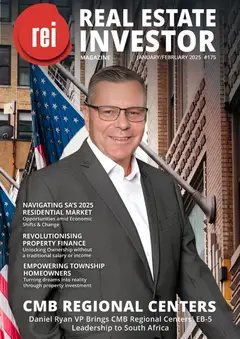
As we enter 2025, there’s growing optimism that the property market is set for a new growth cycle after nearly two decades of stagnation. This issue’s cover story features Daniel Ryan, Vice President of CMB Regional Centers, who introduces South Africa’s high-net-worth individuals to the EB-5 Immigrant Investor Program. The program allows South Africans to gain U.S. permanent residency, a green card, and access to the U.S. economy through an $800,000 investment, with potential returns after five years. This offers a strong investment opportunity for global investors seeking to diversify.
Back home in South Africa, the property market in 2025 presents both challenges and opportunities. While political stability under the Government of National Unity (GNU) and expectations of interest rate cuts are boosting market sentiment, the real drivers are local dynamics. The Western Cape, in particular, is poised for growth, with its consistent service delivery and potential for capital growth, mirroring the early 2000s property booms.
However, risks remain. The recent passage of the Expropriation Bill, which allows land to be seized without compensation, has raised concerns about property rights, food security, and economic stability. Legal experts warn it may contradict the Constitution, potentially leading to a court challenge. In response, Free SA is proposing draft regulations to clarify the state’s expropriation powers while advocating for the repeal of the Expropriation Act, calling for new legislation that better protects property rights.
As always, REI Magazine offers expert insights, investment strategies, and success stories to guide your real estate decisions in 2025. Here’s to a year of smart investing and growth!
Founder & Editor-In-Chief
6
REI MAGAZINE JANUARY 2025
MASTER QUOTE
You want to build wealth and create financial freedom; you can’t just sell real estate; you need to invest in it personally.
DONALD J. TRUMP
7
Contents
MEET THE TEAM
MAGAZINE INFO
EDITOR’S VIEWPOINT
MAGAZINE ARCHIVES
28 - 34
RESIDENTIAL
2
28 - Navigating South Africa’s Residential
4
Property Market in 2025
6 - 7
10 - 11
EB-5 INVESTMENT VISA
36 - 41
36 - Invest in the US with Confidence
12 - 21
INVESTING
22 - 27
COVER STORY
28
EB-5 Investment Visa
Invest in the U.S. with Confidence:
Why South African Investors Should Choose CMB Regional Centers
For over 25 years, CMB Regional Centers has been a leader in the EB-5 industry, providing South African investors a trusted pathway to permanent residency in the United States.
Founded by Patrick F. Hogan, CMB has built a reputation for delivering high-quality investment opportunities that are both financially promising and USCIS-compliant.
12
8
REI MAGAZINE JANUARY 2025
36
PROPERTY MANAGEMENT
42 - It’s Time to Engage
42 -47
66 - 72
COMMERCIAL
66 - Unlocking the Future of Work
26
FINANCE
76 - 77
NEXT ISSUE
48 - The Future of Home Financing
TECHNOLOGY
48 - 53
56 - 63
56 - AI and Rental Shifts
42
56
66
48
9
Newsstand Archives
JAN/FEB 25
DEC/JAN 25
NOV 24
OCT 24
SEPT 24
AUG 24
rei.co.za
JUNE 2024
GUIDE TO MAKE MILLIONS IN PROPERTY
Investor of the Year Darren Francis tells us how
SA’S AFFORDABLE PROPERTY MARKET
Addressing the potential & complexities
COMMERCIAL RENTAL PROPERTIES
Boubker Benjelloun Boubker Benjelloun
What modern tenants seek?
BOUBKER BENJELLOUN
The rising star of global architecture at the service of humanity
JUNE JULY 24 24
10
REI MAGAZINE JANUARY 2025
JUNE 24
Subscribe for Free
to receive future editions of Real Estate Investor Magazine in your inbox
Subscribe for Free
www.rei.co.za
11
Cover Story
Daniel Ryan: A Visionary Investment Visa Space
By Neale Petersen
As the Vice President of Global Market Development at CMB Regional Centers, Daniel Ryan has emerged as a leading figure in the EB-5 Investment Visa space.
His journey from a small-town upbringing in Silicon Valley to helping thousands of international families secure U.S. residency speaks to his unwavering dedication to both the people he serves and the industries he’s helped transform.
12
REI MAGAZINE JANUARY 2025
Leader in the EB-5
13
Early Life: Foundations of Resilience
Daniel Ryan’s roots trace back to the rolling hills of Northern California, where he was raised near Silicon Valley. Growing up, Daniel experienced firsthand the volatile nature of the real estate and construction sectors. His father was a small-time property builder, developer, and general contractor who faced the unpredictable cycles of boom and bust in the construction world.
“When business was booming, we had steak every week for dinner. But when things were slow, we ate a lot of mac ‘n’ cheese and meatloaf,” Daniel reflects. These early experiences shaped his understanding of the cyclical nature of the real estate industry and laid the groundwork for his interest in financial management and strategic planning.
From a young age, Daniel was keenly aware of the importance of preparation and adaptability. His father’s business, while successful at times, taught him that success in construction and real estate investment often depends on understanding and planning for the worst-case scenario. This experience ultimately influenced his decision to pursue a Bachelor’s degree in Business Administration with a focus on Finance. “I wanted to learn how to manage finances, particularly during tough times when real estate investment is most vulnerable,” Daniel says.
After completing his undergraduate degree, Daniel set his sights on further honing his business acumen, eventually leading him to an MBA Essentials program at the London School of Economics, along with other executive education programs at Oxford University and the University of Cape Town. These programs solidified his passion for business leadership and equipped him with the tools to navigate complex, international markets.
14
REI MAGAZINE JANUARY 2025
CMB REGIONAL CENTERS
DANIEL RYAN PROFILE HIGHLIGHTS
Name: Daniel Ryan Company: CMB Regional Centers & NHK Capital Partners Position: Vice President, Global Market Development Education/Qualifications: Recent:
Oxford University, Venture Capital & Entrepreneurship Program (Executive Education), 2020
MBA Essentials, London School of Economics (Executive Education/ Condensed MBA), 2020
University of Cape Town, Negotiation and Conflict Resolution (Executive Education), 2020
Previous:
Master’s Degree, MA, Organizational Development and Corporate Education Bachelor’s Degree, Business Administration/Finance, BSc Company Description: EB-5 Regional Center, Private Equity/Credit Firm
Unique Aspects of Your Company: CMB has raised ~$3.2 billion in EB-5 capital, helping over 6,500 families achieve U.S. residency through job-creating real estate investments. Family: Wife, Agie; 8-year-old daughter, Daniella
Hobbies: Philanthropy, team sports, fitness, travel, volunteering, cooking, music, reading, teaching/education, golf Best Book You’ve Read Lately: The Millionaire Next Door
Personal Motto: “Count your blessings, lift others up whenever 15 possible”
His Early Career: Banking and Real Estate Development
After graduating, Daniel joined Bank of America, where he was selected for the highly competitive Management Training Program. He spent two years working in various roles, gaining invaluable experience in commercial banking and real estate development financing. This exposure to large-scale financial transactions and investment strategies laid the foundation for Daniel’s future career in real estate development.
Upon completing the training program, Daniel moved to Chicago, where he focused on real estate development construction loans, specializing in large commercial projects. His ability to assess and mitigate financial risk was honed through this experience, and his understanding of how financing could shape real estate development was solidified. “Banking was a great learning ground,” Daniel recalls. “But I wanted to move into a more hands-on role in development, where I could make a more direct impact on the real estate projects themselves.”
It wasn’t long before Daniel was recruited by SunBank (now Truist Bank), a regional bank based in Florida, to manage large-scale loans for commercial real estate projects. Eager to escape the cold Chicago winters, Daniel moved to sunny Central Florida, where he would spend several years helping SunBank navigate the booming real estate market. However, Daniel’s next career move would further cement his place in the world of real estate development. He was offered a position as Vice President of Finance and Development for a prominent property developer in Central Florida. This role marked his transition from banking to a more entrepreneurial approach to real estate, where he could directly influence investment decisions, development strategies, and project outcomes.
16
REI MAGAZINE JANUARY 2025
CMB REGIONAL CENTERS
As the VP of Finance and Development, Daniel managed several successful projects, further building his reputation as a trusted leader in real estate finance. But the real estate market was about to change dramatically.
A Global Leap – The Malawi Experience
In 2008, the global financial crisis hit, sparking the collapse of major markets and a dramatic slowdown in the real estate sector. The real estate development firm where Daniel worked found its funds frozen, and many of the projects he had been overseeing came to a halt. Faced with the uncertainty of the financial crisis, Daniel decided to take a temporary break from his career in real estate
That decision would prove to be a pivotal one.
In 2009, Daniel took on a three-month consulting role with the World Bank in Malawi, Africa, a country that, at the time, was struggling with poverty, limited infrastructure, and a lack of development. What began as a shortterm assignment soon turned into a ten-year journey that would shape the course of his career.
17
During his time in Malawi, Daniel met his wife, Agie, a Malawian Chartered Accountant who was also dedicated to improving her country’s economy. Together, they co-founded Development Consulting Solutions (DCS), a firm that provided consulting services to international organizations like the World Bank, the IMF, USAID, the EU, and various NGOs, as well as the Reserve Bank of Malawi. The company focused on driving economic development in Malawi by assisting in project financing, policy development, and implementation.
Daniel’s time in Africa taught him invaluable lessons about resilience, humility, and empathy. “I lived in areas where extreme poverty was the norm. It forced me to reconsider my priorities, not just professionally, but personally,” Daniel says. “I was humbled by the resilience of the people, and I developed a greater sense of gratitude for the opportunities I had.” In 2016, after the birth of their daughter, Daniella, Daniel and Agie decided to return to the United States to raise their child in the U.S. education system. Their journey back to America marked a new chapter in Daniel’s career, one that would bring him full circle into the world of real estate finance—but with an international perspective that few could match.
CMB Regional Centers: Transforming the EB-5 Visa Landscape
Back in the U.S., Daniel rejoined his former firm, Forge Capital Partners, but quickly realised his passion lay in helping foreign investors gain access to opportunities in the United States. This led him to a new role at CMB Regional Centers (CMB). Led by Noreen Hogan (President), CMB is a leading provider of investment solutions for foreign nationals looking to invest in the U.S. under the EB-5 Visa program.
18
REI MAGAZINE JANUARY 2025
CMB REGIONAL CENTERS
Noreen’s leadership at CMB has been marked by a clear vision: to provide international investors with high-quality investment opportunities while creating positive economic impact in U.S. communities. Noreen’s team’s commitment to risk reduction, transparency, and top-tier projects has made CMB a trusted name in the EB-5 space.
The EB-5 program, which offers U.S. residency to foreign nationals who invest in job-creating real estate projects, was a natural fit for Daniel’s expertise. “The chance to help families from around the world build a future in the U.S. while also promoting economic development through high-quality real estate projects was something I felt deeply connected to,” he says.
In his current role as Vice President of Global Market Development, Daniel oversees CMB’s international outreach, helping foreign nationals navigate the complexities of the EB-5 process. Under the leadership of the Hogan family, CMB has raised over $2.5 billion in EB-5 capital and helped more than 6,500 families achieve U.S. permanent residency.
“At CMB, we pride ourselves on the quality of our investments. We have a proven track record of low-risk, high-quality projects that create thousands of jobs,” Daniel explains. “My goal is to continue expanding CMB’s reach, ensuring that we can help even more families secure a better future in the U.S.”
Image: Patrick Hogan: Chief Executive Officer & Noreen Hogan: President of 19 CMB Regional Centers
20
REI MAGAZINE JANUARY 2025
CMB REGIONAL CENTERS
Leadership Philosophy: Empathy and Service
When asked about his leadership philosophy, Daniel is quick to point to the concept of “servant leadership.” “As a leader, my job is to empower my team, to provide them with the tools and support they need to succeed, and to lead by example,” he says. He believes that empathy, respect, and clear communication are the cornerstones of a productive work environment.
I try to treat every member of the team with equal respect, regardless of their role or background. I want people to feel comfortable innovating, making mistakes, and growing.
CONTACT DETAILS
CMB REGIONAL CENTERS
CMB Regional Centers & NHK Capital Partners CMB Address: 5910 N Central Expy, Suite 1000, Dallas, TX 75206 Office no: +1 309 797 1550 Cell/WhatsApp no: +1 309 429 8540
21
Investing
How become
By Neale Petersen
In a world grappling with high unemployment rates and land distribution challenges, the solution to economic empowerment may not always lie in top-down approaches. Instead, a more grassroots, business-driven model can create sustainable change.
This belief inspired the founding of Bitprop in 2019, a company dedicated to transforming township homeowners into property entrepreneurs and helping them unlock the financial potential of their land.
22
REI MAGAZINE JANUARY 2025
From Dream to Reality: Bitprop is empowering township Homeowners to Property Entrepreneurs
23
INVESTING
At the heart of Bitprop’s mission is a powerful partnership: homeowners provide the land, and Bitprop delivers the capital, expertise, and operational model to develop backyard rental units.
Through a rent-sharing agreement, homeowners receive a steady income stream while Bitprop investors earn returns on their capital. It’s a win-win model that not only creates economic independence but also enables homeowners to build generational wealth. This innovative approach has already shown immense promise. Bitprop’s success in Khayelitsha, Cape Town, from 2019 to 2020 has proven the concept’s viability, suggesting that it could serve as a blueprint for economic transformation across Africa and beyond. Let’s take a closer look at how this unique investment model has changed the life of one township homeowner, Mandiswa, who has become a property entrepreneur through Bitprop’s partnership.
24
REI MAGAZINE JANUARY 2025
CASE STUDY
Mandiswa’s Journey to Property Entrepreneurship
Location: iKwezi Park, Khayelitsha, Cape Town Challenge: Financial stability and planning for retirement Mandiswa, a dedicated mother and wife, acquired her property in 1998. Working at a local mall near her home, she began thinking about her family’s future and retirement plans.
As her children had all become adults, Mandiswa was determined to create a stable financial future for them, one that would not depend on her physical presence or employment.
But, like many township homeowners, she faced a daunting challenge: the high cost of property development and the lack of access to formal financing.market, making home loans more affordable. Lower rates will also reduce the financial burden on landlords with mortgages, improving overall profitability in the rental sector.
Frustrations Mandiswa wanted to build backyard flats to generate rental income for her retirement and to set up her family for the future. However, she lacked the financial resources and technical expertise to embark on such a project. Without the capital to fund construction and the knowledge to navigate the legal and technical requirements of property development, her dream felt far out of reach.
Solution In 2022, Mandiswa partnered with Bitprop, embarking on a transformative 10-year journey to turn her property into a long-term income-generating asset. Under the terms of the partnership, she would receive 15% of the gross rental income from the newly developed units. The additional income would help cover everyday expenses, such as groceries and municipal bills.
What’s more, after 10 years, the entire rental income would be hers, enabling her to run the property as a sustainable business. This not only promised a steady income stream for her family but also the flexibility and financial independence to manage her time as an entrepreneur.
25
INVESTING
Turning a Dream Into a Business: The Practicalities of the Partnership
1. Funding Bitprop sourced funding from private investors who, through the rentsharing model, earn a return of 15.4% per annum on their invested capital. This allowed the project to kick off without Mandiswa needing to secure a loan or use her own savings.
2. Construction Bitprop managed the construction process, ensuring that the rental units were built to high standards while adhering to local regulations. By overseeing the entire build, Bitprop ensured that the units would be both durable and attractive to tenants.
3. Tenant Onboarding Once the units were ready, Bitprop assisted Mandiswa with advertising the spaces and selecting reliable tenants. The company managed the technical side of tenant agreements, deposits, and legal matters, ensuring a smooth onboarding process for both Mandiswa and her tenants.
4. Ongoing Support Throughout the 10-year partnership, Bitprop continued to provide ongoing property management guidance and support. From maintenance to tenant relations, Mandiswa had access to a wealth of knowledge and expertise, which allowed her to focus on growing her business and achieving her goals.
26
REI MAGAZINE JANUARY 2025
The Results:
Transforming Mandiswa’s Life and Community Increased Income
Mandiswa now earns an average of R3,882 per month from her rental units, a 54% increase in her household income. This additional revenue stream has significantly improved her financial stability, allowing her to better support her family.
Community Impact The new rental units have also made a positive impact on the community. They provide affordable housing for up to 12 young professionals, offering them a safe and convenient place to live in a market that is severely lacking in affordable housing options.
Personal Growth Mandiswa has expressed a newfound confidence and pride in her ability to run a sustainable business. She no longer feels limited by her circumstances but empowered by her new role as a property entrepreneur.
Conclusion: A Model for Economic Empowerment Mandiswa’s journey is a powerful example of how Bitprop’s partnership model is transforming homeowners into successful property entrepreneurs. By partnering with homeowners, Bitprop not only unlocks the value of underutilized land but also empowers individuals to build wealth, secure their financial futures, and contribute to their communities.
Through this innovative approach, Bitprop is creating a ripple effect of economic growth and empowerment, one property at a time. This is more than just real estate development—it’s about providing financial independence, fostering entrepreneurship, and creating opportunities for generational wealth.
Mandiswa’s story is just one of many that illustrate the potential of this model. As Bitprop continues to grow, it remains committed to helping township homeowners unlock their property’s potential, making dreams of financial security and business ownership a reality.
Find Out More
27
Residential
Navigating South Africa’s Property Market in 2025: opportunities amid
By Jaco Grobbelaar
South Africa’s economy, while facing numerous structural challenges, is showing glimmers of hope. According to the International Monetary Fund (IMF), GDP is projected to grow by 1.5% in 2025.
While this growth rate may seem modest, it signifies resilience in a global economy recovering from various disruptions, including post-pandemic slowdowns and geopolitical tensions.
How to seize Opportunities in a Dynamic Market: Key Trends and Insights for Investors.
28
REI MAGAZINE JANUARY 2025
Residential Unlocking economic change
the
29
INVESTOR INTELLIGENCE
GDP and Unemployment: Key Drivers of Market Behaviour GDP growth directly affects consumer spending power, employment rates, and the overall housing demand. For instance, a higher GDP often correlates with increased disposable income, enabling more people to afford home ownership or rental properties.
However, South Africa’s high unemployment rate according to Statistics South Africa, currently hovering around 32.6%, continues to suppress some demand in the middle-income housing sector.
Inflation and Interest Rates: Key Drivers of Market Behaviour Inflation, forecasted to stabilize at 4.5% in 2025, is a critical factor for investors to monitor. This is also according the International Monetary Fund (IMF). Historically, inflation erodes purchasing power, but when kept within a manageable range, it can stimulate economic activity by encouraging spending. The South African Reserve Bank’s monetary policy has successfully anchored inflation expectations, paving the way for potential interest rate reductions.
Currently, the prime lending rate in South Africa stands at 11.50%. High interest rates have dampened property price growth over the past two years. However, the expected rate cuts in 2025 could rejuvenate the market, making home loans more affordable. Lower rates will also reduce the financial burden on landlords with mortgages, improving overall profitability in the rental sector.
Property Price Growth
According to Lightstone’s Residential Property Index (end of November 2024), property price’s current annual capital growth is 3.3%, with the Western Cape performing the best and Northern Cape in second place.
National propery inflation Current annual property inflation rate is 3.32% and monthly is 0.29%
30
REI MAGAZINE JANUARY 2025
The map below shows the latest provincial house price inflation status from Lightstone.
Urban vs. Coastal Property Coastal properties, especially in regions like the Western Cape, remain highly sought-after. Not only do they attract foreign investment, but they also cater to the growing trend of remote work. With more professionals seeking lifestyle-centric living arrangements, properties in areas like Cape Town and Durban are experiencing steady price appreciation. In contrast, urban properties in Gauteng and KwaZulu-Natal are seeing slower growth. However, these markets provide affordability, appealing to first-time buyers and investors targeting rental yields. Lightstone says that coastal properties have performed better than noncoastal properties and freehold properties have performed better than sectional properties.
31
INVESTOR INTELLIGENCE
Affordable Housing One of the most significant trends in the South African property market is the performance of affordable housing. Properties priced below R250,000 have outpaced all other segments in terms of capital growth. These properties, often located in emerging townships and secondary cities, offer investors the potential for high returns while addressing the country’s housing shortage.
As I’ve mentioned before, high-value properties aren’t always the best investments as Lightstone shows that properties valued at less than R250 000 have outperformed all other value bands for most of the last 10 years with over 10% annual capital growth per year for most of the time since 2018! Properties valued between R250 000 and R700 000 have come in second.
The Rental Market: A Tale of Recovery
Tenant Stability and Good Standing
Being a landlord or property owner is a delight when tenants are in good standing and paying rent! TPN defines tenants who are in good standing as those who “have paid in full and on time, paid in the grace period or paid late”. They also say that an account is only in good standing when fully settled with no arrears. The percentage of tenants in good standing, now at 83.34% according to TPN Residential Rental Monitor Q2 2024, has shown remarkable recovery since the pandemic’s early days. Provinces like the Western Cape have 88.43% of tenants paying on time. This stability is a promising sign for landlords, reducing the risks of rental income disruptions. Rental Value Bands like the R7,000 to R12,000 mark have 88.58% of tenants paying on time.
32
REI MAGAZINE JANUARY 2025
Rental Growth Trends Rental escalations have kept pace with inflation, ensuring that landlords can maintain real returns. For example, PayProp’s Rental Index reveals that national rental growth rates are stabilizing at 4.8%. Investors should note that the highest rental growth is observed in properties priced between R5,000 and R7,500 per month, catering to the middle-income bracket.
33
INVESTOR INTELLIGENCE
Quarterly rental growth rate (YoY) with a moving average tredline: Q1 2021 - Q3 2024 Source: PayProp
Quarterly rental growth
Moving average
Conclusion What does all this mean for your property investments? Here’s my perspective on the current market trends and outlook. First, the property market remains in favour of buyers, with abundant supply and subdued demand creating opportunities to secure exceptional deals. For those ready to act, it’s an ideal time to find properties at attractive prices. Second, the rental market is showing strong signs of recovery. Tenant payment reliability has improved, and rental escalations are picking up. With careful selection of the right properties, you can benefit from consistent rental income and growing property values. Finally, property continues to stand out as one of the most rewarding investment options. The combination of capital appreciation and net rental yields offers significantly higher returns compared to other investment vehicles, including the Johannesburg Stock Exchange (JSE). In short, now is a great time to explore the opportunities the property market has to offer.
34
REI MAGAZINE JANUARY 2025
35
EB-5 Investment Visa
Invest in the U.S. with Confidence:
Why South African Investors Should Choose CMB Regional Centers
36
REI MAGAZINE JANUARY 2025
For over 25 years, CMB Regional Centers has been a leader in the EB-5 industry, providing South African investors a trusted pathway to permanent residency in the United States.
Founded by Patrick F. Hogan, CMB has built a reputation for delivering high-quality investment opportunities that are both financially promising and USCIS-compliant.
37
EB-5 INVESTMENT VISA
About CMB Regional Centers
To date, over 6,500 investor families from more than 100 countries, including South Africa, have partnered with CMB to secure their U.S. green cards. CMB has raised over $3.3 billion in EB-5 capital, financing more than 100 projects across 20 U.S. states, which are expected to generate 200,000 new American jobs.
What Sets CMB Apart?
1
Proven Track Record: CMB has successfully launched over 80 EB-5 offerings, with a 100% approval rate for projects that have undergone United States Citizenship and Immigration Services (USCIS) adjudication. This means every project CMB has brought to market has met the strict requirements of the EB-5 program, offering investors the highest likelihood of success in their immigration pursuits.
2
Investor Security: Over $1.3 billion has been repaid to investors, as a testament to CMB’s financial discipline and commitment to investor protection.
3
High-Quality Investment Opportunities: CMB’s recent I-956F approval for the Group 93 – Coachella Valley project, in California, underscores the strength of their current projects on the market. With this approval, project investors are eligible for immediate USCIS adjudication of their conditional green card petitions.
4
38
Proven Partnerships: With over 40 EB-5 projects and more than $500 million in EB-5 loan repayment to investors, CMB and Hillwood Development Company have cultivated one of the most successful lender-borrower relationship in the EB-5 industry.
REI MAGAZINE JANUARY 2025
Benefits of EB-5
RESIDENCE FLEXIBILITY
Permanent residents of the United States are free to live anywhere in the country, without geographic restriction.
EMPLOYMENT FLEXIBILITY
Visa holders can work anywhere without an employer sponsor or start their own business anywhere within the U.S. 50 states and its territories.
TRAVEL PRIVILEGES
Visa holders have the ability to travel freely within the United States as well as in and out of the U.S. at any time.
PERMANENT STATUS
Visa holders don't need to reapply for a visa, just renew your green card every 10 years.
ACCESS TO FEDERAL PROGRAMS
Visa holders receive retirement benefits in the form of income after contributing to the Social Security Program, and ability to qualify for certain healthcare programs.
EDUCATION
Green card holders may attend U.S. schools at the same cost as citizens. The U.S. has some of the highest rated schools and universities in the world.
ACCESS TO HEALTHCARE
Visa holders gain access to the most advanced health care technology and services only available in the U.S.
PATH TO CITIZENSHIP
After 5 years of residency visa holders can apply for U.S. Citizenship.
39
EB-5 INVESTMENT VISA
CURRENT EB-5 OFFERING
EB-5 Loan
Total Project Spending
Estimated Jobs from Development & Contruction
Job Creation Buffer
Jobs Per Investor
Undertaken in conjunction with Hillwood Development Company, CMB Group 93 – Coachella Valley includes the development and construction of an approximately 240-home community to meet demand for the flourishing build-to-rent residential market in the Palm Springs, California area.
Investors in this I-956F approved project qualify for High Unemployment setaside visas and are eligible for immediate USCIS adjudication of their conditional green card petitions.
We apply rigorous standards of underwriting for our investments, reflected in the 100% approval rate for CMB projects that have undergone USCIS adjudication.
–Noreen Hogan, President
40
REI MAGAZINE JANUARY 2025
CMB REGIONAL CENTERS
HISTORY OF SUCCESS
$1.3B
100%
CAPITAL RETURNED TO INVESTORS
PROJECT APPROVAL
89
TOTAL EB-5 PROJECTS
2,700+
PERMANENT GREEN CARD APPROVALS
28
5,500+
CONDITIONAL GREEN CARD APPROVALS
YEARS OF EXPERIENCE
6,400+
INVESTOR FAMILIES
For South Africans seeking a reliable, transparent, and successful EB-5 investment, CMB Regional Centers offers the expertise and infrastructure to make your U.S. immigration dream a reality.
With a proven track record, a solid portfolio of approved projects, and a commitment to fiduciary responsibility, CMB is the ideal partner to guide you through the EB-5 process with confidence.
Take the first step toward securing your future in the United States.
Contact CMB for more Information
41
Property Management
42
REI MAGAZINE JANUARY 2025
43
Property Management
44
REI MAGAZINE JANUARY 2025
45
Property Management
46
REI MAGAZINE JANUARY 2025
47
Finance
The Future of Home How irregular earners Unlocking Homeownership without a ‘traditional
By Neale Petersen
If you’re a freelancer, self-employed, or working in a role, securing a mortgage for your dream home can feel like battle.
Traditional banks typically favour full-time, salaried employees comes to home loan approvals, leaving many independent significant hurdles.
48
REI MAGAZINE JANUARY 2025
Financing: are salary.’
commission-based an uphill
when it earners facing
49
FINANCE
However, there’s good news. More people are becoming self-employed, and they’re seeking alternatives to traditional mortgage bonds. As Renier Kriek, Managing Director at Sentinel Homes, explains, financing home ownership through instalment sale agreements is becoming an increasingly popular solution for those who don’t fit the typical “salaried” mould.
• Improved Affordability: Instalment sales assess 100% of your income, offering more flexibility to buy the property you truly want.
• Boost Your Credit Score: Ownership improves your credit score, helping you qualify for future home loans or refinance your agreement.
• Lower Default Risk: Missed payments offer more flexibility— buyers can negotiate terms or sell the property, maintaining a clean record.
How Does it Work?
“Instalment sale agreements are rapidly gaining traction—not just for those who are unable to qualify for traditional home loans but also for people whose income is irregular or inconsistent,” says Kriek.
An instalment sale agreement works similarly to a hire purchase agreement for a vehicle. In this case, Sentinel Homes finances the purchase of the property, and the buyer repays the value of the property through monthly instalments.
50
REI MAGAZINE JANUARY 2025
Although the company retains the title deed until the purchase price is fully paid, the buyer enjoys all the rights and responsibilities of homeownership during the contract period. Once the purchase price is repaid in full, ownership is transferred to the buyer.
Why Choose an Instalment Sale Agreement? Kriek explains, “On the surface, buying through an instalment sale agreement is very similar to buying with a bond. The key difference lies in the process followed when payments are missed. However, in that situation, an instalment sale actually works more to the buyer’s advantage.”
Here are some of the key benefits of choosing an instalment sale agreement:
1. Improved Affordability For those with fluctuating incomes, banks often only consider a portion of their earnings when calculating home loan eligibility. This means self-employed buyers may need to settle for cheaper properties or contribute extra funds to cover any shortfall in the purchase price.
Through an instalment sale agreement, up to 100% of your income is assessed, providing more flexibility to purchase the home you truly want. “This allows self-employed buyers the freedom to invest in a property that aligns with their lifestyle and aspirations,” says Kriek.
2. Boost Your Credit Score An instalment sale agreement gives you the opportunity to own a valuable asset sooner, while simultaneously improving your credit score. As your property’s value grows and your financial position strengthens, you’ll become a more attractive borrower.
“Many of our clients have used their instalment payment history as a stepping stone to secure traditional home loans. Several have even refinanced with a bond and settled their instalment agreement early,” Kriek shares. “You can’t start building wealth through property soon enough.”
51
FINANCE
3. Lower Default Risk When borrowers default on a traditional home loan, they risk losing their property through a sheriff’s auction, facing adverse judgments, and being blacklisted for years. This significantly limits their future borrowing power and can even affect their career prospects.
With an instalment sale agreement, however, there are more options if you fall behind on payments. Buyers have the ability to negotiate their payment terms or even sell the property to pay off the debt. “Even in these situations, the buyer retains a clean record, and we’ve helped clients recover from these circumstances to eventually purchase another property,” explains Kriek.
4. Full Legal Protection Just like traditional home loans, instalment sale agreements are governed by the National Credit Act. In addition, the Alienation of Land Act provides further protection to both parties in the agreement. Instalment sales are also registered against the title deed of the property, ensuring that all legal rights are safeguarded.
5. A Growing Market As more individuals move towards freelancing, gig-based work, and self-employment, the demand for flexible home financing options is increasing. Instalment sale agreements are quickly becoming the go-to solution for many who wish to break free from the constraints of traditional bank loans.
The flexibility, protection, and advantages of an instalment sale agreement make it an attractive option for self-employed individuals and anyone with irregular income who wants to own a home without compromising their financial independence.
52
REI MAGAZINE JANUARY 2025
Ask Your Bond Originator or Estate Agent About Instalment Sale Agreements Instalment sale agreements are becoming more widely available and can be offered through mainstream intermediaries. So, if you’re considering buying a home but don’t fit the conventional mortgage model, be sure to ask your bond originator or estate agent about this alternative financing option.
As Kriek puts it: “It’s clear that an instalment sale agreement provides better flexibility, protection, and peace of mind, especially for those looking to secure a home and build financial stability while keeping their independence.”
Find Out More
53
54
REI MAGAZINE JANUARY 2025
55
Technology
AI and Rental Shifts: Africa’s Property Management
By Waldo Marcus
The past year has been challenging for property investors, with a sluggish economy slowing residential rental escalations in most regions in 2024.
Rental escalations are likely to be applied cautiously in 2025 to avoid vacancies, particularly given the potential for a decline in demand for rental properties as tenants, motivated by lower interest rates, migrate to property owners.
56
REI MAGAZINE JANUARY 2025
The Future of South
57
AI & 3D TECH
• Rental market pressures: Sluggish economy and low interest rates will slow rental escalations, causing tenants to shift from renting to owning.
• Tech-driven transformation: AI innovations and property management technology are streamlining operations, while raising concerns over data security and risk.
• Shifting commercial growth: Industrial properties and retail-focused developments in urban and rural areas will continue to outperform other sectors in 2025.
Lower rental returns will see investors looking at alternative ways to generate improved income from their investments. Short-term holiday rentals have impacted rental prices in tourist destinations, with higher rental income achieved in peak holiday times, pricing out consumers looking for long-term rental property.
This trend, especially in the Western Cape, has some lobbyists calling for stricter regulations to protect consumers from inflated rental prices and a lack of affordable rental supply. SA Tourism has requested better transparency from platform providers. The risk for bond providers is that investors are financing these properties based on current tourism trends and rental income, which relies heavily on the success of platforms like Airbnb.
Consumption changes driving commercial property growth The commercial property sector grew in 2024 and this positive trajectory is expected to continue in 2025 as interest rates are lowered. Property developers are focusing on convenient neighbourhood retail and merging with online retailer needs. In urban areas, convenience and easy access are prioritised, while larger developments are succeeding in rural, underserved areas.
58
REI MAGAZINE JANUARY 2025
Jess Moyer
Industrial properties, particularly logistics and warehousing in the Western Cape, KwaZulu-Natal and Gauteng, continue to outperform other commercial sectors. Secure and well-serviced industrial parks are in demand and expected to grow. However, traditional industrial areas around Johannesburg and the Pretoria CBD face a value collapse due to security risks and inadequate infrastructure maintenance to service the nodes.
ESG is likely to become a high-value agenda item for commercial property investors in 2025 to ensure compliance and reduce operating costs. The latest SAPOA Operating Cost Report reveals that 29% of operating expenses go to electricity costs and 23% to property taxes.
The risk of leakages Water shortages are the next big challenge, posing a significant risk to property owners. Government and municipalities must act before it becomes another catastrophic reality like Eskom. Addressing water shortages is a dual challenge requiring both the building of and better maintenance of water infrastructure, including sewage treatment plants, and longer-term, the creation of additional reservoirs to keep up with population growth and mitigate climate change risks.
Leakages extend beyond water. Revenue leakages include missed recoveries, escalations, lease changes, and renewal options, to name a few. Increased regulatory requirements have resulted in more time being spent on compliance, and this is not expected to ease.
59
AI & 3D TECH
Regulatory and compliance changes and demands on property-related companies remove valuable focus and resources from internal due diligence and processes to prevent revenue and recovery leakages. We predict more organisations will invest in technology resources to identify revenue leakages and focus on tools to drive operating costs down.
The Revolution of AI in the Property Sector Technology – particularly AI - has become indispensable to the property sector, from AI-powered marketing and presentation tools to automated management systems. While these advancements streamline operations and enhance decision-making, they also introduce new challenges, particularly in data security and risk management.
As we move into 2025, property companies must carefully consider the appropriate balance between AI and human expertise. By striking this balance and implementing robust data protection measures, organisations can harness the power of AI while preserving their brand authenticity and competitive edge.
The Necessity of diversity in Decision-Making Property investment is a complex and often high-stakes endeavour. As a fixed asset with emotional and financial implications, property valuations and transactions can be challenging. Recent shifts in market perception have further complicated the landscape, with divergent opinions on property’s potential as a wealth generator or alternately, a financial drain.
To navigate this complex market, accurate and reliable data is essential. Mitigating bias and leveraging diverse perspectives allows investors to make more informed decisions. Access to neutral, data-driven insights from respected sources can help uncover hidden opportunities and avoid costly mistakes.
60
REI MAGAZINE JANUARY 2025
Jess Moyer
As the property market evolves, tools and information available to investors must also adapt. Companies of all sizes are increasingly recognizing the importance of accurate, accessible, and representative data. They are investing in reliable external data sources to gain a competitive edge and make more strategic decisions.
The lingering effects of high interest rates Persistently high interest rates raised the cost of credit and placed additional pressure on already strained consumers and businesses. They also dissuaded residential property acquisitions, leading to fewer home loan applications and a decline in the transfer of both bonded and unbonded properties in 2024. Lightstone data reveals that first-time buyer volumes slumped by 20% in 2023.
While welcome, the first two interest rate cuts will take time to filter through to residential property acquisitions. Encouragingly, demand from first-time home buyers appears to be recovering slowly with ooba Home Loans noting a rise in applications to 49.6% in September 2024, the highest reading since November 2022. We expect residential property sales to accelerate in 2025 as interest rate relief starts to filter through, albeit at a slower pace in dysfunctional municipalities.
Individual investors are increasingly choosing to maintain smaller portfolios and using tax-efficient structures such as companies and trusts. TPN anticipates that this trend will persist into 2025. Demand for buy-to-let properties has risen since late 2021, particularly in the Western Cape, followed by the Eastern Cape and Tshwane. Although this trend is expected to continue, it may slow down around mid-2025 as demand shifts from rental properties to ownership.
61
AI & 3D TECH
Municipal performance linked to property value creation Service delivery quality, infrastructure and the maintenance of that infrastructure impact the value of property types. Well-run municipalities will continue to attract investment. Since 2020, semigration has highlighted the successes and failures of provinces and cities, resulting in decreased revenue collections for some of South Africa’s largest municipalities.
Safety and security continue to influence where South Africans choose to live and work, impacting both the residential and commercial property landscape. Mixed-use developments, secure estates, sectional title properties, and commercial parks offering efficient ways to provide enhanced security, service delivery, productive infrastructure, and maintenance spending will continue to be in demand.
62
REI MAGAZINE JANUARY 2025
Jess Moyer
The outlook for property KPIs Residential vacancies are expected to increase in the latter half of 2025 due to lower interest rates and improved consumer confidence. Office and retail vacancies are likely to remain stable in the first half of 2025 but will decrease should business confidence improve and if GDP targets are met. Industrial property vacancies will remain low as demand remains strong, especially in the Western Cape and infrastructure development nodes in Gauteng and KwaZulu-Natal.
Rental escalations for commercial and residential properties will improve in the first half of 2025. Investors will be keen to enhance their returns after a period of sluggish economic performance with slightly healthier consumers offering the opportunity to grow rental income strategically.
The good standing of both commercial and residential tenants is expected to continue to improve as landlords use stricter vetting and collection strategies.
Rental property gross yields will, on average, stay the same as property values are expected to increase in line with rental income. The challenge for investors will be to keep operating costs down to maintain or improve net yields.
A favourable outlook for residential housing market The outlook for the residential housing market is more favourable for 2025 than it has been for the past few years with the property market offering good value overall. The interest rate will likely be cut by a further 50bps by the third quarter of 2025, offering further relief for household finances and renewed activity at both the lower and upper ends of the market.
More investments could see an increase in rental property supply and even a potential decline in rental demand as more consumers shift from renting to buying. We expect continued demand for well-managed rental properties.
Waldo Marcus is a Director at TPN from MRI Software
63
64
REI MAGAZINE JANUARY 2025
65
Commercial
Unlocking the Future Changing Trends driving employee happiness in
By Gidgette Osborne
The world of work is set for a transformative shift in 2025, driven by technological advancements that will reshape business operations across industries. While discussions around the “Return to Office” dominated late 2024, the reality is far more nuanced.
Hybrid working has become the norm for many companies, empowering employees to work flexibly and proving its long-term value to CEOs worldwide. Major Trends Shaping the Future of Work in 2025
66
REI MAGAZINE JANUARY 2025
of Work: 10 Gameproductivity and 2025
67
OFFICES
As we head into 2025, the future of work is being rewritten. The old guard of rigid office structures and 9-to-5 schedules is giving way to a more dynamic and adaptable approach, led by technological advancements and evolving employee needs. The hybrid work model is at the heart of this transformation, offering a more flexible and inclusive approach to work that places productivity, employee happiness, and wellness front and centre.
• Hybrid work will prioritise productivity and employee happiness over traditional office hours and location.
• Flexible workspaces will thrive as small businesses and commuter towns gain momentum.
• Gender parity and wellness will be boosted by hybrid work, enhancing boardroom diversity.
Here are the 10 key trends that will shape the global workforce in 2025
1. The Death of the ‘Return to Office’ Mandate The “Return to Office” (RTO) trend is rapidly losing steam. Companies that insist on daily commutes to a central office will face a growing exodus of talent. Research shows that 73% of employees at large companies like Amazon have considered resigning due to rigid RTO policies.
The power balance has shifted, with employees now more inclined to embrace hybrid work—demanding autonomy over where and when they work. Embracing flexibility will become a competitive advantage, enhancing both employee satisfaction and overall productivity.
2. Output Over Hours By 2025, the era of measuring productivity by clocked hours will be over. Companies will prioritize results over rigid timeframes. As hybrid work continues to rise, businesses will focus on what employees deliver rather than how long they spend at their desks.
68
REI MAGAZINE JANUARY 2025
Over 80% of HR executives acknowledge that hybrid work boosts productivity, with employees reporting increased motivation and efficiency. The focus is on clear KPIs, not hours in the office. This shift will be essential for organisations that want to attract top talent and maximise output.
3. Rise of Flexible Workspaces in Suburbs & Small Towns The demand for flexible, scalable workspaces outside traditional city hubs will surge. Small and medium-sized enterprises (SMEs), which are already a massive driver of global GDP, will fuel this trend.
As remote and hybrid work becomes the norm, businesses will no longer be tethered to expensive city-centre real estate. Flexible workspaces in suburbs and smaller towns will see a boom, offering entrepreneurs, startups, and SMEs the space to grow while reducing overhead costs. By 2025, these locations will be crucial in fostering innovation and supporting business expansion.
4. Commuter Towns Are Reborn Hybrid working is breathing new life into commuter towns. With employees no longer required to commute into city centres daily, these onceoverlooked areas are experiencing an economic renaissance.
People are opting for a better work-life balance, choosing to work from home or local flexible spaces instead of enduring lengthy commutes. This trend will continue to grow in 2025, creating vibrant local economies, reducing congestion, and revitalising communities that were previously on the decline.
69
OFFICES
5. Generation Hybrid Takes Over The workforce is changing, and Generation Z is leading the charge. By 2025, Gen Z will make up a third of the global workforce, driving a major cultural shift. Digital-native, flexible, and highly value-driven, Gen Z expects more autonomy and work-life balance than previous generations.
Companies that fail to cater to their preferences—particularly around flexibility, diversity, and authentic leadership—will struggle to retain top talent. For businesses, adapting to the values of “Generation Hybrid” will be critical to staying competitive in the talent market.
6. Commuting No Longer Makes Sense
The traditional commute is quickly becoming an antiquated concept. Employees are realizing the financial and personal benefits of working locally—both in terms of time and money. Research by International Workplace Group reveals that 76% of workers save significantly on travel costs due to hybrid work.
For younger generations like Gen Z, facing student debt and rising living costs, hybrid work offers a financial lifeline. The future of work will be about cutting unnecessary commutes and focusing on results, not hours spent in traffic.
7. Hybrid Work Boosts Gender Parity Hybrid work is becoming a game-changer for gender parity, especially for women in senior roles. Flexibility in work schedules allows women, who often juggle family and professional responsibilities, to ascend to leadership positions without sacrificing their work-life balance.
A significant portion of women reports that hybrid work has opened doors to career opportunities previously unavailable to them. Companies that embrace this flexibility will not only improve diversity but also benefit from more profitable and socially responsible leadership.
70
REI MAGAZINE JANUARY 2025
8. The Right to Disconnect As hybrid work takes hold, protecting personal time becomes essential. The blurring of lines between work and personal life, accelerated by technology, has made the need for a “right to disconnect” even more urgent.
Several countries are already leading the charge with laws protecting employees’ off-hours. In 2025, this trend will spread globally, as both governments and companies recognise the importance of safeguarding workers’ personal time. This will ensure that the flexibility of hybrid work doesn’t come at the cost of burnout.
9. Wellness Becomes a Work Benefit By 2025, hybrid and flexible working arrangements will be seen as a wellness benefit on par with health insurance. Employees are increasingly seeking employers who offer work-life balance, mental health support, and
Research has shown that hybrid work improves stress levels, physical health, and overall well-being, leading to higher productivity. Companies that offer robust hybrid work policies will stand out as employers of choice, promoting a healthier, happier, and more motivated workforce.
71
OFFICES
10. Mixed-Use Developments Reshape City Centres Hybrid work is transforming the very fabric of urban landscapes. With fewer people commuting to city-centre offices, developers are reimagining commercial districts, incorporating a blend of office, retail, and residential spaces.
Mixed-use developments will dominate as cities evolve to meet the needs of a more flexible workforce. This shift will lead to more vibrant, diverse urban centre, where businesses, entertainment, and housing converge. In 2025, cities will become hubs for collaboration and innovation rather than just places to work.
Looking Ahead In 2025, the future of work will be defined by agility, flexibility, and empowerment. The workplace is no longer just a physical space; it’s a dynamic, digital, and adaptable environment that fosters innovation and well-being. As organisations focus on outcomes rather than hours, the workplace will evolve into a place that supports both productivity and happiness. The ability to offer flexible workspaces, respect employee preferences, and adapt to new technologies will be critical for organisations aiming to stay competitive in the rapidly changing global landscape.
Mark Dixon, Founder and CEO of IWG, sums it up best: “Hybrid working and its far-reaching benefits are now firmly on the boardroom agenda, providing a blueprint for a sustainable, agile, and resilient future of work.” The workplace is being reimagined, and those who embrace these changes will be the ones who thrive in 2025 and beyond.
72
REI MAGAZINE JANUARY 2025
73
Greek Golden Visa
your EU access
rei@sableinternational.com | www.sableinternational.com | +27 (0) 21 657 1584
74
REI MAGAZINE JANUARY 2025
SABL E
I N T E R N AT I O N A L
The Greek Golden Visa is now one of the most affordable options to gain EU access. Purchase a qualifying property from EUR250,000 and gain the right to live in Greece and traverse the Schengen for three out of six months — no more Visas required.
Contact Richard Haller on +27 (0) 83 776 0802 or richard.haller@sableinternational.com
75
Until our next edition of REAL ESTATE INVESTOR Magazine
FEBRUARY 2025
WEBSITE www.rei.co.za EMAIL info@rei.co.za TELEPHONE +27 21 761 3848
76
REI MAGAZINE JANUARY 2025
77