
Real Estate Investor Magazine
April 2023 edition: full text
Every page of the April 2023 issue as text. To see a page as it was designed, open it in the magazine.
Read it as a magazinerei.co.za
APRIL/MAY 2023
OFF PLAN DEVELOPMENTS
7 Reasons why you should invest
TOP ADVICE ELECTRICITY CRISIS
Energy efficient within your means
TECH START-UPS
Bodes well for global competitiveness
INSPIRATIONAL GUIDANCE
How to navigate economic uncertainty
OPPORTUNITY PRIVATE CAPITAL
Outperforming a moribund economy
CALLING ALL STUDENT ACCOMMODATION LANDLORDS
Get student accommodation property management with a difference
LANDLORDS
Get the best student property management experts to step-in to manage your portfolio with an experienced, dedicated team removing all the daily property management hassles.
OUR SPECIALISTS MANAGE:
Over 500+ Student beds Over 30 + Properties In over 3 Provinces
+27 84 575 1000 www.mystudenthouse.co.za
1
APRIL/MAY 2023 SA Real Estate Investor Magazine
Visit us @ 5
OUR SERVICES
WE OWN & SOURCE PROPERTIES
We use a tried and tested formula to find the best properties for SA. We will find a house for you to fit your budget, covert it to optimal usage for students, furnish it correctly and provide you with savings from our bulk purchase discounts at major suppliers
WE SOURCE TENANTS
Students know what they want and so do we. We advertise the house to our database of 200 000 students on email, social media, flyers and our extensive network of university contacts and placement agencies.
WE MANAGE YOUR PROPERTY
We collect the rent from universities, students and parents. We protect the value of your asset through ongoing maintenance, cleaning, student satisfaction and discipline.
WE EDUCATE
We teach and educate interested landlords the best ways in becoming successful and profitable student accommodation landlords
landlords@mystudenthouse.co.za Iona Street, Bellville, Cape Town
CONTACT US
SA Real Estate Investor Magazine APRIL/MAY 2023
2
W
How AI is impacting the real estate industry
elcome to our latest edition of the Real Estate Investor Magazine. As the real estate market continues to evolve and become more competitive, it's important for investors to stay up-to-date with the latest trends and insights.
In this edition, we feature a variety of articles and resources that will help you navigate the current real estate landscape and make informed investment decisions. Some of the topics covered in this edition include: • How to navigate the market when there is uncertainty • Top advice to combat the • The impact of AI on real estate investing • Strategies for investing in residential and commercial real estate • Reasons why you should invest in off plan properties • An overview of the current state of the housing market • Plus lots more
We also feature interviews with industry experts and also our Master Investor feature with Opportunity Private Capital who are defying all the odds offering investors inflation beating returns of 14% - 18% in their capital investment programme in a struggling economy. We share their insights and perspectives on their businesses. Additionally, we have included a section
3
APRIL/MAY 2023 SA Real Estate Investor Magazine
EDITORS PICK: Investment Webinar - Create wealth in student accommodation
that highlights upcoming real estate conferences and events that you won't want to miss.
AI (artificial intelligence) continues to be a major area of focus for the technology industry, with many companies investing in the development of advanced AI systems for a wide range of applications.
Last month Elon made headlines by calling for a 6-month pause on AI experimentation, saying it’s too dangerous. Now he’s launching his own A.I. competitor company to Open AI. Whether you’re a fan or anti-fan of Elon’s doesn’t matter - success leaves clues. He and the long list of tech heavyweights are going all-in on A.I.!
Overall, it is likely that AI has had a significant impact on real estate investing, providing investors with new ways to analyse and make informed decisions about property investments. Here are some examples of how AI has influenced real estate investing: 1. Predictive Analytics: With the help of AI, investors can now use predictive analytics to make datadriven decisions. AI-powered tools can analyse vast amounts of data, such as property sales history, neighbourhood trends, and market trends, to predict the future value of a property. 2. Property Management: AI-powered property management systems can help investors automate tasks such as rent collection, maintenance, and lease renewals. These systems can also analyse data to optimize rental prices and increase occupancy rates. 3. Real Estate Market Analysis: AI can also analyse real estate market data to identify emerging trends and make informed investment decisions. By analysing demographic data, economic indicators, and
other relevant data points, investors can gain insights into the potential demand for a particular type of property in a particular location. 4. Risk Assessment: AI-powered risk assessment tools can help investors identify potential risks associated with a property investment, such as environmental hazards, zoning restrictions, and market volatility. 5. Virtual Tours: AI-powered virtual tour technology has made it easier for investors to evaluate properties remotely. This technology allows investors to take a virtual tour of a property and view it from different angles without having to physically visit the property.
At the end of the day, real estate investing is all about seizing opportunities and mitigating risk. By staying informed and remaining adaptable, you can navigate the ever-changing real estate landscape and build a strong and profitable portfolio.
We hope that this edition provides you with valuable insights and inspiration for your real estate investments. As always, we welcome your feedback and suggestions for future editions.
Successful investing!
NEALE PETERSEN FOUNDER & EDITOR-IN-CHIEF
SA Real Estate Investor Magazine APRIL/MAY 2023
4
REI TEAM
EDITORIAL
Founder & Editor-at-Large
Neale Petersen neale@rei.co.za
Digital Marketing Manager
Alexander De Villiers alexander@rei.co.za
Digital Marketing Strategist
Asheeq Cader asheeq@rei.co.za
Digital Designer
Heather Spangenberg design@rei.co.za
Accounts Manager
Marisa George marisa@rei.co.za
Website Specialist
Graham Miller graham@rei.co.za
CIRCULATION
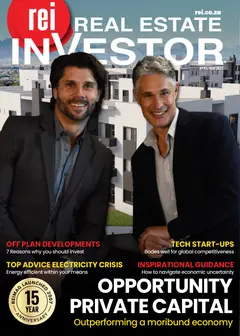
FRONT COVER IMAGE: Wynand Haywood Co-Founder & Nick Morgan Co-Founder & Managing Director of Opportunity Private Capital
CONTRIBUTORS
Alan van der Westhuizen Kristy Welford Rone’ Silke Jaco Grobbellaar Anneline Lamond Filum Ho Joshua Raphael Malcom orne Landseer Collen Joanne Bushell Sophie Gamborg
ADVERTISING
info@rei.co.za
+27 21 761 3848
PUBLISHERS
Audited
*18, 093 (Oct to Dec 22)
*19,650 views
5
APRIL/MAY 2023 SA Real Estate Investor Magazine
All rights reserved. No portion of this publication may be reproduced or used in any form without prior written consent and permission from Reale Media. The publisher gives no written guarantees or assurances and makes no representation regarding any goods or services written or advertised within this edition. Prospective investors should always consult their attorneys, advisors or accountants before investing. Copyright © Reale Activation. Pty (Ltd)
The latest replays
Creating Wealth with Student Accommodation in South Africa
The Easiest Way To Market Your Business At Zero Cost with Meir Ezra
Investing Capital In The Early Stages of the Development Cycle
How to Invest in Mauritius Property
VIEW MORE
Would you like to host your own webinar or event with us? Send us an email on info@rei.co.za
SA Real Estate Investor Magazine APRIL/MAY 2023
6
CONTENTS
APRIL/MAY 2023 #156
TRENDING
003 Editorial View 017 Cover Story Profile 027 Company Profile 161 3 Ways leaders can navigate economic uncertainty to avoid a debacle like Silicon Valley Bank
INVESTING
035 5 Action steps to prevent further rental shortfalls when interest rates rise 041 5 pitfalls to avoid before you invest in property 047 7 Reasons why you should invest in off plan property developments 053 Opportunity is Knocking - Here's How To Open The Door 057 Why do we need to invest? 061 What first-time buyers need to know about the legalities of buying a home
FINANCE
017
035
069
APRIL/MAY 2023 SA Real Estate Investor Magazine
069 Property transfer duties reduced favourably for investors & home buyers 075 ELECTRICITY CRISIS TOP ADVICE - How to make your property more energy efficient - within your means 085 Deeds Office Shutdown: Legal & financial implications for buyers and sellers
7
WEALTH
095 SARS is zooming its focus in on Trusts that are not Tax Compliant
RETIREMENT
115 Bot workers are here - is South African business ready? 119 Hallmark of a successful Africa tech start-up - bodes well for global competitiveness
COMMERCIAL
129 Three Years On Since Hard Lockdown: Real Estate - A Bird’s Eye View 137 The relationship between architecture and brands 143 Which hybrid lifestyle is right for you?
115
OFFSHORE
095
TECHNOLOGY
101 The growing need for properties in natural environments, security, wellness and assisted living 107 Considering life rights in retirement? Here’s what you need to know
151 7 Reasons why young & upcoming SA professionals choose UK over SA property investment 157 Where to get residency, set up your business, emigrate or invest in property offshore?
151
SA Real Estate Investor Magazine APRIL/MAY 2023
8
REI MAgazine
9
MARCH 2023
FEB 2023
DEC/JAN 2022
AUGUST 2022
JULY 2022
JUNE 2022
APRIL/MAY 2023 SA Real Estate Investor Magazine
archives
NOV 2022
OCT 2022
SEP 2022
MAY 2022
APRIL 2022
MARCH 2022
SA Real Estate Investor Magazine APRIL/MAY 2023
10
Send your questions to info@rei.co.za or post on our FaceBook or LinkedIn pages and we will direct them to the necessary expert
Landlord opportunities to partner with leaders in flexible co-working spaces
ALAN VAN DER WESTHUIZEN Head of Partnership Growth SA at Regus - IWG
I
am seeing a growth in the increase in availability of co-working spaces as an alternative to traditional office space and also like the idea of having access to an office but not full-time.
I am a commercial property owner in Port Elizabeth with around 1,200m2 of office space and I would like to explore the co-working flexible work space model and would like to explore different options available with Regus and/or Spaces as a business partner.
How would that work is it franchise based or is there an option to work together on space we own. Can you please elaborate on the typical workable models, minimum office sizes, processes including fitment, locations and investment?
11
APRIL/MAY 2023 SA Real Estate Investor Magazine
Y
The observation is correct that the flexible co-work space is growing. In fact experts predict that 30% of global office space will be flexible by 2030, compared with less than 5% today. In response to this growing demand we have developed a comprehensive range of products and services that are designed to offer our customers more choice, greater flexibility and an easy way to move towards a hybrid working model. 63% of high-growth companies are already enjoying the benefits of a hybrid working model, according to the Accenture Future of Work Study conducted in April 2021.
IWG already has over 3,500 locations in over 120 countries. Our next phase of growth will be driven through the franchise and landlord partner channel, taking flexible office space into every suburb, town
and city where there is demand.
The two Partnership models options are: 1. Franchise Partnership which gives the Partner the right to trade under the IWG trademarks with IWG’s support and guidance. The Partner may own the property or lease the space and will have operational control of the business, which will require training and a full-time commitment to the business. 2. Managed Partnership which applies to Partners that own commercial office space and would like to partner with IWG as the operating partner in the business. This model provides a solution to bring a flexible office into the building and leaving the operational control of the business to IWG.
Both options have exactly the same set up costs and initial upfront fees, the only difference is a variation of 2% in monthly management fees for the Managed Partnership. The capex
requirements to develop the site are determined by the size and the existing infrastructure in the building that can be used. IWG will provide an optimised space plan layout which will then be used by contractors and service providers to quote on the fit-out. The size requirements of the centre are determined by the size of the office intensive population and demand in the area, as well as which IWG brand is most suitable. For a typical Regus centre the size ranges from a minimum of 500sqm up to 1500sqm, with the optimum size around the 1000sqm mark. Locations are assessed by the IWG team and all factors including competition, cannibalisation and risk are considered. A suitable location can be developed and trading within 3 months using approved contractors, with the expectation to ramp up occupancy and quickly as possible to deliver a strong return on investment to the partner.
ENQUIRE NOW
SA Real Estate Investor Magazine APRIL/MAY 2023
12
Finding the best deals in a crowded UK market
KRISTY WELFORD General Manager at Property Fit
I
am really interested in investing in the United Kingdom (UK) residential buy-to-let market. My biggest challenge is firstly finding a good deal at a good price, with a higher-than-average return on investment, is that possible?
Secondly, because of the vast distance between South Africa and the UK it could become a problem for me when we have tenant issues, maintenance on the property and sometimes collecting rent on time. Can you assist with that and lastly, is there an option to get UK mortgage finance and under what circumstances?
A
nswer from Kirsty Welford from Property Fit: Thank you for your questions. With regards to finding a good investment at a higher-than-average return at Property Fit we think the answer is to buy resale two or three bed houses (i.e., not new) in key regions outside of London.
As you will probably know London prices are the highest in the UK (£845K average for a terrace house) and although the rental demand is high the yield is very low due to the high house prices (down to 2% in some areas). The average rental yield for the whole of the UK (according
13
APRIL/MAY 2023 SA Real Estate Investor Magazine
to propertydata.co.uk) is 4.75%. In the regions where we operate, we get yields typically 5.5% - 7%.
We focus on Manchester, Liverpool and Birmingham where average house prices range from £220K (Liverpool) to £286K (Manchester) to £263K (Birmingham). In general investment properties are significantly cheaper than the average.
These cities are major UK cities and have many reasons for rental demand and future capital growth. There are other areas where you could get a slightly higher yield, but they tend to be in tired third tier areas with low prospects. We advise buying in major cities with good rental returns and future prospects. Manchester and Birmingham are considered the two second cities after London and are booming.
Liverpool is a short hop from Manchester and benefits from being part of the ‘Northern Powerhouse’ economic area. Birmingham and Manchester are destinations for HS2 which is the new UK High Speed rail service from London to Manchester. HS2 will open in 2030 and will reduce the travel time from Manchester to London from 2 hours to under one hour.
While most of our purchases for clients are for single let (BTL) property we also operate a ‘HMO Builder’ service where we turn suitable terraces into HMO (houses of multiple occupation) houses where each individual room is let out. This is a way of extending even further the return from a property although there are more upfront costs. Typically returns are 10%+ for our HMOs. Please note we only deal with ‘best in area’ HMOs which are finished to a high standard with planning & HMO license.
Please be very careful with HMOs (i.e. if you find one from Rightmove directly from a seller) as there are many illegal and poor quality HMOs in the UK.
At Property Fit we mainly deal with overseas investors and because of this we operate a ‘one stop’ property investment service. Our sourcing company is called Property Fit, our maintenance company is called Bradwell Maintenance and our lettings company is called @ThePlace.
We all work in the same office and over the 3 companies we have 20 directly employed staff who are specialists in their fields of work. Because of the companies working together we have no gaps in our service and our team manages all aspects of sourcing, maintenance and ongoing management. It is quite unusual for a sourcing company to genuinely offer these services in house.
Many other sourcing companies claim to manage the maintenance and lettings but often contract that out to other companies. We do it all ourselves. Our overseas investors really like this approach as they can trust us to truly manage the whole process with our own staff.
We cannot give any mortgage advice (as we are not qualified to do so) but we have an excellent mortgage broker that the founder of Property Fit has used for 15 years. We can share these mortgage details on request. This mortgage broker is a specialist in helping overseas investors andalready works with many South African property investors buying in the UK.
ENQUIRE NOW
SA Real Estate Investor Magazine APRIL/MAY 2023
14
How to get residency in Mauritius
RONE’ SILKE Consultant at Sovereign Group
I
understand that there are a number of options to obtain residency in Mauritius. I am looking to work and start operating and setting up my business in Mauritius as one option, with a view to eventually invest in property in Mauritius and even retire if it really ticks all the boxes for me and my family. I understand that there is a window of opportunity to get a look and see first for a period of time that starts with an occupation and residency permit? What is the process, main benefits and some broad costs you can share?
T
here are several options for obtaining residency in Mauritius and the one that will work best for you will depend on your personal and family circumstances.
Permanent Residency Permit A Permanent Residency permit can be acquired by a foreign investor who invests at least USD375,000 in a qualifying business activity. An exclusive 20-year residency is granted to ensure that the investor has time to settle and make the business productive in the long term.
A Permanent Residency permit can also be acquired by Investment in a Property Development Scheme (PDS) or a Smart City Scheme
15
APRIL/MAY 2023 SA Real Estate Investor Magazine
starting at USD375,000. Non-citizens with a Residence Permit under PDS will be exempt from the requirement to obtain an Occupation or Work Permit in order to invest and work in Mauritius. The holder of the Residence Permit is entitled to residency in Mauritius for as long as the property is owned.
Occupation Permit Mauritius An alternative residency by investment route into Mauritius is via an Occupation
Permit. Those wishing to apply for an Occupational Permit to work and reside in Mauritius can do so under the three categories: Investor($50 000 investment), Self-Employed($35 000 investment) and Professional(salary of $1500 monthly).
The Investor and Self-employed permits are issued for a maximum period of ten years and are renewable subject to conditions. The Professional permit is issued for a maximum period of three years (also issued for a maximum of 10 years) depending on the duration of the contract of employment and is renewable subject to conditions.
Occupation Permits can be converted into a 20-year Permanent Residency Permit only three years after issue, provided that the holder meets the relevant criteria.
Residency permit by Retirement Retiring in Mauritius may be your best choice of residence if you are aged 50 or above. A Retired Non-Citizen can apply for an initial ten-year Residency Permit. The requirements are to make an initial transfer of at least USD1,500 at the time of issuance of the permit to his/her local bank account in Mauritius.
A Retired Non-Citizen Residence Permit holder is then required to transfer at least USD1,500 per month or at least USD18,000 per year on aggregate during the ten-year validity of the Residence Permit. Retired Non-Citizen Residence Permit holders can apply for renewal or a 20-year Permanent Residence Permit provided they have held the residency for at least three years and have transferred at least USD,54,000 during the three years preceding the application.
ENQUIRE NOW
SA Real Estate Investor Magazine APRIL/MAY 2023
16
COVER FEATURE
How to achieve unstoppable growth in a struggling economy - just seek ‘Opportunity’?
By Neale Petersen
Meet Nick Morgan and Wynand Haywood, founders of Opportunity Private Capital, a successful 17-year old boutique investment business with a secure investment structure providing private investors access to investing capital in the development of residential projects.
17
APRIL/MAY 2023 SA Real Estate Investor Magazine
MASTER INVESTOR
SA Real Estate Investor Magazine APRIL/MAY 2023
18
COVER FEATURE
R
eimag first spoke to Nick and Wynand in May 2020 when they first featured on the front cover of Real Estate Investor during the pandemic when people were concerned about the impact of the pandemic on the real estate sector as well as the broader economy.
Additionally, many investors were concerned about the impact of the pandemic on rental properties, as tenants faced financial difficulties and were unable to pay rent. This led to concerns about a potential increase in vacancies and a decrease in rental income for landlords.
Despite all these challenges in the property sector Opportunity Private Capital (www.opportunity. co.za) have consistently and successfully achieved high growth to beat the odds.
Nick and Wynand are familiar with uncertainty and challenges. Soon after launching their company in 2006 in Cape Town there followed a period of economic uncertainty when the global property and housing market experienced a severe downturn in the global financial crisis. Rather than being
19
APRIL/MAY 2023 SA Real Estate Investor Magazine
discouraged by markets and poor economic climates they saw an opportunity to create a business that would offer the investors alternative investment opportunities to people looking at diversifying their portfolios.
Since we last spoke to the two of them three years ago this is how their business has grown: 1. Capital investment: up 170% from then; 2. Units funded for development as a result of investments: up 190% 3. New Participating Investors: up 155% 4. Bespoke software management systems and processes developed for improved business management and investor experience
The opportunity Nick and Wynand have always been crystal clear on their vision and are focused on their offering which is to provide private investors access to investing capital for the development of residential projects.
Their sole objective has been to offer investment opportunities
MASTER INVESTOR
SA Real Estate Investor Magazine APRIL/MAY 2023
20
COVER FEATURE
21
APRIL/MAY 2023 SA Real Estate Investor Magazine
MASTER INVESTOR
to their investors that deliver attractive, consistent returns, while simultaneously protecting invested capital with immovable development assets as primary security. In this manner development projects to the value of more than R600 million have been completed.
High yielding returns can therefore be offered because investors get access to the value extracted from the development process with capital protected by the assets until the investments mature. It paves the way for all levels of investors to participate in these opportunities. In times of uncertainty the fixed returns can provide consistencyand predictability.
They also identified shifts in investor behaviour as a result of market dynamics such as everincreasing Inflation and high interest rates. Investors tend to turn away from traditional real estate investments and opt instead for alternative investments that offer higher returns or better inflation protection during uncertain times. They offer the solutions.
SA Real Estate Investor Magazine APRIL/MAY 2023
22
COVER FEATURE
Investor-centric Despite the ravages of the SA economy some businesses, such as Opportunity Private Capital, have performed consistently, and Nick and Wynand have remained true to their values of simplicity, execution excellence and the mutual success of both their company and investors.
Investors are integral to the success of the development projects within which they participate and are part of the process from start to finish. They have built a loyal following of investors over the years who appreciate their commitment to providing high-quality investment opportunities in the real estate industry. They are a vital part of the accomplishment of projects such as from this point (the beginning)
23
APRIL/MAY 2023 SA Real Estate Investor Magazine
to this point (the end)
and investors can rightly derive satisfaction from their involvement in building something tangible from the ground up.
The net result is that, although the general investment arena has been inconsistent for a protracted period, particularly during the pandemic, over the last 5 years investors in the offerings provided by Opportunity Private Capital have averaged returns of 16.13% p/a.
Opportunity Private Capital Investment projects status Indeed, in the period since we last featured Nick and Wynand, private capital investments on 312 units have been added to the pipeline of investment developments which started during the pandemic and turmoil. • Completed Residential projects – A couple of these are nearing completion, one
MASTER INVESTOR
SA Real Estate Investor Magazine APRIL/MAY 2023
24
COVER FEATURE
being Endulini in Brackenfell (Cape Town) and Heron Fields in Langeberg Ridge (Cape Town). • Completion 2024 – The third of these is in its earlier stages and on track for completion next year - Heron View in Langeberg Ridge (Cape Town).
The secret success formula • One would think that the attractive returns are the primary reason for success, but actually it’s the tangible security provided for invested capital, through their security structure, which gives investors comfort in investing, and has them continuing to do so cycle after cycle. The Company is not aware of any other offerings where investors are the only parties protected by the development assets which are held as security for their capital – this has resulted in an investor retention rate of over 80%. • Sticking rigidly to their amended strategy which they embarked upon nine years ago of focusing only on investment projects in high-demand areas of Cape Town. • An administrative priority is the Communication - monthly Reports and personal individual service to investors.
25
APRIL/MAY 2023 SA Real Estate Investor Magazine
MASTER INVESTOR
•
•
Consistency of deliverables with investors achieving returns across multiple projects and numerous investment cycles. Close management of deliverables and projects – ‘hands-on’ in protecting investor interests.
As Nick and Wynand reflect on their journey and the impact they have had on the real estate industry they still feel “very bullish” – they believe there is a great deal more to achieve and more continued value to be delivered to investors. Nevertheless, they have to date shown that with vision, perseverance, and a commitment to excellence,
it is possible to build a successful alternative investment business through uncertain times. The progress is ongoing. They are actively engaging with Developers and new residential development opportunities to bolster the 2024 and 2025 pipeline. They are looking to expand the business to include a range of investment options, including introducing new residential development opportunities and exploring new platforms that make capital investments accessible to an even broader range of investors with minimum investments from R50 000.
ENQUIRE NOW
COMPANY PROFILE
Boutique Asset-Backed Investments
Targeted Fixed Annual Returns On Capital
Active Investment Information Heron View Construction Investment
27
APRIL/MAY 2023 SA Real Estate Investor Magazine
OPPORTUNITY PRIVATE CAPITAL
SA Real Estate Investor Magazine APRIL/MAY 2023
28
COMPANY PROFILE
Investment Objective
Investment Fees
29
Geographic Location
Langeberg Ridge, Cape Town, Western Cape
Investment Returns
14% - 18% per annum (dependent on level of investment AMT)
Min Investment
R 100 000
Total investment requirement
R 13 200 000
APRIL/MAY 2023 SA Real Estate Investor Magazine
MEDIUM HIGH
MEDIUM
HIGH
5 YRS
Heron View development- Apartment Complex
4 YRS
Development investment project
3 YRS
Real Estate
2 YRS
Classification
Investment Term (Estimated)
1 YR
Key Investment Information
LOW MEDIUM
LOW
All returns quoted net of fees. Fees The aim is to provide private absorbed by Development Company. investors alternative diversification with access to investing in residential Risk Profile development projects. The result being fixed per annum returns based on pre-determined, projected timeframes with fixed capital assets employed to protect invested funds.
The length of the investment is an approximation – based on project timelines. Rollover/Reinvestment options at end of term.
Investment Summary
Capital Investors are invited to participate in investing in Heron View, a residential development in the suburb of Langeberg Ridge in Cape Town. The Developer has
OPPORTUNITY PRIVATE CAPITAL
started with the development of the project comprising 166 sectional title apartments within a secure gated environment. The installation of services and infrastructure is completed and construction on the first block has begun.
Investment required for this stage of the project is R 13 200 000, with a minimum investment amount of R100 000.
Upon being used in the project, investments receive returns calculater as follows:
Investment level R 100 000 - R 499 000 (14% p/a)
Investment level R 500 000 - R 999 000 (16% p/a)
Investment level R 1 000 000 plus (18% p/a)
Investments have been provided for development projects with a market value over R 500 million. The secure investments offer fixed returns
and pave the way for investors to participate in opportunities typically reserved for very select investment clientele. In addition to the consistent returns on offer, the foundation of the investments is the security given to investors for protection of their capital.
The investment period is projected to be for approximately 12 months. The returns are paid out with the initial capital by the Attorneys at the end of the investment cycle. At this time investors may exercise their option to either have the funds repaid to them or to roll their investment funds over into subsequent investment cycles to prolong the investment.
The Heron View Development
Heron View Development will be a secure, access-controlled complex comprising 166 units
SA Real Estate Investor Magazine APRIL/MAY 2023
30
COMPANY PROFILE
with clubhouse and swimming pool for residents. The homes are all 2-bedroom units with a choice of 1 or 2 bathrooms. Many units will have a patio or balcony with a braai. The complex is located in an already built-up area, on an elevated site with desirable views offered from many units.
The properties are predominantly aimed at the middle-income sector sector with apartments falling within the R 1.3 – R 1.7 Million price range. This ensures the properties will be in the pricing category which is among the most popular and highly absorbable in the greater Cape Town area.
Market Analysis
The site of the development is very well located. Langeberg Ridge is a thriving, popular and safe residential area in the Northern Suburbs of Cape Town. The development is surrounded by houses and townhouses in what is an established, traditional area.
31
APRIL/MAY 2023 SA Real Estate Investor Magazine
In addition, the development is in proximity to the Cape Gate regional shopping centre, the Cape Gate Medi-Clinic private hospital and large flagship amenities such as Virgin Active, Builders Warehouse and Makro. For the sporting enthusiasts it is a few short kilometers down the road from the Durbanville Golf Club and Durbanville Sports Complex. Notably, it is within walking distance of a range of amenities.
OPPORTUNITY PRIVATE CAPITAL
This is an exceptionally desirable residential area and the demand for 2-bedroom units is high, catering to a broad market of owneroccupiers, investors and renters. This remains one of the best performing middleincome residential areas in SA.
Risk Analysis
Potential Risks
Market Risk
Developer Risk
Operational Risk
Investor Risk
Risk Areas
Project in high demand area of CT Project in high demand price category Developer cannot access funds without independent authorisation Investor not linked to Devco via shareholding Experienced team driving all aspects Financial - specific funds allocation Abundance of labour supply Cost increases factored in Investment is asset-backed Investor liquidity - access to funds Pre-determined returns for investor Funds flow via Attorneys
Risk Negated
Investment Security
Unique to the offering is a double-tier security structure for the protection of the invested capital until investors are repaid. This is elaborated upon with more detailed documentation and in discussion.
Investment Consideration
The unique structure of the investments
has been crafted to offer attractive returns within a risk-managed investment environment. While the team of experts do a great deal to ensure the timely completion of projects, property development does have some unique risks.
Therefore the invitation is to investors who understand, (i) the nature of these investments, (ii) the security structures and (iii), where this investment fits into their larger profile.
Investment Disclaimer: This is a private placement. Different types of investments involve varying degrees of risk, and there can be no assurance that any specific investment will either be suitable or profitable for a Lender or prospective Lender’s investment portfolio. No investors or prospective investors should assume that any information presented and/ or made available by Opportunity Private Capital or its Associates is a substitute for personalized individual advice from an advisor or any other investment professional. No guarantees as to the success of the investment or the projected return are offered. They have undertaken to present as much factual information as is available. Every precaution has been taken to offer sufficient security for the investment monies given by investors. Neither Opportunity Private Capital, nor the Borrower has been registered as a regulated collective investment scheme pursuant to the Collective Investment Schemes Control Act 45 of 2002 (“CISCA”) and neither Opportunity Private Capital, nor the Borrower, nor NSST, nor the Attorneys is licensed under CISCA. The information contained in this document does not constitute a financial service as defined in the Financial Advisory and Intermediary Services Act nor is it intended to solicit investment or promote a financial product in any way. Opportunity Private Capital do not provide investment, tax, legal or accounting advice. This material has been prepared for informational purposes only. You should consult your own investment, tax, legal and accounting advisors before engaging in any transaction. Protection of Personal Information Act (POPIA) Disclaimer: Opportunity Private Capital undertakes to treat the client or prospective client’s personal information as confidential and to process this personal information in a fair and lawful manner. The collection, use and storage of your personal information for reasons directly relevant to the relationship between OPC and yourself or for other legitimate purposes, including, but not limited for contacting and doing business in the Real Estate sector as we provide investment opportunities for private investors to earn return on their capital by funding residential property developments.
SA Real Estate Investor Magazine APRIL/MAY 2023
32
A c oast al oasis cr afted b y n at ur e HO MES FROM R 2 00 0 00 | LAND FROM R 460 000
THE MOST SECURE LUXURY LIFESTYLE ESTATE
Sunrise ocean views, roaming wildlife, unrivalled nature, a touch of luxury, and a space centered around family-living – This is Bahari Bay life. Discover this hidden residential lifestyle gem, where homes are designed around modern-day
conveniences and coastal bliss within Shelly Beach, KZN’s South Coast. Pioneering eco-friendly living, Bahari Bay presents land opportunities from R460 000 and a range of 3 and 4-bedroom pet-friendly freestanding homes from R2.6 million.
U NR IVA L L E D ACC ESS TO O UT D O O R FAC I L I T I ES W I T H I N T H E ESTAT E
Mountain biking
Private lagoon and beach access
Tropical forest access
Dedicated walking trails
Catch-and-release fishing dams
For more Information
CLICK HERE
Interview with Gawie Venter and Neal Peterson
Bahari Bay Trailer
INVESTING
35
PAGE
5 Action steps to prevent further rental shortfalls when interest rates rise
41
PAGE
5 pitfalls to avoid before you invest in property 38
47
PAGE
7 Reasons why you should invest in off plan property 38 developments
SA Real Estate Investor Magazine APRIL/MAY 2023
34
INVESTING
5 Action steps to prevent further rental shortfalls when interest rates rise
By Jaco Grobbelaar
When interest rates start going up as they are, bond payments follow swiftly, and, just like that, a surplus in income can become a massive shortfall that accumulates quickly.
35
APRIL/MAY 2023 SA Real Estate Investor Magazine
PROPERTY MANAGEMENT
SA Real Estate Investor Magazine APRIL/MAY 2023
36
INVESTING
O
r a small (manageable) shortfall can suddenly become a big (unmanageable) shortfall.
Let’s consider the basics – For example, if you have a R1,200,000 bond and interest rates go up by 1%, that is an additional R12,000 a year or R1,000 a month that you need to pay! Now, imagine you have 10 properties. Suddenly, you’ll need an extra R10,000 monthly on your shortfall just for interest. And what if interest rates increase by not 1% but 3%? That means you’ll need R30,000 monthly on your shortfall just for interest!
How do you hedge yourself against this risk? The two most common ways to do this are to fix your interest rate and ensure you have a sufficient reserve fund (accessible cash in your access bond/flexi bond). Unfortunately, fixing your interest rate can be expensive in itself (you might get a higher fixed interest rate), and you don’t always know when interest rates will increase.
Reserves can at least help you subsidise your property portfolio shortfalls. You can either build these reserves up over time or,
37
APRIL/MAY 2023 SA Real Estate Investor Magazine
even easier, access them through refinancing. I recommend always having at least 15% of the value of your properties in cash as a reserve fund. If you are older, you can increase this percentage.
What happens if you don’t have fixed interest rates or don’t have insufficient cash reserves?
Top 5 things you can do to improve your property portfolio’s cash flow and hedge against the risk of interest rate hikes.
PROPERTY MANAGEMENT
01
Increase rental income
Stay updated and aware of when rental escalations should take place, and ensure that you escalate your rent by enough. Remember, even if a tenant can find a slightly more affordable property nearby, moving is a tedious process with lot of costs involved, so they might decide to rather stay on.
payment fees, etc.
02
Cut back on expenses
Also, look at which services you are paying for. For example, you could charge fees such as electricity, water, and sewerage to the tenant. With estate properties, even the levies are sometimes charged to the tenant.
You could also consider changing the purpose of the property, for example, turning the property into a multi-let or short-term rental property (e.g., Airbnb).
If you manage the property portfolio yourself, another option is to charge additional fees, such as contract fees, monthly admin fees, late
If you can’t increase your income, look at decreasing your expenses. List the expenses for your property portfolio and decrease or cut them out if possible. You’ll likely be able to find something to cut back on.
Some examples of how you can do this are pushing back when body corporates want to impose special levies or challenging
SA Real Estate Investor Magazine APRIL/MAY 2023
38
INVESTING
the municipality’s valuations that affect rates and taxes. You can also look at reducing or eliminating rental commissions.
When you manage your property portfolio well, it goes a long way to increasing cash flow. Read the article, 5 Ways to Manage your Rental Property Portfolio Better for more ideas.
03
Restructure your debt
Restructuring your debt is a great way to improve your cash flow. The goal with restructuring is to increase your term (reducing monthly payments), decrease interest rates (also reducing monthly payments), or make additional cash reserves available (thus having cash available to subsidise shortfalls). By restructuring your debt, you are either doing a bond switch to another bank, restructuring with the existing bank, or simply refinancing.
To learn more about the restructuring options available, check out our article, To
39
APRIL/MAY 2023 SA Real Estate Investor Magazine
Restructure or Not to Restructure your Property Portfolio.
04
Get a partner in
You may not be able to afford to own this property portfolio by yourself. If this is the case, have you considered bringing in a partner who can assist with cash reserves in the form of a loan or equity?
Personally, I’d rather own 50% of a property portfolio than lose 100% of a property portfolio because I could not manage the shortfalls. How about you?
05
Sell some properties
Lastly, you could sell some of your properties. I intentionally left this option as a last resort because I don’t believe in selling off properties. But again, I would rather have a smaller portfolio than no portfolio at all. Sometimes selling is the best or only option you have.
Beware, you do not want to become a desperate seller who will sell at any cost to survive. It
PROPERTY MANAGEMENT
is, thus, important to plan and act early on if you have to sell. Make sure the property is in good condition and that you have enough time to sell to get a decent price.
Ultimately, you can build a successful property investment portfolio that will provide long-term growth and stability through proactive planning, smart decision-making, and ongoing evaluation. Shortfalls are a challenge for property investors, but when you follow these steps, you can mitigate the
risks and improve your cash flow.
ENQUIRE NOW
Jaco Grobbelaar Managing Director Prosperity Enterprises
SA Real Estate Investor Magazine APRIL/MAY 2023
40
INVESTING
5 pitfalls to avoid before you invest in property
By Editorial
Whether you have yet to do your first investment property deal and even if you have done a few but still fairly new on your journey, there are a few common pitfalls that can take investors out of the game before they get going.
41
APRIL/MAY 2023 SA Real Estate Investor Magazine
PROPERTY ADVICE
SA Real Estate Investor Magazine APRIL/MAY 2023
42
INVESTING
S
kipping any one of these steps or not following the correct procedures could lead to costly mistakes down the road. To make sure this does not happen to you here are the 5 pitfalls that you need to avoid.
5 Big Investment pitfalls to avoid
01
Not doing enough research.
Before you dive into any real estate investment, it's essential to do your due diligence properly and thoroughly. Start with researching and understanding the market, the property, and the potential risks involved.
02
than sound business sense.
03
Overextending yourself financially.
Real estate investing can be expensive, and it's easy to get caught up in the excitement and overspend. Be sure to set a budget and stick to it, so you don't end up in a financial hole.
Failing to set a clear strategy.
To be successful in real estate investing, it's important to set clear goals and develop a plan to achieve them. Without a strategy in place, you may end up making decisions based on emotion or impulse rather
43
APRIL/MAY 2023 SA Real Estate Investor Magazine
04
Underestimating the importance of networking.
Real estate investing is a relationship-based business, and building a strong network of contacts is critical to your success. Attend industry events, join online forums, and connect with other investors to grow your network.
05
Being too conservative.
decisions, being overly cautious can hold you back from taking calculated risks and making smart investments. Don't be afraid to step outside your comfort zone and take on a new challenge.
By being aware of these common mistakes and taking steps to avoid them, you'll be well on your way to becoming a successful real estate investor.
While it's important to do your due diligence and make informed
PROPERTY ADVICE
ENQUIRE NOW
SA Real Estate Investor Magazine APRIL/MAY 2023
44
Main Street
22 Commercial [live-work] stands from R643 000
We We
•
•
The Workshop
26 Light Industrial stands from R645 000
•
•
•
with 60
Bo-die-dam
21 Residential stands from R420 000
To to and
AT A G L A N C E
Crossways Farm Village is South Africa’s first contemporary rural new town. Brought to you by the same people behind the internationally acclaimed Thesen Island’s in Knysna.
supply and manage our own water, sewer, infrastructure. are working towards supplying our own electricity.
200Mbps fibre is immediately available; the perimeter fence is in place with state-of-the-art security planned
35 min drive to Port Elizabeth International Airport
30km’s equidistant to Gqeberha and Jeffreys Bay with easy access to the N2
World-class Woodridge College & Preparatory School is across the road - 10 mins drive
Direct access to hiking and cycling trails; a 20 min drive to the beach
Crossways is a collection of neighbourhoods and a vibrant village centre, each a unique look and feel. The surrounding landscape is beautiful gorges and agriculture with mountain views. When complete there will be: commercial, 40 light industrial and 660 residential properties.
Don’t get away from it all - get back to it all
find out more on how invest in Crossways become part of an inclusive community:
CLICK HERE
North Rocks
5 developer-built homes single storey 2-bed from R2 200 000
INVESTING
7 Reasons why you should invest in off plan property developments
By Editorial
Buying off plan property is a very popular option for buy-to-let investors as well as prospective homeowners looking for that brand new property experience. It is the best way for investors to earn high capital growth appreciation on their assets on completion of the development.
47
APRIL/MAY 2023 SA Real Estate Investor Magazine
OFF PLAN DEVELOPMENTS
Image: Balwin Properties
SA Real Estate Investor Magazine APRIL/MAY 2023
48
INVESTING
I
n addition to the financial and lifestyle benefits which are highly beneficial, for the investor, you also need to understand the pitfalls, the dangers to making your off-plan buying experience an all-round success. This is according to David Jacobs, Regional Sales Manager for the Rawson Property Group.
What is an off plan property? An off plan property is a newly built property that is still in development phase. You won’t know what the final product will look like, other than what you can glean from the building plans and blueprints.
Buying off plan means making a purchase decision based solely on the plans and marketing material your developer shows you. That’s a big leap of faith, with a lot of money at stake.
49
APRIL/MAY 2023 SA Real Estate Investor Magazine
OFF PLAN DEVELOPMENTS
7 Reasons why off plan developments is such a good investment. Capital growth appreciation The earlier you buy into the development, the better the capital appreciation because you can get your pick of units at launch-price specials. You also extend the period of capital appreciation that happens before you take ownership. Buyers often benefit from at least 12 to 24 months of “free” capital growth during the construction period.
Current market prices are generally 20 – 50% lower compared to the final phases on completion of the development. The early period often sees the fastest growth in property values
Affordable deposits
Off-plan purchases are generally secured with an upfront deposit (varies up to around 10% of purchase price) which reserves the property until you get finance for the remainder of the balance.
There is nothing else to pay during the construction phase as the balance or bond approval
for balance is only due on completion of the development. This amount is only payable sometimes 12 – 24 months later.
Immediate profits on selling property You can sell your property on completion of the development to make an immediate profit and financial return (many times in the region of 30% plus) depending on when you bought.
By the time transfer happens and buyers have to start paying off their first instalment on their bonds, it may already be a good time to sell the property for a significant profit.
Ease of financing
Developers often approach banks to have their developments preapproved. This gives banks a chance to confirm that purchases within the development are likely to be financially successful.
When banks have confidence in a development’s potential, they are often willing to give qualified buyers very favourable interest rates.
SA Real Estate Investor Magazine APRIL/MAY 2023
50
INVESTING
Getting preapproved puts those buyers in an even stronger negotiating position. However, they still need to be aware of a few potential downsides.
It is probably best to use a bond originator that Is free of charge to apply for bank financing as they handle all the paperwork and know which banks give the best interest rates and also which banks are open for loans.
No transfer duties
Ordinary property purchases are subject to transfer duty and a number of other hefty fees that aren’t included in the purchase price. Newly built off plan purchases include VAT – which replaces transfer duty – as well as other certain fees in the price tag.
That means you don’t need to budget for those extra transfer expenses which is normally on top of the purchase price as you would have to if you had a second hand property.
New properties appeal to tenants A brand-new property is appealing to potential tenants
51
APRIL/MAY 2023 SA Real Estate Investor Magazine
if you want to rent it out. This also allows the owner to charge a slightly higher rental than a used property.
The quality and ‘newness ‘of the property, rental amount, location of property, access and proximity to amenities, security, layout and finishes of a new property are all factors which a tenant considers.
Development is covered by the CPA – no repairs budget The buyer’s purchase is covered by the Consumer Protection Act (CPA), which will provide legal options if the building does not go according to plan. Being newly built means buyers also don’t need to budget for upgrades or repairs on transfer.
Developers are legally required to fix deviations from plan within 3 months of transfer, repair substandard work or defects within a year, and fix any structural defects that emerge within five years.
The risks of off plan developments You can’t see the finished
OFF PLAN PROPERTY
product and depend on the developer to deliver according to plan. You are essentially buying the developer’s dream.
You’ll have to wait a few years for development to complete, making it a few years before a buy-to-let property can begin generating income to cover the price you paid for it.
The developer might go bust during the construction, in which case you’ll have to hope that the liquidator can pass the contract over to another developer. In the event that a buyer is
contractually obligated to take occupation before transfer happens, they will be liable to pay occupational rent to the developer – regardless of whether they actually move in - so make sure this budgeted for
Check points before you buy offplan It is essential to do a thorough background check on your developer. Ideally, your developer should have a solid track-record of successful developments that continue to appreciate well,” says David Jacobs. “This is a good indication that their build quality is high, and that their designs hold value.”
Visit the developer’s previous projects and chatting to past investors if possible and check online reviews.
Ask about their purchase experience, any project delays, any discrepancies between marketing material and reality, and how good their after sales service was, if it was necessary.
ENQUIRE NOW
SA Real Estate Investor Magazine APRIL/MAY 2023
52
53
APRIL/MAY 2023 SA Real Estate Investor Magazine
SA Real Estate Investor Magazine APRIL/MAY 2023
54
55
APRIL/MAY 2023 SA Real Estate Investor Magazine
SA Real Estate Investor Magazine APRIL/MAY 2023
56
INVESTING
Why do we need to invest?
By Wealth Assist
Investing is an essential tool to protect and grow our wealth in South Africa. The primary goal of any investment is to beat inflation every year, which is currently at 6.9%. If we don't take inflation into account, the value of our money will decrease over time, and we will be able to buy less with the same amount of money in the future.
57
APRIL/MAY 2023 SA Real Estate Investor Magazine
WEALTH ASSIST
SA Real Estate Investor Magazine APRIL/MAY 2023
58
INVESTING
T
o avoid this scenario, we need to consider the rule of 72, which states that if we divide the inflation rate into 72, we will get the number of years it will take for our buying power to be cut in half. Therefore, to grow our portfolio in real terms, we need to achieve a minimum portfolio growth of 6.9% per annum on our cash. This means we need to invest in an asset class that can deliver at least an additional 6% per annum, giving us a minimum of 12.9% p.a.
According to actuarial experts, we need to plan for at least ten more years after retirement age as one person in every couple that reaches 50 years of age will live up to 90 years old. Hence, it is crucial to choose investments that not only protect and grow our capital but also provide higher than inflation income growth. Investing in asset classes that fail to achieve these objectives could lead to a drop in the buying power of our money, especially during old age when we cannot do much to rectify the situation.
Fortunately, Wealth Assist is here to help its clients avoid such a bleak future. Wealth Assist provides clients with expert
59
APRIL/MAY 2023 SA Real Estate Investor Magazine
investment advice and guidance to help them make informed investment decisions. Wealth Assist understands the importance of investing and offers tailor-made investment solutions that are specific to each client's unique financial goals and risk appetite.
How to start your investment journey. Financial freedom means having enough money to live the life you want without worrying about money. However, the key to financial freedom is taking full responsibility for your financial decisions. Your income and expenses every month form your personal economy, and it's important to use that to build a personal balance sheet.
To start building your personal asset portfolio, you can use your paycheck as the channel for investing in different asset classes that allow you to link your personal economic system to an income-generating asset. Wealth-building assets, like owning a business, property, livestock, or personal education, are better investment options than just building equity portfolios with cash.
WEALTH ASSIST
Building personal wealth using an asset base approach always requires time, personal commitment, knowledge, and a system in place. Wealth Assist has a wealth economics model that serves as a tool for creating wealth using property as the asset class. They document their clients' goals and use the plan to measure portfolio growth each year.
Wealth Assist helps real estate investors, and especially investors that are cash and credit rich but time poor, get involved with direct real estate investments in uniquely structured investment opportunities that make measurable and social impact while making excellent returns. As a company, Wealth Assist provides support services and knowledge in the property investment cycle to build a lucrative property portfolio. By using this approach, you can take control of your personal economy and build the wealth you need for financial freedom.
ENQUIRE NOW
INVESTING
What first-time buyers need to know about the legalities of buying a home
By Editorial
Buying a home is an exciting and momentous occasion. But at the core of your purchase process is a contract between the buyer and the seller. As with any contract that involves large sums of money, failing to read the fine print can have serious consequences.
61
APRIL/MAY 2023 SA Real Estate Investor Magazine
FIRST-TIME BUYERS
SA Real Estate Investor Magazine APRIL/MAY 2023
62
INVESTING
“O
ver the course of the homebuying journey many buyers find themselves intimidated by the legal aspect of the property transfer process and think ‘I’ll just leave that to the lawyers’,” explains Jackie Smith, Head of Buyers Trust, a safe and secure bank-hosted deposit solution for homebuyers and subsidiary of ooba Group.
“And while it’s unrealistic to expect every buyer to become a legal expert overnight, it’s crucial that they familiarise themselves with their basic legal obligations prior to making an offer on a home.”
The offer to purchase or OTP is where the legalities of purchasing a home begin in earnest. The potential homebuyer should have a clear understanding of the document and have had read it through carefully prior to signing on the dotted line.
“If possible, ask a legal professional or someone who has purchased a home before whom you trust to review the document, before signing. Remember, this document is a legally binding deed of sale and cannot be easily changed,” urges Smith. “A legal
63
APRIL/MAY 2023 SA Real Estate Investor Magazine
professional can help identify any clauses that may unfairly disadvantage the buyer.”
Once the OTP is signed and accepted, the seller appoints a conveyancing attorney to begin the legal process of transferring ownership to the buyer. This service includes the preparation and gathering of all documents required to finalise registration of the sale once it is lodged with the Deeds Office, so that the new ownership is legally recognised by the government.
FIRST-TIME BUYERS
Legal fees the buyer is responsible for “A surprisingly large percentage of first-time buyers are not aware that they are responsible for paying the legal fees involved in the property transfer process,” explains Smith. These fall under the conveyancing attorney’s service fees, which include FICA verification, transfer fees, deeds office fees, deeds office search, rates application fees, a Homeowners Clearance Certificate, bank guarantee fees if required and other sundries.
If the property purchase is being financed through a home loan, as is usually the case, the bank will appoint its own conveyancing attorney to register the buyer’s mortgage bond. The buyer is also required to cover this attorney’s fees.
“These fees are calculated on a sliding scale based on the value of the purchase price and the bond, and don’t leave the buyer much room to negotiate. This is why it’s so important to read the fine print when signing an OTP so that you can budget accordingly.”
INVESTING
Watch out for bad actors Unfortunately, crime is rife in South Africa and the legal industry is no exception.
Smith references the recent case of disgraced Cape Town conveyancing attorney Rugaya van der Schyff, who was given a hefty prison sentence, after being found guilty of misappropriating over R4.8 million in client funds that were meant to cover property transfer costs.
“She was disbarred in 2017 but continued to facilitate the offer to purchase for multiple properties from 2019 to date, despite knowing full well that she was banned from practising as an attorney by the Western
65
APRIL/MAY 2023 SA Real Estate Investor Magazine
Cape High Court. Her clients paid money into her company’s trust account, which she then stole for her personal use. These victims still haven’t been able to recover their funds,” Smith explains.
Verification of attorneys from Law society “Buyers can visit the Law Society of South Africa website (https:// www.lssa.org.za/) to confirm that the attorney is on the practising roll and in possession of a valid Fidelity Fund Certificate, which is a requirement of operating a trust account,” says Smith
Protecting buyers from harm An additional risk that buyers should be aware of when paying large sums of money over to attorneys is
FIRST-TIME BUYERS
that of cybercrime. Cybercrime costs the economy an estimated R2.2 billion per annum and much of that is lost in phishing schemes.
In a real estate context, phishing takes the form of a criminal impersonating a legitimate individual, such as a conveyancing attorney, to intercept communications relating to the transfer of funds. The criminal then shares falsified banking details to swindle the unsuspecting buyer out of their hard-earned money.
“As conveyancing fees are a legally required part of the property transfer process, buyers have no choice but to hope that the attorney is both acting in good faith and that they
have implemented extensive cybersecurity measures,” comments Smith.
“They do however have a choice when it comes to who manages their deposit, which is another important part of the homebuying process. Buyers are entitled to entrust their deposit to a secure, affordable, and transparent third-party platform like Buyers Trust rather than a conveyancing attorney. This empowers them to make the best decision for their needs, with a free bank guarantee and guaranteed interest returns rather than relying on the decision made by the seller,” she concludes.
ENQUIRE NOW
SA Real Estate Investor Magazine APRIL/MAY 2023
66
67
APRIL/MAY 2023 SA Real Estate Investor Magazine
FINANCE
69
PAGE
Property transfer duties reduced favourably for investors & home buyers
75
PAGE
ELECTRICITY CRISIS TOP ADVICE
85
PAGE
Deeds Office Shutdown: Legal & financial implications for buyers and sellers
SA Real Estate Investor Magazine APRIL/MAY 2023
68
FINANCE
Property transfer duties reduced favourably for investors & home buyers
By Editorial
• Property transfer duties have been reduced across all property values • Investment property is more favourable for influx of tenants • Choosing the correct location and property type will be of benefit to investors
69
APRIL/MAY 2023 SA Real Estate Investor Magazine
PROPERTY TRANSFER DUTIES
SA Real Estate Investor Magazine APRIL/MAY 2023
70
FINANCE
T
he 2023 budget speech from Minister of Finance, Enoch Godongwana, was a sober affair. South Africa's underperforming economy, courtesy of load-shedding, corruption and a variety of other factors, set the scene for what is expected to be another tough year for the country.
Emile Grobbelaar, General Manager of Destinata Properties says, ‘For property investors, the reduction in transfer duties in the value of a property has been decreased, making it more favourable for investors to purchase rental properties. This comes at a time when interest rates are increasing, opening a new market for previous property owners who are selling their homes and seeking rental as an alternative. ‘
Previously, properties under R1 million were not required to pay transfer duties and Minister Godongwana’s announcements include an increase to a R1.1 million threshold. The 3% transfer duties that were required for properties between the bracket of R1 000 001 and R1 375 000 has now been increased to R1 512 500 for property value above
71
APRIL/MAY 2023 SA Real Estate Investor Magazine
R100 000 of that figure.
Transfer duty trend continues for these properties: • Properties between the value of R1 375 001 - R1 925 000 (R11 250 + 6% of property value above R1 375 000) changed to R1 512 501 - R2 117 500 (R12 375 + 6% of property value above R1 512 500) • Properties of higher value have also been positively affected. The R1 925 001 - R2 475 000 (R44 250 + 8% of property value above R1 925 000), is now R2 722 500 (R48 675 + 8% of property value above R2 117 500). • The 11% transfer duty bracket has moved from R2 475 001 - R11 000 000 (R88 250 + 11% of property value above R2 475 000) to R2 722 501 - R12 100 000 (R97 075 + 11% of property value above R2 722 500). • The high end also benefits from R11 000 001 and above (R1 026 000 + 13% of property value above R11 000 000) to R12 100 001 and above (R1 128 600 + 13% of property value above R12 100 000).
The Minister has also added that the VAT treatment of temporary
PROPERTY TRANSFER DUTIES
letting of residential property has been clarified. ‘With effect from 1 April 2022, a new section 18D was introduced in the VAT Act to clarify the VAT treatment of temporary letting of residential property,’ said the Minister.
Grobbelaar concludes, ‘Coupled with the higher demand in rental for two-bedroom, two-bathroom properties, the rental income – despite the increase in interest rates and the cost of utilities - is allowing property investors to increase their
profit margins. Residential property investments are now more attractive to potential buyers.’
To negotiate changes in financial requirements and invest in areas in South Africa that provide the best capital growth matched with the highest rental return, please click on the link below where an expert will be able to guide you through the process.’
ENQUIRE NOW
SA Real Estate Investor Magazine APRIL/MAY 2023
72
FINANCE
Transfer Fees & Bond Costs
Based on recommended fees for 2023. Values quoted based on Rand Value
73
APRIL/MAY 2023 SA Real Estate Investor Magazine
TRANSFER FEES & BOND COSTS
SA Real Estate Investor Magazine APRIL/MAY 2023
74
FINANCE
ELECTRICITY CRISIS TOP ADVICE - How to make your property more energy efficient - within your means
By Editorial
With South Africa’s energy crisis showing no sign of abating, loadshedding regularly shifting between levels two to six, and with both residential and commercial property owners facing more electricity price hikes, the need for immediate and more sustainable solutions is more pressing than ever.
75
APRIL/MAY 2023 SA Real Estate Investor Magazine
ELECTRICITY CRISIS
SA Real Estate Investor Magazine APRIL/MAY 2023
76
FINANCE
P
ersistently high loadshedding is extracting a heavy price from the construction industry, severely constraining its economic growth and job creation potential, warns industry expert Roelof van den Berg, the CEO of Gap Infrastructure Corporation.
Pointing to the urgency of the situation, South Africa had already experienced more than 1,393 hours or 58 days of rolling blackouts within the first two months of 2023 alone. Given that 2022 saw a total 3,776 hours or 157 days of national loadshedding, this year is likely to set another record for blackouts, causing unprecedented and expensive delays to vital construction and infrastructure work.
Van den Berg explains that the construction industry relies heavily on electricity to power machinery and lights. Loadshedding has thus disrupted work schedules, caused delays, and forced contractors to reschedule their projects, and damaged electrical equipment through power surges and voltage spikes.
Additionally, the rising cost of electricity has resulted in increased building costs, while the supply
77
APRIL/MAY 2023 SA Real Estate Investor Magazine
ELECTRICITY CRISIS
and upkeep of generators can also result in higher costs and increased pollution. Together, these factors mean significantly higher costs and a loss of productivity.
Ultimately, it’s critical that we find a solution to the energy crisis as soon as possible. We need to take action to ensure the stability of the industry and to protect the country’s economic interests,” he concludes.
The off grid opportunity Antonie Goosen, Principal and Owner of Meridian Realty looked into the question, “Is going off grid a good investment?” last year. This year he says we now need to look at the financial implications of this.
He says, ‘Transitioning to an offgrid home is costly and electricity and water supply are inextricably linked with pump systems and critical water pipelines being affected by loadshedding. Neither electricity, nor water supply can be viewed in isolation. Securing some alternatives is no longer a nice to have, but a necessity. This will, unfortunately, again make the discrepancy between the haves and have nots more obvious in a country that should be building a solid and sustainable middle class.
Immediate solutions Mitesh Bhawan, MD of Broll Property Group’s Energy, Water & Sustainability (Broll EWS) division says instead of only looking to energy generation in the form of solar panels, gas or generators, which come with their own costs, owners should place greater emphasis on identifying the most basic ways to reduce energy consumption such as ensuring lights in a building – or a particular node in a building – are switched off when not in use.
Dawie Roodt, head economist for Efficient Wealth noted that businesses and individuals are becoming far more productive and
SA Real Estate Investor Magazine APRIL/MAY 2023
78
FINANCE
wiser in using less electricity when units of electricity consumed to produce more economic output when compared from 2007 to 2022. In addition, the private sector is slowly increasing their electricity generation capacity mainly through installation and use of solar power.
Goosen believes that South Africa at a tipping point. One where resourceful South Africans are planning to have consistent utility supplies at home or in the office, to remain productive, connected and to run a basic household or office.
Renewable energy solutions need to be understood in terms of how they can best meet the consumption needs of a property. As we know, renewables cannot provide energy 24 hours a day. They also need to be constantly maintained, which is an additional cost, and they need to be supported by back-up power in the form of batteries. And, what works for one property may not work for another.
“Commonly, it’s the most fundamental things people overlook, such as not switching off geysers, lights or water urns when they are not in use.
79
APRIL/MAY 2023 SA Real Estate Investor Magazine
Creating a habit of sustainable and efficient energy consumption behaviours is the most important starting point for everyone, be they private households or large property energy consumers,” says Mitesh Bhawan.
Tips to make your property energy efficient within your means • Start buying LED bulbs for the house • Shower instead of bathing, this saves water and energy • Install a gas stove or buying/renting a freestanding one • Turn geysers, lights and unused appliances off as much as possible • Install a gas geyser • Consider appliance upgrades to more energy efficient ones (ratings range from A to G) • Consider smart plugs and using an associated app
ELECTRICITY CRISIS
Solar or not to go solar is the question? Larger scale solar and wind farms are often located in remote destinations based on where the best solar and wind resources are. This results in these projects being concentrated in specific areas, leading to grid access issues since these areas often have little to no grid capacity available. Though the tax incentives could serve to incentivise rooftop solar installations in more urbanised areas, where grid access may be more readily available, transmission and distribution systems may still be inadequately developed to accept power generated from these installations.
To understand the existing grid constraints better, and aid Eskom in its overall grid planning, the South African Photovoltaic Industry Association (SAPVIA) and the South Africa Wind Energy Association (SAWEA) recently announced the launch of the 2023 South African Renewable Energy
Grid Survey in conjunction with the State-owned power utility.
Despite Finance Minister, Enoch Godongwana, announcing a rebate of 25% of the cost of solar panels (up to a maximum of R15,000), installations remain expensive. According to SAPVIA, most average households would need to purchase a 5kW hybrid system with solar panels and an inverter which costs between R95,000 and R200,000. Even R15,000 off this hefty price is beyond the means of many, but this is a positive step by government, even if it is a small step.
The solar tax rebate incentive of 25%, like the medical credit system, is currently limited to the tax period of 1 March - 29 February 2024. The tax benefits can only be claimed at the end of the tax year. To qualify, the solar panels must be purchased and installed at a private residence, and a certificate of compliance for the installation must be issued from 1 March 2023 to 29 February 2024. It is important to note that the rebate is only available for solar PV panels, and not inverters or batteries, to focus on the promotion of additional generation.
SA Real Estate Investor Magazine APRIL/MAY 2023
80
FINANCE
While solar provides the single, most cost-effective solution for homeowners, cost-effective doesn’t necessarily mean easily affordable. “In the same way that we always advise prospective homeowners to have a budget in mind and finance in place, we also recommend that solar shoppers do a needs assessment, cost it and then research the options for financing their solar installation,” says Andrea Tucker of MortgageMe.
With such a high demand for solar in South Africa, banks and finance companies are starting to offer more innovative and affordable solutions, including adding the cost of solar to a home loan on registration of the bond, extending home loans to cover the cost of installation, or financing solar as a rent to buy option or even on a subscription basis.
“Given that Eskom’s problems are unlikely to be resolved any time soon, the installation of solar will almost certainly enhance the resale value of a property or attractiveness to potential renters - it is therefore seen as a good investment by finance houses,” says Tucker. “This is, of course, based on the installation being professional,
81
APRIL/MAY 2023 SA Real Estate Investor Magazine
compliant and adequate for the needs of the house and its occupants,” she adds.
Leading residential solar energy company, Versofy SOLAR, connected around 900 homes in 2022 and demand is already rising significantly for 2023. Co-founder and CEO Ross Mains-Sheard has advised hundreds of homeowners on their solar installations and has provided top advice to consider before you invest.
ELECTRICITY CRISIS
Top tips to consider before going solar • Talk to friends, neighbours and your community for recommendations of companies that they have used. • Assess your home’s energy needs based on historical usage patterns. • Assess your home’s capacity to support solar panels, taking into consideration surface area of the roof, orientation, pitch, and exposure to the sun. • When you have completed these two exercises, you will be able to determine - in conjunction with a reputable solar installation company - the capacity of the solar panel and storage system you need to install. • Ensure that your installer is accredited and uses only the best-quality materials. • Get the necessary approvals including from the municipality, homeowners’ association, body corporate etc. • Use only the most trusted components and verified installers that can advise on issues around compliance. • Ensure your solar system is maintained regularly and that it is insured the same as any other household asset.
•
Solar systems come with generous warranties, but basic ongoing maintenance such as keeping panels free of dust and debris, and monitoring and inspection of the system will ensure the system functions optimally at all times.
SA Real Estate Investor Magazine APRIL/MAY 2023
82
FINANCE
This will reduce electricity dependence, but also, should you be able to install solar into your home, you will require less Kilowatts (kW) and your installation will cost less. South Africans are already on the trajectory of becoming more energy efficient, since as early as 2007.
In addition, water security is becoming a reality as aging infrastructure and electricity outages impact on supply. Installing a water tank is far
83
APRIL/MAY 2023 SA Real Estate Investor Magazine
more affordable than electricity alternatives, with tanks ranging from around R2,500 to R15,000.
Homes with hybrid electricity solutions (pairing solar with inverters), water storage, boreholes and grey water systems continue to demand higher prices. Eco estates and complexes with solar are sought after with the added benefit of security and alleviating the hassle of maintaining systems from owners. Finally, as interest rates ease and lending is made
ELECTRICITY CRISIS
more accessible, some recovery may be seen, but potential buyers remain cautious.
Goosen says, ‘We are in the throes of a global and local energy transition and the fact remains that South Africa is one of the 30th driest countries according to WWF. A phased approach to reducing electricity dependence and conserving water is advised. Be prepared for outages as best you can and know that any improvements to your home will
add to the property’s value in the medium to long term.
Whether the price of electricity is increased or not, better managed, and more sustainable buildings and properties offer their owners greater savings and align them with the global drive towards greener buildings and reduced carbon footprints.
ENQUIRE NOW
SA Real Estate Investor Magazine APRIL/MAY 2023
84
FINANCE
Deeds Office Shutdown: Legal & financial implications for buyers and sellers
By Editorial
The recent closure of the Deeds office in Pretoria, South Africa, has left many property buyers and sellers feeling uncertain about the status of their transactions. The office has been closed indefinitely, leaving the property industry in a state of confusion and disarray.
85
APRIL/MAY 2023 SA Real Estate Investor Magazine
DEEDS OFFICE SHUTDOWN
SA Real Estate Investor Magazine APRIL/MAY 2023
86
FINANCE
B
ernard Cowley, a real estate agent at Fitzanne Estates is here to shed light on how the closure affects home buyers and sellers and offer some advice on how they can mitigate the effects of this closure.
Understanding the role of the Deeds Office "Firstly, it is important to understand the role of the Deeds office in the property transaction process," advises Cowley. "The Deeds office is responsible for registering property transfers, ensuring that the transfer of ownership is legal and valid. Without the Deeds office, property transactions cannot be completed, and buyers and sellers are left in limbo."
Effect of the closure on property transactions "Many property buyers and sellers who are currently in the process of purchasing or selling a house are understandably concerned about
87
APRIL/MAY 2023 SA Real Estate Investor Magazine
the impact of the recent closure of the Deeds office in Pretoria, South Africa," says Cowley.
The closure of the Deeds office means that property transfers cannot be registered, which in turn means that the transfer of ownership cannot take place. This has led to uncertainty and delays in the property industry, with many transactions being put on hold indefinitely.
If you are in the process of selling or buying a house, the
DEEDS OFFICE SHUTDOWN
closure of the Deeds office will likely have a significant effect on your transaction. Without the registration of property transfers, the sale and transfer of ownership cannot be completed.
Legal and financial implications for buyers and sellers As a seller, the closure of the Deeds office may have legal and financial implications for you. For example, if you have already sold your property and have not yet
received the proceeds of the sale, you may be unable to access these funds until the property transfer is registered. Additionally, if you have any outstanding debts on the property, you may be unable to clear these debts until the transfer is registered, which could result in additional fees and interest charges.
As a buyer, the closure of the Deeds office may also have legal and financial implications. If you have already paid a deposit on the property, you may be unable to take possession of the property until the transfer is registered. Additionally, you may be unable to access any funds from your bank or mortgage lender until the transfer is registered, which could result in additional fees and charges.
It is important to note that while the duration of the closure of the Deeds office is indefinite, efforts are being made by Industry stakeholders such as the Pretoria Attorneys Association to address the issue. However, until the Deeds office reopens, and property
SA Real Estate Investor Magazine APRIL/MAY 2023
88
FINANCE
transfers can be registered once again, the property industry will continue to experience delays and uncertainty.
“The closure of the Deeds office in Pretoria has had a significant impact on the property industry, particularly for those who are currently in the process of buying or selling a house. Buyers and sellers should be aware of the legal and financial implications of the closure and should work closely with their real estate agent and legal team to mitigate any potential issues. While the situation is challenging, it is important to remain patient and to continue working towards a successful transaction,” Cowley advises.
Completing and submitting paperwork "To soften the blow of the closure of the Deeds office, ensure that all necessary paperwork is completed and submitted as soon as possible," suggests Cowley. "This includes transfer documents, bond applications, and any other legal documents required for the transaction. Work closely with your Professional Property Practitioner and legal team to ensure that everything is in order and that
89
APRIL/MAY 2023 SA Real Estate Investor Magazine
DEEDS OFFICE SHUTDOWN
all paperwork is submitted as soon as possible."
Ensuring the availability of necessary funds "To mitigate the effects of the Deeds office closure, ensure that all necessary funds are available for the transaction," advises Cowley. "Buyers should ensure that they have the necessary funds available to cover the purchase price and any associated costs, such as transfer fees and bond registration fees. Sellers should ensure that they have paid off any outstanding debts on the property and that they have the necessary
funds available to cover any outstanding payments."
Regular communication with all parties involved "Communication is key to ensure a successful transaction during this challenging time," says Cowley. "Regularly communicate with all parties involved in the transaction, including the real estate agent, the legal team, and the buyer or seller. This can help to ensure that everyone is on the same page and that any issues or concerns are addressed as soon as possible."
CLICK HERE to attend NAMA Event
Exploring alternative options "Finally, it may be worth considering alternative options for completing the transaction," suggests Cowley. "Buyers and sellers may be able to complete the transaction using a different Deeds office, or by using an alternative registration process. Consult with your legal team and real estate agent to explore all available options and determine the best course of action."
ENQUIRE NOW
SA Real Estate Investor Magazine APRIL/MAY 2023
90
FINANCE
TRENDING ONLINE
Ways to prepare for an Interest Rate Hike
Have interest rates finally peaked? What is next for property?
How to keep going in the face of a crisis – Business Continuity
91
APRIL/MAY 2023 SA Real Estate Investor Magazine
FINANCE
South African Interest Rates
South African interest rates 1948 to 2023
SA Real Estate Investor Magazine APRIL/MAY 2023
92
HOW TO MAKE
MONEY & CREATE WEALTH IN
STUDENT ACCOMODATION
IN SOUTH AFRICA
Join REI and Retha van Rooyen student accomodation, investor, property manager, author and expert on a unique investor experience.
LIVE COURSE DATE: Saturday 3 June 2023 TIME: 09h00 - 17h00 VENUE: IEASA, 10 Howard Studios, Sheldon Way, Pinelands, Cape Town, 7945
DATE: Friday, 2 June 2023 TIME: 12h00 STUDENT ACCOMMODATION BUS TOUR Please confirm attendance on tour BUS BOARDING ADDRESS: 12 Iona Street, Avondstil, Bellville Cape Town
LIVE EVENT PRICING: R2997 per person Includes: Bus tour, Full day course, teas & coffees, light lunch PLUS a FREE copy of Retha’s book ' Creating wealth with student accommodation in South Africa.'
COURSE LIVESTREAM PRICING: R1,497 per person includes FREE copy of Retha’s book.
93
APRIL/MAY 2023 SA Real Estate Investor Magazine
REGISTER NOW
WEALTH
95
PAGE
SARS is zooming its focus in on Trusts that are not Tax Compliant
TRENDING ONLINE
How greylisting has affects the Trust Property Control Act
Where There’s No Will, There’s Drama & Consequences!
SA Real Estate Investor Magazine APRIL/MAY 2023
94
WEALTH
SARS is zooming its focus in on Trusts that are not Tax Compliant
By Anneline Lamond
• SARS is sharpening its focus on Trusts that are not Tax compliant • If the Trust financial statements are not done in time, and there are profits, it is likely that a 45% tax rate will apply • SARS is moving towards a data-driven automated system that can identify noncompliant Trusts
95
APRIL/MAY 2023 SA Real Estate Investor Magazine
SARS
SA Real Estate Investor Magazine APRIL/MAY 2023
96
WEALTH
T
he South African Revenue Service (SARS) is going to be slamming down the gavel on Trusts that are not tax compliant.
SARS began its focus on Trust tax compliance in September last year when it issued a press statement stating that "(SARS) has conducted a detailed current state analysis of tax compliance by Trusts and their beneficiaries to determine whether all Trusts and their Beneficiaries are registered with SARS for tax purposes and whether all Trusts and their Beneficiaries have filed their annual Income Tax Returns. If so, whether such returns fully and accurately reflect their actual tax status and their payment obligations have been fully met".
The government department added, "SARS has identified a significant number of beneficiaries of Trusts who have received distributions but have not submitted income tax returns in line with their legal obligation as per the annual public notice under section 25 of the Tax Administration Act 23 of 2011".
The income, especially from Capital Gains Tax (CGT), is significant in the release of the 15th Annual Edition of Tax Statistics issued on 3 March 2023. In the media statement it detailed the income: "In 2021/22, CGT of R16.2 billion of which R7.7 billion was attributable to individuals and Trusts and R8.5 billion to companies. An aggregate of R189.3 billion has been raised since the
97
APRIL/MAY 2023 SA Real Estate Investor Magazine
SARS
introduction of CGT in October 2001, with R88.6 billion from individuals and trusts and R100.6 billion from companies".
To ensure that a Trust is taxcompliant, various legal principles need to be adhered to. The first is the Conduit Principle where the income and capital gains distributed to beneficiaries must be reflected in their Personal Income Tax Return; essentially the normal tax paid on a Trustee or Beneficiary's Income.
With SARS now moving to a datadriven automated system, they have stated that "Beneficiaries consist of companies, individuals and Trusts who must submit their outstanding Income Tax Returns immediately. Failure to remedy this non-compliance will lead to SARS invoking the provisions of the law, which may include actions such as raising estimated assessments, imposition of interest and penalties as well as civil and criminal sanctions".
If the Trust's financial statements are not done on time, and there are profits, it is likely that the Trust will have to leave the profits in the Trust and get taxed at 45%. Trust taxes must become a priority
and must also be treated with the same urgency as your Personal Income Tax.
The Wealth Masters Club and their team of experts are some of the best at what they do when it comes to utilising the incredible SARS benefits, such as the Conduit Principle. These principles can ONLY be handled by professionals, and failure to understand them in full will lead to severe fines and penalties. We urge you to contact us if you would like to have a consultation with one of our Wealth Officers to see how the benefits of the Conduit Principle and other tax-reduction methods can work for you in your personal and business accounting.
ENQUIRE NOW
Anneline Lamond Managing Director Distinata Accounting
SA Real Estate Investor Magazine APRIL/MAY 2023
98
Page 100
Open page 100 in the magazine →R1
000
Page 101
Open page 101 in the magazine →RETIREMENT
101
PAGE
The growing need for properties in natural environments, security, wellness and assisted living
107
PAGE
Considering life rights in retirement? Here’s what you need to know
TRENDING ONLINE
What You Need To Know For Retirement
SA Real Estate Investor Magazine APRIL/MAY 2023
100
Page 102
Open page 102 in the magazine →RETIREMENT
The growing need for properties in natural environments, security, wellness and assisted living
By Editorial
The importance of health and wellness has sharply been brought into focus by Covid, many home buyers with retirement in mind continue to place a greater emphasis on wellness in terms of lifestyle, location and the natural environment, says Dr Andrew Golding, chief executive of the Pam Golding Property group.
101
APRIL/MAY 2023 SA Real Estate Investor Magazine
Page 103
Open page 103 in the magazine →WELLNESS AND ASSISTED LIVING
SA Real Estate Investor Magazine APRIL/MAY 2023
102
Page 104
Open page 104 in the magazine →RETIREMENT
“W
hile a desire for wellness, health and fitness is not a new trend but one which is rapidly gaining momentum, it is increasingly, widely recognised that connecting with our natural environment is an instinctive human imperative, as it positively contributes to our mental and physical wellbeing,’ says Golding.
According to the World Health Organisation, an estimated 80- 90% of our health outcomes are ultimately connected to the built environment in which we live. The Global Wellness Institute (GWI) indicates wellness real estate was the fastest growing sector in the wellness economy in 2020, when it experienced explosive growth reaching USD275 billion – 6.25% of the $4.4 trillion global wellness economy in that year.
Positively, South Africa, according to the GWI, ranked 28th out of 150 countries in the 2020 Global Wellness Economy Country Rankings. The GWI defines wellness as the active pursuit of activities, choices and lifestyles that lead to a state of holistic
103
APRIL/MAY 2023 SA Real Estate Investor Magazine
health, so the wellness economy includes industries which enable consumers to incorporate wellness activities and lifestyles into their daily lives.
Devmark Property Group’s latest development in its ‘Retirement Collection’, Langebaan Manor which is its ninth retirement village over their 32 years existence has ensured that they consider the environment, security, wellness and assisted living as a key part of their offering. Their other eight successful retirement villages include Cle du Cap, Legato, La Vie Est Belle, Heritage Manor, Onrus
Page 105
Open page 105 in the magazine →WELLNESS AND ASSISTED LIVING
Manor, Villa Cortona, Helderberg Manor and The Plettenberg Manor and Imhoff Manor which launched late last year.
Langebaan Manor has 100 freehold homes, 26 sectional title apartments is a case in point. Besides stateof-the-art security, gardens and house cleaning services, as well as other amenities to give residents peace of mind and a stress free lifestyle. The
selective location in a natural ecosystem was central with a design scope incorporating sustainability products and a healthcare centre with assisted living suites and frail care that have been carefully planned around wellness.
Eduan van Rooyen, Managing Director of Devmark Construction says, “The semigration trend has gathered momentum over the last couple of years, with retirees favouring coastal regions in a natural setting. The Western Cape is a wellrun province under the leadership of Alan Winde, and buyers from Gauteng and other parts of the country are flocking here to enjoy the beauty and cleanliness. We’re also finding that many retirement buyers prefer the location and convenience offered by security estates.”
SA Real Estate Investor Magazine APRIL/MAY
Page 106
Open page 106 in the magazine →RETIREMENT
The hugely successful Helderberg Manor Retirement Village in Somerset West, a prestigious collection of houses and garden apartments, opened its Healthcare Centre managed by well-known leaders in high-quality healthcare and wellness solutions, Medwell SA.
Hein Ehlers, founder and Group CEO of the Devmark Property Group, says, ‘ an established home health care provider and service company with a national footprint was critical for us and Medwell ticked those boxes. They currently manage healthcare services
105
APRIL/MAY 2023 SA Real Estate Investor Magazine
of 14 retirement and lifestyle estates across South Africa. Their emphasis is on a proactive approach to assist residents to maintain an independent lifestyle for as long as possible, with or without supportive care services.
Executive Director of Medwell SA, Gerhard Lombard, adds that the company is contracted with medical schemes to provide managed home nursing and care
Page 107
Open page 107 in the magazine →WELLNESS AND ASSISTED LIVING
as well as other amenities to give residents peace of mind and a stress free lifestyle.
service within the comfort of a person’s home. “As the healthcare service provider, we manage all services in newly completed Healthcare Centre s which offers frail care beds. We provide and manage home care services to the Assisted Living Suites as well as the rest of the estate if and when required. Over and above the nursing and care services we offer, emergency support is provided to all residents 24/7 with additional backup from a local emergency medical response team.”
Van Rooyen concludes: "La Frail Care and Assisted Living Centre,
Ehlers concludes that the success of Helderberg Manor lies in the fact that it offers retirees everything they need. “We all know that location is of the utmost importance. Helderberg Manor is situated close to the scenic winelands of Somerset West and Stellenbosch, beaches, shops and restaurants. Furthermore, all the amenities have been completed including the clubhouse, library, Assisted Living Suites and 24- hour medical care – all located in beautifully landscaped gardens. It remains one of our most successful developments to date. Our residents are active, social and enjoy life to the fullest, and our garden and house cleaning services give residents the opportunity to lead a lock-up and go lifestyle. Somerset West is and will always be a very popular destination for retirement. Together with our facilities and security, holistic healthcare services on offer and the availability of home based care services, it definitely makes for an attractive retirement investment.”
ENQUIRE NOW
SA Real Estate Investor Magazine APRIL/MAY 2023
106
Page 108
Open page 108 in the magazine →RETIREMENT
Considering life rights in retirement? Here’s what you need to know
By Editorial
Choosing a retirement property can be a daunting prospect as there are so many factors to consider: location, cost, amenities, healthcare services and, crucially, what ownership scheme you are buying into.
107
APRIL/MAY 2023 SA Real Estate Investor Magazine
Page 109
Open page 109 in the magazine →LIFE RIGHTS
SA Real Estate Investor Magazine APRIL/MAY 2023
108
Page 110
Open page 110 in the magazine →RETIREMENT
T
wo options most commonly offered by retirement developments 1. Sectional title or 2. Life rights ownership
These two options differ significantly on the matter of monthly costs (in terms of special levies and maintenance) as well as what happens to the unit after the owner passes on. Sectional title ownership is also an option for homebuyers of all ages, while life rights are reserved for retirees buying in to a life rights estate.
“Retirees are usually much more aware of what’s involved in sectional title ownership than about life rights ownership, despite its increasing popularity,” explains Gus van der Spek, founder of life rights management company, Manor Life and retirement lifestyle estate, Wytham Estate in Cape Town. “This has created some misconceptions around what life rights ownership actually entails. While both options have their pros and cons, life rights offer retirees a more flexible form of ownership. It also offers lowered upfront and ongoing costs, along with a host of other benefits.” He shares that one of the most
109
APRIL/MAY 2023 SA Real Estate Investor Magazine
common misconceptions around life rights ownership stems from the incorrect idea that it offers the same claim to the unit as someone who is renting. “Life rights give a buyer the exclusive right to live in a unit – and enjoy security of tenure - for the rest of their life. Life right holders are entitled to the same rights they would have if they’d entered into a registered long-term property lease but crucially, they’re not required to oversee the transfer of ownership,” says van der Spek.
Life rights model explained A life right agreement involves three parties:
1. The Owner, who grants the life right. This is the owner of the retirement estate. They grant a right of tenure known as the Housing Interest over their property. 2. The Holder, who pays for and holds the life right. They acquire the Housing Interest in return for an interest-free loan made to the Owner. 3. The Occupant, being the person who lives in the Housing Interest and has the right to remain there for the remainder of their life.
Page 111
Open page 111 in the magazine →LIFE RIGHTS
“The Holder and Occupant of the life right are usually the same person or a couple, but occasionally the Holder is a formal trust or family member who pays the life right to ensure that the Occupant can live in the unit,” van der Spek explains. “A life rights contract is cancelled when either the Occupant voluntarily decides to move out or they pass away.”
Hein Ehlers, founder, and Group CEO of the Devmark Property Group an established retirement developer in the Western Cape says life rights has many advantages for example, “There
are no transfer duties, VAT or bond registration costs. Furthermore, it offers life-time occupation in a fully maintained and managed environment. We strongly believe that retirement estates should offer support for all the different phases of your retirement, especially if one becomes immobile or ill, healthcare must be on hand.”
What your family should know Life rights differs to sectional title or freehold home ownership in that a life right occupant’s claim to the property ends upon their death. This has obvious implications for the family members and
SA Real Estate Investor Magazine APRIL/MAY 2023
110
Page 112
Open page 112 in the magazine →RETIREMENT
descendants who would ordinarily be tasked with managing the sale of a home when wrapping up the estate of the deceased.
“If the Occupant of the Housing Interest passes away, the sale of the life right operates similarly to a house sale. The holder of the life right (if not the occupant) is paid once the life right is sold to a new holder. If the holder of the life right is also the deceased occupant, the money will be paid to their estate,” van der Spek explains.
If the right sells for more than the previous holder paid, they will be paid back the full amount they invested, less any transactional and
111
APRIL/MAY 2023 SA Real Estate Investor Magazine
renovation costs.
“It’s important to talk to your family before entering into life rights ownership so that they are aware of the different transfer process should you pass away. Ultimately, the life rights owner is responsible for the marketing and sale of the unit and acts as a liaison between all parties”.
“This takes a lot of pressure off of the deceased’s family and saves them the money and time that they would have spent on overseeing the sale of the home themselves,” he adds.
Take exit fees and levies into account The final considerations that
Page 113
Open page 113 in the magazine →LIFE RIGHTS
retirees should take into account are the exit fees and special levies built into most life right contracts.
“Renovation and other hidden fees may be charged in some retirement estate contracts, and vary from estate to estate. Something being undetermined values which can form a large part of the original investment. However, some estates, choose to cap these fees after a certain period. They are intended to be all-inclusive and cover estate maintenance, unit refurbishment and placement fees,” says van der Spek.
“This is hugely beneficial to the occupant as they
can enjoy a huge range of amenities, serviced living, and home-based care, and have no maintenance responsibilities for an all-inclusive, lower cost. It allows them to spend enjoy their golden years stress-free, as is always the goal with retirement,” he concludes.
ENQUIRE NOW
SA Real Estate Investor Magazine APRIL/MAY 2023
112
Page 114
Open page 114 in the magazine →Experience a New World.
VIEW OUR VIRTUAL WORLD
Join the metaverse & transform the way you do business
I N F O @ R E I . C O . Z A
Page 115
Open page 115 in the magazine →TECHNOLOGY
115
PAGE
Bot workers are here - is South African business ready?
119
PAGE
Hallmark of a successful Africa tech start-up - bodes well for global competitiveness
TRENDING ONLINE
5 Reasons why you should automate your FICA Process
SA Real Estate Investor Magazine APRIL/MAY 2023
114
Page 116
Open page 116 in the magazine →TECHNOLOGY
Bot workers are here - is South African business ready?
By Filum Ho
Artificial Intelligence is the world’s hottest technology trend right now, with tools like ChatGPT and Google’s Bard grabbing global headlines.
115
APRIL/MAY 2023 SA Real Estate Investor Magazine
Page 117
Open page 117 in the magazine →ARTIFICIAL INTELLIGENCE
SA Real Estate Investor Magazine APRIL/MAY 2023
116
Page 118
Open page 118 in the magazine →TECHNOLOGY
H
owever, there is another technology that is set to automate more mundane, tedious, and time-consuming tasks in just a fraction of the time and cost compared to traditional methods — and it’s called Robotic Process Automation (RPAs).
This form of technology employs “bots”, or software programs, which are trained to mimic repetitive human actions to perform various assignments. These can range from data entries in CRM systems, to automated invoicing, text recognition, and more.
An RPA bot is essentially a coded script that follows a predetermined set of rules to emulate user interactions. It can operate 24/7 and can be used for different industries, from finance, insurance, automotive, healthcare and more.
117
mimicking human actions, AI is used to develop an intelligent system that “thinks” for itself.
Bots in the South African environment According to Gartner Research, the worldwide RPA software market is projected to continue to experience double-digit growth in 2023, growing 17.5% year over year, to top $3.3 billion.
But the advent of this technology comes with huge responsibilities, especially in a country like South Africa where unemployment is at record levels.
RPA technology can do its job with accuracy, speed, and without any human errors. It is easier to scale, and the rote tasks that can be automated are virtually limitless.
Businesses in South Africa need to be sensitive to the fact that RPAs can reduce headcount, but where this happens, it is imperative that the staff in those roles are upskilled for more meaningful work.
RPA and artificial intelligence (AI) aren’t the same though. While a typical RPA bot is a workhorse that carries out linear tasks by
In this regard, RPAs are a disruptive force, but they can also be a force for
APRIL/MAY 2023 SA Real Estate Investor Magazine
Page 119
Open page 119 in the magazine →ARTIFICIAL INTELLIGENCE
good by placing an emphasis on companies to upskill and further develop their staff.
There are many options in this regard, with programmes in South Africa ranging from adult matric to other accredited certifications in aspects such as accounting and HR, among many more.
Furthermore, companies in South Africa can receive tax rebates and additional B-BBEE points for
upskilling their staff. In fact, the skills development pillar of the B-BBEE Act can contribute up to 20 points of a company’s BEE rating.
Our early education system, for children between Grade R and Grade 12, will also need to be adapted and made future-fit for a world in which technology takes over more day-to-day tasks.
The power lies in our hands to use technology to become better and more efficient at what we do. Crucially, the power also lies in our hands to make this transition as smooth as possible for our society so that it’s a win-win situation for all.
1. The Owner, who grants the life right. This is the owner of the ENQUIRE NOW retirement estate. They grant a right of tenure known as the Housing Interest over their property. 2. The Holder, who pays for and holds the life right. They acquire the Housing Interest in return for an interest-free loan made to the Owner. 3. The Occupant, being the Filum Ho person who lives in the Housing CEO Interest and has the right to Studios remain Apollo there for the remainder of their life.
SA Real Estate Investor Magazine APRIL/MAY 2023
118
Page 120
Open page 120 in the magazine →TECHNOLOGY
Hallmark of a successful Africa tech start-up - bodes well for global competitiveness
By Joshua Raphael
It is widely accepted that Africa’s potential is likely to be unleashed through widespread and sustained digital transformation
119
APRIL/MAY 2023 SA Real Estate Investor Magazine
Page 121
Open page 121 in the magazine →START-UPS
SA Real Estate Investor Magazine APRIL/MAY 2023
120
Page 122
Open page 122 in the magazine →TECHNOLOGY
I
n other words, technology, and the innovative solving of complex problems, will catapult the continent into global competitiveness. This is not just theoretical, it is likely, and this is because Africa itself shares the hallmarks of a tech start-up.
Comparing a continent to a startup may, at first glance, seem odd, until we look at what most startups have in common: while they all need inspiration and perspiration to succeed, there is an element of desperation. This desperation is not of the negative variety, rather it is the jet fuel of innovation.
The hard yards Consider an average start-up. One may argue that about 10% of its success comes from inspiration - there is a problem to solve and an opportunity to solve it with technology. 80% of the success comes from perspiration - doing the hard yards, pitching to investors, hiring staff, and selling the product or service. What then of the remaining 10%? The start-up is desperate to survive - it simply has no choice but to innovate to be competitive at best or survive at worst. It must find creative solutions to challenges it encounters.
121
APRIL/MAY 2023 SA Real Estate Investor Magazine
Africa has no shortage of inspirational ideas and its people are no stranger to hard work. However, it also has challenges that would otherwise choke industries. Think about poor connectivity, missing infrastructure, informal economies and large unbanked populations, among others.
Entrepreneurs on this continent are forced to be creative and develop solutions because of, and not despite, the continent’s challenges. The result is increased efficiency.
Page 123
Open page 123 in the magazine →START-UPS
History of technology To illustrate the point more clearly, let’s take a look at the history of technology and how it relates to today. Simply put, technology is what helps humans get from point A to point B more efficiently. Long ago the wheel was invented to make transporting humans and goods more efficient. This innovation meant that those with access to wheels had a distinct competitive advantage over those that didn’t.
To explain how this would look in business, consider the following example: Two bakers make equally high-quality loaves of bread. The second baker has access to technology and automation that allows her to make the loaves in half the time, at half the cost. Her business’s advantage is clear. This is how businesses with access to technology gain a competitive advantage in all spheres.
Software represents the next level in efficiency. It helps us to calculate, or move from A to B, far more efficiently than would be possible using only human resources. Anyone who can provide this software-driven technology to industry will have an advantage over other service providers, and
more businesses will, in turn, seek out these efficient technology solutions. In other words, we will witness a revolution in technology and efficiency, which is widely called digital transformation or the 4IR!
The big idea By way of analogy, allow me to explain how I, as founder and CEO of Parket, which is a software-driven solution that’s revolutionising parking bay management, started my journey in IT and coding. I taught myself. How is this possible? There are treasure troves of online resources and courses available to anyone who is looking for it. For the equivalent of about R250 every six months, you can quite literally learn all the skills to become an effective software developer.
And so, if you have hundreds, or thousands, of people who can develop code and come up with great ideas and innovative solutions, you have a tsunami of technology entering the African landscape.
However, for the democratisation of opportunity to become a reality, three things need to fall into place: widespread connectivity, affordable devices and investorfriendly regulations.
SA Real Estate Investor Magazine APRIL/MAY 2023
122
Page 124
Open page 124 in the magazine →TECHNOLOGY
While I was privileged to have access to high-speed internet while studying, many young Africans don’t have access to affordable, reliable, fast connectivity. However, this is changing. Necessity is the mother of invention and if one looks at the evolution of connectivity costs, there is a clear exponential graph depicting increased speed and affordability, and we are headed on a trajectory to a world where affordable internet is ubiquitous.
The World Bank estimates that reaching the African Union’s goal of universal and affordable internet will increase the continent’s GDP by 2 percentage points a year. Starlink will play a major role here. Starlink will, in effect, blanket the earth - including Africa. When this happens, and connectivity is democratised, a population hungry to learn will need devices through which to access an entire world of information. Access to devices is improving, with something like a Chromebook offering users access to the internet at a fraction of the cost of a traditional laptop, tablet or smartphone.
In this world, then, you have a situation where opportunity is
123
APRIL/MAY 2023 SA Real Estate Investor Magazine
more widely available than at any point in Africa’s history. Millions of young people with affordable devices would be able to tap into a world of knowledge and learning resources. These young people would be empowered to solve problems with technology.
Funding Of course, funding is vital for startups. While a business can start and succeed without seed capital, access to funds massively improves a business’s chances, as well as its ability to scale and become a profitable force. Some African countries are more welcoming to foreign capital, while South Africa is hamstrung by archaic regulation that, in effect, keeps foreign tech investors off our shores.
If a foreign investor has a million dollars to invest in a great technology seed, they’ll take it elsewhere because if IP is developed in South Africa, it has to stay here. The effect is that some entrepreneurs are looking to register their IP in other countries. The Start-up Act activism in South Africa looks to address this problem, because if this restriction did not exist in South Africa, there would be a massive boost in the amount of
Page 125
Open page 125 in the magazine →START-UPS
funds local start-ups would be able to raise to reach their potential.
With improved access to connectivity, devices becoming more affordable and a progressive regulatory environment, Africa could well find itself at the leading edge of tech innovation. This would catapult Africa into global competitiveness. Cynics may see more problems than opportunities, but because this continent has the hallmarks of a tech start-up, don’t be surprised to see it act like a start-up and grab hold of this golden opportunity to fast track its development.
About Parket Parket is a Smart Parking Management Software Platform company that is headquartered in Cape Town. Having commenced operations in early 2019, the company is fast becoming recognised as the disruptor in the parking management and access control space.
The organization owns its IP, which it developed here in South Africa. Today, Parket delivers an intuitive software management platform that interfaces seamlessly with IoT driven access technology to bring about real business change, that landlords and parking management
ENQUIRE NOW
Joshua Raphael CEO & Founder Parket
companies are striving for.
The company has introduced a No-Touch, cashless and ticketless parking system that comprises License Plate Recognition and QR Code enabled access with mobile app-based pre-booking and payment facilities. Going beyond alleviating the frustrations of searching for parking in busy cities, Parket aspires to positively impact the environment through reducing greenhouse gas emissions associated with circling/cruising for parking and through eliminating the use of consumables relating to ticketing. With Parket, customers can park smart for less.
SA Real Estate Investor Magazine APRIL/MAY 2023
124
Page 126
Open page 126 in the magazine →South Africa’s PREMIER
Virtual Real Estate Agency
This is your year to earn
commission
Start with 70% commission
125
APRIL/MAY 2023 SA Real Estate Investor Magazine
Page 127
Open page 127 in the magazine →Registered with PPRA
When you join Meridian Realty as an iAgent, you get the full support of our multi-award winning team of specialists that provides you with the right systems, takes care of your admin, makes your marketing shine and helps you to build and grow your personal brand. All of this gives you more time to focus on what you do best…building relationships that bring buyers and sellers together!
Ask our 100% Club Members
Explore our model www.meridianiagent.co.za
Receive 100% when you CAP
SA Real Estate Investor Magazine APRIL/MAY 2023
126
Page 128
Open page 128 in the magazine →Healthcare
24-hour manned security
Restaurant
Clubhouse
Library
Gym
Swimming pool
Pet-friendly
Page 129
Open page 129 in the magazine →COMMERCIAL
129
PAGE
Three Years On Since Hard Lockdown: Real Estate - A Bird’s Eye View
137
PAGE
The relationship between architecture and brands 38
TRENDING ONLINE
5 Factors Impacting The Current Property Market Right Now
SA Real Estate Investor Magazine APRIL/MAY 2023
128
Page 130
Open page 130 in the magazine →COMMERCIAL
Three Years On Since Hard Lockdown: Real Estate - A Bird’s Eye View
By Malcom Horne
“My greatest take-out from the three years following hard lockdown is that opportunity exists in chaos. And, while this is true for the property sector, I think it applies to all industries,” says Group CEO, Broll Property Group, Malcolm Horne.
129
APRIL/MAY 2023 SA Real Estate Investor Magazine
Page 131
Open page 131 in the magazine →REAL ESTATE - A BIRD'S EYE VIEW
SA Real Estate Investor Magazine APRIL/MAY 2023
130
Page 132
Open page 132 in the magazine →COMMERCIAL
B
usinesses that had strong strategies in place prepandemic – often five-year strategies – saw these plans playing out at an unexpectedly accelerated pace, Horne says. “In our case, our five-year plan, which incorporated strategies around sustainability, continuity, inclusivity, innovation and growth, was implemented within two years.
“Businesses that were able to move quickly from survival mode to sustaining their operations and then to securing their businesses were able to garner greater successes in their respective markets.
“In our case, the success wasn’t what we might ordinarily have defined as success. It related to the people side of the business: there was an enormous amount of growth in their ability to be agile, learn new skills, collaborate and become solutions-driven.”
Here’s a consolidated look at how the commercial real estate sector has fared in the “new normal” since the Covid-19 pandemic wreaked havoc in South Africa and around the world from four Broll Property Group executives;
131
APRIL/MAY 2023 SA Real Estate Investor Magazine
Participation in property cycle is tough, but possible Sean Berowsky, who heads up Capital Markets at Broll Property Group, says following lockdown, the market (made up of commercial/office, industrial, retail and logistic space) was in a state of semi-paralysis.
“People were – and still are – particularly concerned about the office sector, which has been most affected by the shift to remote and hybrid working. While office occupancy has not returned to
Page 133
Open page 133 in the magazine →REAL ESTATE - A BIRD'S EYE VIEW
of developments and larger office areas, have not yet had the same success as Cape Town. “The absorption of office space will take some time to resolve. It is not always possible to transform every office building into a residential (or other) space. That said, these options will be investigated and if there is a case for them, they will be taken up,” says Berowsky.
pre-pandemic levels, there are pockets of change. One of the most notable changes is that quality office space was snapped up first, albeit at lower rentals than pre-pandemic ranges.
“There are, however, areas such as Cape Town where a significant amount of space is being taken up for call centres and where rentals have almost reached prepandemic levels,” adds Berowsky.
Johannesburg and Tshwane, which have a greater number
He notes that there is unlikely to be any major speculative development for a while. “While there may be some development in particular nodes, it is not expected to reach anywhere near to pre-pandemic levels in the foreseeable future, especially because of a lack of demand and it is difficult for funds to raise capital in the debt market.
“In most instances, funds’ nett asset values are higher than their share prices, which means they will be diluting themselves by going to the market. There is a definite trend towards recycling capital
SA Real Estate Investor Magazine APRIL/MAY 2023
132
Page 134
Open page 134 in the magazine →COMMERCIAL
through the selling of non-core older buildings, particularly in the office market space.”
Pricing in the retail market is where it was expected to be, with some reversions in the larger retail centres. Convenience and lower-LSM centres have been holding their values well, with investor appetite still intact and positive rental growth.
Logistics has been the clear winner overall “There is still demand for logistics space, although it is now beginning to slow down as many of the available deals have now been placed. There has also been a high take up of fit-for-purpose industrial space and this seems to be growing,” says Berowsky.
While the property sector with high (and increasing) interest rates is currently a tough environment to operate in, Berowsky says there are definitely opportunities for investors and landlords to participate in the property cycle. “ Investors, who know what they want and stick to their knitting, will do well in certain pockets of the market and where pricing is marked down because of deflated nett operating income.”
133
APRIL/MAY 2023 SA Real Estate Investor Magazine
Sustainability and continuity take centre stage Surine Griffin, Broll’s head of Property Management, says the industry has experienced a notable shift towards sustainability and continuity over the past three years.
She says the energy crisis has played a major role in compelling property owners to ensure uninterrupted service to their tenants and the public. “Essentially, the pandemic has been replaced by the energy crisis and the other issues raised by Sean. This has seen
Page 135
Open page 135 in the magazine →REAL ESTATE - A BIRD'S EYE VIEW
the implementation of alternative forms of energy such as generators and solar for the provision of backup power and water supply.”
In addition, the threat of civil unrest has seen increased investment in security measures for properties, especially malls, distribution centres and logistics premises. “Malls had to become safer for people who prefer visiting shopping centres as opposed to buying goods online. Greater security measures such as roller shutters and reinforced fencing have been implemented; stricter service level agreements have been put into place with security companies; and many clients have made sure their premises can be
fully locked down in the event of an emergency,” notes Griffin.
These and other costs, such as increases in rates and taxes, have made it increasingly expensive to be a landlord, with some of the costs relating to power supply and related maintenance getting passed on to tenants, but not all. “Top of mind for us as managing agents is to try and minimise cost escalations,” says Griffin.
Valuations: a medium- to longterm view Head of Valuations at Broll Property Group, Roger Long, concurs with Griffin and Berowsky’s assessments. “From a valuation perspective, the office market has been hardest hit, especially since employees are not fully back at the office and working models (home/office/hybrid) are still being deliberated on.
“In the retail sector, we are witnessing relatively flat rentals, although rental reversions in the more popular regional centres are showing signs of increasing. Activity is picking up in the industrial sector and there is a flattening in demand for logistics buildings. What we are also noticing is greater demand for alternative investments including
SA Real Estate Investor Magazine APRIL/MAY 2023
134
Page 136
Open page 136 in the magazine →COMMERCIAL
data centres, hospitals and student accommodation.” However, ever increasing Municipal rates and a high interest environment are dampening factors.
Taking a five-year-plus view, he says that property is a good buy on the stock exchange with total returns of between 10% and 14% expected for 2023. “Lockdown is not the issue now – rather the main issues are energy, the economy and politics. Property is a long-term investment and the sector will bounce back, but it still has a hard climb to reach prepandemic levels.”
Solid business continuity plans set scene for success Jason Griessel, who heads up strategic risk management at Broll Property Group says the pandemic was (and remains) an exercise in business continuity and resilience.
“During the pandemic, businesses had to determine how to scale their operations to enable communication – both upwards and downwards. After all, without managing, communicating and practicing a duty of care over employees and – in some instances –vendors, there would
135
APRIL/MAY 2023 SA Real Estate Investor Magazine
be no business.”
When the pandemic hit South African shores, businesses that were better prepared for emergencies started to gain market share. This was also evidenced during the KwaZulu-Natal riots: where some vendors and service providers were unable to deliver, this created a gap for others that were better prepared to thrive.
While the pandemic might largely be behind South Africans’ backs, the energy and other economic setbacks mean businesses must ensure they identify, train and support the people who have been tasked with operating their business continuity plans.
“Employees are every business’s most important tool in managing crises. No artificial intelligence tool can do so, because crises require personal and interactive inputs and processes,” adds Greissel.
Innovation and solutionfocused mindsets key to success Horne says the negative sentiment in South Africa has compelled corporate leaders to adopt
Page 137
Open page 137 in the magazine →REAL ESTATE - A BIRD'S EYE VIEW
solutions-focused mindsets. “This is what I have seen in our business: new solutions, new partnerships and new service lines. These are all part of remaining relevant and staying ahead of the curve.
I'm talking about a mindset of committing to our country, a mindset of growth. We are here. We are going to make a difference. We want to be relevant. This is what I am witnessing post-Covid.
“The reality is, if people run their businesses in the same way they ran them pre-Covid, they will find themselves in trouble. We have seen that embracing innovation within the business and allowing business leaders the freedom to be vulnerable and bring their thoughts to the table has had numerous positive spin-offs.
“As a nation, one factor is a given: we are able to accept and adapt to left-field circumstances, whether black swan events, energy breakdowns or riots. As South Africans, we have a propensity to look for the silver lining or the next opportunity. It’s part of our DNA. When times are bleak, we are able to focus on people, solutions, innovation, growth and the future – to believe in our country, despite its challenges,” he concludes.
“It is also more proactive to look to the future rather than to linger on the past. Looking past Covid – yes there have been some consequences of the pandemic that must be managed – I think more businesses are becoming selfsufficient and solutions focused.”
He says South Africans are a resilient bunch who know how to celebrate laduma moments, moments of thunder, moments of being allowed to celebrate success and help people through failure.
“I'm not talking property-specific.
ENQUIRE NOW
Malcom Horne Group CEO Broll Property Group
SA Real Estate Investor Magazine APRIL/MAY 2023
136
Page 138
Open page 138 in the magazine →COMMERCIAL
The relationship between architecture and brands
by Landseer Collen
Branding and architecture – two forms of design – have an interesting and overlapping relationship, according to Landseer Collen, principal, director and founder of BPAS Architects.
137
APRIL/MAY 2023 SA Real Estate Investor Magazine
Page 139
Open page 139 in the magazine →ARCHITECTURE AND BRANDS
SA Real Estate Investor Magazine APRIL/MAY 2023
138
Page 140
Open page 140 in the magazine →COMMERCIAL
T
his has changed through the decades and is likely to continue to develop into the future, as new design technologies and philosophies evolve.
“There are many ways that branding and architecture intersect,” says Collen. “For example, an architect might become known for their own ‘brand’ of design and become sought after by clients who want buildings designed with this signature style.”
Classic examples of architects who have become known for a signature style include Frank Lloyd Wright, known for his revolution of domestic architecture and his signature organic architecture and “Prairie style” during the early 20th Century, and more recently, Frank Gehry, known for his iconic buildings that include the Bilbao Guggenheim, the Walt Disney Concert Hall, and the Biomuseo in Panama City.
“The architects themselves are the brand, and the architecture becomes the outcome of that brand,” says Collen.
139
APRIL/MAY 2023 SA Real Estate Investor Magazine
Page 141
Open page 141 in the magazine →ARCHITECTURE AND BRANDS
SA Real Estate Investor Magazine APRIL/MAY 2023
140
Page 142
Open page 142 in the magazine →COMMERCIAL
Then, there is also the way that architecture and organisational brands interact. This relationship has evolved significantly over the last century. Collen points out that the easiest example of how the two began to interact probably traces back to the USA in the 1950s and 1960s, where buildings began to physically mimic the brand and product they related to.
“This was when we started to see hamburger joints built to look like hamburgers,” says Collen.
“Another example is the famous KFC bucket. Architects would be asked to design a KFC restaurant to include a giant bucket on a support tower that people could see from a distance.”
From this, there was a move towards architecture that incorporated a brand logo and even colours, for example through large-scale signage. Las Vegas pioneered this in its
141
APRIL/MAY 2023 SA Real Estate Investor Magazine
massive neon lights, such as the iconic The Sands Hotel sign, designed by Wayne McAllister.
Collen believes this idea persists in some form today, albeit in a more sophisticated manner. Branded environments, developed largely by interior architects for their corporate clients, provide a way for people to experience a brand
Page 143
Open page 143 in the magazine →ARCHITECTURE AND BRANDS
through physical touchpoints. For example, if you’re familiar with the Starbucks brand, you’re likely to recognise the interior of a Starbucks coffee shop wherever it is in the world. The physical space incorporates more than a logo and brand colours – there is a specific look and feel that relates to the brand.
“When it comes to incorporating the brand into designing buildings, an architect will look to understand what the brand stands for – its values, the people it needs to connect with and the purpose it serves, and then to find ways to represent these things through structural elements,” says Collen. “It’s no longer a case of designing a school that looks like every other school, or a hospital that replicates previous hospitals. It’s about translating the client’s purpose, vision and brand into a building that will be functional, practical and that tells their story.”
Collen believes that architects create buildings from a client narrative and that each building tells its own story. “That’s what an
architect does,” he says.
“We translate stories into the built environment. The way we tell those stories has changed as material technologies have developed, and as the functions of spaces have evolved. At the moment, with all the regenerative work we’re seeing taking place, it’s a case of adapting existing buildings to support new stories.
While styles and trends will come and go and brands will evolve, architects will continue to be the storytellers of civilisation, capturing narrative through the built environment.”
ENQUIRE NOW
Landseer Collen Architect & Director BPAS Architects
SA Real Estate Investor Magazine APRIL/MAY 2023
142
Page 144
Open page 144 in the magazine →COMMERCIAL
Which hybrid lifestyle is right for you?
by Joanne Bushell
Working from multiple locations is becoming the norm, but what is the best way of structuring your days and weeks? There is more than one way to go about it…
143
APRIL/MAY 2023 SA Real Estate Investor Magazine
Page 145
Open page 145 in the magazine →HYBRID WORKING
SA Real Estate Investor Magazine APRIL/MAY 2023
144
Page 146
Open page 146 in the magazine →COMMERCIAL
H
ybrid working allows people to personalise their work schedules to suit their needs, demands, homelives and capabilities. When you think about it, it makes perfect sense: some people struggle to get into an office at 9 am but are far more productive in the evening; new parents may not be able to commute into a city centre office but could spend a few hours a day in a local co-working space; while young recruits may find the cost of commuting to a city centre every day a drain on their finances.
The beauty of hybrid working is that it doesn’t have to be the same for everyone. You can find out what work style is best for you and which method best supports your productivity, mental health and well-being…
145
APRIL/MAY 2023 SA Real Estate Investor Magazine
Which hybrid lifestyle best suits you? 1. Structured and predictable
A popular option among many professionals is to split the week up ‘3-2’ so that three days are spent ‘off-site’ at home or in a local flex space and two days are spent ‘on-site’ working in a central HQ. Many companies are setting expectations to show up at least a couple of days a week and allowing employees to choose when, allowing the individual to design their week, which is empowering.
For example, a pre-set structure is also useful for teammates, who can plan weekly in-person meetings on a Monday or Tuesday. Meanwhile, employees
Page 147
Open page 147 in the magazine →COMMERCIAL
know that on Wednesdays, Thursdays and Fridays, they can fit in a gym workout before going to a nearby flex space to get through their emails and focus on ‘deep work’. The model can even benefit freelancers and entrepreneurs who need more structure in their lives.
and then the following five days, they all regroup in the company office. This means everyone is together simultaneously and benefits from direct face-to-face time and a chance to catch up on projects and workflow without compromising too much on flexibility and reduced commutes.
2. Week-by-week routines
3. Ad hoc and reactive
In some cases, it can be simpler for teams to take a ‘week-byweek’ approach to hybrid working, whereby everyone operates remotely from home or from a flex space near where they live for the first five days,
For some people, every day is different, so an ad hoc and reactive approach to hybrid working will suit them best. This is also known as the ‘at will’ model, whereby people choose when and where to work in a way that suits them and with little forward planning.
It’s a good idea for employees to devise a strategy to maximise visibility while minimising stress. Finding an effective way of checking in and letting teammates and employers know where they’ll be, makes this much more achievable.
SA Real Estate Investor Magazine APRIL/MAY 2023
146
Page 148
Open page 148 in the magazine →COMMERCIAL
For a small company, it could be as simple as sending an email or updating a shared calendar; while for bigger organisations, a more formal way of logging people’s whereabouts will be required. Team Tracker is a good platform – allowing everyone to update when they are on holiday, see who is travelling for work or manage hot desk allocations.
good portion of the population. Whether someone is a parent trying to juggle childcare or an entrepreneur developing a side hustle alongside a full-time job, fitting in an early morning sprint, evening shift, and even nights can be opportunities to progress on a project or fit in some tasks on their ‘to-do’ list.
4. Asynchronous shifts and sprints
Professionals have hit the road again and may travel for extended periods rather than taking many carbon-heavy flights yearly. In this case, hybrid working could take the form
Working 9-5, five days a week, has been the traditional way of working for more than 100 years, but this isn't viable for a
5. Long-distance and fragmented
147
APRIL/MAY 2023 SA Real Estate Investor Magazine
Page 149
Open page 149 in the magazine →COMMERCIAL
of more fragmented use of a dedicated company office space (check-ins might be once a month), complemented by multiple co-working spaces in locations worldwide, wherever they happen to be.
Making the transition easier, IWG offers access to more than 3,000 co-working sites worldwide, which is ideal for the long-distance hybrid worker because you know you’ll always find a comfortable and professional environment with super-fast Wi-Fi, and a good cup of coffee, wherever you are. It’s reassuring to touch down in
About IWG PLC IWG is the global leader in hybrid work solutions and workspace brands. We create personal, financial, and strategic value for businesses of every size, from some of the most exciting companies and well-known organizations on the planet to individuals and the next generation of industry leaders.
They all harness the power of IWG's hybrid working platform to increase their productivity, efficiency, agility, and market proximity. IWG’s unrivalled network
a new city, knowing where you will spend your working days.
ENQUIRE NOW
Joanne Bushell Vice President of Sales IWG PLC
coverage includes approximately 3,500 locations across more than 120 countries, and 83% of Fortune 500 companies are amongst our growing customer base.
Through our brands, including Regus, Spaces, HQ and Signature, we help millions of people and their businesses to work more productively. We provide the world's leading hybrid work platform with professional, inspiring and collaborative workspaces and digital services, all available via the IWG app.
SA Real Estate Investor Magazine APRIL/MAY 2023
148
Page 151
Open page 151 in the magazine →OFFSHORE
151
PAGE
7 Reasons why young & upcoming SA professionals choose UK over SA property investment
157
PAGE
Where to get residency, set up your business, emigrate or invest in property offshore?
TRENDING ONLINE
Switzerland a long-term dream investment with immediate benefits
SA Real Estate Investor Magazine APRIL/MAY 2023
150
Page 152
Open page 152 in the magazine →OFFSHORE
7 Reasons why young & upcoming SA professionals choose UK over SA property investment
by Sophie Gamborg
In the last month I have noticed an interesting trend, most of the clients that I have sold UK investment property to have been aged between 35-45.
151
APRIL/MAY 2023 SA Real Estate Investor Magazine
Page 153
Open page 153 in the magazine →UNITED KINGDOM
SA Real Estate Investor Magazine APRIL/MAY 2023
152
Page 154
Open page 154 in the magazine →OFFSHORE
T
he question is why are they choosing to invest in UK property rather than buy property in South Africa?
Sophie Gamborg, UK property specialist for South Africans looking to invest offshore discusses their reasoning and why they see the potential for longer term financial gains by investing in the UK as opposed to South Africa.
Strong currency
Most South Africans who take funds offshore do so as a security measure, they feel more confident once they have converted rands into UK sterling or US dollars. The majority chose tangible assets over Bitcoin or shares, which are more fluctuating and can pose a risk to capital.
The rand is a depleting currency, if you grow wealth here you are competing against 1st world markets. If you start investing in UK property you can begin to build wealth in the 6th
153
APRIL/MAY 2023 SA Real Estate Investor Magazine
Page 155
Open page 155 in the magazine →UNITED KINGDOM
biggest economy in the world, giving younger investors the chance to achieve greater global independence and an opportunity to gradually build an income stream in UK pounds, putting in place a strong financial support for the future.
Retirement and education planning For the younger generation there is an added factor; they have started to become conscious of retirement and education planning and want to invest in the safest place they can.
I myself am in the 35-45 age bracket so the most important factor for me when it comes to investing is that my money is safe and that I can make it grow. When I was in my 20s, making plans for my children’s education and retirement planning was not at the forefront of my mind, I was more concerned with getting a university degree and finding a good job.
Now the time has come when planning for the future is something I am seriously thinking about because I am married and have 2 young children. I want to put plans in place for their future but also for my husband and I. If I can generate an income in UK pounds, through renting a UK property, whilst I am living here in South Africa, I will have a support base in place and options should my children want to be educated in the UK at a later stage.
But why choose the UK property market for investment?
UK housing shortage
The UK has a massive housing shortage, it is one of the biggest challenges the country faces. The UK Government has pledged to build 300,000 homes per year but is not managing this rate and less than 250,000 were built last year. House Building in the UK is lower now than it was in the 1960s, which means supply is low and demand is high.
SA Real Estate Investor Magazine APRIL/MAY 2023
154
Page 156
Open page 156 in the magazine →OFFSHORE
Record level of renters If we couple this with the record levels of renters in the UK, it makes the UK housing market a strong investment vehicle; property is in demand and the rental market is booming.
So why would this make sense for a South African investor?
Access to cheaper finance and UK mortgages A South African has access to interest only UK bonds, allowing them to take funds out of the country. There is a R1 million annual allowance that can be taken out of the country so through the use of UK bond and structured payments with certain UK property purchases, it allows South Africans to keep within this allowance. The rent from a property covers the mortgage because the UK rates are around half what they are in SA currently and are set to drop even further. According to a statement released by the International Monetary Fund last week the “UK is set to see the return of ultra-low interest rates”
155
APRIL/MAY 2023 SA Real Estate Investor Magazine
Investing in more affordable strategic locations The UK presents an opportunity to grow your capital through property by buying in strategic locations. The UK government has set up the “Northern Powerhouse Initiative”, with a plan to build up the northern UK cities through billions of pounds of funding into infrastructure and development. https:// northernpowerhouse.gov.uk
Page 157
Open page 157 in the magazine →UNITED KINGDOM
Higher than average capital growth returns If you buy an apartment in a northern UK city you would expect to see significant capital growth over a long term property investment. For example house prices in Manchester have increased 85% in the past decade and in Birmingham 56% over the same period. Large corporations are relocating out of London to these areas because costs are
cheaper and there is a young workforce, due to the world class universities.
ENQUIRE NOW
Sophie Gamborg Property Specialist LIO Global SA
SA Real Estate Investor Magazine APRIL/MAY 2023
156
Page 158
Open page 158 in the magazine →OFFSHORE
Where to get residency, set up your business, emigrate or invest in property offshore?
by Editorial
If you’re one of the growing numbers of South Africans looking for a second residency or citizenship, set up your business offshore or even invest in property there’s a country out there with your name on it.
157
APRIL/MAY 2023 SA Real Estate Investor Magazine
Page 159
Open page 159 in the magazine →RESIDENCY
SA Real Estate Investor Magazine APRIL/MAY 2023
158
Page 160
Open page 160 in the magazine →OFFSHORE
B
ut make sure you do your homework properly, as residency and citizenship options particularly are constantly evolving and changing.
One recent change saw Portugal, who have terminated their Golden Visa and residency programme which was very popular with South Africans. They have also limited the purchase of qualifying residential property to its low density designated interior regions. Those wishing still to invest their now have a very narrow window to apply investing in real estate and/or private equity.
There are still a broad range of residency and citizenship programmes available for South Africans either looking for a ‘Plan B’, or simply wanting to benefit from greater investment and business opportunities, tax efficiency, improved lifestyles, education options and greater freedom of movement, says Rone’ Silke, an offshore business, residency, and citizenship consultant at Sovereign group SA.
“Correctly planned and implemented, residency and citizenship programmes provide
159
APRIL/MAY 2023 SA Real Estate Investor Magazine
a solid foundation that enable individuals and families to build comprehensive, flexible and tax efficient wealth management strategies,” says Silke. “But it’s important to realise that there’s no one-size-fits-all approach. Everyone has different requirements and objectives, which means that alternative residency should be approached holistically.”
Navigating the range of options can be a daunting task, as there are various types of residency and citizenship programmes available, with different qualifying requirements applicable in each country.
Residency Programmes Financially Independent or Passive Income Programmes offer residence permits to applicants who can demonstrate a passive income or personal wealth above a specified amount. These generally require you to make the chosen country your primary place of residence and place of tax residence.
Active, Start-up and Business Investment Programmes offer residence permits to applicants who establish a business or
Page 161
Open page 161 in the magazine →RESIDENCY
invest in a business, creating local employment opportunities and economic activity in the chosen country. Here the options are broader, and the amount needed as an initial investment can be low.
Business Incubation Programmes provide residence permits to applicants who invest and work with specialist business incubation partners and local government-backed research and development (R&D) facilitators to establish a local business and economic activity. In some cases, these programmes have low minimum stay requirements.
Residency by Investment (RBI) Programmes are often referred to as ‘Golden Visas’, and provide individuals and their dependents with a residence permit and a variety of associated benefits in exchange for a wide range of investment and donation options. Programmes such as this have low minimum stay requirements.
Tax Residency programmes offer preferential rates for non-domiciled individuals who establish tax residency.
SA Real Estate Investor Magazine APRIL/MAY 2023
160
Page 162
Open page 162 in the magazine →OFFSHORE
The advantages of this can be numerous, but you will have to move your tax residency from South Africa, which comes with its own set of challenges.
Citizenship Programmes Direct Citizenship programmes offer citizenship within three to six months in exchange for an investment or government donation, generally with no physical presence requirements. They also provide residency rights within a range of other countries with which the issuing country holds freedom of movement treaties.
Indirect Citizenship programmes offer citizenship in exchange for government donations following a one or three-year period of legal residency.
Citizenship through naturalisation is a process by which you may qualify for citizenship of a country after holding legal residency for a certain period. The rules of naturalisation vary from country to country. Typically, they include a promise to obey and uphold that country’s laws and may
161
APRIL/MAY 2023 SA Real Estate Investor Magazine
include additional requirements such as demonstrating an adequate knowledge of a country’s language and culture. Most countries around the world offer this route to citizenship, but many have strict requirements to get residency in the first place.
“There are many points to consider before making a decision on where to emigrate - and it’s always advisable to seek professional assistance and start planning 12 to 18 months before heading abroad,” said Pratley.
Who offers which Programmes Financially Independent or Passive Income Programmes Europe: Greece, Portugal and Spain; MENA: Mauritius and the United Arab Emirates (UAE); Asia: Thailand.
Active, Start-up and Business Investment Programmes Europe: Cyprus, Guernsey, Portugal, Spain and the United Kingdom (UK); MENA: Mauritius and the UAE; Asia: Singapore and Thailand; Caribbean: Antigua & Barbuda, the Bahamas and the Cayman Islands; North America: Canada and the United States (US).
Page 163
Open page 163 in the magazine →RESIDENCY
Residency by Investment (RBI) Programmes Europe: Cyprus, Guernsey, Portugal, Spain and Malta; MENA: Mauritius and the UAE; Asia: Thailand; Caribbean: Bahamas and the Cayman Islands.
Direct Citizenship Programmes Caribbean: Antigua & Barbuda, Dominica, Grenada, St Kitts & Nevis and St Lucia. Indirect Citizenship Programmes Europe: Malta.
Business Incubation Programmes Europe: Portugal and France; North America: Canada and the US.
Tax Residency Programmes Europe: Cyprus, Gibraltar, Greece, Malta, Portugal and the UK; MENA: Mauritius; Asia: Thailand; Caribbean: Antigua & Barbuda, the Bahamas and the Cayman Islands.
ENQUIRE NOW
Page 164
Open page 164 in the magazine →INSPIRATION
3 Ways leaders can navigate economic uncertainty to avoid a debacle like Silicon Valley Bank
By Editorial
How business leaders can create a culture of accountability, transparency and growth in an ever-changing business landscape to build organizations that are resilient, adaptive and sustainable amid adversity.
163
APRIL/MAY 2023 SA Real Estate Investor Magazine
Page 165
Open page 165 in the magazine →NAVIGATE ECONOMIC UNCERTAINTY
SA Real Estate Investor Magazine APRIL/MAY 2023
164
Page 166
Open page 166 in the magazine →INSPIRATION
T
he collapse of Silicon Valley Bank (SVB) has highlighted the importance of leadership, relationships, and resilience in the startup world. As CEOs and entrepreneurs seek to navigate this complex ecosystem, Joe Hart, CEO of Dale Carnegie Training one of the oldest and largest training companies in the world with locations in over 90 countries believes that, in an environment rife with uncertainty, leaders must communicate swiftly, with clarity, and confidence. Joe asserts that leaders must take command of their vision, their key relationships and their risk management, respectively.
165
APRIL/MAY 2023 SA Real Estate Investor Magazine
Page 167
Open page 167 in the magazine →NAVIGATE ECONOMIC UNCERTAINTY
Joe Hart’s 3 ways to take action
Take command of your Vision
This means developing a clear and compelling vision for your organization, and aligning your strategies, resources, and operations to achieve that vision. In the case of SVB, the bank's leadership failed to recognize the risks inherent in its lending practices and investments, and as a result,
the institution crumbled under the weight of bad debt and poor management. CEOs can learn from this by taking a proactive approach to risk management and by cultivating a culture of accountability and responsibility within their organizations. This means aligning their business strategies and operations with a clear and compelling vision that reflects their purpose, values, and aspirations.
SA Real Estate Investor Magazine APRIL/MAY 2023
166
Page 168
Open page 168 in the magazine →INSPIRATION
Take command of your Relationships
The second principle of take command is to take command of your relationships. This means recognizing the importance of collaboration, communication, and trust in
achieving success. In the case of SVB, the bank's collapse was not just the result of poor internal management but also of external pressures from the wider financial ecosystem. CEOs can learn from this by cultivating strong relationships with partners, investors, customers, and other stakeholders, and by maintaining open lines of communication and transparency. This means building a strong network of allies and advocates who can provide support and guidance in times of need, and who can help to mitigate risks and amplify opportunities.
Take command of your Risk Management
The third principle of take command is to take command of your risk management. This means developing strategies to identify and mitigate potential threats and vulnerabilities, as well as cultivating a culture of accountability and responsibility within the organization. In the case of
167
APRIL/MAY 2023 SA Real Estate Investor Magazine
Page 169
Open page 169 in the magazine →NAVIGATE ECONOMIC UNCERTAINTY
SVB, the bank's leadership failed to adequately manage risk, which left the institution vulnerable to shocks and disruptions. CEOs can learn from this by taking a proactive approach to risk management, and by developing policies and procedures that promote transparency and accountability. This means conducting regular assessments of potential threats and vulnerabilities, empowering employees to speak up about concerns, and maintaining a strong sense of purpose and vision that can guide decision-making even in difficult times.
Putting the principles into Practice To put these principles into practice, CEOs can start by developing a clear and compelling vision for their organization, and aligning their strategies, resources, and operations to
achieve that vision. They can also invest in building strong relationships with partners, investors, and other stakeholders, and by fostering a culture of open communication and transparency. Finally, they can take a proactive approach to risk management by conducting regular assessments of potential threats and vulnerabilities, developing strategies to mitigate risk, and ensuring that employees are held accountable for their actions.
The collapse of Silicon Valley Bank serves as a reminder of the importance of leadership, relationships and risk management, in the start-up world and beyond. By taking command of their entrepreneurial vision, relationships and risk management, CEOs and entrepreneurs can build organizations that are resilient, adaptive, and sustainable, even in the face of adversity. By embracing these principles, business leaders can create a culture of accountability, transparency, and growth that can help them succeed in an ever-changing business landscape.
ENQUIRE NOW
SA Real Estate Investor Magazine APRIL/MAY 2023
168
Page 170
Open page 170 in the magazine →Look out for our next issue in May/June 2023
info@rei.co.za