






Sandton's next investment story moves beyond offices
- Sandton office vacancies are recovering, but decentralised nodes are outperforming the CBD as investors broaden their search for value.
- Mixed-use assets can spread income risk across industrial, residential, retail and hospitality rather than relying on a single property sector.
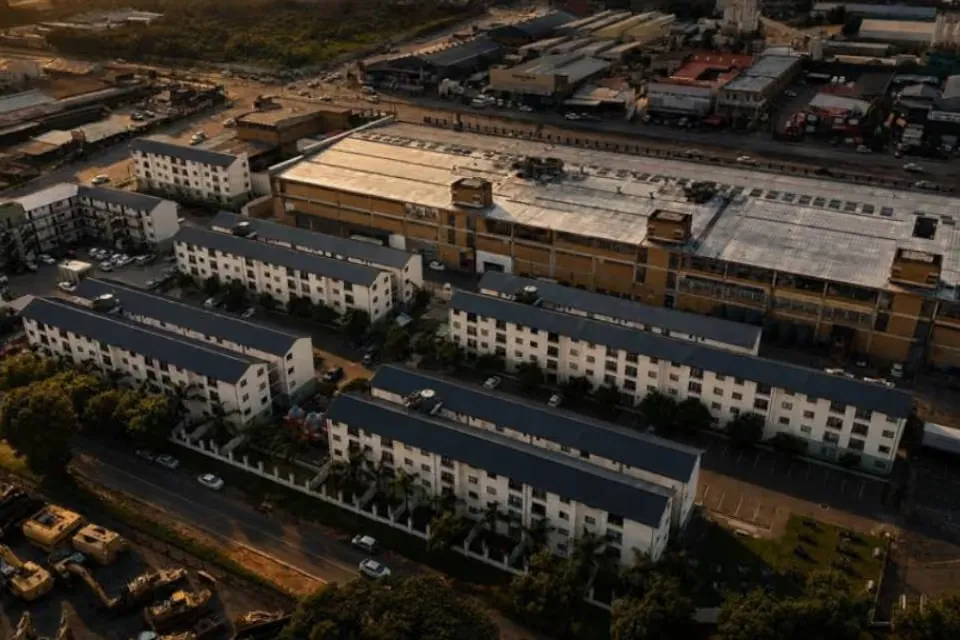
- Sandton View combines four income streams across 46,802m², illustrating how diversification is reshaping investment around Sandton.
Sandton's investment market is changing
For decades, Sandton's commercial property story was dominated by one asset class: offices.
Known as "Africa's richest square mile", the node developed into South Africa's premier corporate address and one of the continent's most concentrated office markets. At its peak, premium office space was fiercely contested, vacancies were low and investor appetite was strong.
But oversupply, changing workplace requirements and the pandemic fundamentally disrupted that equation. Today, Sandton is recovering, but the next investment opportunity may not necessarily be found in another office tower.
Instead, investors are increasingly looking beyond the traditional CBD towards the broader Sandton ecosystem, where industrial, residential, retail and hospitality uses intersect with offices and major transport infrastructure.
According to Justin Thom, Director of Galetti Corporate Real Estate, Sandton's evolution needs to be viewed against what has happened to its office market over the past decade.
"Rewind to 2015, arguably the peak of commercial property performance in Sandton, a time when every business wanted to occupy space in the country's most sought-after office node. Vacancies were hard to come by, yields were high and the market was generally booming."
That changed as an oversupply of premium office stock pushed vacancies higher and prices lower, followed by the pandemic and the structural shift towards hybrid working.
There are now clear signs of recovery. Thom points to SAPOA data showing Sandton office vacancies at 15.5% in Q1 2026, down significantly from a peak of 21.2% in 2022.
But there is an important distinction for investors: the decentralised office market is performing even better, with vacancies at 11.5%. That is directing attention towards areas such as Wynberg, Kramerville and Marlboro, where investors can potentially access properties at more competitive pricing while benefiting from proximity to Sandton and major transport corridors.
"The Sandton story is becoming less about a single asset class and more about the strength of the ecosystem around the node," says Thom.
"As the market evolves, investors are looking at where people live, where businesses operate, where goods move and where consumers spend and how those uses interact with one another."
Diversification helps future-proof investments
The shift has an important implication for commercial property investors: the strongest investment opportunity may no longer be the most obvious building at the most recognisable address.
Instead, the ability of an asset to generate income from several demand drivers is becoming increasingly important. Thom says investors should understand the relationship between Sandton's CBD and its surrounding precincts rather than assessing each area in isolation.
An asset exposed to several established demand drivers can offer a fundamentally different risk profile from one dependent on a single tenant, industry or property sector.
That is particularly relevant in a market where changing working patterns, consumer behaviour, logistics requirements and residential demand can rapidly alter the performance of individual property categories.
"Future-proofing an investment is about more than predicting exactly what the market will look like in five or ten years," says Thom.
"It is about having an asset that is positioned to adapt as demand changes. A property with multiple established uses, strong accessibility and development or repositioning potential gives an investor more options."
Sandton View: a diversification success story
One asset Thom believes demonstrates this evolving investment thesis is Sandton View, a 46,802m² mixed-use estate in Wynberg that Galetti Corporate Real Estate is bringing to market through a sealed-bid process.
Instead of relying on a single property category, the estate combines industrial, residential, retail and hospitality components within one investment.
"Sandton View offers investors exposure to four distinct income streams within a single integrated estate," says Thom. "The combination of industrial, retail, residential and hospitality uses creates a diversified income profile, reducing reliance on any single tenant category or property sector."
The four components
1.Industrial - 26,173m²
The industrial component forms part of the Sandton Commercial Park precinct and is fully occupied.
It generates approximately R18.75 million in annual net operating income and benefits from access to Pretoria Main Road, Arkwright Avenue and the wider Sandton and Marlboro logistics corridors.
Its scale and occupancy also illustrate why industrial property has become an increasingly important component of the broader Sandton investment landscape.
2.Residential - 208 apartments
The residential portfolio is approximately 95% occupied and generates around R16.55 million in annual NOI.
Its investment proposition is underpinned by demand from residents seeking proximity to Johannesburg's northern economic corridor and the Sandton employment node.
There is also potential for expansion. Approved plans are in place for a further 84 residential units, with bulk contributions paid and services installed, creating a defined pathway for increasing the estate's residential component and potentially its future income.
3. Retail - approximately 15,800m²
The Sandton Clearance Centre provides the third income stream.
The centre is fully occupied and generates approximately R13.35 million in annual NOI, with its tenant mix focused on furniture, décor, homeware and value retail, including anchor tenants Coricraft and @Home.
4.Hospitality - 156 rooms
Mint Express Sandton View provides the fourth component. The 156-key hospitality operation is occupied under a double-net lease and contributes approximately R10.9 million in annual NOI.
For Thom, it is the interaction between these different uses that strengthens the overall investment proposition. "Investors are acquiring an established income-producing estate with exposure to different demand drivers, rather than relying on a single asset class," he says.
Offers are invited from 31 August through a sealed-bid process.
Looking beyond the skyline
Sandton's office towers will remain central to its identity and commercial relevance, and the decline in vacancies indicates that the traditional office market is moving in a more positive direction.
But the emerging investment story is broader. Residential demand is following employment and connectivity. Industrial and logistics properties benefit from access to major economic corridors. Retail follows consumers and residential density. Hospitality benefits from Sandton's position as a corporate and commercial destination.
For investors, this means Sandton increasingly needs to be analysed as an interconnected urban economy rather than simply an office node.
"There will always be demand for well-located office space in Sandton, but if you look at the market through a wider lens, you can see that the investment story is increasingly being shaped by the relationship between offices and the uses around them," says Thom. "That is where some of the more interesting dynamics are emerging."
A broader Sandton investment thesis
Sandton's recovery is therefore not simply about whether office vacancies continue falling.
The more significant question is how the broader node is being repositioned as businesses, residents, retailers, logistics operators and hospitality providers respond to a changing Johannesburg economy.
For commercial property investors, diversification, accessibility, adaptable assets and multiple income drivers are becoming increasingly important measures of value.
Sandton's skyline may still define the node visually, but its next investment chapter is increasingly being written beyond the office towers and across the wider urban ecosystem that surrounds them.