









Green Homes could save owners R21,000 a year
Listen · 1-minute summary
0:00 / 1:17
Read the summary
Green Homes could save owners R21,000 a year. New research presented at the Green Building Council South Africa Convention in Cape Town found that EDGE-certified apartments can deliver big water savings. University of Cape Town researchers compared two certified developments with similar non-certified ones, and estimated annual water savings of nearly R12,000 in one development and about R21,000 in the other. Modelling suggested that redirecting those savings into home loan repayments could help owners settle their bonds 69 to 93 months earlier. But the research also found a gap between building performance and resident awareness: more than 40 percent of residents surveyed only discovered their homes were green-certified when researchers asked them. Over 70 percent said their savings were simply absorbed into household expenses. Green Building Council South Africa CEO Georgina Smit said, "Once you put people into those buildings, it's a whole another ballgame." The findings suggest green buildings need better communication to help residents turn savings into long-term wealth. Read the full story by Neale Petersen on rei.co.za.
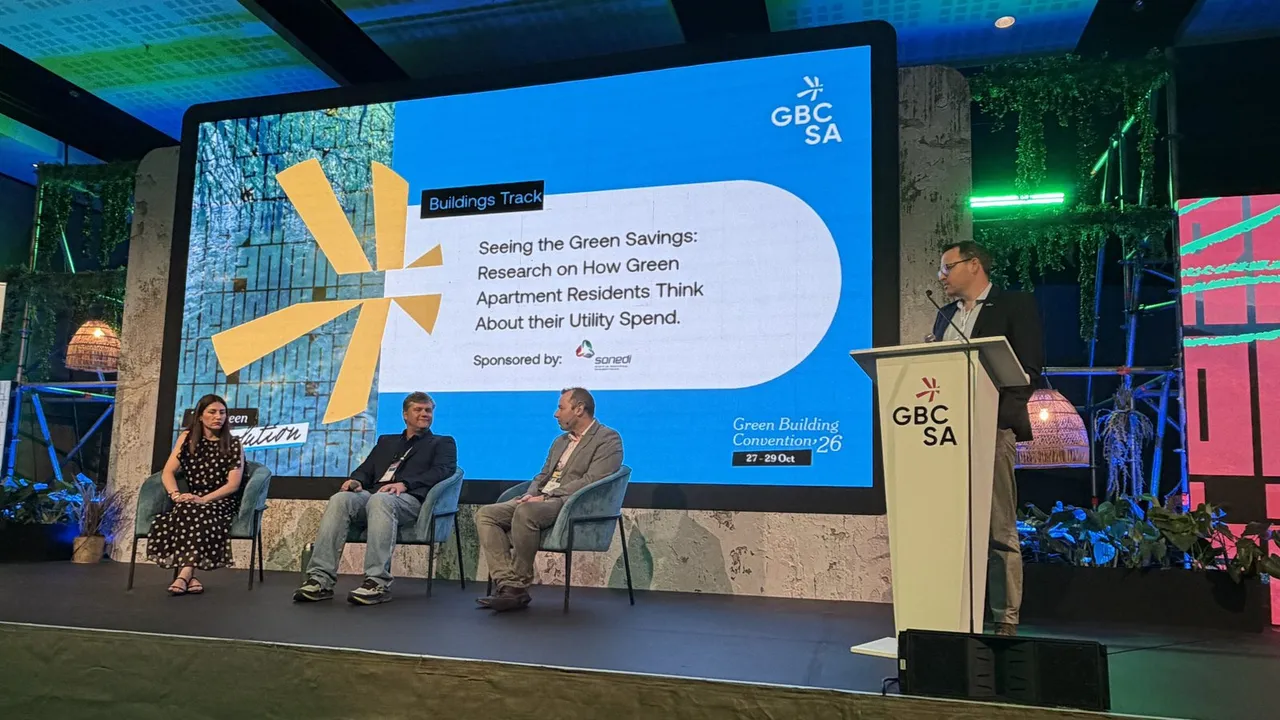
New research presented at the Green Building Council South Africa Convention in Cape Town reveals substantial utility savings in certified apartments, but also exposes a surprising disconnect between building performance, resident awareness and long-term wealth creation.
- UCT research found estimated annual water-cost savings of nearly R12,000 to R21,000 in two EDGE-certified residential developments.
- More than 40% of surveyed residents only discovered their homes were green-certified when researchers asked them.
- Redirecting utility savings into home loans could shorten repayment periods by 69 to 93 months under modelled assumptions.
Green buildings are saving money. But do residents know?
Green buildings are increasingly recognised for reducing electricity consumption, conserving water and lowering environmental impact. Yet a more important question is emerging for South African property investors and homeowners: Are residents recognising the financial benefits of living in greener homes and using those savings to build wealth?
That question took centre stage at the Green Building Council South Africa (GBCSA) Convention 2026, held in Cape Town this week, during a research-led session titled Seeing the Green Savings: Research on How Green Apartment Residents Think About Their Utility Spend.
The discussion brought together Matthew Whalley, Managing Director of Balwin Properties; Georgina Smit, CEO of GBCSA; Grant Smith, Senior Research Officer at the University of Cape Town's Energy Systems Research Group; and Dr Saul Nurick, Director of UCT's Urban Real Estate Research Unit.
Their central message was clear: green-certified residential buildings can deliver meaningful financial savings, but building design alone does not guarantee that occupants understand, maximise or reinvest those benefits.
For developers, investors, landlords and homeowners, the implications extend well beyond sustainability ratings.
1. Green apartments deliver measurable water savings
Presenting research into EDGE-certified residential developments in the Western Cape, Dr Saul Nurick outlined how lower water consumption could translate into significant household savings.
The study compared two EDGE-certified developments with three non-certified developments, using broadly comparable two-bedroom, one-bathroom apartments of approximately 55m². The researchers analysed water consumption and applied tariff rates to estimate the financial benefits.
RESEARCH HIGHLIGHTS
Development 1
- R980 estimated monthly water saving
- Nearly R12,000 annually
Development 2
- R1,800 estimated monthly water saving
- Approximately R21,000 annually
Research estimates presented at the convention; these are development-specific comparisons, not guaranteed savings for every green apartment.
Nurick argued that these savings create an opportunity to reconsider the traditional property investment equation. Instead of measuring wealth creation only through rental income and capital appreciation, homeowners could also benefit from reduced operating costs.
Key findings:
- EDGE-certified apartments in the study consumed less water than comparable non-certified units.
- Reduced utility expenditure can improve household affordability and disposable income.
- The financial benefit becomes more powerful when savings are deliberately redirected towards debt reduction or investment.
Nurick explained that green-certified homes offer an additional route to building long-term wealth through utility savings, particularly for households entering the property market.
2. Could water savings help homeowners settle bonds years earlier?
One of the session's most compelling findings concerned the potential impact of redirecting utility savings into monthly mortgage repayments.
Researchers modelled what would happen if homeowners used the water-cost savings from the two EDGE-certified developments to make additional home loan payments.
The model assumed an 80% mortgage, a 20% deposit and green financing at one percentage point below the prime lending rate applicable when the analysis was conducted.
The results suggest that homeowners could potentially settle their mortgages approximately 69 months earlier in Development 1 and 93 months earlier in Development 2.
Nurick also presented an illustrative reinvestment model in which the mortgage payments freed up after early settlement, together with ongoing utility savings, could be invested elsewhere.
Under an assumed annual investment return of 10.5%, the model produced projected future investment values of approximately R731,000 and R1.3 million respectively.
These are theoretical outcomes rather than guaranteed returns. They depend on financing conditions, household discipline, investment performance and the actual savings realised.
Nevertheless, the findings introduce an important proposition: reducing the cost of running a home could also accelerate the process of owning it outright.
3. The surprising reality: residents often don't know they're saving
Perhaps the most revealing research presented at the convention was not about building performance, but about resident behaviour.
A separate 2026 UCT survey examined 390 completed responses from residents across nine EDGE-certified residential estates in Gauteng, the Western Cape and KwaZulu-Natal.
The findings exposed a substantial awareness gap.
What 390 residents revealed
- Over 40% - Only learned their estate was green-certified during the survey
- About two-thirds - Unaware they were receiving utility savings
- Over 70% - Said savings were absorbed into household expenses
- 43% - Interested in a potential savings-investment mechanism
Approximate findings from preliminary research discussed at the convention. The detailed survey research has not yet been formally released.
Only 17 respondents, just over 4%, reported directing utility savings towards their home loans.
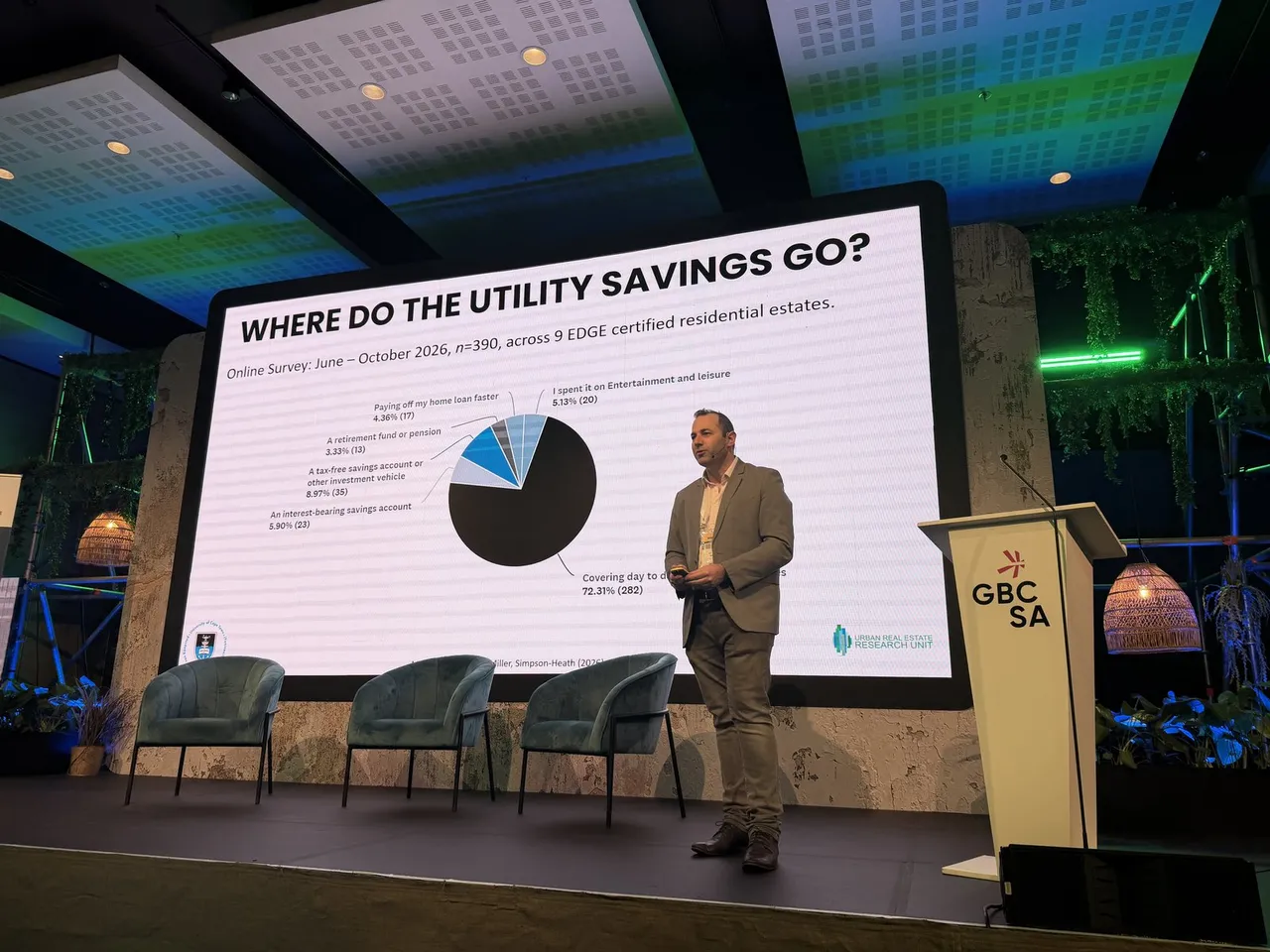
For most households, the financial benefit was simply absorbed into everyday expenditure. The research therefore points to an important distinction between saving money through building design and consciously using those savings to improve long-term financial outcomes.
Nurick highlighted the importance of financial education and incentives that help residents recognise the value already being created by their homes.
4. Georgina Smit: Good design is only half the equation
GBCSA CEO Georgina Smit drew attention to what the green building industry describes as the performance gap: the difference between how a building is designed to perform and how it operates once people move in.
A building may incorporate efficient water systems, solar energy, insulation and other resource-saving technologies, but actual consumption depends on management and occupant behaviour.
Smit explained: “Once you put people into those buildings, it’s a whole another ballgame.” Her point was that certification at the design stage cannot replace ongoing performance measurement.
For developers and property managers, the priorities include:
- Measuring actual electricity and water consumption against appropriate benchmarks.
- Helping residents understand the practical benefits of efficient building systems.
- Improving building management and maintaining green technologies throughout their useful lives.
- Introducing simple incentives that encourage more efficient everyday behaviour.
Smit also called for greater collaboration with financial institutions to support wider adoption of sustainable residential practices. Rather than adding more compliance requirements, she emphasised the potential of practical incentives that make green living accessible across different income groups.
5. Grant Smith: Residents understand rands better than tariffs
Grant Smith, Senior Research Officer at UCT's Energy Systems Research Group, presented research examining how apartment residents respond to utility tariffs and manage prepaid electricity and water accounts.
The analysis drew on approximately 7,000 apartments across nine developments, using more than a year's worth of consumption and payment information. His findings suggest that residents generally do not respond closely to the detailed structure of municipal tariff bands.
However, they manage their prepaid utility wallets surprisingly carefully, typically topping up once or twice a month and maintaining relatively small surplus balances. Smith observed: “People do pay attention to money.”
This creates an opportunity for developers and estate managers to communicate sustainability benefits in more familiar financial terms. Rather than focusing exclusively on kilowatt-hours, kilolitres and technical specifications, the industry could demonstrate how much money residents are saving each month.
Smith also presented a model examining the effect of removing an existing 10% electricity-price rebate associated with on-site solar generation. Under the model, residents would consume approximately 6.3% less electricity but still spend about 4.9% more.
This was a counterfactual simulation, not an actual tariff increase imposed on residents. The implication is that lower-cost renewable electricity can provide a meaningful financial benefit even when residents do not fully understand the technology behind it.
6. Matthew Whalley: Making green savings visible
Balwin Properties Managing Director Matthew Whalley brought the developer's perspective to the discussion. Whalley highlighted the importance of translating technical efficiency into benefits that residents can understand, particularly when green design is already producing savings without changes in behaviour.
He said the research showed substantial savings despite many residents being unaware of the benefits. For residential developers, this raises a practical question: how can the industry encourage residents to engage more actively with the financial advantages of green living?
Whalley pointed to financial benefits such as preferential mortgage rates as examples of messages that resonate more directly with homebuyers than technical measures of resource consumption.
The wider discussion also explored the potential for resident education, clearer utility information and rewards for more efficient consumption.
7. What this means for property investors
The research presented at the GBCSA Convention suggests that green buildings should increasingly be assessed through both their environmental credentials and their real-world financial performance.
For investors evaluating a residential development, several practical considerations emerge:
- Operating costs: Compare actual utility expenditure rather than relying only on projected efficiency savings.
- Tenant affordability: Lower monthly utility bills may improve the overall affordability of accommodation.
- Building management: Investigate whether efficient systems are properly maintained and monitored.
- Resident engagement: Assess whether occupants receive useful information about consumption, tariffs and savings.
- Long-term returns: Consider how lower operating costs, financing incentives and building performance affect the investment case.
Importantly, the research does not establish that every green-certified property will achieve the same savings or automatically command a higher resale price or rental premium.
Those outcomes still depend on location, acquisition price, market demand, financing costs and the building's actual operating performance.
Conclusion: Green buildings must deliver value residents can see
The most important message from the Cape Town convention was that South Africa's green building conversation is moving beyond certification and design.
The evidence presented by UCT researchers demonstrates that green residential developments can deliver substantial utility savings. Yet it also reveals that many residents remain unaware of those benefits, while others use the money simply to meet rising household expenses.
For developers, landlords, investors and policymakers, the next challenge is to make green savings more visible, understandable and financially useful.
Better communication, transparent utility data, effective building management and targeted incentives could help bridge the gap between green design and resident behaviour.
Ultimately, the real investment case for green housing lies not only in consuming less water and electricity, but in turning those efficiencies into measurable household affordability, stronger financial resilience and long-term wealth creation.