










SA REITs target 16%–18% returns as funding costs fall
Listen · 1-minute summary
0:00 / 1:27
Read the summary
SA REITs target 16%–18% returns as funding costs fall. New research from SBG Securities says South Africa's listed property sector could deliver total investor returns of between 16% and 18% over the next 12 months, as finance costs fall, balance sheets strengthen and earnings become more resilient. Lower borrowing costs, as REITs refinance fixed-rate debt, are expected to drive sector-wide distributable income per share growth of 6% to 7% in 2026. SBG Securities expects refinancing rates to decline by between 50 and 150 basis points during 2026, with the repo rate forecast at 6.25% by December 2027. The projected returns combine a fair forward earnings yield of 8.00% with potential valuation upside of 4.8%, well above the sector's typical 12% to 13% annual return. Analyst Mweishö Nene says, "We believe the sector's distributable earnings will be protected from downside surprises because of expectations that finance costs will improve at the margin." Risks include renewed interest-rate hikes, inflation and weak rental growth. Read the full story by Neale Petersen on rei.co.za.
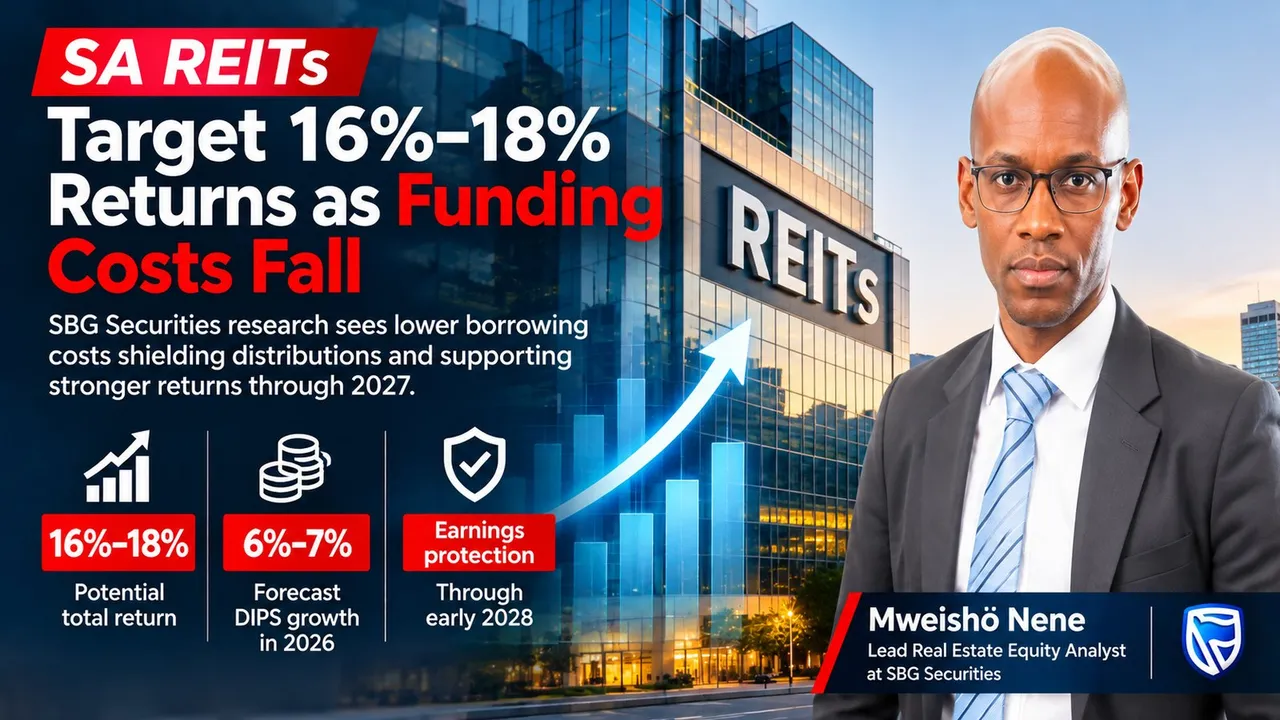
New SBG Securities research forecasts stronger distributions, improving balance sheets and potential double-digit investor returns as borrowing costs ease through 2027.
- 16%–18% potential returns: SBG Securities forecasts above-average total returns for SA REITs over the next 12 months.
- Distributions set to grow: Falling finance costs could support sector DIPS growth of 6%–7% in 2026.
- Earnings protection through 2027: Lower debt costs and improving balance sheets could help shield REITs from market volatility.
SA REITs emerge as a defensive investment opportunity
South Africa's listed property sector could deliver total investor returns of between 16% and 18% over the next 12 months, supported by declining finance costs, stronger balance sheets and improving earnings resilience.

That is the central finding of new research by Mweishö Nene, Lead Real Estate Equity Analyst at SBG Securities, published in the SA REIT Association's SA REIT Journal on 9 November 2026.
Against a backdrop of geopolitical uncertainty, oil-price shocks and volatile global financial markets, Nene argues that South African real estate investment trusts (REITs) offer investors a relatively defensive income-generating opportunity.
His investment case rests on a powerful financial shift: even where rental growth remains subdued, lower borrowing costs could protect distributable earnings and underpin stronger returns through 2027.
1. Falling debt costs could unlock stronger distributions
The relationship between net property income (NPI) and distributable income per share (DIPS) is central to understanding listed property returns.
Historically, rental income growth has been the main driver of distributions. However, higher interest rates disrupted this relationship. In 2024:
- Like-for-like net property income increased by 4.5%.
- Distributable income per share declined by 2.1%.
- Higher finance costs absorbed much of the benefit of improved property performance.
Nene expects this pressure to ease as REITs refinance existing debt at lower interest rates. South African REITs typically fix approximately 80% of their debt for an average of 2.3 years, with the remaining exposure linked to floating interest rates.
As fixed-rate facilities mature, SBG Securities expects refinancing rates to decline by between 50 and 150 basis points on individual facilities during 2026 and potentially 2027.
The result: projected sector-wide DIPS growth of 6%–7% in 2026.
“We believe the sector’s distributable earnings will be protected from downside surprises because of expectations that finance costs will improve at the margin.”
Mweishö Nene, SBG Securities
2. Interest rates remain the critical variable
The outlook for South African interest rates will play a decisive role in determining whether these forecasts materialise.
The South African Reserve Bank increased the repo rate by 25 basis points to 7.25% in September 2026 amid renewed inflationary pressures.
Despite this increase, SBG Securities expects monetary policy to become more supportive over the medium term.
Its forecasts include:
- Average inflation of 3.4% during 2027.
- A repo rate of 6.25% by December 2027.
- Continued improvement in REIT financing costs through 2027.
- Reduced risk of significant distributable earnings disappointments until early 2028.
The principal downside risk is a sustained interest-rate hiking cycle, particularly if inflationary pressures persist.
3. Why SBG Securities forecasts returns of 16%–18%
SBG Securities: 12-month forecast
| Potential total return | 16%–18% |
| Potential valuation re-rating | 4.8% |
| Fair forward earnings yield | 8.00% |
| Assumed 10-year bond yield | 8.41% |
Forecast assumptions, not guaranteed outcomes. Source: SBG Securities research supplied to REI.
The projected returns are based on a combination of improving earnings, dividend income and a potential upward re-rating of listed property valuations. Nene's valuation model uses the sector's historical relationship with South African government bond yields.
On these assumptions, SBG Securities estimates a fair forward earnings yield of 8.00%, implying potential valuation upside of 4.8%. The resulting 16%–18% projected total return exceeds the sector's more typical annual return expectation of 12%–13%.
However, actual outcomes will depend on interest rates, operating performance, bond yields and market valuations.
4. Stronger balance sheets improve investment resilience
Beyond falling borrowing costs, Nene identifies improving financial fundamentals across the listed property sector. The main supporting factors include:
- Lower gearing as property companies reduce debt exposure.
- Stronger interest coverage as finance costs decline.
- More predictable dividend and distribution growth.
- Improving capacity to withstand weaker rental growth.
- Greater appeal for investors seeking income-producing assets.
Nene favours high-dividend assets with predictable growth, relatively low gearing and strong interest coverage. These characteristics could become increasingly valuable in an environment where investors are seeking stability without sacrificing return potential.
5. What this means for South African property investors
For investors considering listed property exposure, the research highlights several opportunities and risks.
Potential opportunities
- Dividend income supported by improving financing conditions.
- Capital appreciation if listed property valuations strengthen.
- Access to diversified property portfolios through JSE-listed REITs.
- Improved earnings resilience compared with the recent high-interest-rate environment.
Risks to monitor
- Renewed interest-rate increases.
- Higher inflation and global energy-price volatility.
- Pressure on retail rentals and property vacancies.
- Weak underlying property income growth.
- Changes in government bond yields affecting REIT valuations.
Importantly, lower financing costs can support earnings, but they cannot permanently compensate for deteriorating property fundamentals.
Investors should therefore assess individual REIT balance sheets, debt maturity profiles, distribution policies and underlying property performance rather than relying solely on sector-wide forecasts.
6. SA REIT Association: Stronger foundations heading into 2027

Joanne Solomon, Chief Executive Officer of the SA REIT Association, says the research highlights the importance of understanding the relationship between borrowing costs and property distributions.
“Mweishö’s research is a timely reminder of how closely the income SA REITs pay depends on the cost of funding.”
Solomon adds that the analysis demonstrates how the sector's balance sheets have strengthened as it approaches 2027. The association's SA REIT Journal provides a platform for institutional analysts and property specialists to share independent perspectives on the listed property sector.
The bottom line: A more compelling case for listed property
After several years of interest-rate volatility, South African REITs may be entering a more favourable earnings environment.
Falling financing costs, improving balance sheets and the prospect of stronger distributions could provide a foundation for above-average investor returns through 2027. For investors, the opportunity is significant, but selective investment remains essential.
The central investment question is whether lower finance costs can continue supporting earnings while underlying rental growth recovers.
If both conditions materialise, South African listed property could become one of the more attractive income and capital-growth opportunities over the next 12 months.
Further reading: Mweishö Nene's full research article in the SA REIT Journal
Source: SBG Securities research published in the SA REIT Journal, 9 November 2026. This article is for general information and does not constitute investment advice.