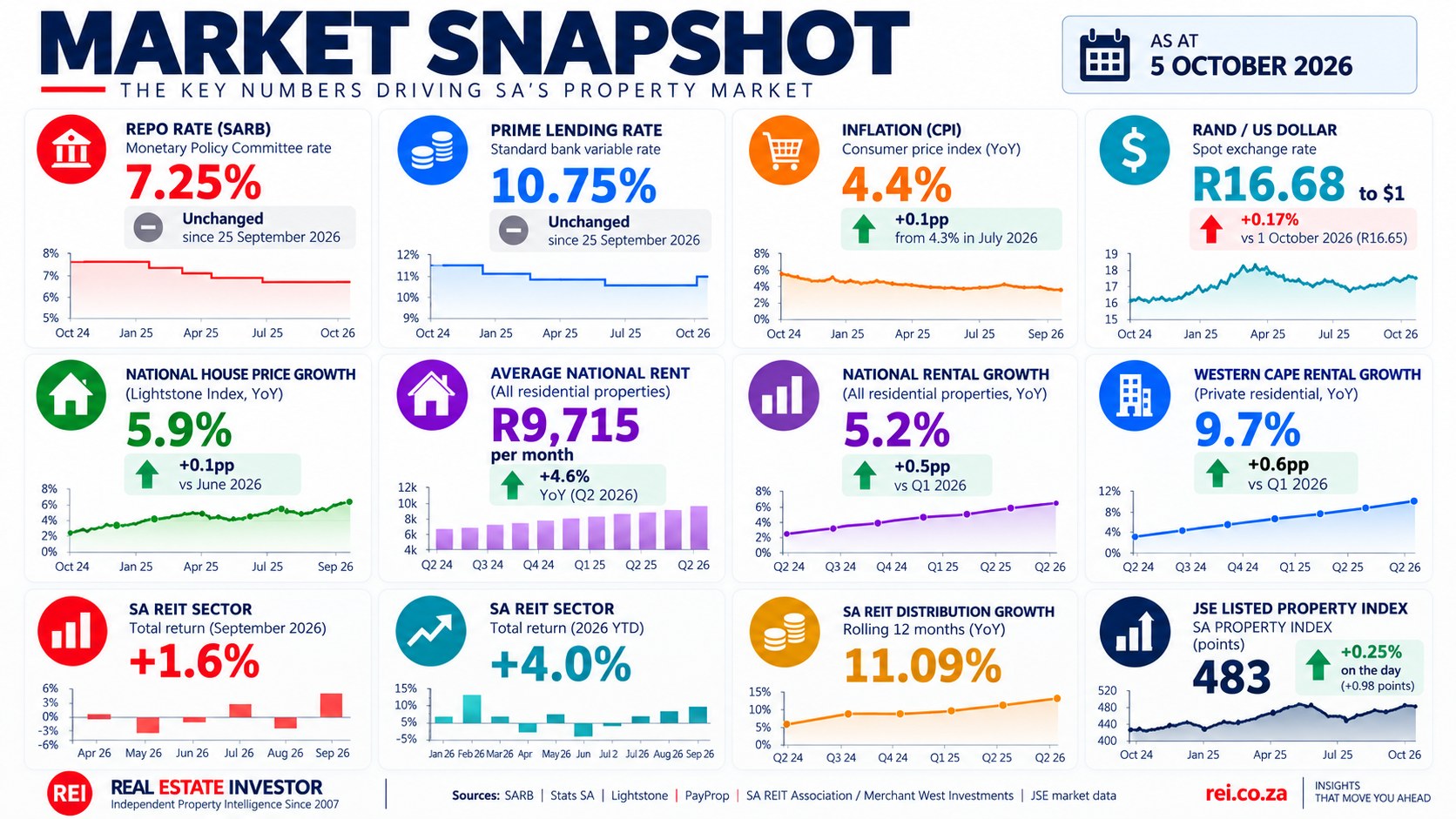
Listed property has done something investors shouldn’t ignore: SA REITs gained 1.6% in September while equities fell 5.8%, as rolling distribution growth accelerated to 11.09%.
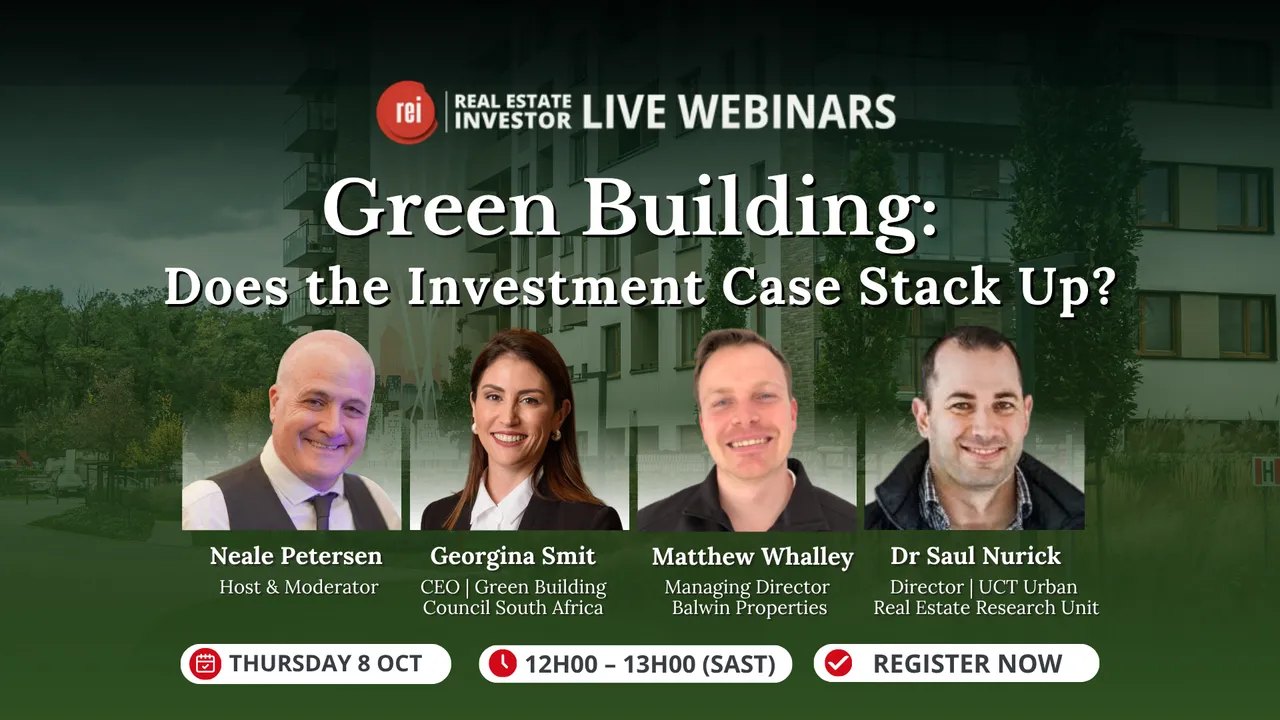
GREEN BUILDING: DOES THE INVESTMENT CASE STACK UP?
The evidence, economics and future of sustainable property in South Africa
Thursday, 8 October 2026 | 12:00–13:00 | Live Online
Are greener buildings actually delivering better returns, or does the investment case still need to be proven?
Join REI for a high-impact discussion on the real economics of sustainable property, from development costs and operational savings to EDGE performance, investor expectations and what residents actually experience.
MEET THE PANEL
•
Georgina Smit – CEO, Green Building Council South Africa
•
Matthew Whalley – Managing Director, Balwin Properties
•
Dr Saul Nurick – Director, UCT Urban Real Estate Research Unit
Moderated by Neale Petersen, Founder & Editor-in-Chief, REI.
One hour. Three expert perspectives. One critical investment question.
THE SIGNALS ARE CHANGING. INVESTORS NEED TO CHANGE WITH THEM.
Global economies and property markets are entering a period where the old assumptions are becoming less dependable.
Geopolitical risk is again feeding into energy prices, inflation expectations and household finances. Artificial intelligence is beginning to reshape employment, business models and the amount and type of space companies require. At home, affordability remains under pressure, yet listed property has just delivered a striking counter-signal: SA REITs gained 1.6% in September while the broader equity market fell 5.8%.
That divergence matters. At the same time, our latest rental story shows why investors need to look below headline demand. FindHomes is tracking more than 156,600 live rental listings, and almost a quarter of Western Cape listings have already undergone an asking-price reduction. Strong demand does not automatically mean landlords can charge whatever they want.
Residential migration is changing too. The Garden Route is increasingly evolving from a holiday-home market into a permanent-living destination, while the JLL research we heard at SAPOA suggests AI could accelerate a widening divide between the right and wrong offices, tenants, sectors and locations.
So what should investors do? Follow income, not hype. Watch affordability. Know your tenants. Stress-test your assumptions. Prioritise quality assets and pay close attention to where people, businesses and capital are actually moving.
Markets rarely send one clear signal. This week they are sending several. Our job at REI is to help you connect them. Neale Petersen Founder and Editor-in-Chief Real Estate Investor
Five sectors. Five signals. What property investors should be watching now.
RESIDENTIAL | LIFESTYLE MIGRATION IS BECOMING PERMANENT
The Garden Route’s evolution beyond holiday homes points to a deeper shift in where South Africans want to live, particularly around lifestyle, security and amenities.
INVESTOR WATCH: Follow permanent population movement. Sustained relocation creates demand for housing, rentals, healthcare, retail and services.
RENTALS | STRONG DEMAND DOESN’T MEAN ANY PRICE WORKS
Western Cape asking rents remain elevated, yet almost one in four advertised properties tracked by FindHomes has already undergone a price reduction.
INVESTOR WATCH: Underwrite achievable rent, vacancy and days on market, not the highest comparable listing you can find online.
COMMERCIAL | AI COULD WIDEN THE QUALITY DIVIDE
AI is changing how businesses use people and space, while JLL sees an accelerating flight towards better buildings as occupiers consolidate portfolios.
INVESTOR WATCH: Know your tenants and favour adaptable, well-located assets that businesses and employees actively want to occupy.
LISTED PROPERTY | INCOME GROWTH IS BACK IN FOCUS
SA REITs rose 1.6% in September while equities fell 5.8%, with rolling distribution growth reaching 11.09%, a significant divergence for investors.
INVESTOR WATCH: Look beyond share-price momentum to distribution growth, balance-sheet strength, vacancies, asset quality and sustainable earnings.
DEVELOPMENT & FINANCE | CAPITAL MUST FOLLOW REAL DEMAND
Development opportunities remain compelling, but land, finance, feasibility, construction costs and end-user affordability need to work together before capital is committed.
INVESTOR WATCH: Stress-test the deal before buying the site. Margin is created in the feasibility, not rescued during construction.
UPCOMING PROPERTY EVENTS & SEMINARS
OCTOBER
•
WED 7 OCT | URERU SEMINAR Capetrain Express | UCT, Cape Town | 16:30–19:00 REGISTER →
•
THU 8 OCT | REI LIVE WEBINAR Green Building: Does the Investment Case Stack Up? | Online | 12:00–13:00 REGISTER FREE →
•
THU 15 – FRI 16 OCT | NAMA NATIONAL CONFERENCE CSIR Convention Centre, Pretoria CONFERENCE DETAILS →
•
THU 15 OCT | PROPERTY INVESTORS EVENING Sandton, Johannesburg | 18:00–21:00 BOOK →
Property markets don’t usually change overnight. They change through a series of signals: a tenant needing less space, a landlord cutting rent, a family relocating permanently, distributions recovering, capital moving towards a different sector.
Individually, those signals can look insignificant. Together, they tell you where the market may be heading.
The advantage isn’t predicting every turn correctly. It is recognising when the evidence changes and being prepared to change your investment thesis with it. QUOTE OF THE WEEK “The best property investors don’t predict every change. They recognise the signals early enough to position before the market catches up.” Neale Petersen
Follow Us On
LOVE THIS NEWSLETTER! STAY AHEAD WITH REI
Get the property intelligence, opportunities and insights that matter, delivered directly to you.
You are receiving this email because you opted in through the REI website, subscribed to our newsletter or magazine, registered for one of our webinars, or attended an REI event.
Mailing address: REI, 10 Howard Studios, Sheldon Way, Pinelands, 7405, Cape Town, South Africa.